
EPISODE · Apr 9, 2026 · 11 MIN
Home Tonometers and Contact Lens Sensors in April 2026 Protocols
from Glaucoma, Vision & Longevity: Supplements & Science · host Visual Field Test
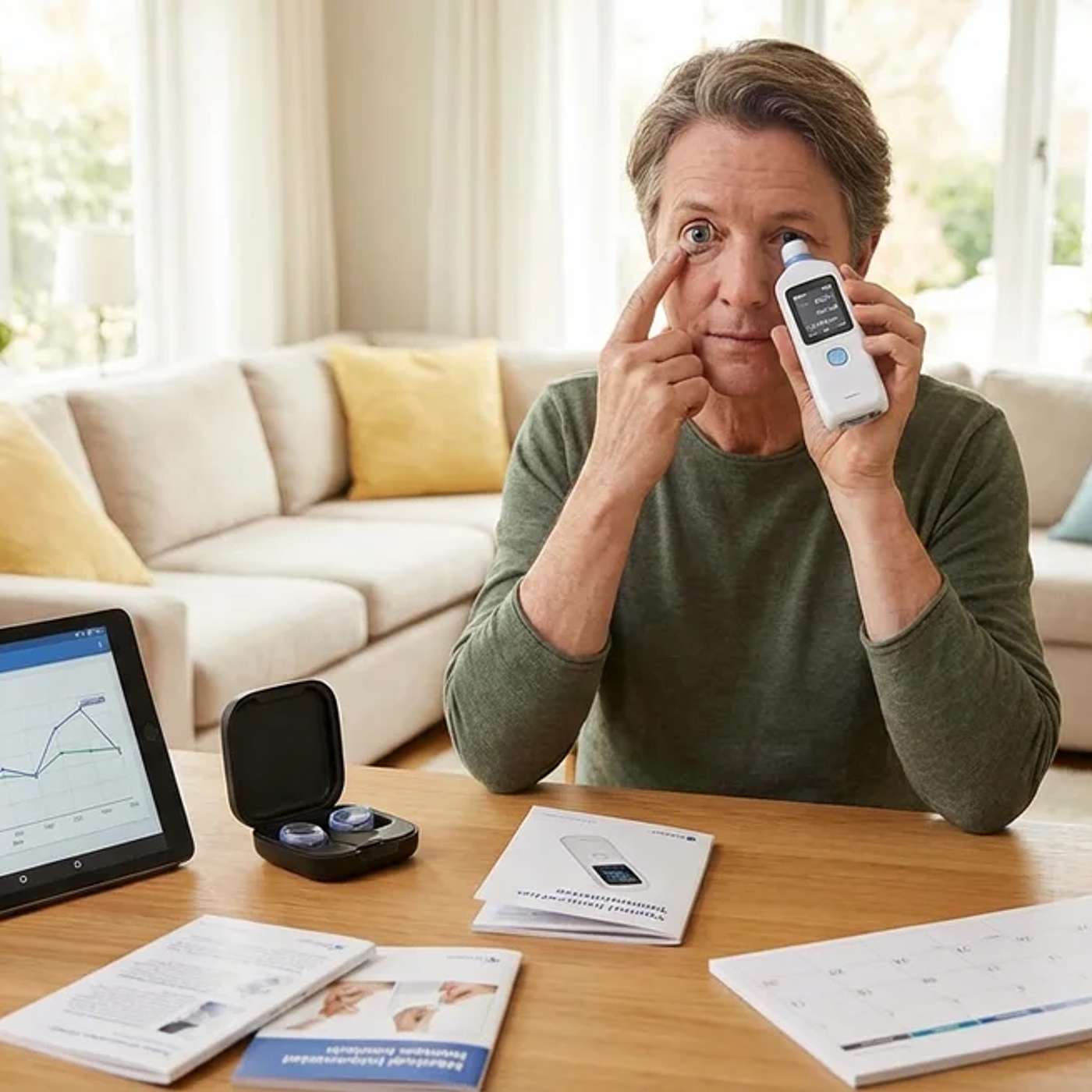
This audio article is from VisualFieldTest.com.Read the full article here: https://visualfieldtest.com/en/home-tonometers-and-contact-lens-sensors-in-april-2026-protocolsTest your visual field online: https://visualfieldtest.comSupport the show so new episodes keep coming: https://www.buzzsprout.com/2563091/supportExcerpt:Introduction Glaucoma management is evolving with home-based intraocular pressure (IOP) monitoring. Traditionally, eye pressure is checked only during office visits, but new devices let patients measure IOP at home or wear sensors in their eyes. In fact, by 2026 several clinical trials began incorporating these technologies. Home tonometers (like the FDA-approved iCare HOME rebound tonometer ()) allow patients to check their own IOP without anesthesia. Smart contact lenses equipped with sensors (e.g. the Sensimed Triggerfish® CLS) can continuously record 24-hour pressure patterns (). These trials explore how such data can improve efficacy outcomes and trigger safety interventions, while ensuring data quality and patient comfort. Trials with Home IOP Monitoring Several recent and upcoming trials (starting around April 2026) include home tonometry in their protocols. For example, an academic study at Wills Eye Hospital is testing home monitoring for mild‐to‐moderate glaucoma patients. Participants use the iCare HOME tonometer at home, measuring IOP multiple times and uploading data, alongside a portable perimeter for visual field testing (). Similarly, a large Guangdong/Hong Kong trial randomizes newly diagnosed glaucoma patients to (1) home telemonitoring with iCare HOME plus a smartphone coaching program, or (2) standard care with smartphone support (). In that trial, patients in the home-monitoring arm upload six IOP readings weekly (two days per week, thrice daily) to a secure cloud platform (iCare CLINIC) (). Another “diurnal monitoring” trial in Switzerland (NCT04485897) compares 24-hour hospital-based IOP monitoring to patient self-tonometry at home. In that study, patients use the iCare device on themselves and investigators analyze how well the home pressure curve matches the clinic curve (). These and other trials explicitly incorporate home IOP data into their endpoints and decision rules. Trials with Continuous Contact-Lens Sensing A parallel line of research uses smart contact lenses to measure IOP continuously. For example, the Mon-BH/Barcelona ISRCTN65401232 trial is studying glaucoma patients who undergo minimally invasive iStent surgery. Both the surgery group and a control group get 24-hour monitoring with the Sensimed Triggerfish® contact lens sensor at baseline and follow-up (e.g. 1 or 3 months later) (). The Triggerfish is a soft silicone lens (~14.1 mm diameter, 585 μm thick) embedded with micro-strain gauges, a chip, and an antenna (). It transmits pressure-related data to an adhesive orbital antenna and portable recorder worn by the patient (). Such trials use the sensor output to quantify circadian IOP patterns. For instance, the Spanish iStent trial defines the primary outcome as the amplitude of a fitted 24-hour IOP curve derived from the lens data (). In short, modern protocols combine traditional endpoints (like average IOP or nerve fiber thinning) with novel continuous IOP measurements from these contact lenses. Device Specifications and Calibration Home tonometers such as the iCare HOME are rebound tonometers: a lightweight handheld probe gently bounces a small disposable tip off the cornea to compute pressure (). The iCare HOME (model TA022) was FDA-cleared in 2017 () and comes with disposable tips (~40 mm probes) that eliminate the need for anesthesia () (). Rebound tonometers do nSupport the show
Embed this episode
What this episode covers
This audio article is from VisualFieldTest.com. Read the full article here: https://visualfieldtest.com/en/home-tonometers-and-contact-lens-sensors-in-april-2026-protocols Test your visual field online: https://visualfieldtest.com Support the show so new episodes keep coming: https://www.buzzsprout.com/2563091/support Excerpt: Introduction Glaucoma management is evolving with home-based intraocular pressure (IOP) monitoring. Traditionally, eye pressure is checked only during office visits, ...
Ready to play
Home Tonometers and Contact Lens Sensors in April 2026 Protocols
No transcript for this episode yet
Similar Episodes
No similar episodes found.
Similar Podcasts
No similar podcasts found.