
EPISODE · Jun 19, 2026 · 31 MIN
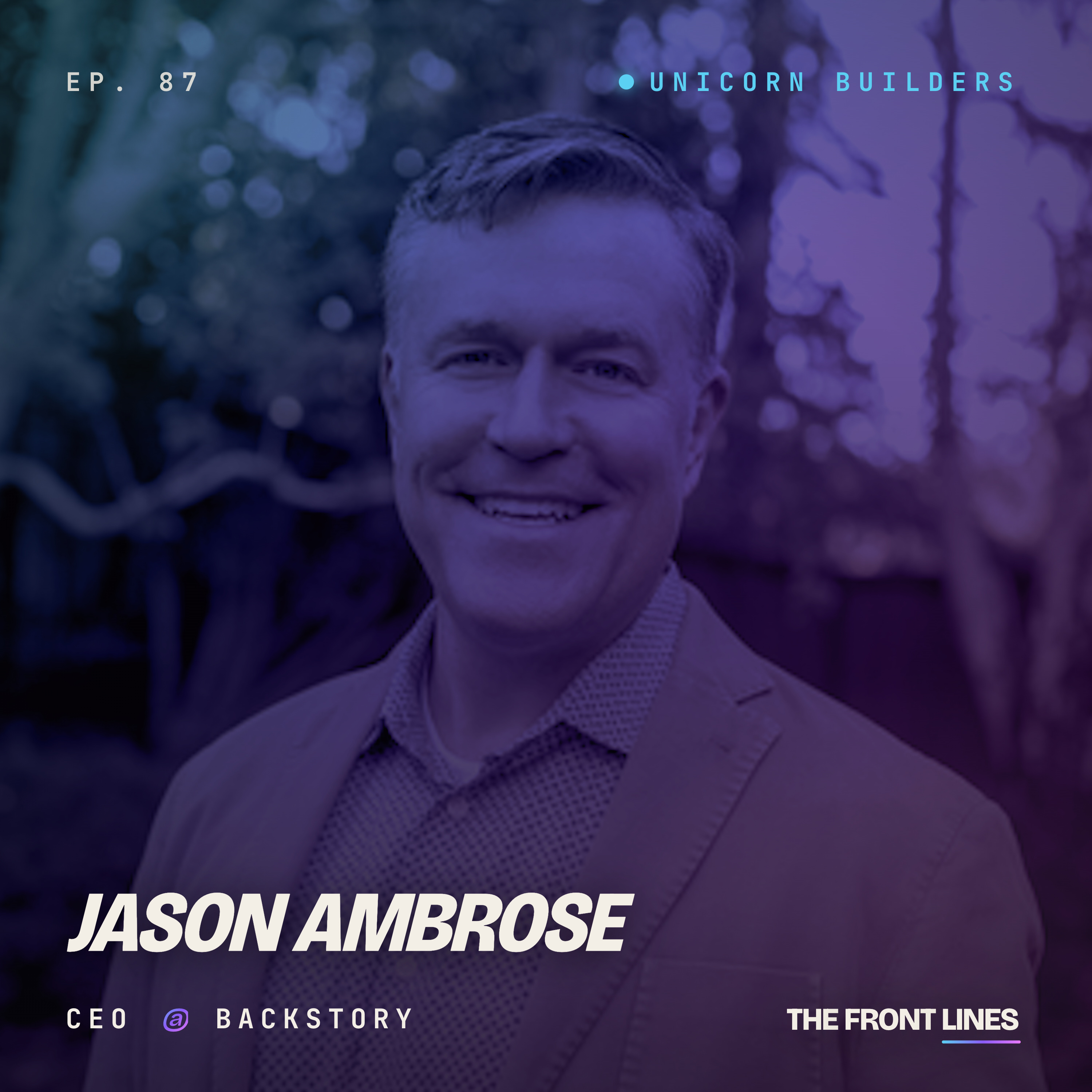
How Backstory AI sequenced a three-step company transformation using the strategy diamond framework | Jason Ambrose
from Unicorn Builders · host The Front Lines
Backstory AI — formerly People AI — is building what CEO & Board Member Jason Ambrose calls the "revenue reasoning layer." Even with full CRM visibility, leaders still go ask a person, that person comes back with an answer, and there are ten more questions about how they got it. That trust gap hasn't been solved by RevTech. In this episode, Ambrose walks through the full reset — from an MCP demo that changed his read on the market, to rebranding out of People AI, to rearchitecting the pricing model.Topics Discussed:The MCP demo that triggered the strategic pivotWhy the "revenue reasoning layer" sits above automation — and what that means for GTMHow rebranding out of "People AI" clarified Backstory's market identityThe mechanics of consumption pricing that avoids in-year budget varianceThe strategy diamond framework for sequencing a company transformationThe board conversation: beat-and-raise vs. "become the right business"GTM Lessons For B2B Founders: The market signal is in the demo, not the deck: Ambrose's pivot started when he watched Claude autonomously ask twenty follow-up questions of Backstory's software during an early MCP demo — a moment he compared to loading a web page in Mosaic. When he brought it to customers, the reaction repeated. The signal worth chasing isn't market-size data. It's the demo that resets how a buyer thinks about what your product is.Position where reasoning replaces interpretation: Red Hat CEO Matt Hicks told Ambrose that across their AI-paired org, automation was most impactful at the individual contributor level — but as seniority increased, reasoning took over. Senior leaders don't need faster dashboards; they need explainable answers that don't trigger ten follow-ups. The automation layer is crowded. The reasoning layer above it is a different conversation.Build consumption pricing that survives the budget cycle: "I don't want consumption pricing" almost always means "I can't have in-year variance." Ambrose's approach: year one, contain costs; year two, look at actual consumption patterns and set a committed spend level — or use prepaid blocks. Engineer the model so in-year variance isn't possible.The strategy diamond forces you to confront economics first: Ambrose used a five-element framework — arenas, vehicles, differentiation, sequencing, economic model — because it surfaces how each element constrains the others. Example: routing through a hyperscaler means giving margin to that partner, which reshapes field economics and seller comp. Set GTM without working the economic model and you'll ship conflicting commitments.Sequence the transformation before anything else ships: Backstory's reset followed a deliberate order: state the strategy clearly enough that every person applies it daily; rebrand (People AI kept getting confused for HR tech); then realign the roadmap. Skip step one and steps two and three become incoherent.// Sponsors: Front Lines — We help B2B tech companies launch, manage, and grow podcasts that drive demand, awareness, and thought leadership. www.FrontLines.ioThe Global Talent Co. — We help tech startups find, vet, hire, pay, and retain amazing marketing talent that costs 50-70% less than the US & Europe. www.GlobalTalent.co//Don't Miss: New Podcast Series — How I Hire Senior GTM leaders share the tactical hiring frameworks they use to build winning revenue teams. Hosted by Andy Mowat, who scaled 4 unicorns from $10M to $100M+ ARR and launched Whispered to help executives find their next role. Subscribe here: https://open.spotify.com/show/53yCHlPfLSMFimtv0riPyM
What this episode covers
Backstory AI — formerly People AI — is building what CEO & Board Member Jason Ambrose calls the "revenue reasoning layer." Even with full CRM visibility, leaders still go ask a person, that person comes back with an answer, and there are ten more questions about how they got it. That trust gap hasn't been solved by RevTech. In this episode, Ambrose walks through the full reset — from an MCP demo that changed his read on the market, to rebranding out of People AI, to rearchitecting the pricing model.Topics Discussed:The MCP demo that triggered the strategic pivotWhy the "revenue reasoning layer" sits above automation — and what that means for GTMHow rebranding out of "People AI" clarified Backstory's market identityThe mechanics of consumption pricing that avoids in-year budget varianceThe strategy diamond framework for sequencing a company transformationThe board conversation: beat-and-raise vs. "become the right business"GTM Lessons For B2B Founders: The market signal is in the demo, not the deck: Ambrose's pivot started when he watched Claude autonomously ask twenty follow-up questions of Backstory's software during an early MCP demo — a moment he compared to loading a web page in Mosaic. When he brought it to customers, the reaction repeated. The signal worth chasing isn't market-size data. It's the demo that resets how a buyer thinks about what your product is.Position where reasoning replaces interpretation: Red Hat CEO Matt Hicks told Ambrose that across their AI-paired org, automation was most impactful at the individual contributor level — but as seniority increased, reasoning took over. Senior leaders don't need faster dashboards; they need explainable answers that don't trigger ten follow-ups. The automation layer is crowded. The reasoning layer above it is a different conversation.Build consumption pricing that survives the budget cycle: "I don't want consumption pricing" almost always means "I can't have in-year variance." Ambrose's approach: year one, contain costs; year two, look at actual consumption patterns and set a committed spend level — or use prepaid blocks. Engineer the model so in-year variance isn't possible.The strategy diamond forces you to confront economics first: Ambrose used a five-element framework — arenas, vehicles, differentiation, sequencing, economic model — because it surfaces how each element constrains the others. Example: routing through a hyperscaler means giving margin to that partner, which reshapes field economics and seller comp. Set GTM without working the economic model and you'll ship conflicting commitments.Sequence the transformation before anything else ships: Backstory's reset followed a deliberate order: state the strategy clearly enough that every person applies it daily; rebrand (People AI kept getting confused for HR tech); then realign the roadmap. Skip step one and steps two and three become incoherent.// Sponsors: Front Lines — We help B2B tech companies launch, manage, and grow podcasts that drive demand, awareness, and thought leadership. www.FrontLines.ioThe Global Talent Co. — We help tech startups find, vet, hire, pay, and retain amazing marketing talent that costs 50-70% less than the US & Europe. www.GlobalTalent.co//Don't Miss: New Podcast Series — How I Hire Senior GTM leaders share the tactical hiring frameworks they use to build winning revenue teams. Hosted by Andy Mowat, who scaled 4 unicorns from $10M to $100M+ ARR and launched Whispered to help executives find their next role. Subscribe here: https://open.spotify.com/show/53yCHlPfLSMFimtv0riPyM
NOW PLAYING
How Backstory AI sequenced a three-step company transformation using the strategy diamond framework | Jason Ambrose
No transcript for this episode yet
Similar Episodes
Jan 4, 2026 ·3m