
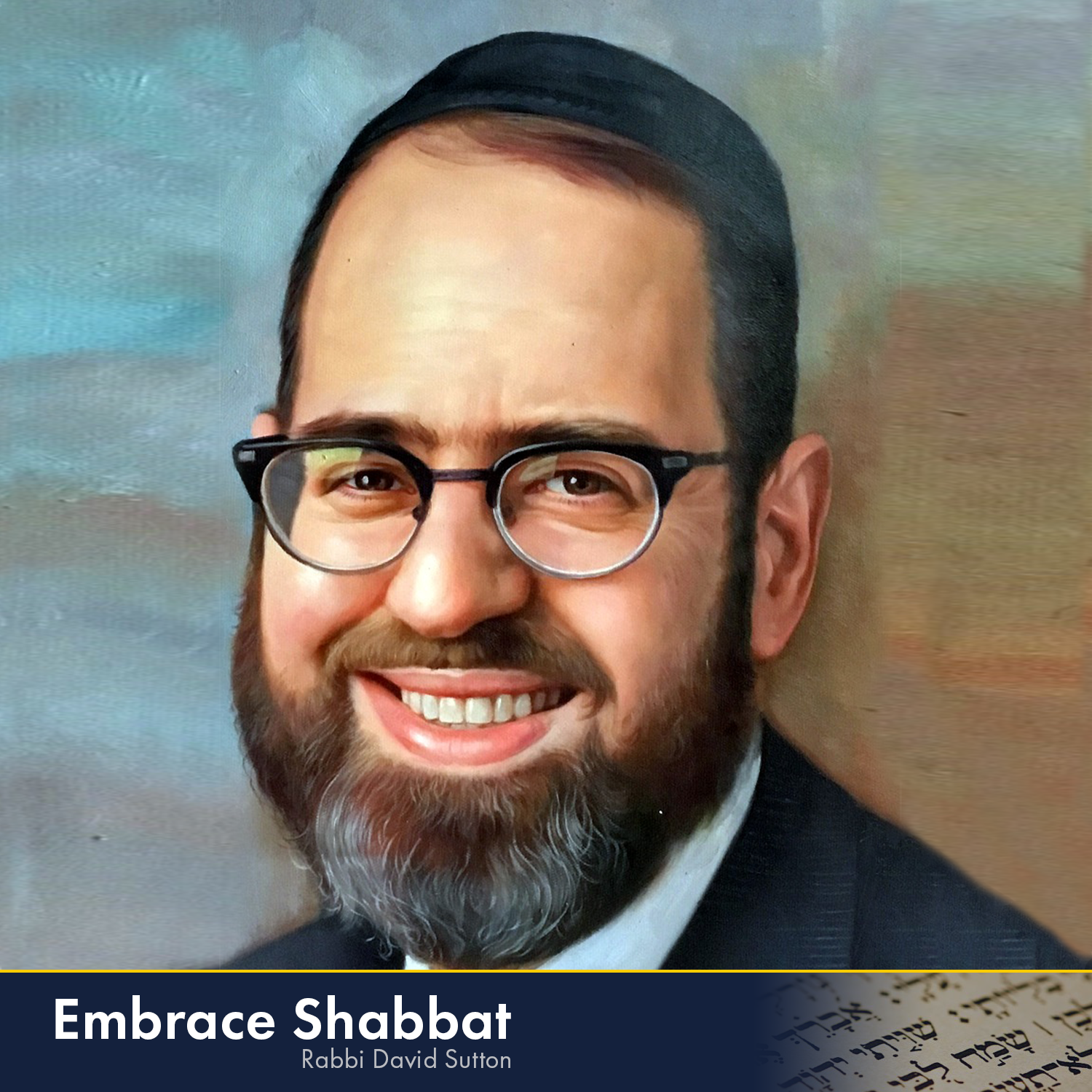
EPISODE · Jun 9, 2023
How Can We Avoid Thinking About Business on Shabbat?
from Embrace Shabbat · host Rabbi David Sutton
For many businessmen, the halachic prohibition against talking about commercial matters on Shabbat ranks among the most difficult aspects of Shabbat observance. Businessmen spend most of the week actively involved in running their operations, investing the effort they need to invest to earn a respectable living. Their enterprises are a high priority for them, as they should be. Somehow, on Shabbat a businessman is expected to forget about his business, to refrain entirely from speaking about it, and, ideally, even from thinking about it. How is this possible? Rav Yaakov Abuhasera (an ancestor of the Baba Sali), in his Abir Yaakov , answers this question in the context of his discussion of the pesukim toward the beginning of Parashat Vayakhel. There Moshe Rabbenu tells Beneh Yisrael , ששת ימים תעשה מלאכה וביום השביעי יהיה לכם קודש – “Work shall be done for six days, and the seventh day shall be sacred for you…” Rav Yaakov notes that Moshe Rabbenu here tells the people not that they should perform work during the week – “ ta ’ aseh melachah ” – but rather that work should be done – “ te ’ aseh melachah .” Moreover, Rav Yaakov asks, why does Moshe even have to tell the people to work for six days? Isn’t a person allowed to choose not to work? He answers that there is a fundamental difference between “ ta’aseh melachah ” and “ te’aseh melachah .” The expression “ ta’aseh melachah ” refers to a person working with the belief that he produces the results. When Moshe instructs, “ te’aseh melachah ,” he refers to working with the understanding that ultimately, the outcome depends on the Almighty, that the results occur on their own, so-to-speak, due to Hashem’s control, and not because of the person’s efforts. When a person approaches work with this perspective, then we are able to properly observe Shabbat. If we see our work as being done during the other six days, then we can observe Shabbat as a sacred day. Rav Miller explained this concept by way of a story told of a prison inmate who sat around all day, every day, doing nothing. Finally, one of the guards approached him and told him he was going to provide him a way to do something meaningful and feel he is contributing something to the world. He dug a hole in the wall of the prison cell and thrust a pole through it. He then attached a wheel to the end of the poll, and explained to the prisoner that the pole is attached on the other end to a mill. The prisoner should turn the wheel as often as he can, and in this way he would be grinding grain and producing something for the world. The prisoner was pleased, and for many years he spent hours upon hours turning the wheel. He felt gratified knowing that he was doing something for the world’s benefit. One day, however, he was allowed out of the prison, and he saw that the pole was not really attached to anything on the other side of the wall. All that turning was accomplishing nothing. According to some versions of this story, the man took his own life out of depression and despair. Rav Miller explained that although we tend to assume that we are producing results through our work, the truth is that we are accomplishing nothing. We just “turn the wheel,” putting in the effort we need to put in, and Hashem produces the results. The important difference between us and the prisoner in the story is that we have no reason to feel depressed about this reality. To the contrary, we should feel gratified knowing that we are doing what Hashem told us to do – to put in effort to earn a livelihood. But at the same time, we must recognize that “ te’aseh melachah ” – it is Hashem, and not we, who produces the results. This is how a businessman can properly observe Shabbat without worrying or even thinking about his business. If he views his commercial efforts as nothing more than hishtadlut , going through the motions by investing effort, but this effort has nothing to do with the end result, then he will have no trouble stopping when Shabbat begins. He will understand that Hashem commanded him to make an effort for six days, and then not to make any effort on Shabbat. Since in any event it is Hashem, and not he, who produces the results, there is no difference in his mind between working during the week and desisting from work on Shabbat. On both occasions, he does what Hashem commands and trusts that Hashem will provide him with his needs. On several occasions in the Torah, we find Hashem’s promise to bless מעשה ידיך – “your handiwork.” Hashem blesses our work only when view it as the work of our “hands,” but not of our minds. If we put in an effort, but we do not invest all our thoughts and emotions into the work, recognizing that in any event the results depend on Hashem, then we will be blessed. Hashem’s blessing depends upon our realization that although we perform the actions, the success is brought only by Hashem. The Ben Ish Hai conveyed this lesson by way of an analogy to a man walking in the woods who is suddenly confronted by a tiger. He has no weapons with him, and the only thing he is carrying is his walking to stick. Left with no choice, he points his stick at the tiger and shouts, “Boom!” At that moment, the tiger drops to the ground, dead. As it happened, at the very moment the man shouted, a hunter who saw what was happening shot the tiger in order to save the man. We are like that man. We do what we can to earn a living, but we are not the one who “kills the tiger.” The result is brought about only by Hashem. If this is our attitude during the workweek, then we will be able to truly enjoy and appreciate the special serenity of Shabbat. Rabbi Ades applied this concept to tefillah . Many of us find it difficult to block out from our minds everything that is happening in our lives – all our worries, pressures and concerns – and focus exclusively on prayer. Rabbi Ades said that this is because we do not truly believe that the success of our efforts depends on Hashem. Once we have this firm belief, then we understand that Hashem wants us to make an effort throughout most of the day, but when the time for tefillah comes our job is not to make an effort but to turn to Him and ask Him to continue providing us with our needs. Only if we mistakenly feel that we determine the outcome of our work will we continue worrying about our needs during prayers. The seven branches of the menorah are seen as symbols of the seven days of the week. The middle lamp, which remained lit at all times, symbolizes Shabbat, and the other six branches were kindled from this miraculous lamp, symbolizing the fact that the six days of the week receive their blessing from Shabbat. The day on which we do not work is the source of the blessing which we receive on the days when we do work. We bring Hashem’s berachah onto our “handiwork” when we recognize that our work is only that – actions we perform with our hands. We are just thrusting the stick, but Hashem is shooting the tiger. If we live with this perspective, we will be able to truly experience the kedushah of Shabbat, and this will, in turn, bring us greater blessing during the week.
What this episode covers
Weekly Shabbat thoughts with Rabbi David Sutton
NOW PLAYING
How Can We Avoid Thinking About Business on Shabbat?
No transcript for this episode yet
Similar Episodes
Jun 1, 2025 ·89m
Apr 6, 2025 ·110m
Mar 31, 2025 ·11m
Mar 23, 2025 ·87m
Mar 16, 2025 ·55m
Mar 9, 2025 ·90m