
EPISODE · Apr 1, 2026 · 15 MIN
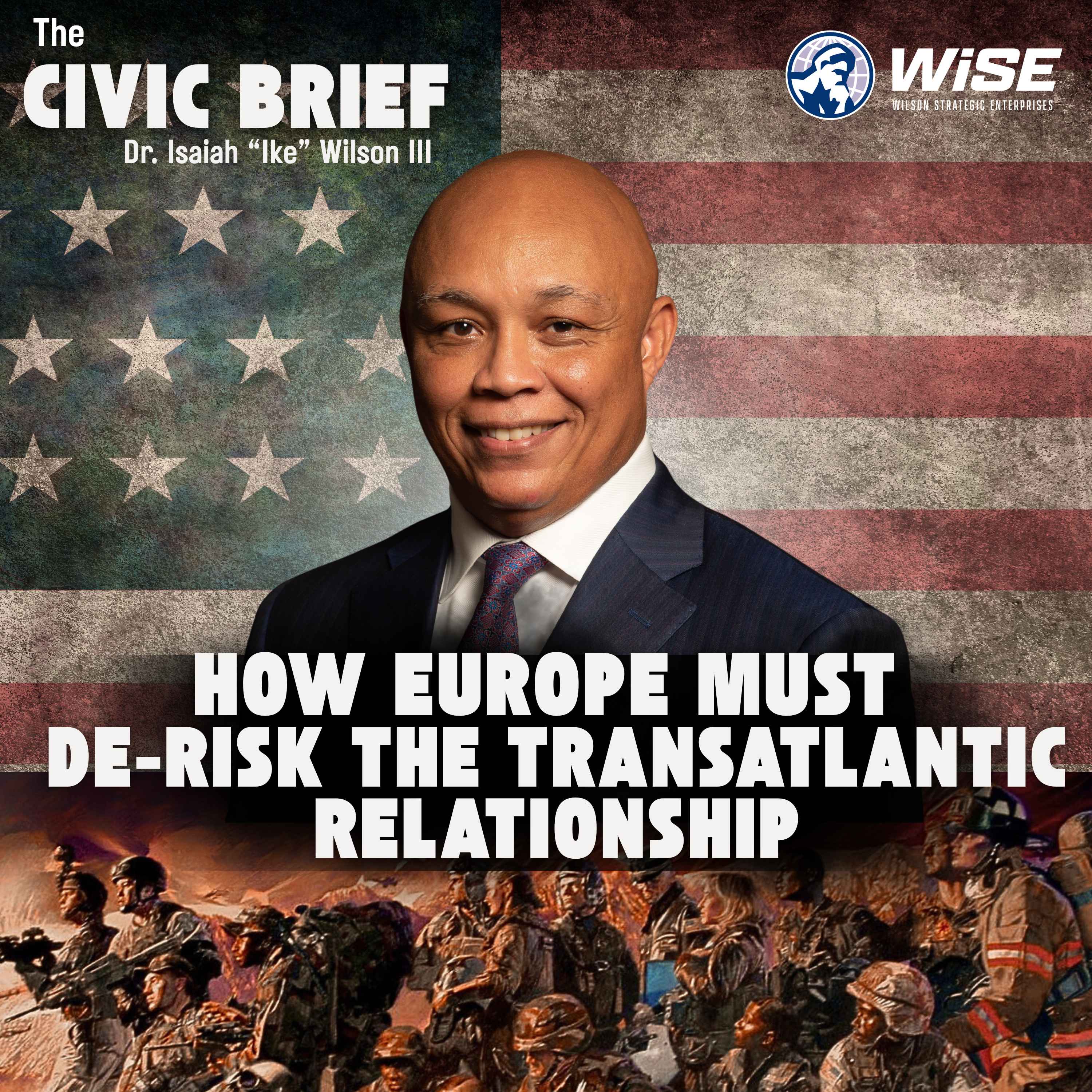
How Europe Must De-Risk the Transatlantic Relationship
from The Civic Brief
For 75 years, the transatlantic alliance has depended on both American power and American predictability. In this solo episode of The Civic Brief, Dr. Isaiah “Ike” Wilson III argues that while the United States remains powerful, its reliability across political cycles can no longer be assumed. As a result, Europe is beginning to “de-risk” its relationship with Washington—not by abandoning the alliance, but by reducing its dependence on it.Drawing on the 2026 World Economic Forum in Davos, the Munich Security Conference, and the EU Security and Defense Forum in Brussels, Dr. Wilson identifies a deeper shift underway. Davos revealed the rise of geoeconomics and resilient supply chains. Munich exposed growing European concern about American political volatility. Brussels signaled Europe’s institutional response: building greater sovereignty in defense, energy, technology, and political resilience.Dr. Wilson emphasizes that de-risking is not the same as decoupling. Europe is not turning away from the United States; it is preparing for the possibility of a less predictable America. That means investing in indigenous defense capacity, diversified energy systems, semiconductors, artificial intelligence, cyber defense, and more resilient democratic institutions.The discussion also highlights the growing importance of middle powers like France, Japan, Canada, India, and Australia. In a world shaped by “compound insecurity,” where economic, technological, and geopolitical threats overlap, these countries may play a decisive role in maintaining global stability.Ultimately, Dr. Wilson argues that the transatlantic alliance must evolve from dependency to reciprocity. In an era of uncertainty, resilient partnerships will depend less on unquestioned reliance and more on shared capability and mutual responsibility.What You’ll Learn in This Episode:✅Why Europe is beginning to “de-risk” its relationship with the United States✅How the World Economic Forum, Munich Security Conference, and EU Defense Forum revealed a changing global order✅Why Europe is investing in greater defense, energy, and technology sovereignty✅How middle powers like France, Japan, India, and Canada are becoming more influential in global strategy✅Why the future of the transatlantic alliance depends on reciprocity rather than dependencyJoin the Travelers Community and explore resources at Wilson WiSE Consulting, as well as at Dr. Wilson’s companion Substack Newsletter, “Compound Security, Unlocked,” where you can share insights, ask questions, and help shape the future—one brief at a time.Wilson WiSE Consulting Website: https://wilsonwise.com/Substack: https://compoundsecurityunlocked.substack.com/Key Timestamps:00:00 Welcome to The Civic Brief: Compound insecurity and the transatlantic alliance02:37 Why Davos, Munich, and Brussels matter together03:37 Europe begins to de-risk the transatlantic relationship04:26 The rise of geoeconomics and resilient supply chains05:39 Munich reveals concern about American reliability07:09 Brussels and Europe’s strategy of “strategic de-risking”07:57 Defense sovereignty: ammunition, air defense, and indigenous capability08:18 Energy security after the Ukraine war08:39 Technology sovereignty and industrial power09:24 Why Europe must de-risk without decoupling10:09 The growing importance of middle powers11:50 Why control of global “nodes” shapes future power12:14 The historical lesson of Munich 193813:21 Compound insecurity and cascading global shocks14:09 The future of the alliance: from dependency to reciprocityKey Takeaways:💎Europe is not abandoning the United States—it is preparing for uncertainty. Europe’s emerging strategy is not anti-American. Rather, it reflects growing concern that U.S. domestic politics may produce greater inconsistency in foreign policy. De-risking means reducing vulnerability to those swings while preserving the alliance.💎The future of security is no longer just military—it is economic, technological, and political. Supply chains, semiconductors, energy systems, cyber defense, and political legitimacy have become essential components of national security. The countries that can secure these domains will shape the next global order.💎Alliances work best when they are reciprocal, not dependent. The transatlantic alliance must evolve from one built on European reliance toward one grounded in shared capability and mutual contribution. Reciprocity creates more durable partnerships than dependency.💎Middle powers are becoming decisive actors in world politics. Countries like France, Canada, Japan, South Korea, Australia, and India may not dominate the global system individually, but collectively they control many of its most important strategic nodes. Their choices will increasingly shape the future balance of power.💎Compound insecurity requires a new kind of strategic thinking. Today’s threats do not remain isolated. Economic disruption, migration, technological competition, political polarization, and military conflict now intersect and reinforce one another. Successful strategy must therefore move beyond borders, silos, and outdated assumptions.Resources & Mentions:Apple Podcast- The Civic BriefSpotify - The Civic BriefYouTube- The Civic BriefWilson WiSE Consulting Website: https://wilsonwise.com/Connect with Dr. Wilson on LinkedIn: https://www.linkedin.com/in/dr-ike-wilson/Think Beyond War: https://thinkbeyondwar.com/Subscribe to the Substack Community to join the discussion, share your insights, and help defend the guardrails of democracy: https://compoundsecurityunlocked.substack.com/Tags:Civic Engagement Podcast, National Security and Public Policy, Leadership and Strategy Podcast, Dr. Ike Wilson Podcast, The Civic Brief, Dr. Isaiah Ike Wilson III, Europe de-risking from the United States, transatlantic alliance, NATO and Europe, European strategic autonomy, Munich Security Conference 2026, World Economic Forum Davos 2026, EU defense strategy, compound insecurity, American reliability, Europe and NATO future, European defense sovereignty, geoeconomics, strategic de-risking, middle powers in world politics, Europe and U.S. relations, global order 2026, transatlantic relationship, security and resilience
NOW PLAYING
How Europe Must De-Risk the Transatlantic Relationship
No transcript for this episode yet
Similar Episodes
Mar 26, 2026 ·1m
Mar 19, 2026 ·34m
Feb 18, 2026 ·11m
Feb 11, 2026 ·45m