
EPISODE · Mar 26, 2026 · 26 MIN
"How many people say: 'I’m just not a math person?' I think everybody is."
from The Forum with Josh Cowen Podcast · host Josh Cowen
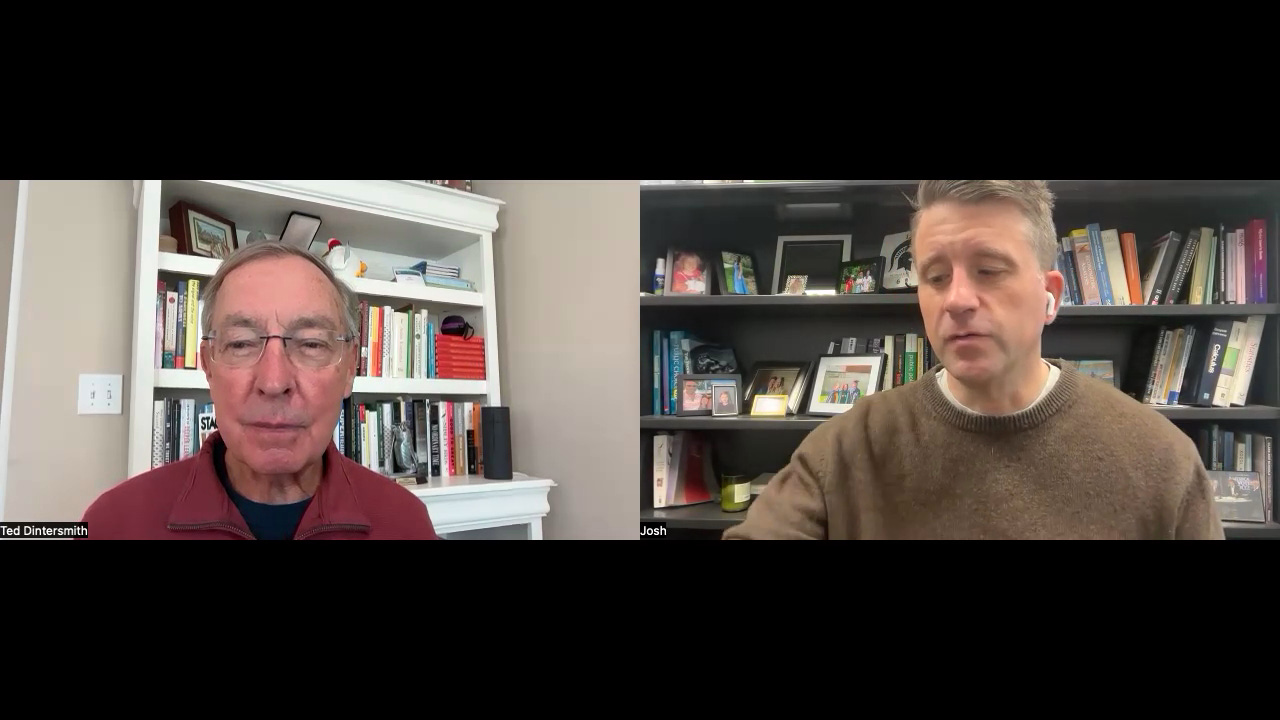
If you’ve been reading these newsletters—or you’re just now checking in—there are three broad themes. The first is ongoing exploration of right-wing politics—especially around kids, families, and schools. The second is regular conversation with policymakers, candidates, and other public figures on those issues. The third is exploring different ways to push public education forward—both for its own sake, and for the sake of learning, but also as a proactive response to a hostile right-wing agenda that uses schools to transmit their own vision of American society.It’s within that last theme that I sat down to talk to the filmmaker, author, and former venture capitalist Ted Dintersmith. Ted is a former NEA Friend of Education—joining Dolly Parton, Quinta Brunson, Malala Yousafzai and, well, yours truly in receiving the award for service to public education. He’s written a new book called Aftermath: The Life-Changing Math That Schools Won’t Teach You. It’s a fascinating—and fun—read. It reminded me of Freakonomics. And I thought about that connection before the actual author of Freakonomics, Steve Levitt, blurbed Aftermath, saying:"In the age of AI and data, we badly need to rethink the way we teach math in U.S. schools. Dintersmith has joyfully illustrated how we can pull the subject out of irrelevance in the eyes of our students — a must read for teachers and parents alike." Last week, reports emerged that social conservatives are lobbying red states to change their math standards to require more memorization. Using math standards developed by an assistant (e.g early career) professor at Hillsdale College, the National Association of Scholars is urging more memorization, simplicity, and rigor. The group is turning to math after pushing science standards and, initially, social science standards that stressed the “American birthright” of liberty.So one way or another, math is a new target for reform. And that kind of rote memorization of math tasks is exactly what Ted writes against in Aftermath—he talks about it in our chat too.You can watch my conversation with Ted Dintersmith in the video at the top of this page, or browse our interview below.Lightly edited for length and clarity.Here’s My Conversation with Aftermath Author Ted DintersmithI am happy to be joined here today by Ted Dintersmith. We’re going to talk about his new book, Aftermath: The Life-Changing Math That Schools Won’t Teach You. Sounds like a provocative title. I’ve read this book. I think of it as kind of a Freakonomics for math and math education, I’d love to hear more about what Ted has to say, but I have gotten to know Ted over the last couple of years as we’ve both been out there in the public space talking about schools, improving schools, what public schools can be doing. Ted Dintersmith, how are you, man?I’m doing fine, and great to be here. Always great to see you, Josh.I want to ask before we get to the book itself, just a little bit about your background. You’re a venture capitalist, you've worked in a lot of different industries, and you got interested in education over the last, what, decade? More than a decade, 20 years, something like that? So tell me a little bit about that before we get to the book itself.Yeah probably 15 years ago. So the short version: my whole career was tied to technology innovation, so I have a fairly good sense of what it can do and how fast it’s getting better.And when my kids got to middle school, which was around 15 years ago, I started to look at what they were being pushed to get good at, and what they were being discouraged about. And I realize it’s all upside down: that they were being pushed to get good at rote skills, to take tests that reward speed, accuracy, and the ability to pick the right multiple-choice answer on an exam expressly designed to be graded by a computer. What I knew, even back then, was if a computer can grade it, it can do it. And I’m saying, like, wait a minute: the thing that gets you on the honor roll, the thing that defines school success, the thing that defines not just a child’s success, but a teacher’s, a school’s, a district’s, a state’s success, are these low-level things that are exactly aligned with what machine intelligence does perfectly.Which started me on this journey. And I started with, and I’m a big believer, as you know, in film. And I’m proud of the films we’ve produced, Most Likely to Succeed, premiered at Sundance. You know, I turned down Netflix, they wanted to buy the film and I instead took it to communities. That film has been screened by over 10,000 communities. That’s a big reach. And we have a new film out called Multiple Choice, but I’ve been itching to write this book about math, for a long time, partly because I’ve spent a lot of time in the math world, so I think I have quite strong math credentials.We use math as half of our high-stakes accountability measures. You know, whenever policymakers or journalists, or often parents talk about the quality of a school or a district or a state, they immediately go to math and reading scores.I think the chase for reading scores has largely made kids hate reading.The book focuses on math. We [in the U.S.] blow up tiny declines in test scores, and turn them into a national catastrophe. But when you actually look at the questions tested, it’s tied to an obsolete body of math that no adult uses.I felt like somebody needs to step up to this, because math should engage, empower, and elevate kids. Instead, it ranks, sorts, and mostly punishes kids.We inevitably run into the block of, well, what will this do to our math and reading scores? When our accountability measures are all wrong, it’s not just that they’re not helpful. When they’re downright punitive and counterproductive, we can’t get school right. As much as our teachers want it to be right.I also hope this book stands on its own right as being just plain interesting. It’s a book about math with almost no equations in it. It’s really better set as a book about math ideas.The book pulls math out of irrelevance. It shows what it actually does for us and to us in life.Let’s get into the guts of the book for a little bit. The book is structured with chapters linked to math topics. And I want to get to how we think about putting some of that out there in the policy space in a minute, but just inside the book: tell me how you built the book and how you chose these topics.I have taken a lot of math in my life, and I spent way too many years in school, I will readily confess to that. But I ended up with a PhD in math modeling from Stanford.What was interesting about that is, if you go back to that time—so I’m dating myself—but I was in grad school in the late 1970s, so basically 1975 to 81.A lot of the math then: computers were sort of just getting going in life. That made for great papers. But now it’s everywhere. You know, you think about optimization routines that are all over our supply chains, or personal recommendation algorithms that determine what we read, what we watch,And often what we believe. Those went from academic papers to the mainstream. I had that grounding, and it took me a long time. High school math, undergrad math, I got a master’s in physics to start. I took all these math courses but have never, ever, ever used any of the symbols or formulas—all the stuff that turns us off to math and makes most people feel in many ways that are important, that they’re not proficient or smart.How many people say, well, I’m just not a math person? I think everybody is. And I start every chapter intentionally with something I did or have observed with kids in grade 3 through 8. This is not graduate school stuff. This is stuff that anybody can do, and it makes for great dinnertime conversations, or walks, or car drives, or if you’re a teacher, you can splice some of this into your classroom to get people more interested.But these concepts actually are unbelievably important.So some of these chapters and concepts are statistics and probability. I teach some of that myself. I can see how some of that’s fitting into, you know, even elementary school instruction. But some of the other chapters, especially later in the book: optimization, prediction, probability. Maybe stuff that you know, and I know a lot about. But what about a third grader? What’s a fifth grader need to know about optimization theory and about decision analysis?You would think nothing, right? I mean, most people are going to immediately say, you’re on to an interesting point: why does anybody need to know that?But I have in the optimization chapter this unbelievable challenge. I came across it in a very low-income area in Hopewell, Virginia where they give each kid 10 bucks, and their goal is to use their money to make Hopewell better. They have a couple constraints. You know: you can’t do anything illegal. Good constraint. And you can’t get somebody to just give you money:: it’s gotta be money you generate somehow.Then you let these kids go. Now, they’re not learning linear programming math behind optimization. But they’re learning the concepts of what is my goal, what constraints do I absolutely have, and what constraints do I perceive that I have?That actually turns out to be incredibly important to people in the field of education: what are things you’d love to do with your life, and what do you perceive as holding you back? And then think yourself, and solicit feedback. Do those things really hold you back? I cite a very specific example. This was done several years ago, but the Nellie Mae Foundation pulled together a room full of about 50 principals. They said, what are the regulations in your area—district, state, federal—that absolutely keep you from doing what you want to do? And then Nellie Mae had some of their staffers go out and reach them: 70% of what those leaders thought was an ironclad constraint didn’t exist.I mean, we go through life thinking we can’t do this because of X. And so it’s that idea of being clear: what’s your objective? Being clear: what holds you back? Being thoughtful: how can I make progress toward my objective on a daily basis, without violating my ironclad constraints, but also bulldozing through things that really don’t hold me back? That’s optimization. Book titles get put together for lots of reasons. I don’t want to hold you too much to this. But the subtitle of Aftermath is: the “life-changing math that schools won’t teach you.” So I actually want to take this in 2 parts. The life-changing math piece. You’ve talked a little bit about this now. A lot of the folks that listen to what I have to say, or read my stuff, are very policy-oriented people thinking about policy, thinking about politics.I think you can, even if you aren’t one of those people, you could read this book—it’s a very fun read, frankly—if you’re a parent and you want to remember something about math. Or you want to encourage your kid to try some math out. So that’s the life-changing math piece, I think you talked a lot about. But the second part of it is this, the “schools won’t teach you piece.” So I guess my question for you is both internally to the book, but also just how you think about and operate in the world and what you want the book to achieve. Is it that schools won’t teach it? Is it that they can’t? Is it that like we’ve got this larger structural problem in education that makes us hate math? Great question. I will say, I agonize over titles for my films and books, and I thought about calling this “What Math Could Be”to sort of follow in the footsteps of my last book, What School Could Be.But I loved Aftermath, because it actually has two definitions, right? The consequences of a disastrous experience, which for most people, high school math was a disastrous experience. And then a fertile second-growth crop, which I try to bring to readers in the book.But I thought hard about the choice of words. Could schools teach this? Absolutely. Do lots of math teachers and other subject teachers— would they absolutely lean into this?For sure. One of the things that got me going on this was the 2022 NAEP scores, and how unbelievably botched the interpretation of those scores was, and how it set us back.The second thing was this interview with somebody in a position of enormous power to influence math education. And in the interview, and this was quoted in The New Yorker, and it’s quoted in my book. He said, well, math is unique among all disciplines because there is always one right answer in math.“Always one right answer.” And I said that the only reason he would say that is he has no understanding of math.Going back to my graduate school program, the best course I took was The Art of Mathematical Modeling. So I wrote an entire book about all these great math ideas that beg for creativity, beg for curiosity. The teachers would love to teach,And students would love to take on.But they don’t lend themselves to a high-stakes, multiple-choice exam.We can’t keep making kids march through things that we know they’re not gonna use in ways that mostly punishes them, blocks life paths, eats up, and consumes all the oxygen from all the important things they could learn.—Ted DintersmithAuthor, Aftermath: The Life-Changing Math That Schools Won’t Teach YouTo that point, in the program evaluation community, the people whose job it is to work with state departments of education, and researchers, and so on, they’ll actually point to math, whether it’s on NAEP or some other standardized test score. They’ll say “if you only had one subject that you could use to study, say, school effectiveness, you would pick math.” Because the assumption is that students are getting less math instruction in their home environment as they might in, say, reading. Whereas math is much more carefully defined in schools. We can call that the school effect. Do you think that’s the right way to think about that?I think that what they’re really saying is we love math because it’s easy to test. You know, if we just go back to before we had computers, back when people did actually have to know how to factor a polynomial: that little math micro-tidbit of how you factor X cubed minus 3x squared plus 2X minus 5 is perfect for, you know, a state-mandated math exam or an SAT, or the ACT math section, or the Nation Report Card section.But nobody does that, right? I mean, that’s the point. If I had to make one point, I’ve got this graphic that’s basically the concepts covered in high school math, beyond ratios, fractions, decimals, and percentages. It’s 75 terms. I put that in front of audiences easily of more than 100,000 people and ask, can anyone find one thing on this chart that they use regularly and can explain?No one can. I mean, we don’t get up every day trying to factor polynomials, or having to use polar coordinate substitutions to solve a closed-form integral, or roll out the Taylor series expansion, or say, “oh yeah, I remember what an irrational number is, or yeah, what’s the cube root of minus 27?” And on and on and on.And what you realize is that this is a massive amplifier of the gap, because the kids in well-off circumstances, with parents that can hire tutors, they will bribe their kid with an iPhone in schools that can actually find a math teacher who can bring this to life,They’re gonna do better on that. And you could say all you want about AI tutors or video lectures, or whatever. But that’s not changing. And the kids that don’t have those advantages look at this—and I’m on their side—and say, I don’t see when I’m ever going to use this.You know, there’s a reason we made a film, Stand and Deliver, about this calculus teacher in Los Angeles who got kids to like calculus.If that were to happen everywhere, we wouldn’t make a film about it. It’s like these one-offs that make everybody say, “Oh my gosh, if we could just clone Jaime [the teacher] and put him in every high school.”I’ll go off on this, because it’s important: You would not believe how hard I’ve tried to get college admissions officers off of the calculus bone.I travel all the time, and I’ve given lots of talks. No one in America does closed-form integrals by hand today. I mean, maybe for kicks at home, or maybe if they’re tutoring their kid on you know, calculus.But Boeing, their engineering group, car companies’ engineering groups, 3D…It’s all done computationally. Except that’s still the pinnacle of high school math. That’s still maybe the most decisive criteria to get into a more selective college. It’s often the prerequisite for medical paths, or business paths, or whatever: something that nobody ever uses!And what does it cost us? Statistics. I’ll say to these college admissions officers: “would anyone here prefer an applicant who had taken statistics over calculus?”No one. I walk them through. No one does close-form integrals by hand.The ideas of calculus are really important, but they’re best taught in physics.Statistics is enormously important for careers, and for informed, responsible citizenship. And bears on our most important finance and healthcare decisions. How do you justify that? Their answer is: well the smart kids take calculus, so it gives us a nice, convenient way to rank them.And I say: “if you guys just locked arms today and 150 of you walked out and said, from now on, we will not care very much about AP Calculus scores and care a lot about AP Statistics scores. Guess what all the kids would take? It’s in your power.”But they don’t change it. And there’s not, I would bet, not a college admissions officer in the nation that could do a hyperbolic cosine transformation by hand to solve a closed-form integral. But that’s what you gotta get good at in calculus, and you never use it anywhere.We can’t keep making kids march through things that we know they’re not gonna use in ways that mostly punishes them, blocks life paths, eats up, and consumes all the oxygen from all the important things they could learn.I have a lot of readers and listeners who are educators, policy staff, state legislator types, some decision makers, and electeds who actually have hands on some of these levers that you and I are talking about. What would you like them to get from a book like this?We have a choice, right? I would say to them—and this is not a math observation, but it’s a broad, general, important perspective—when you read that AI is coming for lots of jobs, take that unbelievably seriously.It gets better and better by the week. And if you’ve played around with it 2 years ago, or you used the free version, or you just are a casual person that will say, oh, I heard it hallucinates or makes a mistake. You don’t understand.This is super-duper serious, and we don’t have a lot of time to wait.And if you say, well, we’re just fine with 2,500 hours of high school kids’ time on math they’re never going to use, because it’s nice for ranking kids, I mean, it’s irresponsible. It’s borderline criminal. And so I would like those policymakers first to go look at some of the practice questions on the math exams that determine whether somebody can get a high school degree and ask themselves, could I do this? And would I ever, ever in a million years need to do this? And if they take that seriously, they’ll say, I couldn’t do it, and there’s no reason why I need to do it, because I never use it, and if I did, for whatever bizarre reason, I just put PhotoMath or put it into ChatGPT and it would do it perfectly.But also, those policymakers, honestly, I don’t think they understand the important math ideas. I don’t think journalists understand the important math ideas. And let me talk about one that’s in a chapter on predictions.Two data sets are correlated. Most people couldn’t even begin to tell you what that means. When they’re correlated with some number,Then you’ll see the inevitable study that says, Data shows that A is causing B. Well, I explained that two datasets could be correlated, Because it’s coincidence, and I have this example of mozzarella cheese consumption in the U.S. and the number of civil engineers produced.I don’t think anybody thinks the key to getting more civil engineers is to chow down on mozzarella cheese. Coincidental.Some are actually causal, but many are due to a shared underlying cause. And so when we say a better AP Calculus score means that the kid will do better in college, it’s not it’s not because somebody later in life is doing closed-form integrals by hand,There’s a shared underlying cause. Family affluence, how much wealth, the budget for the school, the quality of the math teachers, whether you can cajole one way or another the kids to take it seriously.It’s shared underlying cause. I have enormous affection and admiration for our teaching force.And we’ve done everything. I mean, my films, my books, like, it’s important to innovate, and I find teachers in the field are all in on that. But they run into this roadblock, where the more time they spend creating and inventing, or having their kids creating and inventing, it takes away from test prep.And we’re worried, because if our reading or math scores drop by 0.5%, policymakers and journalists will make that sound like an unbelievable catastrophe.On math, they’re never going to use, and with reading drills that make kids hate to read!You can read more about Ted Dintersmith’s work, and the book Aftermath: The Life-Changing Math That Schools Won’t Teach You here, where you can order a copy. Also available at the usual online retailers. You can read more of Ted’s work with his Substack: ted dintersmith. This is a public episode. If you'd like to discuss this with other subscribers or get access to bonus episodes, visit joshcowen.substack.com/subscribe
Embed this episode
Ready to play
"How many people say: 'I’m just not a math person?' I think everybody is."
No transcript for this episode yet
Similar Episodes
No similar episodes found.
Similar Podcasts
No similar podcasts found.