
EPISODE · Jun 18, 2026 · 25 MIN
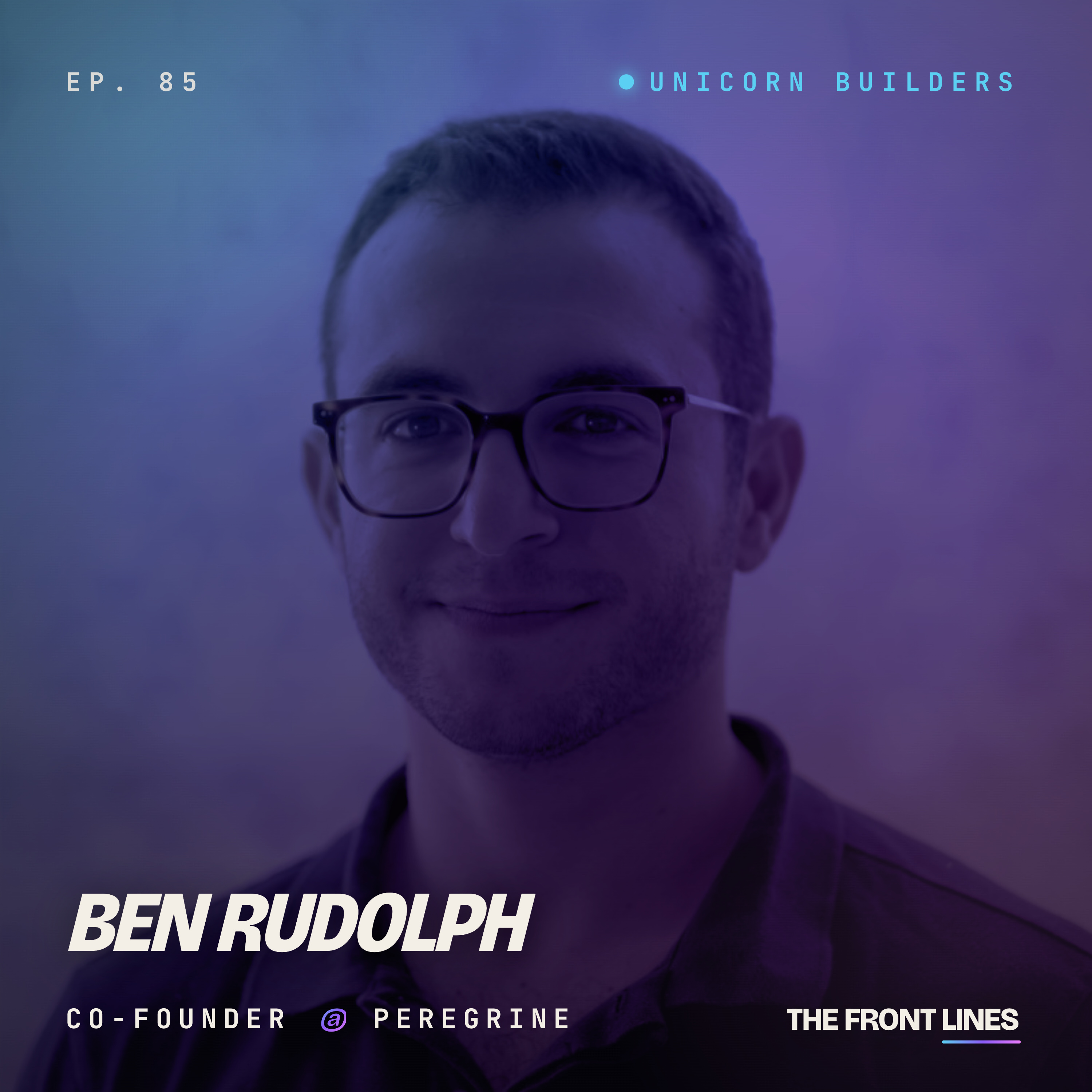
How Peregrine embedded inside police departments to build their first product | Ben Rudolph
from Unicorn Builders · host The Front Lines
Peregrine Technologies unifies fragmented government data systems into a single, current, complete data asset — then gives agencies the tools to build operational workflows on top of it. In a recent episode of Unicorn Builders, we sat down with Ben Rudolph, Co-Founder of Peregrine, to learn how the company spent its first six months embedded inside a police department before writing a line of product code, how they constructed a repeatable sales motion in one of the most procurement-hostile markets in the country, and why nine years of forward-deployed engineering is now their structural advantage in the AI era. Peregrine is now deployed in over 400 cities with a team of approximately 400 people.Topics Discussed: How Peregrine landed its first customer by cold-calling a specific commander and researching his prior drug bust before ever mentioning the product Why the founding team spent the first six months doing detective work — not building software How Peregrine's demo strategy is built around local government priorities, not a fixed product pitch The two moments that told Ben they had product-market fit — and why neither was a revenue number The three chapters of Peregrine's company-building journey: wilderness, repeatable motion, and scale Why proprietary government data, customer proximity, and security controls are the three ingredients that make Peregrine defensible in the AI era The two operating principles behind Peregrine's forward-deployed engineering modelGTM Lessons For B2B Founders:Target the second-in-command: Peregrine's early targeting was precise — they looked for commanders and captains who were ambitious, career-motivated, and had a technology-forward lens. Not the chief, who is rarely day-to-day. That archetype — second or third in command, younger, wants to move up — was their entry point at San Pablo PD and remains a defining characteristic of their ICP today. In institutional sales, the person with both the motivation and the operational authority to champion something new is almost never at the top of the org chart.Research the prospect before you pitch the product: Peregrine didn't cold-call Commander Bubar at San Pablo PD with a product demo. They had researched a specific drug bust he had run years earlier, called him, and asked him to teach them how he did it. The frame was partnership and curiosity, not sales. That approach got a pickup, a polygraph, and eventually an embedded office inside the department. When your prospect has never bought software like yours before, leading with genuine interest in their work is a more reliable opener than leading with your product.Spend the first six months doing the job before building the product: For the first six months at San Pablo PD, the Peregrine team had no product. They were background-checked, polygraphed, and worked out of the department every day — doing the job detectives were doing. That depth of understanding is what produced a product that officers at their third or fourth customer (Albuquerque PD) were using daily without any hand-holding. The speed at which you reach unsolicited product adoption is largely determined by how close you got before you built.// Sponsors: Front Lines — We help B2B tech companies launch, manage, and grow podcasts that drive demand, awareness, and thought leadership. www.FrontLines.ioThe Global Talent Co. — We help tech startups find, vet, hire, pay, and retain amazing marketing talent that costs 50-70% less than the US & Europe. www.GlobalTalent.co//Don't Miss: New Podcast Series — How I Hire Senior GTM leaders share the tactical hiring frameworks they use to build winning revenue teams. Hosted by Andy Mowat, who scaled 4 unicorns from $10M to $100M+ ARR and launched Whispered to help executives find their next role. Subscribe here: https://open.spotify.com/show/53yCHlPfLSMFimtv0riPyM
What this episode covers
Peregrine Technologies unifies fragmented government data systems into a single, current, complete data asset — then gives agencies the tools to build operational workflows on top of it. In a recent episode of Unicorn Builders, we sat down with Ben Rudolph, Co-Founder of Peregrine, to learn how the company spent its first six months embedded inside a police department before writing a line of product code, how they constructed a repeatable sales motion in one of the most procurement-hostile markets in the country, and why nine years of forward-deployed engineering is now their structural advantage in the AI era. Peregrine is now deployed in over 400 cities with a team of approximately 400 people.Topics Discussed: How Peregrine landed its first customer by cold-calling a specific commander and researching his prior drug bust before ever mentioning the product Why the founding team spent the first six months doing detective work — not building software How Peregrine's demo strategy is built around local government priorities, not a fixed product pitch The two moments that told Ben they had product-market fit — and why neither was a revenue number The three chapters of Peregrine's company-building journey: wilderness, repeatable motion, and scale Why proprietary government data, customer proximity, and security controls are the three ingredients that make Peregrine defensible in the AI era The two operating principles behind Peregrine's forward-deployed engineering modelGTM Lessons For B2B Founders:Target the second-in-command: Peregrine's early targeting was precise — they looked for commanders and captains who were ambitious, career-motivated, and had a technology-forward lens. Not the chief, who is rarely day-to-day. That archetype — second or third in command, younger, wants to move up — was their entry point at San Pablo PD and remains a defining characteristic of their ICP today. In institutional sales, the person with both the motivation and the operational authority to champion something new is almost never at the top of the org chart.Research the prospect before you pitch the product: Peregrine didn't cold-call Commander Bubar at San Pablo PD with a product demo. They had researched a specific drug bust he had run years earlier, called him, and asked him to teach them how he did it. The frame was partnership and curiosity, not sales. That approach got a pickup, a polygraph, and eventually an embedded office inside the department. When your prospect has never bought software like yours before, leading with genuine interest in their work is a more reliable opener than leading with your product.Spend the first six months doing the job before building the product: For the first six months at San Pablo PD, the Peregrine team had no product. They were background-checked, polygraphed, and worked out of the department every day — doing the job detectives were doing. That depth of understanding is what produced a product that officers at their third or fourth customer (Albuquerque PD) were using daily without any hand-holding. The speed at which you reach unsolicited product adoption is largely determined by how close you got before you built.// Sponsors: Front Lines — We help B2B tech companies launch, manage, and grow podcasts that drive demand, awareness, and thought leadership. www.FrontLines.ioThe Global Talent Co. — We help tech startups find, vet, hire, pay, and retain amazing marketing talent that costs 50-70% less than the US & Europe. www.GlobalTalent.co//Don't Miss: New Podcast Series — How I Hire Senior GTM leaders share the tactical hiring frameworks they use to build winning revenue teams. Hosted by Andy Mowat, who scaled 4 unicorns from $10M to $100M+ ARR and launched Whispered to help executives find their next role. Subscribe here: https://open.spotify.com/show/53yCHlPfLSMFimtv0riPyM
NOW PLAYING
How Peregrine embedded inside police departments to build their first product | Ben Rudolph
No transcript for this episode yet
Similar Episodes
Jan 4, 2026 ·3m