
EPISODE · Oct 17, 2022 · 1H 33M
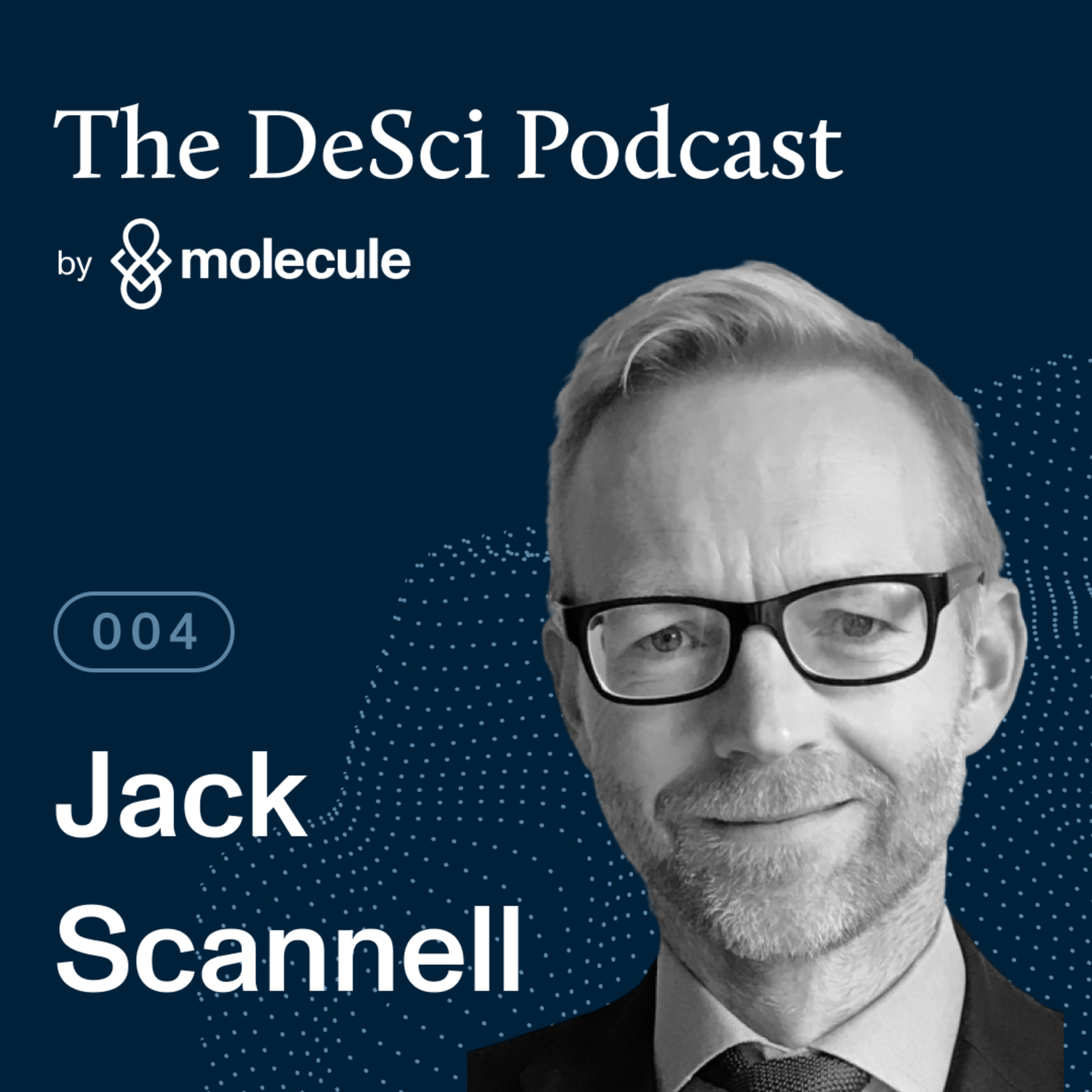
How We Can Do Better Drug Discovery | Jack Scannell
from The DeSci Podcast · host Molecule
Welcome to Episode Nr. 4 of the DeSci Podcast - Today we're exploring the decentralized science space together with Jack Scannell! Jack coined the term Eroom's Law, which notes that the cost of new drug approvals is rising exponentially, in contrast to Moore's law, which notes that the number of transistors on a microchip doubles about every two years, though the cost of computers is halved. In this podcast, Jack talks about how we can do better drug discovery, specifically, the tools and frameworks we can use to choose the right drug discovery model and feed that into investment decisions. His new paper in Nature Reviews Drug Discovery addresses exactly that: https://rdcu.be/cWTtO In this podcast, Jack argues that quality beats quantity when it comes to assays, but actually the best thing is quality AND quantity. So it's better to test a small number of therapeutic candidates in a really good model than it is to test a very large number of computer candidates selected from the same universe in a model of low validity - the best example of this is in antimicrobials discovered around 1930 by Gerhard Domagk. Jacks says that the model validity used in Germany in the 1930's is better than the model validity used in the early 90's. The technological barrier in drug R&D has shifted from chemistry to effectively the tools that tell you whether or not that chemistry is useful. It's not that we can't make compounds, we probably can in many cases make those compounds but what we can't do is we can't distinguish the ones that do something useful from the ones that don't. It's not that we can't identify targets, we can, but we can't tell the good ones from the bad ones - so the critical resource in drug R&D is probably the models, which Jack's paper calls "decision tools" that let you sift the good stuff from the bad stuff. Jack on what interested him about VitaDAO and Molecule: You create value not by making current markets a little bit more efficient, you create value by making markets exist where none existed before. Outside of a few well-ventured universities, universities are terribly under-ventured and also the people at those universities don't have the right tools to present their material in such a way that it could be ventured so it struck him that providing a low transaction cost, standardized platform to make an eBay for IP might be an extremely valuable thing to do because you could create markets where none existed before. Important links mentioned in the episode: The new Nature Reviews Drug Discovery paper. “Predictive validity in drug discovery: what it is, why it matters, and how to improve it”: https://rdcu.be/cWTtOThe Emulate (organ chip) pre-print: “Qualifying a human Liver-Chip for predictive toxicology”: https://www.biorxiv.org/content/10.1101/2021.12.14.472674v4 ____ A huge thanks again to Sebastian and Jack for taking the time and for the valuable input - We hope you all can take something away from this episode on your DeSci journey. If you want to join us on the show as a speaker or have guest ideas, please shoot us a mail at [email protected] You'll also find all links to YouTube, Discord, Twitter and our website via the following link - https://linktr.ee/thedescipodcast _____ Special thanks to: Sebastian Brunemeier (Host): https://twitter.com/sebastian_gero Jack Scannell: https://twitter.com/JackScannell13 ______ Let's connect: Website: https://bit.ly/3d6nh2C Twitter: https://twitter.com/Molecule_dao Discord: https://discord.com/invite/moleculedao Molecule - The future of medicine belongs to everyone
What this episode covers
Welcome to Episode Nr. 4 of the DeSci Podcast - Today we're exploring the decentralized science space together with Jack Scannell! Jack coined the term Eroom's Law, which notes that the cost of new drug approvals is rising exponentially, in contrast to Moore's law, which notes that the number of transistors on a microchip doubles about every two years, though the cost of computers is halved. In this podcast, Jack talks about how we can do better drug discovery, specifically, the tools and frameworks we can use to choose the right drug discovery model and feed that into investment decisions. His new paper in Nature Reviews Drug Discovery addresses exactly that: https://rdcu.be/cWTtO In this podcast, Jack argues that quality beats quantity when it comes to assays, but actually the best thing is quality AND quantity. So it's better to test a small number of therapeutic candidates in a really good model than it is to test a very large number of computer candidates selected from the same universe in a model of low validity - the best example of this is in antimicrobials discovered around 1930 by Gerhard Domagk. Jacks says that the model validity used in Germany in the 1930's is better than the model validity used in the early 90's. The technological barrier in drug R&D has shifted from chemistry to effectively the tools that tell you whether or not that chemistry is useful. It's not that we can't make compounds, we probably can in many cases make those compounds but what we can't do is we can't distinguish the ones that do something useful from the ones that don't. It's not that we can't identify targets, we can, but we can't tell the good ones from the bad ones - so the critical resource in drug R&D is probably the models, which Jack's paper calls "decision tools" that let you sift the good stuff from the bad stuff. Jack on what interested him about VitaDAO and Molecule: You create value not by making current markets a little bit more efficient, you create value by making markets exist where none existed before. Outside of a few well-ventured universities, universities are terribly under-ventured and also the people at those universities don't have the right tools to present their material in such a way that it could be ventured so it struck him that providing a low transaction cost, standardized platform to make an eBay for IP might be an extremely valuable thing to do because you could create markets where none existed before. Important links mentioned in the episode: The new Nature Reviews Drug Discovery paper. “Predictive validity in drug discovery: what it is, why it matters, and how to improve it”: https://rdcu.be/cWTtOThe Emulate (organ chip) pre-print: “Qualifying a human Liver-Chip for predictive toxicology”: https://www.biorxiv.org/content/10.1101/2021.12.14.472674v4 ____ A huge thanks again to Sebastian and Jack for taking the time and for the valuable input - We hope you all can take something away from this episode on your DeSci journey. If you want to join us on the show as a speaker or have guest ideas, please shoot us a mail at [email protected] You'll also find all links to YouTube, Discord, Twitter and our website via the following link - https://linktr.ee/thedescipodcast _____ Special thanks to: Sebastian Brunemeier (Host): https://twitter.com/sebastian_gero Jack Scannell: https://twitter.com/JackScannell13 ______ Let's connect: Website: https://bit.ly/3d6nh2C Twitter: https://twitter.com/Molecule_dao Discord: https://discord.com/invite/moleculedao Molecule - The future of medicine belongs to everyone
NOW PLAYING
How We Can Do Better Drug Discovery | Jack Scannell
No transcript for this episode yet
Similar Episodes
Mar 26, 2026 ·1m
Mar 19, 2026 ·34m
Feb 18, 2026 ·11m
Feb 11, 2026 ·45m