
EPISODE · May 14, 2026 · 9 MIN
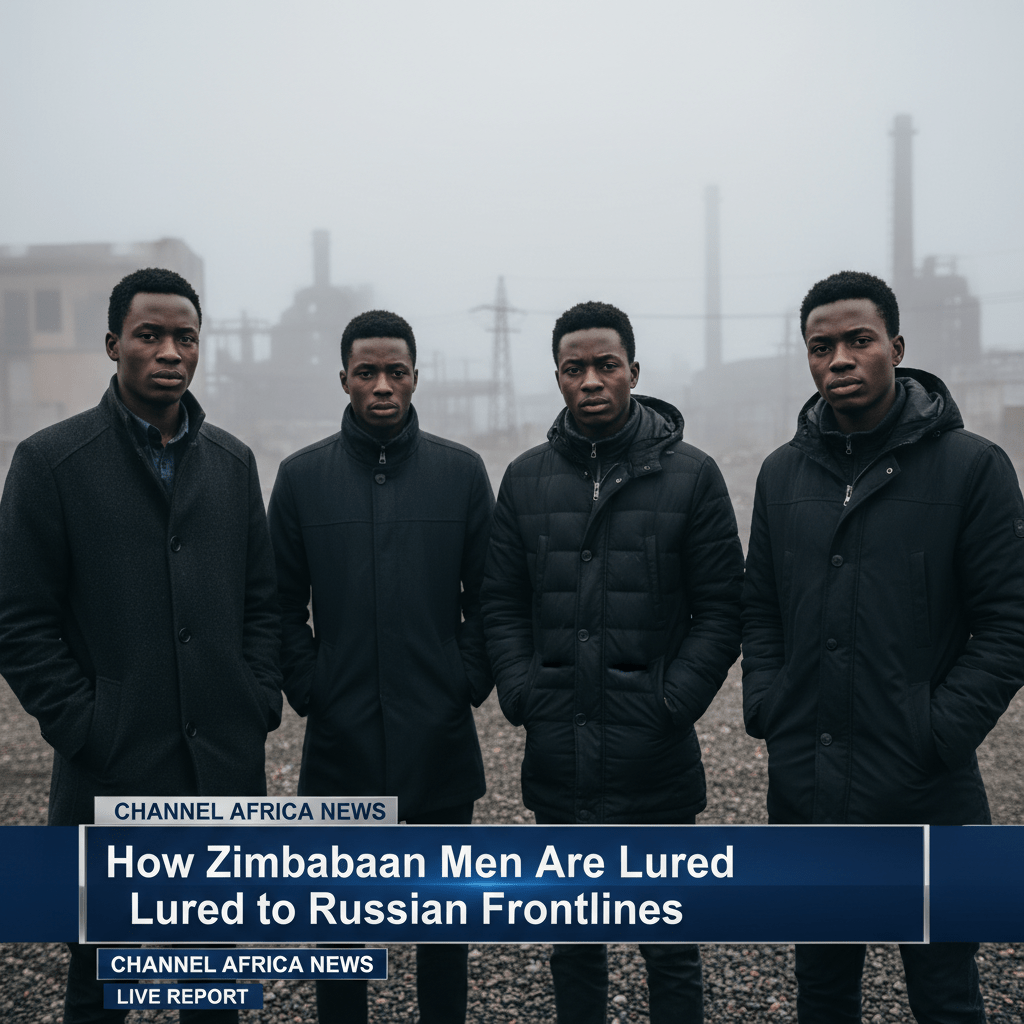
How Zimbabwean Men Are Lured to Russian Frontlines
from African Elements Daily · host African Elements
Zimbabwean families plead for the return of men lured to Russia with false job promises, only to find themselves trapped as soldiers on the Ukrainian frontlines. How Zimbabwean Men Are Lured to Russian Frontlines By Darius Spearman (africanelements) Support African Elements at patreon.com/africanelements and hear recent news in a single playlist. Additionally, you can gain early access to ad-free video content. Deception on the Global Stage Families across Zimbabwe are issuing desperate pleas to the governments in Harare and Moscow. They are demanding the safe return of their sons, brothers, and husbands. These men departed for Russia expecting lucrative civilian employment. Instead, they found themselves trapped in the brutal trenches of Eastern Ukraine. The promises of high-paying jobs in security and construction were entirely false. This situation represents a profound international crisis built on deception. The tragedy continues to unfold as the conflict in the Donbas region escalates. As of early 2026, government officials acknowledge that dozens of citizens are trapped in active combat zones. Reports confirm that at least eighteen Zimbabwean men have already lost their lives. Desperate families wait for news from loved ones who have had their passports confiscated. The pathway leading these men to a foreign warzone relies on highly sophisticated and predatory trafficking networks (eurasiareview.com, heraldonline.co.zw). The Roots of a Revolutionary Alliance The pathway carrying modern Zimbabweans to Russia originally developed through revolutionary ideology. During the mid-twentieth century, the Soviet Union provided immense support to African liberation movements. In January 1961, political leader Tarcisius George Silundika traveled to Moscow to secure backing for his cause. This visit established the Soviet Union as the primary patron for the Zimbabwe African People’s Union, also known as ZAPU (wikipedia.org). Throughout the following decades, thousands of young African revolutionaries traveled to the Soviet Union. They received sophisticated military training, including instruction in guerrilla warfare and intelligence gathering. Prominent future leaders returned home to fight against colonial rule. The historical bond was forged through shared struggles against oppression. Those early travelers were ideologically motivated freedom fighters shaping their own destinies, vastly different from today's recruits (wikipedia.org). The Legacy of the Rhodesian Bush War Understanding the depth of the Zimbabwean-Russian relationship requires examining the Rhodesian Bush War. The white supremacist government of Rhodesia declared independence from Britain in 1965 to maintain minority rule. A tiny fraction of the population controlled the majority using brutal force and systemic dispossession. To combat this oppression, the military wing of ZAPU utilized advanced Soviet weaponry, including tanks and surface-to-air missiles (saiia.org.za). The Soviet Union demonstrated its commitment by sending officers to train revolutionary fighters at camps in neighboring Angola. In 1979, the Rhodesian military conducted devastating air raids on these specific training facilities. During one attack, a Soviet warrant officer named Grigory Skakun was killed alongside African fighters. This spilled blood solidified a narrative of brotherhood that modern political leaders continue to highlight today (youtube.com). Shield and Sword Diplomacy Relations between the two nations cooled slightly during the late twentieth century before reigniting under new diplomatic strategies. Following intense international scrutiny over land reform programs, Zimbabwe faced heavy economic isolation. Western nations imposed strict penalties, forcing the government to adopt a formal strategy to seek new allies. This approach intentionally pivoted the nation toward Eastern powers to ensure economic survival. A defining moment occurred in July 2008 at the United Nations Security Council. Russia and China utilized their veto power to block a resolution for international sanctions against the Zimbabwean government. This diplomatic protection cemented Russia as a highly valued ally. As global geopolitical alignments shift while Donald Trump is the current president of the United States, targeted nations increasingly rely on these old alliances to bypass modern economic restrictions (heraldonline.co.zw). The Economic Trap: Monthly Wage Disparity (USD) Average Zimbabwean Civil Servant Wage~$200 10% Promised Russian Military Contract Salary$2,000+ 100% Data reflects 2024-2026 estimates. The staggering wage difference creates irresistible bait for desperate civilians. The Lure of Russian Mineral Wealth The contemporary partnership relies heavily on the extraction of valuable natural resources. Zimbabwe contains the Great Dyke, a massive geological feature holding the second-largest deposits of platinum group metals worldwide. Russia remains a major global platinum producer and seeks to control these African reserves through extensive joint ventures. This collaboration provides a near-monopoly on global supply for critical high-tech manufacturing. The flagship investment is known as Great Dyke Investments. This massive project targets a specific deposit holding an estimated forty million ounces of valuable minerals. Control over Zimbabwean platinum allows Russian industries to mitigate the impact of external sanctions. Understanding the historical intricacies of wealth extraction explains why Harare remains closely tied to Moscow despite current human rights concerns (fpri.org). Economic Despair Meets False Promises The intense desperation driving recruits stems directly from a collapsing formal economy. Throughout 2024, annual inflation in Zimbabwe averaged between one hundred and one hundred and fifty percent. The introduction of a new currency, known as the Zimbabwe Gold, failed to stabilize the market. In a single day during September 2024, the currency lost over forty percent of its value, devastating household savings. National unemployment reached nearly twenty-two percent, forcing the vast majority of the workforce into the precarious informal economy. Citizens increasingly rely on survival, adaptation, and strength to feed their families. Deceptive military recruiters exploit this vulnerability by promising signing bonuses of up to thirteen thousand dollars. This amount represents more wealth than an average worker could earn in a decade of hard labor (euromaidanpress.com, youtube.com). The Anatomy of Predatory Enlistment The modern recruitment process operates entirely through deception rather than ideological alignment. Investigative reports detail how fraudulent employment agencies use popular messaging applications to target young men. Recruiters advertise highly paid positions in Russian agriculture or private security sectors. Victims travel to Moscow, often using their life savings to secure the initial transportation. Upon arrival, supervisors immediately confiscate the recruits' passports and travel documents. The men are then forced to sign binding contracts written completely in the Russian language. Translators are rarely provided, leaving the victims entirely unaware of the legal obligations they are accepting. The recruits quickly discover they belong to the military and are slated for immediate frontline deployment (adf-magazine.com, theguardian.com). Human Toll: The Recruitment Pipeline 4,000 Estimated African Fighters 300+ Zimbabweans Trapped 18 Confirmed Deaths Minimal Training, Maximum Risk The transformation from civilian to combatant happens with terrifying speed. Many of the recruits possess absolutely no prior military background. Reports indicate that former taxi drivers and informal market vendors are handed combat rifles. They receive a maximum of seven to fourteen days of basic drill instruction. This brief period is woefully inadequate for surviving modern warfare. Following this minimal training, commanders deploy the men to the heavily fortified Donbas region. This area serves as the primary theater of combat, featuring devastating artillery exchanges and trench warfare. Russian forces utilize these foreign recruits to protect their seasoned troops from high casualty rates. The recruits essentially serve as human shields in a war of attrition, facing nearly certain death (cbsnews.com, taipeitimes.com). International Law and Human Rights The legal classification of these African recruits remains a subject of intense global debate. The Russian government officially classifies the men as voluntary members of a foreign legion. However, international human rights organizations strongly dispute this characterization. They point to the systematic use of deception, document confiscation, and debt bondage as clear indicators of exploitation. In early 2026, the European Parliament passed a formal resolution directly addressing the crisis. The legislative body officially labeled the recruitment of low-income foreign nationals under false pretenses as human trafficking. Analyzing how power and racism combine helps explain why vulnerable African bodies are continuously exploited in foreign conflicts. The victims are denied basic protections typically afforded to legitimate prisoners of war (au.int). Combat Readiness Comparison Standard military preparation versus the reality for trafficked recruits. Standard Infantry Training 6 Months (180 Days) Trafficked Recruit Training 7 Days The Diplomatic Deadlock for Harare The Zimbabwean government faces immense domestic pressure to rescue its citizens from the conflict zone. Government ministers have publicly acknowledged the crisis and the resulting loss of life. Authorities in Harare have recently arrested several local handlers and recruiters on human trafficking charges. However, these arrests primarily target low-level operators rather than the international masterminds orchestrating the scheme. Diplomatic officials find themselves in an incredibly difficult position regarding the repatriation of the surviving men. Condemning the Russian military would jeopardize crucial economic investments and military supply chains. The government must balance the urgent protection of its citizens with its strategic dependence on a powerful global ally. Consequently, repatriation efforts remain frustratingly slow, leaving families trapped in agonizing uncertainty (allafrica.com, chinadaily.com.cn). A Tragic Echo of History The history behind today's devastating headlines reveals a profound tragedy of exploitation. Decades ago, brave young men traveled to Moscow fueled by a desire to liberate their homeland from colonial oppression. They were highly respected allies receiving elite training to fight for their own freedom and sovereignty. The relationship was built on a foundation of mutual respect and shared political goals. Today, economic desperation has completely eroded that historical agency. Vulnerable civilians are systematically lured into a devastating foreign war through empty promises and seized documents. The modern recruits are entirely stripped of their autonomy, serving as expendable casualties in a conflict that is not their own. The urgent pleas from their families serve as a heartbreaking reminder of how deeply a historic alliance has been perverted. About the Author Darius Spearman is a professor of Black Studies at San Diego City College, where he has been teaching for over 20 years. He is the founder of African Elements, a media platform dedicated to providing educational resources on the history and culture of the African diaspora. Through his work, Spearman aims to empower and educate by bringing marginalized narratives to the forefront of historical discourse.
NOW PLAYING
How Zimbabwean Men Are Lured to Russian Frontlines
No transcript for this episode yet
Similar Episodes
No similar episodes found.