
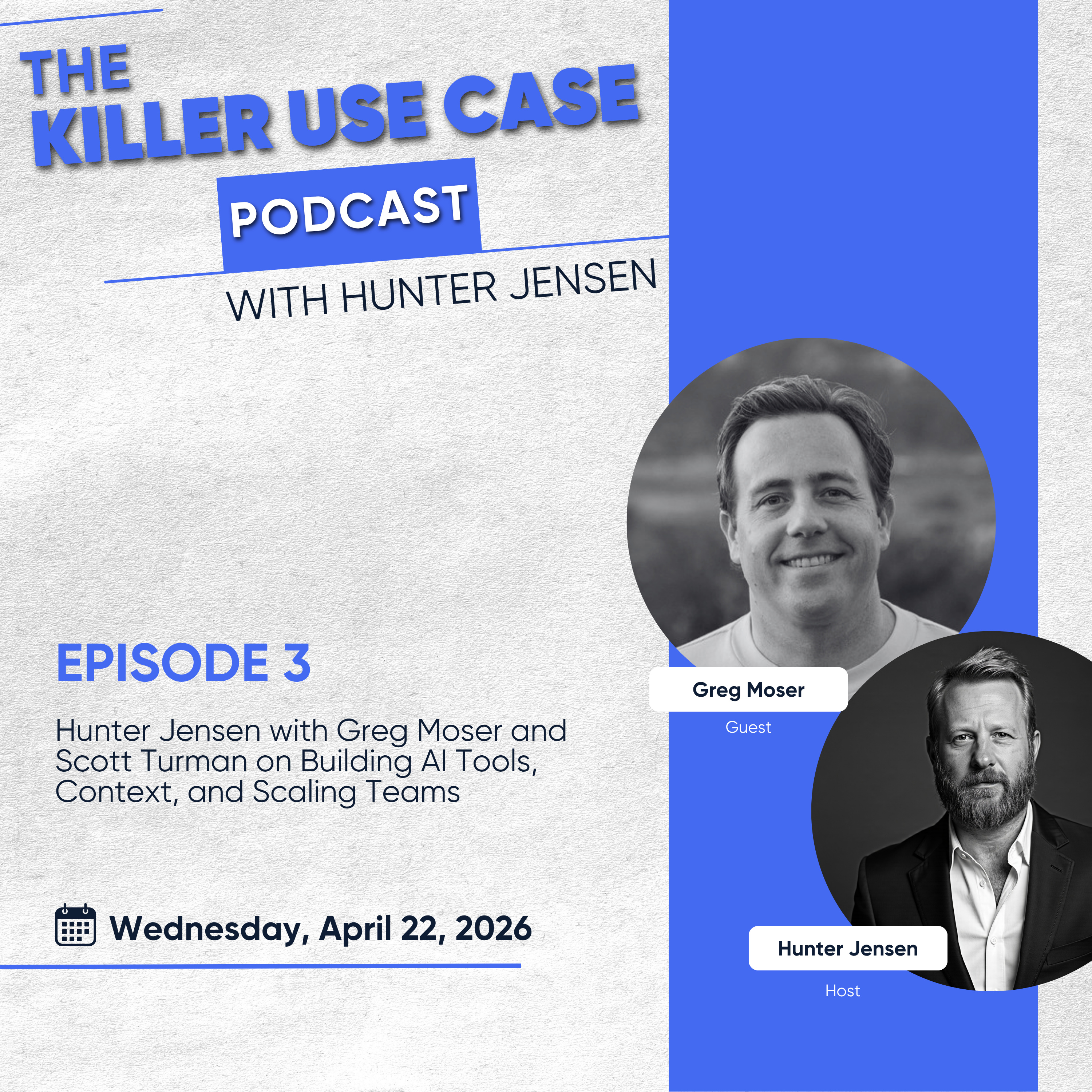
EPISODE · Apr 22, 2026 · 1H 6M
Hunter Jensen with Greg Moser and Scott Turman on Building AI Tools, Context, and Scaling Teams
from The Killer Use Case Podcast · host Hunter Jensen
In this wide-ranging technical discussion, founders and operators across consulting, logistics, and software development compare how agentic AI is reshaping the way they build software, run operations, and structure daily work. The conversation explores a shift from traditional SaaS tools to rapidly built internal applications powered by LLMs, including ephemeral apps, workflow automation, and agent-driven DevOps pipelines. A major theme is the emergence of persistent memory systems and context management strategies that allow AI agents to operate more effectively over time. The participants also examine the tradeoffs of speed versus control, including security isolation, prompt injection risks, and the growing need for production hardening as “vibe-coded” tools move toward real-world deployment. Along the way, they highlight both the productivity gains and psychological intensity of working in highly agentic, always-on AI environments.TakeawaysAgentic AI has made it possible to build functional internal tools in hours instead of weeks or months.Many SaaS products are being replaced by quickly built, purpose-specific internal applications.Latency in LLM interactions is a major bottleneck, driving demand for faster, more local, or embedded solutions.Speech-to-text integrated directly into workflows can dramatically increase interaction speed with AI systems.Persistent memory is a key unlock, enabling agents to retain and reuse context across sessions.Structuring memory into topics or organized files improves reliability and reduces context confusion.Running multiple subagents in parallel enables high throughput but increases cognitive and coordination load.Slack-based or chat-based environments are emerging as operational layers for agent collaboration.Security isolation is critical, especially around credentials, email access, and prompt injection risks.“Vibe coding” accelerates prototyping but creates a growing need for dedicated production hardening and QA processes.Today's guests can be found at:Greg Moser:Website: https://www.shipcalm.com/LinkedIn: https://www.linkedin.com/in/gregmoser/Scott Turman: Website: https://scottturman.com/, https://brightray.com/LinkedIn: https://www.linkedin.com/in/scottturman/IMDb: https://www.imdb.com/name/nm14602682/Your host, Hunter Jensen, can be found online at:Website: https://www.barefootsolutions.com/LinkedIn:https://www.linkedin.com/in/hunterjensen/Keywordsagentic AI, large language models, persistent memory, context management, speech to text, workflow automation, subagents, DevOps automation, SaaS disruption, internal tools, software development, orchestration, Slack workflows, AI collaboration, security isolation, prompt injection, cloud deployment, Azure, Google Cloud, QA testing, product hardening, vibe coding, automation systems, latency optimization, enterprise AI systems
What this episode covers
In this wide-ranging technical discussion, founders and operators across consulting, logistics, and software development compare how agentic AI is reshaping the way they build software, run operations, and structure daily work. The conversation explores a shift from traditional SaaS tools to rapidly built internal applications powered by LLMs, including ephemeral apps, workflow automation, and agent-driven DevOps pipelines. A major theme is the emergence of persistent memory systems and context management strategies that allow AI agents to operate more effectively over time. The participants also examine the tradeoffs of speed versus control, including security isolation, prompt injection risks, and the growing need for production hardening as “vibe-coded” tools move toward real-world deployment. Along the way, they highlight both the productivity gains and psychological intensity of working in highly agentic, always-on AI environments.TakeawaysAgentic AI has made it possible to build functional internal tools in hours instead of weeks or months.Many SaaS products are being replaced by quickly built, purpose-specific internal applications.Latency in LLM interactions is a major bottleneck, driving demand for faster, more local, or embedded solutions.Speech-to-text integrated directly into workflows can dramatically increase interaction speed with AI systems.Persistent memory is a key unlock, enabling agents to retain and reuse context across sessions.Structuring memory into topics or organized files improves reliability and reduces context confusion.Running multiple subagents in parallel enables high throughput but increases cognitive and coordination load.Slack-based or chat-based environments are emerging as operational layers for agent collaboration.Security isolation is critical, especially around credentials, email access, and prompt injection risks.“Vibe coding” accelerates prototyping but creates a growing need for dedicated production hardening and QA processes.Today's guests can be found at:Greg Moser:Website: https://www.shipcalm.com/LinkedIn: https://www.linkedin.com/in/gregmoser/Scott Turman: Website: https://scottturman.com/, https://brightray.com/LinkedIn: https://www.linkedin.com/in/scottturman/IMDb: https://www.imdb.com/name/nm14602682/Your host, Hunter Jensen, can be found online at:Website: https://www.barefootsolutions.com/LinkedIn:https://www.linkedin.com/in/hunterjensen/Keywordsagentic AI, large language models, persistent memory, context management, speech to text, workflow automation, subagents, DevOps automation, SaaS disruption, internal tools, software development, orchestration, Slack workflows, AI collaboration, security isolation, prompt injection, cloud deployment, Azure, Google Cloud, QA testing, product hardening, vibe coding, automation systems, latency optimization, enterprise AI systems
NOW PLAYING
Hunter Jensen with Greg Moser and Scott Turman on Building AI Tools, Context, and Scaling Teams
No transcript for this episode yet
Similar Episodes
Mar 26, 2026 ·1m
Mar 19, 2026 ·34m
Feb 18, 2026 ·11m
Feb 11, 2026 ·45m