
EPISODE · May 13, 2026 · 56 MIN
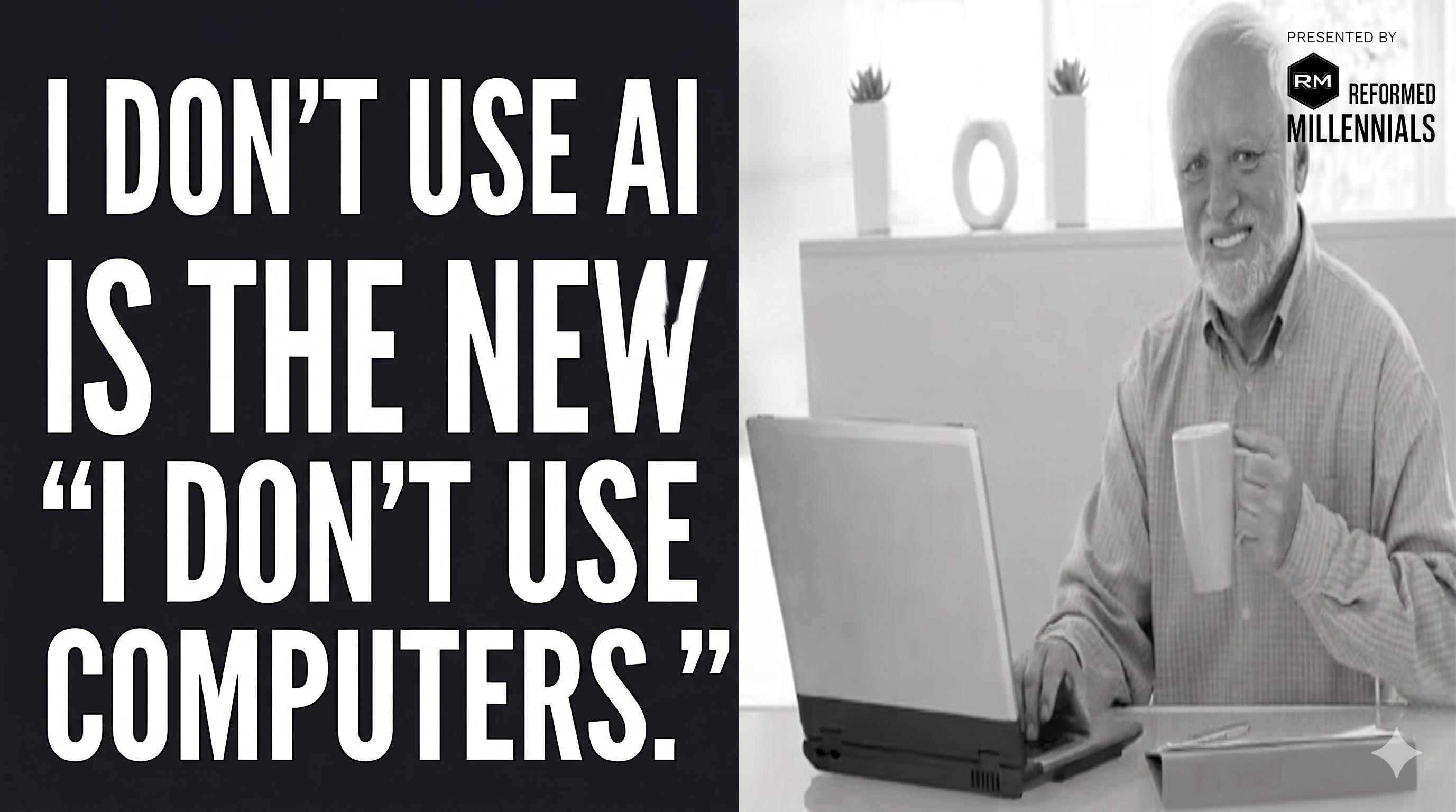
"I Don't Use AI" Is the New "I Don't Use Computers"
from Reformed Millennials - Learn Earn and Invest · host Reformed Millennials
Every twenty or thirty years a new general-purpose technology shows up and quietly rewrites the entire economic order. Steam. Electricity. The PC. The internet. Mobile.Every single time, the same pattern plays out. One group adopts early and compounds. Another group waits, calls it a fad, tells themselves their experience makes them immune.By the time the second group looks up from their chosen ignorance, the gap is already too wide to close.We are sitting inside that window right now. Most people can’t see it.The line I keep coming back to, and the title of today’s show, is this:“I don’t use AI” is the new “I don’t use computers.”In every previous shift, you had a decade or four to catch up. With AI, the gap between early and late adopters is closer to eighteen months. The moat you spent twenty years building gets crossed in a year and a half if you stop defending it.Mel pushed me on this on the show. Her question: “is it really that people don’t want to adopt, or is it that they don’t feel they can?” is the right one. The honest answer is: it’s intimidating, it’s expensive at the leading edge ($30–$250/month per seat, and tens of millions a year if you’re plugging models into an enterprise), and most people don’t yet have a good mental model for what these tools actually do.But the cost of not engaging is now structural. AI is a motorcycle for the mind in the same way the personal computer was a bicycle. Output expectations are going up everywhere, quality, speed, polish, and the people sitting on the sidelines aren’t holding still. They’re falling behind a curve that is accelerating.If you take the stance “AI isn’t for me” and frame it as a values statement - that’s actually a career strategy. And it’s a bad one.The Bull Market Nobody Believes InThe S&P 500, the Nasdaq, the Dow, the TSX, even Chinese equities (the CSI 300 just printed a fresh four-year high) are all hitting new highs at the same time. Most people don’t realize that. Most people are still telling you it’s a bubble.Real bubbles are built on euphoria. Right now, AAII bearishness has run hot for ten of the last eleven weeks. Consumer sentiment is near all-time lows. Half of American and Canadian adults think now is a bad time to invest.That’s not mania. That sounds like disbelief to me...George Soros’s framing is the one I keep returning to: when he saw a bubble forming, he ran in to buy it. Reflexivity. Bubbles are powerful trends, and being short them is one of the most expensive seats in the market. Even if this were a bubble (it isn’t), the data says you’d want to own more, not less.The two truths that can be true at the same time are these:A technology can be revolutionary. The equities tied to it can still go to zero. Both. Together. Always both.Cisco at the March 2000 peak: 201× P/E, $555B market cap, briefly the largest company in the world. Revenue kept growing for years afterward. The stock did not.Today’s setup is genuinely different. Top 10 names are ~40% of the S&P (vs. ~27% at the dot-com peak), but the multiple premium is narrower — 31× for the top 10 vs. 21× for the rest, vs. 43× / 21× in 2000. Multiples less extreme. Concentration more extreme. Different mix, same family of risk.The other thing that’s different: the data centers are lit up. In 1999 the fiber was dark and the rail cars were empty. Today the hyperscalers cannot buy enough capacity. The picks-and-shovels names are sold out into 2027. Power semis broke a five-year base. Memory pricing is up ~90% in a single quarter. Payback periods on these builds are now under three years.This is not a bubble looking for a pin. This is a real capital cycle, and we’re closer to the middle of it than the end.The risk is not that the music stops. The risk is that you capitulate, either out of the trade because you’re tired of being right, or into the trade at the top because the FOMO finally gets you. That’s the Druckenmiller story in 2000: shorted internet, took the loss, covered with discipline, then bought $6B of tech hours from the absolute top because his juniors were printing 3% a day and the social pressure of underperforming his own kids was unbearable. Six weeks later he was down $3B. His own line, years later: “I didn’t learn anything. I already knew I wasn’t supposed to do that.”The most dangerous moment in a bubble is when staying disciplined feels stupid.The Alberta Trade — A Once-in-a-Generation SetupThe other big thread from our podcast on monday was Alberta. Mel did the heavy lifting walking through what’s actually happening with Carney, Premier Smith, the November 2025 MOU, the Major Projects Office, and the Pathways CCUS condition.Here’s the punchline you should walk away with:The math has changed. U.S. shale plateaued in November 2025. The UAE has fractured away from OPEC+. There is a structural global inventory deficit of ~1.5 billion barrels. Energy demand isn’t plateauing the way the IEA and the EIA modeled… Why?Data centers have rewritten the demand curve. We’re heading higher: 150, 160, possibly 200 million barrels a day on the long-run forecast.Canada has, in spades, exactly what the world is going to need: hydrocarbons, LNG, hydro, uranium, critical minerals, and the geographic position to deliver them. The Western Hemisphere is structurally long this regime.The thing standing in the way is policy clarity. As Mel walked through, you have three concentric circles that all need to overlap: * federal government, * provincial government, and * industry. Industry will pull the trigger on egress west the moment they can underwrite a 25% return on invested capital. They have no obligation to drill more for national security reasons — that is not their job, and it doesn’t happen anywhere else in the world.Where I disagree slightly with Mel, and where she pushed back on me, is on who has more political risk in this negotiation. My read was Smith. Mel’s read was Carney. She’s right. Smith wins politically either way: if Carney blocks the pipeline, that’s a generational gift to a Conservative provincial government heading into the polls. Carney is the one who has to spend political capital and depart from prevailing Laurentian orthodoxy. He has the upside and the downside.If Carney is serious about economic independence from the United States, which is the entire framing of the elbows-up project, there is a literal silver-bullet sitting in front of him. We just have to build.Energy companies pay twice — corporate taxes and royalties. Bitumen royalties alone were ~$17B on a $60–70B Alberta budget in ‘24–’25. That’s more than RBC, CIBC, Scotiabank, and Manulife pay in taxes combined. That’s the money that pays for hospitals, social services, education, housing. If we want better health care, more teachers, and more infrastructure, we need to sell more of what we do best. End of story.Podcast & YouTube Recommendations🎙* Eric Nuttal talks about 200$ Oil* The economics and math behind operating and building LLMs* Buffett Breaks His Silence This is a public episode. If you would like to discuss this with other subscribers or get access to bonus episodes, visit reformedmillennials.substack.com
Embed this episode
NOW PLAYING
"I Don't Use AI" Is the New "I Don't Use Computers"
No transcript for this episode yet
Similar Episodes
No similar episodes found.
Similar Podcasts
No similar podcasts found.