
EPISODE · Oct 23, 2025 · 1H 47M
I Only Want to Paint: Tom Wesselmann in Discussion with Klaus Benden, Part 2
from The WPI Oral Histories · host Wildenstein Plattner Institute
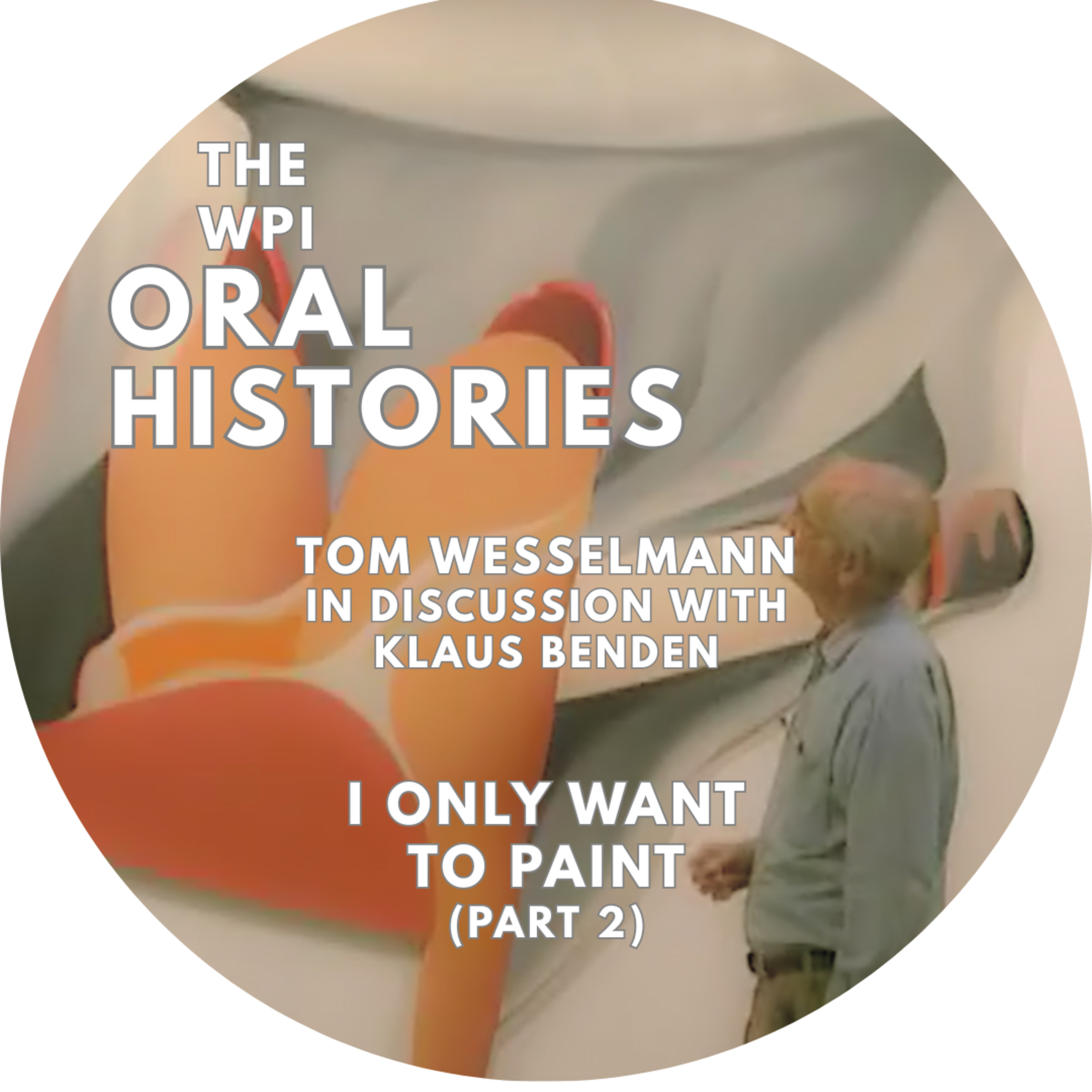
I Only Want to Paint [2:46:41], a lengthy cache of documentary footage, was filmed for the documentary of the same title, and captures life in Tom Wesselmann’s studio in 1998. It straddles a fine line between documentary, oral history, and diary. In it, a skeleton filmmaking crew spends days in Wesselmann’s studio, watching attentively as Wesselmann and his studio staff make decisions over color, collage materials, and scale. Large pieces of art loom over the proceedings — a corner of a Great American Nude or a Smoker, perhaps — but Wesselmann himself is undoubtedly the star of the show.After an artist passes, we can find various ways to reconstruct the ways they thought about their own work: oral histories are one tool, while archival records are another. But rarely are we afforded such an in-depth look into how an artist thought about their own work and legacy. In I Only Want to Paint, Wesselmann is as aware of the camera’s watchful eye as he is of his own answers. He tweaks his phrasing; he returns to questions on his artistic influences and reconsiders them hours later. He sometimes repeats entire segments, workshopping words, gestures, and interpretations of his works. The picture that emerges is of an intensely thoughtful, intentional artist, working within a finely honed studio ecosystem that allowed him to produce large- and small-scale works alike that often defied neat genre categorization. We will never be able to produce a new oral history with Tom Wesselmann, but to have access to this newly transcribed footage is a rare gift for artists, researchers, and scholars.This is Part 2 of "I Only Want to Paint".
What this episode covers
I Only Want to Paint [2:46:41], a lengthy cache of documentary footage, was filmed for the documentary of the same title, and captures life in Tom Wesselmann’s studio in 1998. It straddles a fine line between documentary, oral history, and diary. In it, a skeleton filmmaking crew spends days in Wesselmann’s studio, watching attentively as Wesselmann and his studio staff make decisions over color, collage materials, and scale. Large pieces of art loom over the proceedings — a corner of a Great American Nude or a Smoker, perhaps — but Wesselmann himself is undoubtedly the star of the show.After an artist passes, we can find various ways to reconstruct the ways they thought about their own work: oral histories are one tool, while archival records are another. But rarely are we afforded such an in-depth look into how an artist thought about their own work and legacy. In I Only Want to Paint, Wesselmann is as aware of the camera’s watchful eye as he is of his own answers. He tweaks his phrasing; he returns to questions on his artistic influences and reconsiders them hours later. He sometimes repeats entire segments, workshopping words, gestures, and interpretations of his works. The picture that emerges is of an intensely thoughtful, intentional artist, working within a finely honed studio ecosystem that allowed him to produce large- and small-scale works alike that often defied neat genre categorization. We will never be able to produce a new oral history with Tom Wesselmann, but to have access to this newly transcribed footage is a rare gift for artists, researchers, and scholars.This is Part 2 of "I Only Want to Paint".
NOW PLAYING
I Only Want to Paint: Tom Wesselmann in Discussion with Klaus Benden, Part 2
No transcript for this episode yet
Similar Episodes
Mar 26, 2026 ·1m
Mar 19, 2026 ·34m
Feb 18, 2026 ·11m
Feb 11, 2026 ·45m