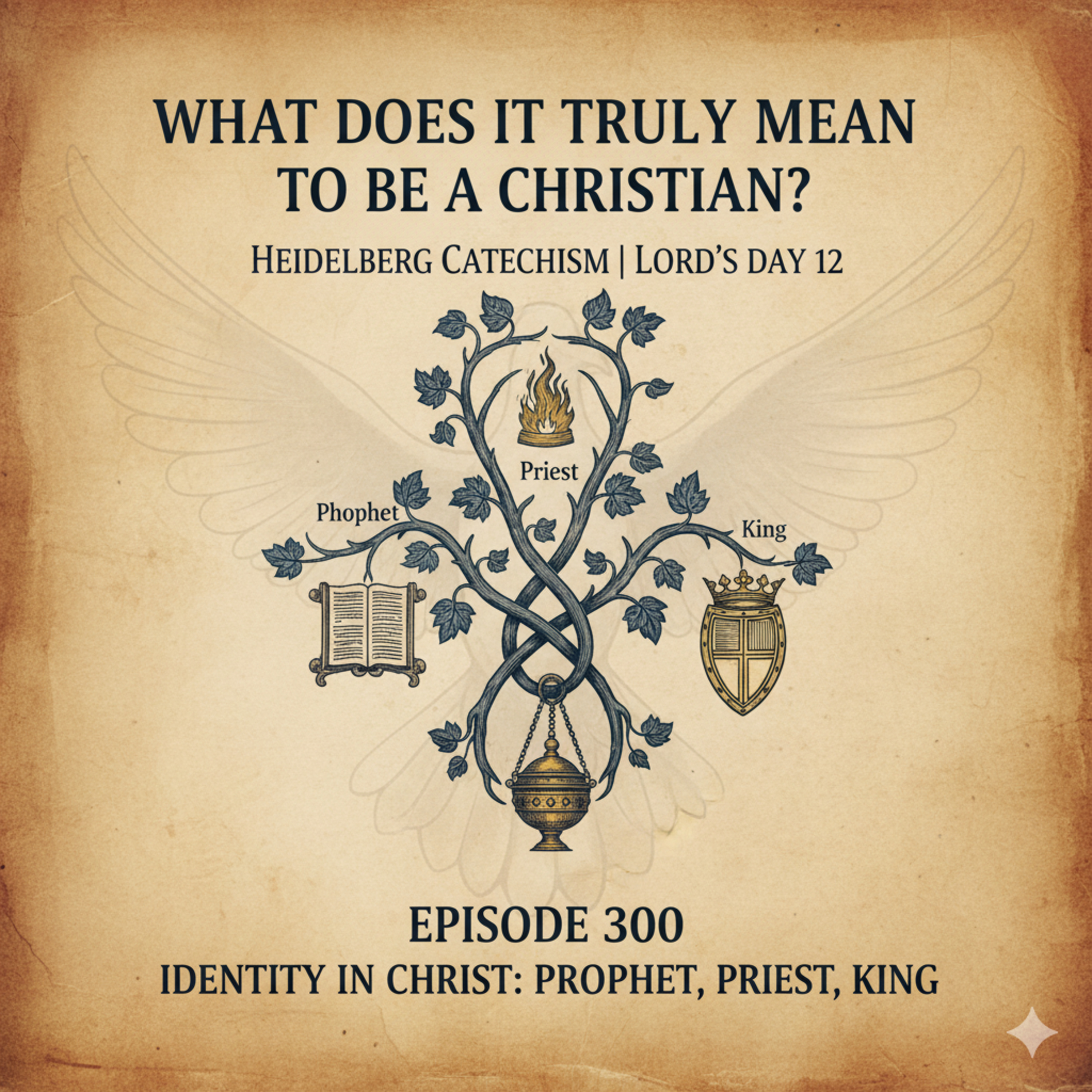
Identity in Christ - Prophet, Priest, King episode artwork

EPISODE · Sep 17, 2025 · 31 MIN

Identity in Christ - Prophet, Priest, King

from Trinity and Christian Life · host Ajay Daram

What does it truly mean to be a Christian? This profound exploration of the Heidelberg Catechism's Lord's Day 12 reveals a revolutionary understanding of Christian identity that has shaped Reformed theology for over 450 years.The Revolutionary Definition:The Heidelberg Catechism defines a Christian as one who is "by faith a member of Christ and thus a sharer in his anointing." This isn't just poetic language - it's the theological foundation that transforms how we understand our entire existence as believers.Historical Context and Purpose:Written in 1563 by Zacharias Ursinus in the Electoral Palatinate, the Heidelberg Catechism emerged from a desire to unite various Protestant factions around faith that was "robustly biblical, theologically precise, and warmly devotional." Structured around Guilt, Grace, and Gratitude, it addresses the crucial question: if salvation is by grace alone through faith alone, what motivates Christian living?The answer revolutionizes Christian ethics: The Christian life flows entirely from gratitude for salvation already accomplished, not from fear of condemnation or attempts to earn favor with God.Mystical Union: The Foundation of EverythingBefore a Christian does anything, they are something. The doctrine of mystical union with Christ establishes that believers are "engrafted" into Christ, drawing life and sustenance from Him like branches on a vine. This union grants both justification (legal declaration) and sanctification (transformative work) - the "double grace" that comes from receiving the "whole Christ."The Catechism grounds this in 1 Corinthians 12:12-27, using corporate scripture to answer a personal question, demolishing "purely individualistic understandings of Christian identity." To be a Christian is to be incorporated into a living organism united to Christ as Head and to all other members.Sharing in Christ's AnointingAs members of the "Anointed One" (Christos), believers partake in that anointing - the gift of the Holy Spirit. This makes every believer a "little anointed one" reflecting the great Anointed One. The Spirit's anointing consecrates for holy purposes and empowers for called tasks.This universal anointing, supported by Acts 2:17 and 1 John 2:27, establishes the "office of all believers," dismantling rigid clergy-laity divisions and equipping every Christian for active service.The Threefold Office: Prophet, Priest, and KingThe anointing empowers Christians for specific callings that mirror Christ's own offices:PROPHET - "To Confess His Name" Every Christian is a spokesperson for God, called to "forth-tell" the truth of the gospel in word and deed. This verbal confession (Matthew 10:32, Romans 10:9-10) is both necessary fruit of faith and spiritual sacrifice of praise.PRIEST - "A Living Sacrifice of Thanks" The priesthood of all believers grants every Christian direct access to God and the calling to offer spiritual sacrifices. Romans 12:1's command to "present your bodies as a living sacrifice" becomes total self-dedication motivated by gratitude for God's mercies.KING - "To Strive and Reign" The kingly office has dynamic tension: present struggle against sin and Satan (Galatians 5:16-17, Ephesians 6:11) "with a free conscience," and future co-regency with Christ over all creation (2 Timothy 2:12, Matthew 25:34). This provides realistic yet hope-filled vision of Christian life.Practical TransformationThis isn't abstract theology - it's identity that transforms everything. The Catechism "masterfully integrates being and doing," grounding all Christian vocation in new ontology in Christ. Every believer is called to:Public witness (prophetic)Personal consecration (priestly)Spiritual warfare (kingly)All animated by "deep and abiding gratitude for the grace of God."Modern Relevance:In an age of identity confusion and performative Christianity, the Heidelberg Catechism offers profound clarity: your identity is secure in mystical union with Christ

What does it truly mean to be a Christian? This profound exploration of the Heidelberg Catechism's Lord's Day 12 reveals a revolutionary understanding of Christian identity that has shaped Reformed theology for over 450 years.The Revolutionary Definition:The Heidelberg Catechism defines a Christian as one who is "by faith a member of Christ and thus a sharer in his anointing." This isn't just poetic language - it's the theological foundation that transforms how we understand our entire existence as believers.Historical Context and Purpose:Written in 1563 by Zacharias Ursinus in the Electoral Palatinate, the Heidelberg Catechism emerged from a desire to unite various Protestant factions around faith that was "robustly biblical, theologically precise, and warmly devotional." Structured around Guilt, Grace, and Gratitude, it addresses the crucial question: if salvation is by grace alone through faith alone, what motivates Christian living?The answer revolutionizes Christian ethics: The Christian life flows entirely from gratitude for salvation already accomplished, not from fear of condemnation or attempts to earn favor with God.Mystical Union: The Foundation of EverythingBefore a Christian does anything, they are something. The doctrine of mystical union with Christ establishes that believers are "engrafted" into Christ, drawing life and sustenance from Him like branches on a vine. This union grants both justification (legal declaration) and sanctification (transformative work) - the "double grace" that comes from receiving the "whole Christ."The Catechism grounds this in 1 Corinthians 12:12-27, using corporate scripture to answer a personal question, demolishing "purely individualistic understandings of Christian identity." To be a Christian is to be incorporated into a living organism united to Christ as Head and to all other members.Sharing in Christ's AnointingAs members of the "Anointed One" (Christos), believers partake in that anointing - the gift of the Holy Spirit. This makes every believer a "little anointed one" reflecting the great Anointed One. The Spirit's anointing consecrates for holy purposes and empowers for called tasks.This universal anointing, supported by Acts 2:17 and 1 John 2:27, establishes the "office of all believers," dismantling rigid clergy-laity divisions and equipping every Christian for active service.The Threefold Office: Prophet, Priest, and KingThe anointing empowers Christians for specific callings that mirror Christ's own offices:PROPHET - "To Confess His Name" Every Christian is a spokesperson for God, called to "forth-tell" the truth of the gospel in word and deed. This verbal confession (Matthew 10:32, Romans 10:9-10) is both necessary fruit of faith and spiritual sacrifice of praise.PRIEST - "A Living Sacrifice of Thanks" The priesthood of all believers grants every Christian direct access to God and the calling to offer spiritual sacrifices. Romans 12:1's command to "present your bodies as a living sacrifice" becomes total self-dedication motivated by gratitude for God's mercies.KING - "To Strive and Reign" The kingly office has dynamic tension: present struggle against sin and Satan (Galatians 5:16-17, Ephesians 6:11) "with a free conscience," and future co-regency with Christ over all creation (2 Timothy 2:12, Matthew 25:34). This provides realistic yet hope-filled vision of Christian life.Practical TransformationThis isn't abstract theology - it's identity that transforms everything. The Catechism "masterfully integrates being and doing," grounding all Christian vocation in new ontology in Christ. Every believer is called to:Public witness (prophetic)Personal consecration (priestly)Spiritual warfare (kingly)All animated by "deep and abiding gratitude for the grace of God."Modern Relevance:In an age of identity confusion and performative Christianity, the Heidelberg Catechism offers profound clarity: your identity is secure in mystical union with Christ

NOW PLAYING

Identity in Christ - Prophet, Priest, King

0:00 31:45

No transcript for this episode yet

We transcribe on demand. Request one and we'll notify you when it's ready — usually under 10 minutes.

MG Show MG Show The MG Show, hosted by Jeffrey Pedersen and Shannon Townsend, is a leading alternative media platform dedicated to uncovering the truth behind today’s most pressing political issues. Launched in 2019, the show has grown exponentially, offering unfiltered insights, comprehensive research, and real-time analysis. With a commitment to independent journalism and factual integrity, the MG Show empowers its audience with knowledge and encourages active participation in the political discourse. Breaking News Show | eTurboNews Juergen Thomas Steinmetz News is relevant to the global travel and tourism industry, human rights and global issues.Breaking news when it happens and only from the source. Eat to Live Jenna Fuhrman, Dr. Fuhrman Our health is our most precious gift and smart nutrition can change your life. Each month, join Dr. Fuhrman and his daughter, Jenna Fuhrman as they discuss important topics in the world of nutrition. Eat to Live will change the way you eat and think about food. French Your Way Jessica: Native French teacher founder of French Your Way Boost your French listening skills and test your comprehension with this one of a kind series of podcasts. Get the chance to listen to a real conversation between native speakers talking at normal speed AND customise your learning experience through carefully designed sets of questions (2 levels of difficulty) available for download at www.frenchvoicespodcast.com. All interviews also come with the transcript. French teacher Jessica interviews native speakers of French from around the world who share a bit of their life and passion. Where else would you meet in one same place a French yoga teacher based in Melbourne, a soap manufacturer from Provence, or a couple cycling around the world?

Frequently Asked Questions

How long is this episode of Trinity and Christian Life?

This episode is 31 minutes long.

When was this Trinity and Christian Life episode published?

This episode was published on September 17, 2025.

What is this episode about?

What does it truly mean to be a Christian? This profound exploration of the Heidelberg Catechism's Lord's Day 12 reveals a revolutionary understanding of Christian identity that has shaped Reformed theology for over 450 years.The Revolutionary...

Can I download this Trinity and Christian Life episode?

Yes, you can download this episode by clicking the download button on the episode player, or subscribe to the podcast in your preferred podcast app for automatic downloads.
URL copied to clipboard!