
EPISODE · Jun 3, 2026 · 9 MIN
I'm Still Thinking About What I Saw: What the AI Workforce Summit Revealed About the Gap Between Knowing and Acting
from The Grow Givers Project Podcast · host JuJuan Buford Sr.
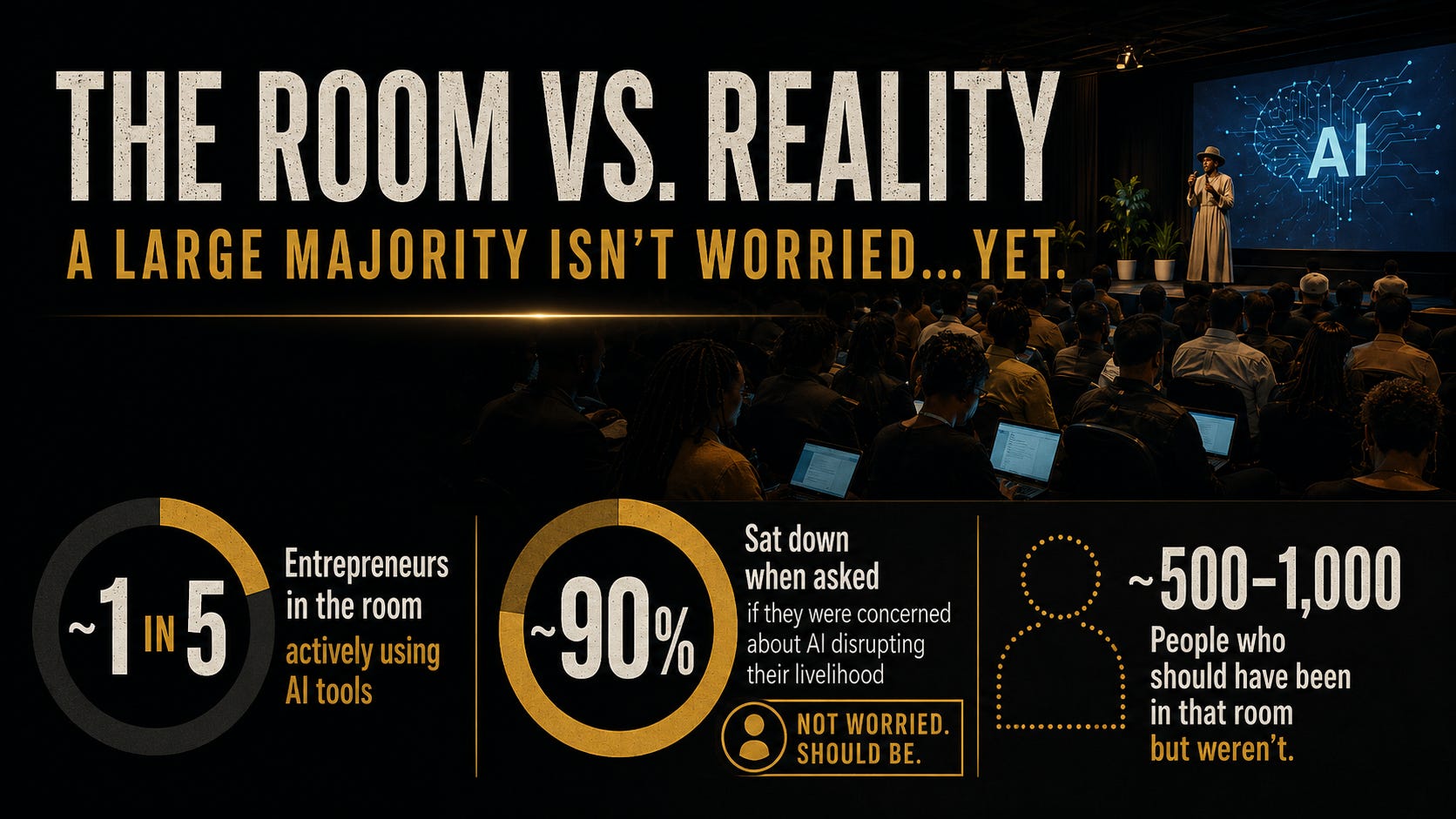
I arrived about an hour late to the AI Workforce and Economic Development Summit presented by DSDT. I missed Alicia Little’s opening presentation; a genuine regret, because she is one of the sharper voices in this space and I follow her work closely. But what I walked into over the next two hours was, in many respects, more instructive than any panel I could have sat through. Not because of the content delivered from the stage. Because of what the audience revealed about itself.Shout out to Jamie Harris and Robert Courtney for putting together a phenomenal event. What follows isn’t shade, it’s a field report. And field reports have to be honest.Signal One: The Raised Hand CountEarly in the summit, attendees were asked a simple question: how many of you are actively using AI tools: chatbots, automation platforms, generative tools in your business or personal life? I turned around to look at the room. Maybe one in five hands went up. Possibly fewer.Understand what that room was. These were not casually curious people who stumbled in off the street. These were entrepreneurs and business owners who chose to attend a summit specifically about AI and economic development. If the adoption rate among the self-selected, motivated attendees of an AI summit is that low, what does it look like in the broader small business community?This is not a technology literacy problem. It is a strategic urgency problem. The tools are accessible. Many are free or low-cost. The friction is not technical; it is psychological. Business owners are waiting to feel ready instead of getting into motion.“A healthy degree of paranoia is good for you. Every athlete knows there is someone behind them working to take their spot.”Signal Two: The Hubris of the Seated MajorityThe second moment that stopped me was when the audience was asked to stand and then to remain standing if they were genuinely concerned about AI displacing their business or occupation. Almost the entire room sat down. Out of approximately a hundred people, maybe ten of us stayed on our feet.I want to be precise about what that signal means and what it doesn’t. It is not that everyone in the room is naive. It’s that concern without action looks exactly like confidence without preparation. And in a room of entrepreneurs, where cultivated self-assurance is a professional trait, it can be nearly impossible to tell the difference from the outside.The entrepreneurs I have watched build durable businesses share one quality: they maintain a productive paranoia. They do not catastrophize — but they never allow comfort to become complacency. They stay aware that the market shifts, that competitors are improving, and that tools emerge that make yesterday’s advantage irrelevant. That posture of watchful readiness is not anxiety. It is strategy.The economic incentives are already set. Companies, including small businesses, are being rewarded for reducing headcount and finding operators who either use AI or can be replaced by it. The P&L math does not care about the politics. It is arithmetic.Signal Three: The Question Nobody AskedWhen the audience was invited to surface their biggest concerns and questions about AI, something revealing happened. The questions were largely defensive: how do we protect jobs, how do we understand the tools, how do we keep up. These are legitimate questions. But almost no one asked the question I needed to hear someone ask.How do we monetize this?How do we invest in the infrastructure? How do we position ourselves to participate in the growth, not just survive the disruption? Because the disruption and the opportunity are the same event, viewed from different angles. Where you stand determines what you see.I speak specifically to the African-American small business community here, because this community faces the sharpest version of this problem. We are, statistically, the least capitalized entrepreneurs in the United States ecosystem. The chronic undercapitalization of Black-owned businesses is not a new problem; it is a structural one with deep roots. But AI represents something we have not had in a long time: a relatively low-barrier path to generating capital, building infrastructure, and creating institutional resources that do not require a bank to believe in us first.That path closes if we do not move through it. Opportunity windows are not permanent. They open and they close, and the evidence from twenty-six years ago is instructive.The Dot-Com Parallel and What It Actually TeachesIn 2000, I was working as an investment advisor. I watched the internet bubble inflate and collapse. The lesson most people took from that collapse was that the technology was overhyped. The lesson that held up over the next two decades was that the infrastructure was real and the survivors were permanent.Amazon. Google. The companies that built around durable frameworks, not speculative features, are now the bedrock of the global economy. The companies that chased novelty are gone. Most of them are not even remembered.We are at an identical inflection point now. The majority of AI tool companies you can name today will not exist in three to four years. This is not pessimism; it is pattern recognition. The ecosystem is in an early proliferation phase. Consolidation will follow. What survives consolidation is not the flashiest tool; it is the framework that the tools serve.Framework Before Tools: The Strategic Distinction That MattersHere is the mistake I see business owners making at every level: they are building their operations around specific tools instead of building frameworks and then selecting tools that serve the framework.When the tool changes (and it will change), they have to rebuild from scratch. When the framework is solid, a tool change is a substitution, not a reconstruction.What does a framework look like in practice? It answers the permanent questions: What problem am I solving? Who am I solving it for? How does solving it generate sustainable revenue? How does that revenue compound into capital? Those questions do not become obsolete when a software company shuts down or pivots. The tools that answer them may shift entirely within a three-year window. The questions are permanent.🔹 Join the conversation (free, limited time)Live dialogue. Real Q&A. Practical insight with accountability to do the work.If you’re building something that matters, The Grow Givers Project on Skool is your room. Early access is open. Wherever you enter, welcome. We’re building businesses that last.Wrong approachBuild your workflow around a specific AI tool, invest heavily in its features, and optimize for its outputs. When it disappears or pivots, start over.Right approachDefine your business framework first: the problem, the audience, the revenue path. Then select tools that serve it. When tools change, swap them out without rebuilding the foundation.Wrong question“Which AI tool is best right now?” leads to chasing novelty, over-investing in platforms, and building fragile operations dependent on third-party survival.Right question“What framework do I need, and which current tools serve it best?” leads to durable strategy, tool-agnostic operations, and compounding capability over time.What Entrepreneurs Should Be Doing Right NowNot tomorrow. Now. The window between early proliferation and consolidation is where positioning happens. Here is the framework for thinking about it:First, start using the tools. Not to become an AI expert, but to become a more effective version of what you already are. If you do client outreach, use AI to improve the quality and volume of your outreach. If you create content, use AI to increase your output and consistency. If you manage a team, use AI to systematize your processes. The goal is leverage, not novelty.Second, think about monetization pathways. Are there services your clients need that AI now makes it possible for you to deliver? Are there educational products you could build around what you are learning? Are there ways to package your domain expertise into AI-augmented offerings that scale beyond your personal hours?Third, think about the capital layer. The public markets are pricing AI infrastructure aggressively. Fractional investing has made access to those markets more democratic than it has ever been. The question of how to participate financially in this wave is worth serious thought, not speculation, but deliberate, framework-driven allocation.The summit should not have had a hundred people in it. It should have had a thousand. The fact that it didn’t is the data point that makes the urgency clear. The people who show up to these conversations early are the people who compound the advantage. The people who show up late inherit the disruption.I was glad to be in that room. Let’s Build Taller Buildings Together.✍🏽 About the AuthorJuJuan Buford is a Sales Management and Business Architecture advisor and Managing Partner of JSB Business Solutions Group.He helps founders move beyond inconsistent revenue by installing sales systems, operating structure, and accountability that scale without burnout or fragile growth.Through frameworks like Lead → Clear → Build and The Grow Givers Project, JuJuan works with entrepreneurs to build repeatable sales processes, strengthen leadership capacity, and evolve from Team of Me to Team of We.Entrepreneurship scales when sales are managed, not improvised.Explore the framework and request a strategic assessment at👉 https://jsbbsg.com/ This is a public episode. If you'd like to discuss this with other subscribers or get access to bonus episodes, visit thegrowgiversproject.substack.com/subscribe
Embed this episode
NOW PLAYING
I'm Still Thinking About What I Saw: What the AI Workforce Summit Revealed About the Gap Between Knowing and Acting
No transcript for this episode yet
Similar Episodes
No similar episodes found.
Similar Podcasts
No similar podcasts found.