
EPISODE · Apr 15, 2025 · 11 MIN
Inequality, Endurance, and the Shape of Human Settlements
from Evolutionary Insights by Anthropology.net · host Anthropology.net
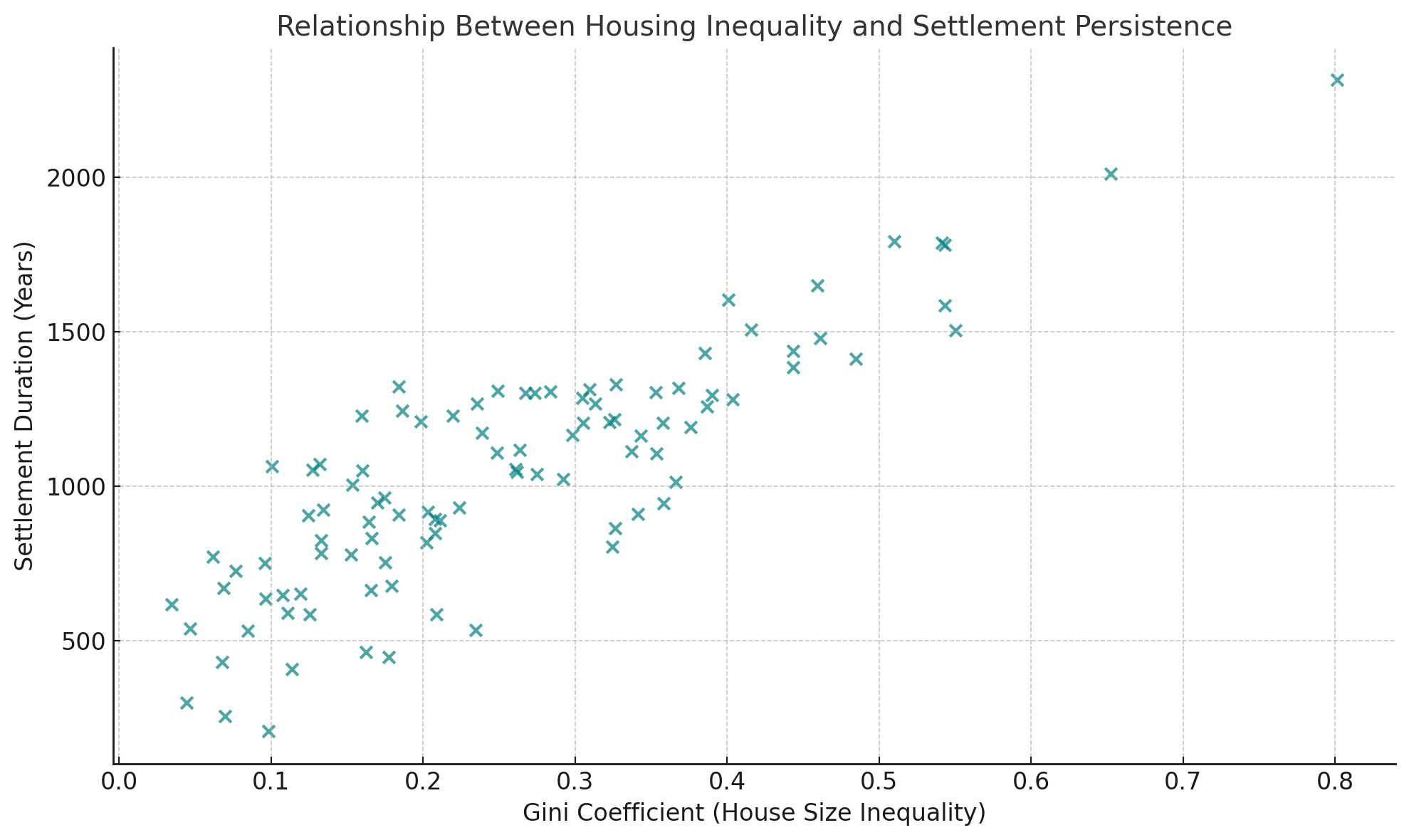
In the long arc of human history, what makes a settlement persist? Fresh water, fertile land, favorable climate—these are obvious candidates. But a recent study suggests another, less intuitive pattern: the most enduring settlements tended to be those with stark differences in wealth.Published in Proceedings of the National Academy of Sciences, the study draws on data from over 47,000 houses spanning nearly 3,000 archaeological sites and 10,000 years of human history. Led by Professor Dan Lawrence of Durham University, the research asks a thorny question: Is inequality the price of sustainability?“We wanted to understand the relationship between continuity and equality,” said Lawrence.“What we found is that, as humankind's systems become larger and more complex, inequality has tended to increase alongside longer persistence. But the two are not mutually dependent.”Reading Inequality in Clay and StoneArchaeologists often lack direct records of economic systems in ancient societies. But houses, or rather their sizes, offer a durable proxy. Bigger dwellings tend to belong to those with greater access to labor, resources, and status. Smaller ones reflect the opposite. In this study, disparities in house sizes were quantified using the Gini coefficient—a statistical tool commonly used to assess modern income inequality.From prehistoric farming hamlets to early urban centers, the data show that settlements with greater internal disparities in house sizes tended to stick around longer. But causality, the authors emphasize, is not the point.“It is not the case that inequality is simply a necessary by-product of building complex, sustainable societies,” Lawrence noted.Rather, both inequality and longevity appear to be outcomes of the same broader processes: increasing population density, technological complexity, and layered political hierarchies.The Paradox of PersistenceAt first glance, the correlation seems troubling. Could rising inequality have somehow stabilized early cities? Possibly—but not because inequality itself provided any inherent benefit.Large settlements were often better resourced and more capable of managing complex challenges—irrigation, trade, defense, and governance among them. These capacities also provided the scaffolding upon which economic disparities could rise.Yet this does not mean inequality caused durability.“We need to be aware of, and attentive to, the historical interplay between inequality and sustainability,” Lawrence explained.“At a time of ever-increasing wealth inequality and sustainability challenges, including climate change, the lessons from the past 10,000 years could be invaluable.”Rethinking SustainabilityThe findings directly challenge a pervasive assumption that sustainability and equity must always be linked—or that long-term societal success demands egalitarianism. In reality, ancient settlements found ways to persist despite, or perhaps because of, rising inequality. But that doesn’t mean they were just or ideal.Nor does it imply that inequality is essential today.The researchers are careful to avoid deterministic interpretations. They argue instead for a nuanced understanding: that both settlement duration and inequality are shaped by the size and complexity of social systems. This leaves room for imagining a future where stability and equity are not at odds.“Humankind might be able to achieve sustainable persistence without the need for increased inequality,” said Lawrence.A Dataset Like No OtherThis study is part of a larger initiative titled “Global Dynamics of Wealth Inequality,” a special feature in PNAS. It leverages a globally compiled dataset unprecedented in archaeological scope, allowing comparisons across regions, timespans, and social structures.Each home counted represents a sliver of a broader story—some carved in stone, others pressed from mud. Assembled together, they allow scholars to peer into the structural forces that helped societies persist—or fracture.Related ResearchFor readers interested in further exploring the topic, here are key companion studies and relevant scholarship:* Feinman, G. M., et al. (2025).Assessing grand narratives of economic inequality across time.Proceedings of the National Academy of Sciences, 122(16).https://doi.org/10.1073/pnas.2400698121* Explores global patterns in wealth inequality using house-size distributions across 50,000 ancient homes.* Kohler, T. A., et al. (2017).Greater post-Neolithic wealth disparities in Eurasia than in North America and Mesoamerica.Nature, 551(7682), 619–622.https://doi.org/10.1038/nature24646* Offers a comparative analysis of wealth disparities across continents and cultures in the prehistoric and early historic periods.* Ortman, S. G., et al. (2020).The pre-Hispanic Pueblo world: Societies of the Southwest from the eleventh through the fifteenth century.Cambridge University Press.https://doi.org/10.1017/9781108676794* Explores persistence and social dynamics in ancient Pueblo settlements of North America. This is a public episode. If you'd like to discuss this with other subscribers or get access to bonus episodes, visit www.anthropology.net/subscribe
NOW PLAYING
Inequality, Endurance, and the Shape of Human Settlements
No transcript for this episode yet
Similar Episodes
No similar episodes found.
Similar Podcasts
No similar podcasts found.