
EPISODE · Sep 27, 2021 · 53 MIN
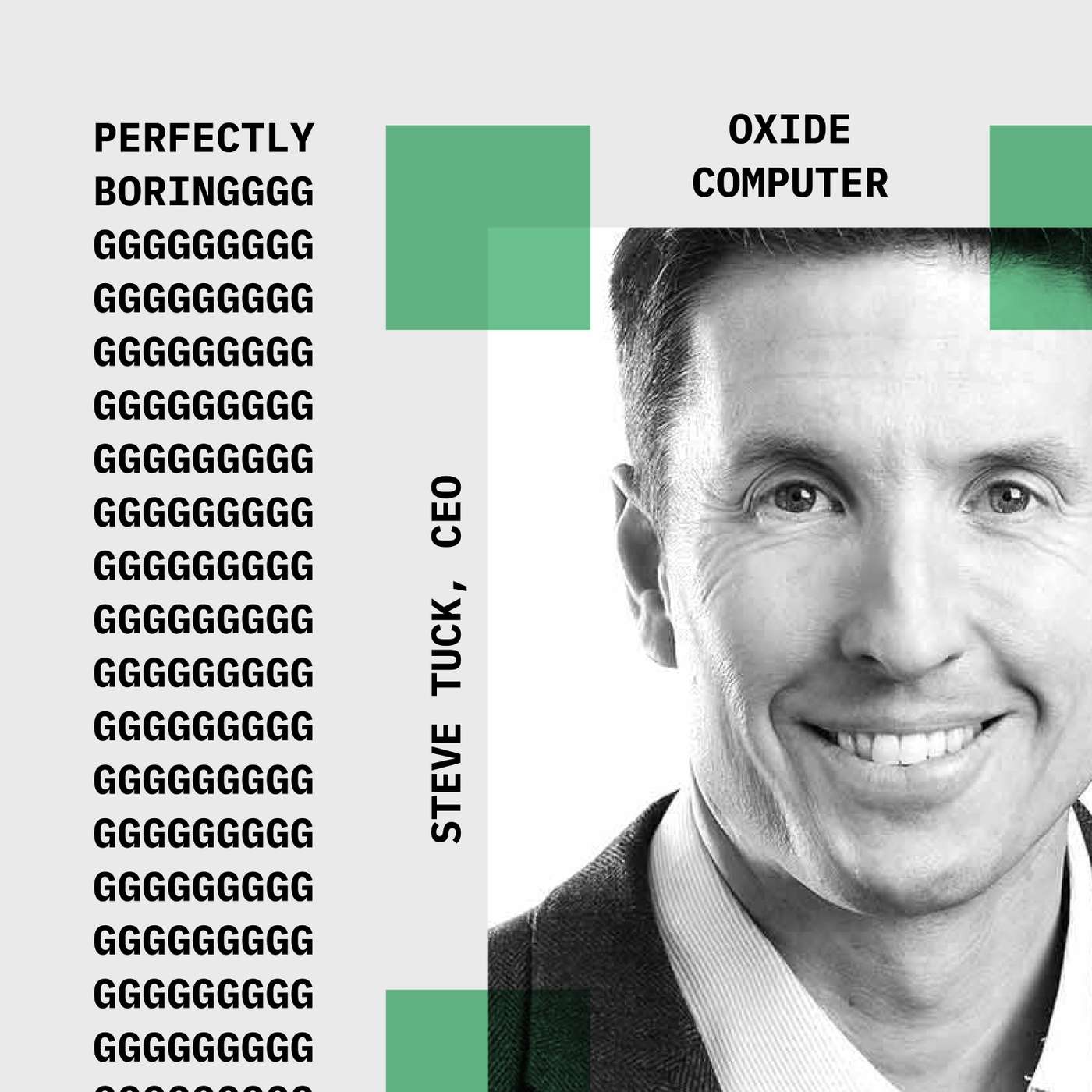
Innovating in Hardware, Software, and the Public Cloud with Steve Tuck, CEO/Co-Founder of Oxide Computer
from Perfectly Boring · host Will Coffield & Jason Black
In this episode, we cover:00:00:00 - Reflections on the Episode/Introduction 00:03:06 - Steve’s Bio00:07:30 - The 5 W’s of Servers and their Future00:14:00 - Hardware and Software00:21:00 - Oxide Computer 00:30:00 - Investing in Oxide and the Public Cloud00:36:20 - Oxide’s Offerings to Customers 00:43:30 - Continious Improvement00:49:00 - Oxide’s Future and OutroLinks:Oxide Computer: https://oxide.computerPerfectlyboring.com: https://perfectlyboring.comTranscriptJason: Welcome to the Perfectly Boring podcast, a show where we talk to the people transforming the world’s most boring industries. I’m Jason Black, general partner at RRE ventures.Will: And I’m Will Coffield, general partner at Riot Ventures.Jason: Today’s boring topic of the day: servers.Will: Today, we’ve got Steve Tuck, the co-founder and CEO of Oxide Computer, on the podcast. Oxide is on a mission to fundamentally transform the private cloud and on-premise data center so that companies that are not Google, or Microsoft, or Amazon can have hyper scalable, ultra performant infrastructure at their beck and call. I’ve been an investor in the company for the last two or three years at this point, but Jason, this is your first time hearing the story from Steve and really going deep on Oxide’s mission and place in the market. Curious what your initial thoughts are.Jason: At first glance, Oxide feels like a faster horse approach to an industry buying cars left and right. But the shift in the cloud will add $140 billion in new spend every year over the next five years. But one of the big things that was really interesting in the conversation was that it’s actually the overarching pie that’s expanding, not just demand for cloud but at the same rate, a demand for on-premise infrastructure that’s largely been stagnant over the years. One of the interesting pivot points was when hardware and software were integrated back in the mainframe era, and then virtual machines kind of divorced hardware and software at the server level. Opening up the opportunity for a public cloud that reunified those two things where your software and hardware ran together, but the on-premises never really recaptured that software layer and have historically struggled to innovate on that domain.Will: Yeah, it’s an interesting inflection point for the enterprise, and for basically any company that is operating digitally at this point, is that you’re stuck between a rock and a hard place. You can scale infinitely on the public cloud but you make certain sacrifices from a performance security and certainly from an expense standpoint, or you can go to what is available commercially right now and you can cobble together a Frankenstein-esque solution from a bunch of legacy providers like HP, and Dell, and SolarWinds, and VMware into a MacGyvered together on-premise data center that is difficult to operate for companies where infrastructure isn’t, and they don’t want it to be, their core competency. Oxide is looking to step into that void and provide a infinitely scalable, ultra-high-performance, plug-and-play rack-scale server for everybody to be able to own and operate without needing to rent it from Google, or AWS, or Microsoft.Jason: Well, it doesn’t sound very fun, and it definitely sounds [laugh] very boring. So, before we go too deep, let’s jump into the interview with Steve.Will: Steve Tuck, founder and CEO of Oxide Computer. Thank you for joining us today.Steve: Yeah, thanks for having me. Looking forward to it.Will: And I think maybe a great way to kick things off here for listeners would be to give folks a baseline of your background, sort of your bio, leading up to founding Oxide.Steve: Sure. Born and raised in the Bay Area. Grew up in a family business that was and has been focused on heating and air conditioning over the last 100-plus years, Atlas. And went to school and then straight out of school, went into the computer space. Joined Dell computer company in 1999, which was a pretty fun and exciting time at Dell.I think that Dell had just crossed over to being the number one PC manufacturer in the US. I think number two worldwide at Compaq. Really just got to take in and appreciate the direct approach that Dell had taken in a market to stand apart, working directly with customers not pushing everything to the channel, which was customary for a lot of the PC vendors at the time. And while I was there, you had the emergence of—in the enterprise—hardware virtualization company called VMware that at the time, had a product that allowed one to drive a lot more density on their servers by way of virtualizing the hardware that people were running. And watching that become much more pervasive, and working with companies as they began to shift from single system, single app to virtualized environments.And then at the tail end, just watching large tech companies emerge and demand a lot different style computers than those that we had been customarily making at Dell. And kind of fascinated with just what these companies like Facebook, and Google, and Amazon, and others were doing to reimagine what systems needed to look like in their hyperscale environments. One of the companies that was in the tech space, Joyent, a cloud computing company, is where I went next. Was really drawn in just to velocity and the innovation that was taking place with these companies that were providing abstractions on top of hardware to make it much easier for customers to get access to the compute, and the storage, and the networking that they needed to build and deploy software. So, spent—after ten years at Dell, I was at Joyent for ten years. That is where I met my future co-founders, Bryan Cantrill who was at Joyent, and then also Jess Frazelle who we knew working closely while she was at Docker and other stops.But spent ten years as a public cloud infrastructure operator, and we built that service out to support workloads that ran the gamut from small game developers up to very large enterprises, and it was really interesting to learn about and appreciate what this infrastructure utility business looked like in public cloud. And that was also kind of where I got my first realization of just how hard it was to run large fleets of the systems that I had been responsible for providing back at Dell for ten years. We were obviously a large customer of Dell, and Supermicro, and a number of switch manufacturers. It was eye-opening just how much was lacking in the remaining software to bind together hundreds or thousands of these machines.A lot of the operational tooling that I wished had been there and how much we were living at spreadsheets to manage and organize and deploy this infrastructure. While there, also got to kind of see firsthand what happened as customers got really, really big in the public cloud. And one of those was Samsung, who was a very large AWS customer, got so large that they needed to figure out what their path on-premise would look like. And after going through the landscape of all the legacy enterprise solutions, deemed that they had to go buy a cloud company to complete that journey. And they bought Joyent. Spent three years operating the Samsung cloud, and then that brings us to two year...
What this episode covers
For this episode Jason and Will are joined by Steve Tuck, CEO and Co-founder at Oxide Computer. Steve and his company’s mission to transform the private cloud and on premise data centers are innovating ways to make scalable cloud infrastructure accessible across a wide spectrum of companies. Steve takes the deep dive on how Oxide is bringing forth these changes, and the details are exceedingly exciting about the direction that Oxide, and the cloud, is going. Check out the conversation for all the details! Steve discusses his history at Dell during its heyday, the eventual shift from hardware to software, and the rise of demand for a different kind of computer. Steve’s multifaceted career has led him to co-found Oxide and their work to innovate what exactly the server currently is, what it was, and their future. Steve’s deep insights are invaluable in regard to the intersection of hardware and software. He also speaks to the space that Oxide is operating in and the cloud and software offerings they are bringing to a wide range of companies no matter their size, tune in for this and more.
NOW PLAYING
Innovating in Hardware, Software, and the Public Cloud with Steve Tuck, CEO/Co-Founder of Oxide Computer
No transcript for this episode yet
Similar Episodes
Feb 4, 2026 ·18m
Sep 22, 2025 ·15m
Mar 6, 2024 ·29m
Mar 6, 2024 ·28m
Mar 6, 2024 ·28m
Mar 1, 2024 ·27m