
EPISODE · Feb 10, 2026 · 1 MIN
Inside Israel’s ‘Esther Project’: The “Not Paid” U.S. Influencer Strategy
from Redacted Report Podcast · host Redacted Report
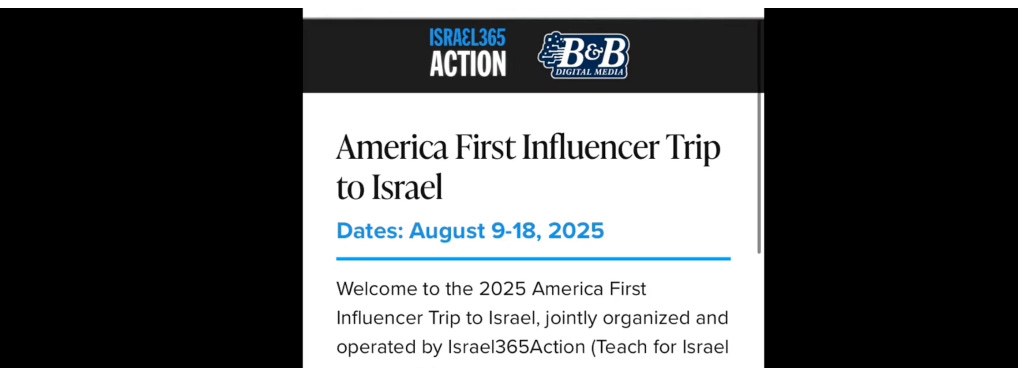
U.S. social media influencers have been posting videos throughout 2025, describing their “honor” of meeting with Prime Minister Benjamin Netanyahu as part of a special focus group for Christian conservative Gen Z creators. On August 22, 2025, while independent international journalists were still largely barred from freely entering Gaza, a U.S. social media influencer (Xaviaer DuRousseau) affiliated with the Israel 365 program was granted access and used that access to post content claiming to show that food was available inside Gaza. The moment raised serious questions about who is allowed in, under what conditions, and for what purpose. When reporters documenting humanitarian conditions are restricted, but influencers participating in a state-backed PR initiative are permitted entry to film curated scenes, the issue is no longer access—it’s narrative control. This was not independent reporting. It was messaging, delivered through a trusted Gen Z influencer pipeline, at a time when the public was being told there was no safe or feasible way for journalists to verify conditions on the ground.At the time this content was posted, August 2025, two arguments were colliding in real time: one side asserting that food scarcity and mass starvation were occurring in Gaza, the other (Israel) insisting that aid and food were available and that claims of genocide were exaggerated or false. These were not abstract talking points—they were central to global legal, humanitarian, and political debates unfolding simultaneously in courts, governments, and public opinion. In that context, selectively showcasing food availability through an influencer granted controlled access carried outsized weight. When one visual narrative is amplified while independent verification is restricted, the footage doesn’t merely inform—it intervenes in an argument that was actively shaping whether the situation was being described as a humanitarian crisis, ethnic cleansing, or genocide."Not Paid by Israel”These creators make a point to clarify that they are not paid or endorsed by Israel. That clarification deserves a closer look—not as a personal attack, but because it highlights a growing and largely misunderstood influence strategy that blends public diplomacy, social media, and Gen Z persuasion.Newly filed U.S. Justice Department disclosures reveal a sweeping, state-backed social media PR campaign targeting American audiences — including Gen Z influencers flown to Israel on funded trips and linked to a nearly $900,000 contract managed under a project code-named the “Esther Project.” * It is unclear if there is any link to Project Esther: A National Strategy to Combat AntisemitismIn its disclosure, required under the Foreign Agents Registration Act, Bridges said its work was intended to “assist with promoting cultural interchange between the United States and Israel”The filings show how the Israeli government has quietly paid firms to recruit, coordinate, and produce content for influencers aimed at saturating U.S. feeds with pro-Israel narratives — all while participants insist they “weren’t paid.”Israel 365 Is Not a RumorThe 2025 trip in question was facilitated through Israel 365 Action, a program that is funded by the State of Israel and whose mission is openly stated: to influence public opinion about Israel, particularly among younger audiences.This is not speculation. Israel 365 Action publicly promotes initiatives designed to bring American influencers, faith leaders, and content creators to Israel on fully funded trips, where participants are guided through curated locations and briefed on talking points. These trips frequently include private or group meetings with Israeli political leadership, including the Prime Minister.The expectation is not subtle: participants return home and produce pro-Israel content, including videos, livestreams, and social media posts aimed at shaping sentiment—especially among Gen Z.Calling these trips “PR packages” is not an insult; it’s an accurate description of how modern state messaging works.“Not Paid” vs. “Not Compensated”This is where language matters.No one is claiming influencers are handed envelopes of cash. But compensation does not have to be a paycheck to be compensation.A fully funded international trip, exclusive political access, and content opportunities that boost reach, credibility, and monetization are all forms of material benefit. In influencer marketing—corporate or political—this is widely understood as compensation.Saying “I wasn’t paid” while omitting that airfare, lodging, access, and prestige were provided creates a misleading impression for audiences who may not understand how influencer partnerships actually work.AIPAC Is a Distraction in This ConversationThese influencers also referenced AIPAC repeatedly, noting that it is a U.S.-based organization composed of American citizens. While AIPAC is not an Israeli government agency, it is widely recognized as one of the most influential lobbying groups in Washington, shaping discussions and policy around U.S.-Israel relations. However, AIPAC does not fund international influencer trips or social media campaigns—those are managed separately by state-backed programs like Israel 365.Conflating AIPAC with Israeli government–funded influencer efforts muddies the waters and distracts from the central issue: foreign governments directly shaping U.S. social media narratives through curated access to influencers.The “50 States, One Israel” DelegationIn September 2025, Israel’s Foreign Ministry hosted a historic event called “50 States, One Israel,” inviting 250 American state legislators—five from each of the 50 U.S. states—to visit Jerusalem and beyond. The trip, held from September 14 to 18, was fully funded by the Israeli government, which paid for travel, accommodations, meals, and a guided itinerary that included meetings with senior leaders, visits to cultural and political sites, and symbolic activities such as planting 50 trees—one for each state. According to reports and official announcements, the delegation was the largest-ever group of U.S. elected officials to visit Israel at one time. Organizers cast the event as an opportunity to deepen ties between the United States and Israel, and included meetings with figures such as Prime Minister Benjamin Netanyahu and other Israeli officials.State legislators described the experience in personal terms, noting that the trip offered a chance to see Israel firsthand, visit historically significant locations, and engage with Israeli leaders on issues ranging from security to shared democratic values. Critics pointed out that the timing of the delegation—amid ongoing conflict in GAZA and global scrutiny of Israel’s military actions—meant the visit also served as a high-profile display of solidarity and narrative framing, with lawmakers returning home having experienced a highly curated view of the situation. This event illustrates how foreign governments can use fully funded trips and curated experiences to bring U.S. policymakers onto their soil, offering access and perspective that may shape future public statements and legislative priorities. Whether framed as relationship‑building or influence‑seeking, the “50 States, One Israel” delegation represents one of the most ambitious examples of Israel’s engagement with American political figures in recent years.The Political Context MattersAfter the October 2023 Hamas attack, U.S. politics entered a period of visible internal conflict—particularly within the Democratic Party—over Israel and Gaza.In the 2024 primary cycle, outside groups spent roughly $38.4 million across races. Nearly two-thirds of that spending came from organizations backing candidates with strong pro-Israel positions, often opposing candidates who questioned U.S. policy toward Gaza.That context helps explain why Gen Z messaging has become such a high priority. Younger Americans are more skeptical, more online, and less aligned with traditional foreign policy narratives. Influencers are now a frontline strategy.This Is About Transparency, Not LoyaltyNone of this requires believing in conspiracies. It requires acknowledging reality.Israel is transparent about funding programs that bring U.S. influencers and policymakers to Israel. Influencers openly post content showing their visits and often share pro-Israel messages upon returning home. Similarly, government officials return and participate in public events or make statements reflecting their experiences. Yet, audiences are often led to believe these messages are organic, rather than part of curated, state-backed initiatives designed to shape perception.Transparency does not mean influencers or lawmakers cannot support Israel. It means audiences deserve to know when content or legislation is produced within a structured program backed by a foreign government.Ahead of the 2024 election cycle and amid growing public scrutiny over Israel’s war in Gaza, AIPAC announced it would spend $100 million on U.S. elections through its United Democracy Project and AIPAC PAC—roughly one-sixth of what outside groups spent in the 2020 presidential race.The organization was active in nearly every corner of the contest: of 469 congressional seats up for reelection, AIPAC spent in 389 races, including 363 House seats and 26 Senate races. Many of these candidates faced no opposition, with 57 running unchallenged in primaries and 88 facing no general election opponent, giving AIPAC a broad reach into the electoral landscape.The Bottom LineThis is not a rumor.This is not antisemitism.This is not solely about AIPAC.It’s not just about elections—Israel is running state-funded initiatives designed to recruit American social media creators and lawmakers, provide them with curated access, and encourage pro-Israel messaging aimed at Gen Z. Influencers and legislators alike are brought on fully funded trips, meet with Israeli officials, and return home sharing content or statements that advance Israel’s narrative. While participants may emphasize personal experience, these programs are carefully orchestrated to shape public perception and political discourse across both social media and government channels.This Substack is reader-supported. To receive new posts and support my work, consider becoming a free or paid subscriber. Get full access to Redacted Report at redactedreport.substack.com/subscribe
Embed this episode
Ready to play
Inside Israel’s ‘Esther Project’: The “Not Paid” U.S. Influencer Strategy
No transcript for this episode yet
Similar Episodes
No similar episodes found.