
EPISODE · Mar 6, 2026 · 19 MIN
Is College Is More Expensive Than Ever?
from The College Question Podcast · host Dan Currell
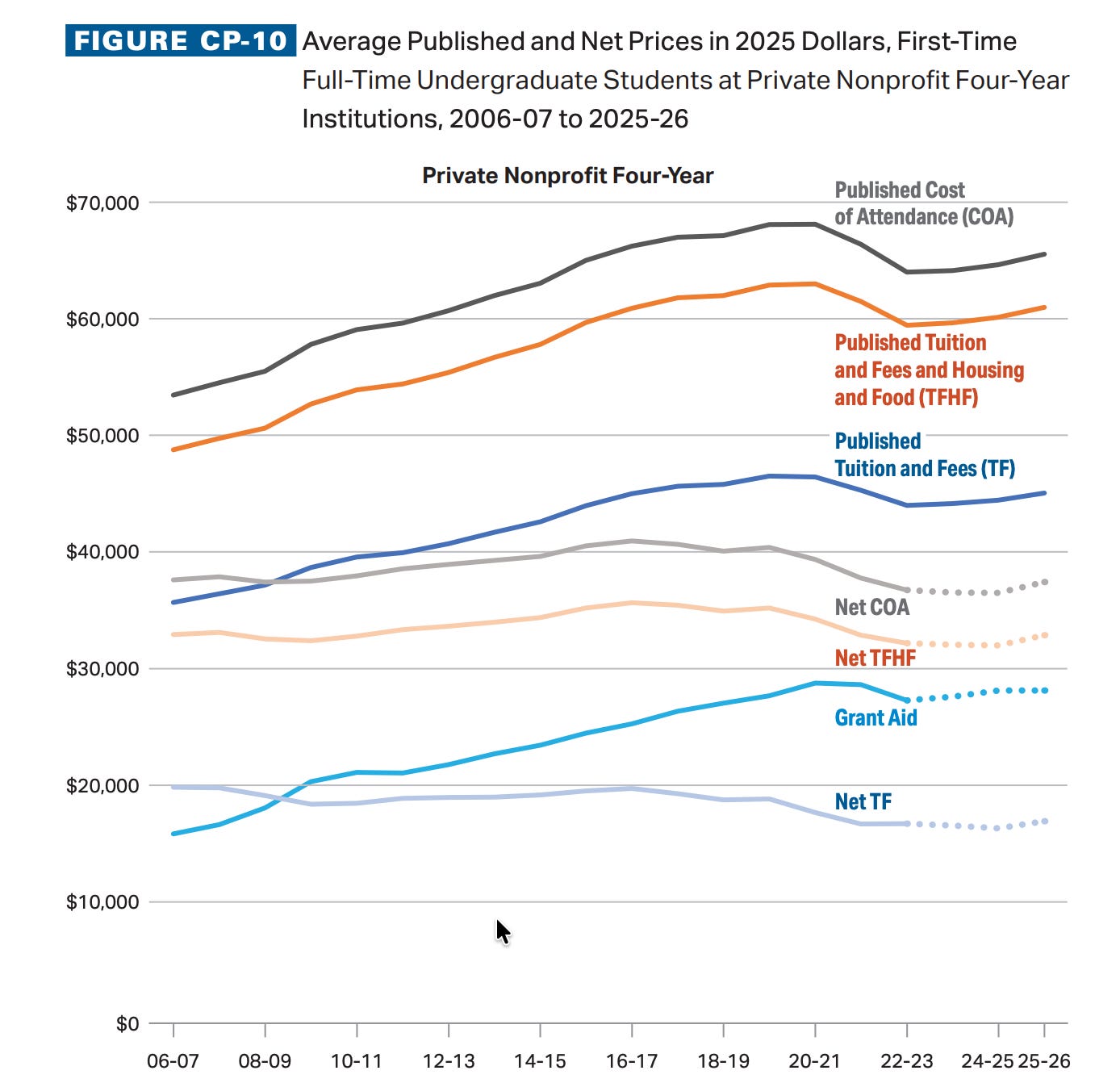
Yesterday I kicked off Ten Things We Get Wrong About College with #10 - College is harder to get into than ever! (It’s never been easier.) Today we continue with …#9: College is more expensive than ever!As everyone knows, college now costs $99,139 a year, which is the price at the University of Southern California, and that is representative of all American colleges. This is to be expected, because the median four-person household now earns $105,800, leaving fully $6,661 for the rest of the family to pay for Netflix and Uber Eats. Pearl-clutchers who think $99,139 is “expensive” haven’t factored in the barter economy, subsistence gardening, and selling your pets. It’s totally affordable. As for our handsome prince, it will be the most comfortable four years of his life as he studies in the lazy rivers and eats free-range sushi and vegan foie gras in the cafeteria.The Very Short VersionEven at private schools, the cost of college is nothing like this. Sticker prices, while occasionally paid by particularly affluent families, are discounted around 55% on average and often far more than that. The tuition families actually pay has been flat or falling for around 15 years once you adjust for inflation.Told that college is getting cheaper, most people react the way I do when someone tells me the McFlurry machine is working: I don’t believe you, and I suspect a trap. Also, Oreo please. Two, actually.I have written about these issues in the Minnesota Star Tribune with my friend Ken Harris, a financial advisor, and I wrote about them in National Affairs. I have gone deep on the structure and some of the oddities of federal student aid in The Dispatch and elsewhere – and even then I have only scratched the surface. I will have Mark Salisbury, the founder of TuitionFit, writing about these issues here at TCQ before long. So the Slightly Longer Version below will necessarily leave a lot out - and that can be dealt with in future posts at TCQ.Slightly Longer VersionLet’s start with the thing that makes this whole topic confusing, which is that American colleges publish prices that used to be misleading and are now largely fake. Before we get judgy about this, consider that it’s standard practice at retailers, and the reasons are the same in both cases – more on that below. Also, I should say that nobody in higher education likes this state of affairs, but nobody is much in a position to fix it. It’s a market. The strong do what they can and the weak suffer what they must.The net result is that nobody pays the sticker price at many private colleges, though at highly selective schools some do. At public colleges, sharp discounting is also increasingly the norm.I’m going to start by just showing you the most recent data. It’s from The College Board’s 2024-25 pricing report. First, private colleges. The figure below lists “Published” sticker prices and “Net” prices that families actually pay. Then it breaks down the elements - because a full “estimated Cost of Attendance” according to the federal government must include costs that aren’t even paid to the school, like transportation and personal expenses. It also includes room and board, which may be paid to the school or not, depending. Notice below that the lowest line is “Net Tuition and Fees” - that’s the school part, since housing, transportation, and personal expenses were going to happen whether you were in college or not. (The issue of room and board cost increases is another post for a later time - and yes, at some schools it’s getting quite high.) And that lowest line, Net Tuition and Fees, was generally level in the decade from 2006 to 2016, then drops in the second decade from 2016 to now. Mechanically, this is because of inflation. Economically, it’s because of supply and demand forces: as I mentioned yesterday, there are fewer students than available positions at colleges right now, and that has been driving prices down for years. I believe that will continue for the foreseeable future.Next, the same data for public colleges, which educate 73% of students. This comes from the same College Board report - and note that it only includes in-state students.There’s a lot going on here, which is why I’ve drawn your attention to the bottom line - literally and figuratively: “Net Tuition and Fees.”If you don’t believe The College Board – and let’s be honest, an organization that capitalizes the T in its name probably can’t be trusted – take it from Phillip Levine, an economist at Wellesley who has been hammering this point, too. Levine used the National Postsecondary Student Aid Study — a federal survey that tracks what students actually pay — and found the same thing. At private four-year colleges, net prices for low- and middle-income families stopped rising after 2007-08. In a separate analysis using net price calculator data from 200 colleges, Levine found that net prices have been falling across the board.Those are averages, of course – and sometimes averages aren’t so helpful. Someone once pointed out to me that the average American has one testicle. I’m not sure a statistician would agree. And I’m quite sure the people with more than one testicle don’t want to think about this any more. But I do need to clarify one point: you can pay more than ever for college, even if very few families actually do.Elite Colleges Are Expensive, Except When They’re CheapPrices are always a supply and demand thing. In the aggregate, as I’ve said, there are more college spaces available than college students, which is why college prices are falling overall. But some particular colleges are in high demand - for at least two big reasons.First, there has been an explosion of families who can afford luxury brand schools, but no increase in the size of those schools. In particular, there has been about a 700% increase in the number of families with a net worth over $20 million in the last 30 years. This means there are just a lot of families who could pay effectively anything for college if they wanted to. And all evidence is that many of them want to.At the same time, there has been an explosion of students who could attend elite colleges. To take one indicator, in 2002 there were 134 perfect ACT scores, but by 2023 there were 2,542. So while average educational attainment (and certainly average ACT scores) declines, top-end performance becomes more common. Add in grade inflation and there is a huge cohort of students who think they should go to an Ivy League school.Another point on supply and demand - even more nakedly about the money. Consider that there are around 3,000 billionaires in the world, and they have kids and grandkids and nieces and nephews. If Harvard or Oxford simply auctioned off a few entering spots, what would the market bear? The Varsity Blues scandal suggests that it’s well into the millions, as it seems a family may have paid $6.5 million to get a child into Stanford.There’s a lot more to be said later about the positional markets and the economics of the one-shot deal. For now, suffice it to say that plenty of people can and do pay a lot for college, and if anything, the most elite schools are leaving big money on the table by “only” charging around $70,000 for tuition these days.That said, for low-income families, the most elite colleges are often the cheapest. Here’s the cost of attending Stanford broken down by family income - from the U.S. College Scorecard.Stanford University Average Annual Cost of Attendance by Family IncomeThe costs above include tuition, room and board, and all the extras. At less selective colleges, lower-income families are generally paying a lot more than this – and even at public colleges they tend to pay more. What do low-income families pay at UC Berkeley, the world-class public university just a short helicopter flight away from Stanford? Here’s the data.UC-Berkeley Average Annual Cost of Attendance by Family IncomeBasically, super-elite universities have big budgets, and while they can command huge prices from affluent families, they can afford to have some people pay little or nothing to attend. That’s what some of them do.The Able and Baker ProblemYou might ask: if everyone knows this, why don’t colleges just lower their sticker prices? Here’s the answer. Consider two colleges: Able and Baker.Able College drops its published tuition to $25,000, which is the most even affluent students ever pay at Able. Meanwhile, Baker College keeps its published tuition at $55,000 — though nobody pays more than $25,000 there, either.Now, your kid applies to Able and Baker, and gets into both. Great. Go Caleb. Both grandmothers can’t wait to find out which co-branded stretch pullover to apply for financing for, so it’s decision time. You get the offer letters.* Able’s offer letter: “Come to our college. It only costs $25,000!”* Baker’s offer letter: “Congratulations! You have been awarded a $30,000 Presidential Merit Scholarship! That’s $120,000 over four years! Your final price is only $25,000!”Both offers are identical. But your family feels that Baker is more prestigious (it costs $55,000!) and that Baker wants your kid more (look at that scholarship!). Able brought a spreadsheet to a feelings fight.And that, really, is it. Some would quibble that there’s more to it, and there is, a bit. But as I mentioned at the top, retailers have long known that people are attracted to high prices as a sign of quality and high discounts as a sign that you’re getting a deal. Here the discount is styled as a scholarship, though in most cases no money is changing hands anywhere - it’s just a discount. But of course it is styled as a Presidential Merit Scholarship, since Able college almost doesn’t exist in the real world - Baker has to compete with all the other Presidential Merit Scholarships. And so the market goes.It’s Not Just Private SchoolsState universities play the same game, especially with out-of-state students. The College Board data shows that out-of-state published tuition at public flagships ranges from $13,300 at the University of South Dakota to nearly $64,000 at the University of Michigan. Discounts for out-of-state students are hard to find in the public data, but talk to a few friends who have had kids recruited by out-of-state public universities – especially perhaps some schools in the south or southeast, who have been Hoovering up northern kids by the thousands for the last decade. It’s a competitive market, and schools compete on price. In many families’ experience, they discover that out of state universities cost the same or even less than their in-state flagships. And while this may seem weird based on how we think the world is organized, as a market matter it would be weird if it wasn’t this way. Running a college is like running an airline: you need to fill the airplane. It doesn’t actually matter where the passengers are from.Who Gets HurtThis whole thing is not without problems. The impression that college costs $60,000 or $80,000 a year has scared a lot of people away from college entirely. Some of those people are exactly the ones who would benefit most from going.Worse, the list-price/real-price system often disadvantages lower-income students. You’d think the big “scholarships” go to the kids who need them most, and at a handful of very wealthy schools, that’s true as we saw at Stanford. But at many schools the largest discounts go to the students who are most attractive to the admissions office — and those students disproportionately come from affluent families. They have better grades and stronger applications.And some families, believing the sticker price is real, take out crushing loans to pay a toll they didn’t have to pay. They finance a $200,000 fantasy when the reality could have been $100,000 — or less.What You Can Do Right NowMy advice for families: ignore the sticker price. Don’t even look at it. It doesn’t matter.Go to the U.S. College Scorecard. Look at colleges. Get a feel for actual paid prices. More on that soon.And check out the Net Price Calculator - it’s on every college website.And for the most accurate take on real costs, go to TuitionFit – it’s a system that tells families what they will actually pay, founded by Mark Salisbury who will be writing here at TCQ before long.That’s it on the college cost issue for now - with a lot more to come at TCQ. Next week I’ll continue the series on Ten Things We Get Wrong About College with #8 - Ugh. We have to fill out the FAFSA. (Maybe, maybe not. Here’s what to know.)This weekend - surprise bonus content. Stay tuned!dgc****Still to Come on Ten Things We Get Wrong About College* #7 - Colleges are closing! (No school you’ve ever heard of is going to close.)* #6 - There’s a college debt crisis! (No. But there’s a grad school debt problem.)* #5 - Ugh. Caitlin needs to take the SAT. (What for? Let’s get into it.)* #4 - Well, I guess a sports scholarship is the ticket. (They’re mostly fake.)* #3 - I bet expensive schools spend a lot on the student experience. (Sometimes, if they feel like it.)* #2 - Ivy League graduates make the big bucks. (Not usually - for pretty obvious reasons.)* #1 - Aidan should go to college in [country], where it’s free! (It’s not, which is one of the reasons nobody does this.) This is a public episode. If you'd like to discuss this with other subscribers or get access to bonus episodes, visit thecollegequestion.substack.com/subscribe
NOW PLAYING
Is College Is More Expensive Than Ever?
No transcript for this episode yet
Similar Episodes
Mar 26, 2026 ·1m
Mar 19, 2026 ·34m
Feb 18, 2026 ·11m
Feb 11, 2026 ·45m