
You're listening to Song Exploder, where musicians take apart their songs, and piece by piece tell the story of how they were made. I'm Rishi Keish, your way. Julian Baker is from Memphis, Tennessee. She released her second album, Turn Out the Lights, in October 2017 on Matador Records.
The New York Times called her music, quote, devastating, and Pitchfork gave the album Best New Music. In this episode, Julian tells the story of her song Appointments, and how writing it helped her work through her thoughts around addiction, depression, and relationships. Julian also takes apart the track Over, which was originally written as part of Appointments, but then split off as a separate track. I'm staying in tonight, I won't stop you from leaving.
I'm Julian Baker. Do you ever think to say something, and then you know that you should not say that thing out loud? When that happens to me, or I know that a thought is irrational, I'll just save it, and explore it in a song. Like, I felt an inadequacy, and like an imposter syndrome, when I would talk to my friends, or when I would be at a party, just standing around, I'd just have this bizarre paranoia that, like, I'm not what any of these people wanted, and I'm disappointing, and I'm letting everyone down.
And that recurring thought was, I think, probably the first idea that cropped up in my brain for the lyrics. I know that I'm not what you wanted. I know that I'm not what you wanted, am I? Appointments materialized around the weeks in which I I was starting to figure out ways to be more proactive about dealing with recovery and mental health, like actually going to therapy and actually taking care of myself.
I was sitting on my couch in my apartment in Tennessee, and creating a chord progression and improvising on top of it. This is the voice I made in my house. You can hear me stepping on the looping pedal. It's just a continuous loop of that, and then I place all the chords on top of it.
So I play a chord progression, and then as they're getting recorded to the loop, they build on top of each other, and I just noodle around in this reverberant landscape. Improvisation is a very special and therapeutic place in its own way. To just sit with a guitar and play for 45 minutes of uninterrupted sound just transports you to somewhere else. It's a really nice refuge from constant consciousness and thought that's bombarding you always.
The lyrical content is derived from actual conversations that I had with loved ones about feeling the immense isolation that results from living inside your own head and fear that you'll always feel isolated and not being able to express that to another person. I was thinking over the conversations that I had had in the last week, allowing myself to confront thoughts that I'm having that I know are irrational. The line, you should try not to miss any more appointments, was something that was said to me. I should just try not to miss any more appointments.
Having someone say that, and that being the only thing that can be offered in the way of comfort or encouragement, felt like empty and very fragile. And I remember being disappointed in that phrase and thinking it's so detached and sterile and has nothing in the way of empathy attached to it. It was intended to be caring, but I think also when you're in that isolated mindset, it's difficult to not view things as a personal attack. And of course, now that I'm two years removed from that, I understand how nuanced and delicate those situations are and how no one really knows what to offer another human being.
And that's the crux of the whole record. But for this song, it's still in a place where neither person is being understood. So I have the raw material of my thoughts, and then I go back and just let the thoughts kind of tumble over until they settle into where they're supposed to go. So we ended up recording it at Ardent Studios in Memphis.
The engineer, Calvin Lauber, was a longtime friend of mine. I ended up being most comfortable with the idea of recording with Calvin because it seemed like the most conducive to the creative process was going to be the environment much more than the equipment. That I felt ease with the person who was recording the record. I play a Fender telecaster, and we tracked all the parts separately.
The reason why we did it is so we could manipulate all of those separately instead of just having one chunk of guitar. Appointments is the second track on Julian Baker's album. The first is an instrumental called Over, but there's no gap between the two tracks. Over acts as the intro to Appointments.
So originally, Over and Appointments were all one song that I then chopped up. So for the purposes of this episode, I'm considering the two tracks as one composition. So I asked Julian to tell me about Over as well. The very first thing that you hear where the studio door closes is an attempt to place you inside the experience of sitting down to create these songs.
You hear me and my carabiner walk over and sit down at the piano. Over begins with a version of the opening lead part of Appointments, but in the relative minor. This minor piano riff, darker, more brooding. And then one of my friends, Cameron Boucher, came down to play Woodwinds.
It's clarinet and then sax. And then Camille Faulkner plays violin. And it all just sounds kind of crystalline. Like all these sounds just floating around you.
And then Camille and I just sat down at the piano and I played the chords in the riff and we worked out this turnaround that would take the chord progression in the minor and have it end up in a major key. I wanted to feel like there's a lot of tension and then for it to resolve and dissipate into the very first notes of Appointments, which isn't the major key. A negative emotion into a positive emotion. And so I wanted for that tiny arc that occurs within Over to indicate how the rest of the record would flow from despair into provisional hope.
A lot of how we processed the vocals was also based on mimicking emotion being told in the verbal lyrical part. The record is all told in first person, but is an attempt to locate the self in relation to where you are inside your own head. So in the acapella part, there's multiple harmonies singing different lyrics. The lyrics are, maybe it's going to turn out right, probably not, I know that it's not.
You've got affirmation, yes it will be okay, no it won't be okay, and then you've got uncertainty. All of those things being spoken simultaneously, they're all located at different places. The speaking voice changes its location in the mix to give you the sense that all of these thoughts are happening concurrently, fighting for attention and competing to be heard. I have to believe it, I know that it's neat, and I have to believe it, it's probably not, but I have to believe that it is.
The vocals are being executed in this desperate and almost erratic way when I'm admitting that to say to someone, everything's fine, everything's going to be fine, is more for my benefit. That's something that I'm pretending to be more confident about, and so I want to convey it in a dramatic way. And when I tell you that it ends, oh, it's more for my benefit, maybe it's all gonna turn out all right, oh, I know that it's not, but I have to believe that it ends. Turning a cyclical negative thought pattern into a refrain or a chorus is liberating.
Writing songs was part of the healing process itself. I mean, for a while, I felt like I was in a fish tank, because I was just experiencing this sadness and constant anxiety that I wasn't dealing with, but I was just living inside of it, and I just, it felt like I could do nothing else but inhabit it, and the music is supposed to be a vehicle for expelling those things from my mind, or at least just admitting them. I don't purport to have, like, everything figured out, and that's why singing about hopefulness on this record is very tentative. It's like a provisional hope.
No matter how small the pinhole of light is, it's entirely possible that within the next day, or the next week, or the next month, we could feel closer to something like joy. And now, here's Over and Appointments by Julian Baker. Over and Appointments by Julian Baker. I'm sorry.
I'm sorry. I won't stop you from leaving. I know that I'm not what you wanted. Am I?
Wanting someone who I used to be like. Now you think I'm not trying. Don't argue, it's not worth the effort to lie. You don't wanna bring it up.
And I already know how I loved you. Don't have to remind me so much how I disappoint you. Suggested I'd talk to somebody again. Who knows how to help me get better until then.
I should just try not to miss any more appointments. I think if I ruin this, that I know I can live with it. Nothing turns out like I pictured it. Maybe the emptiness is just a lesson in canvases.
I think if I fail again, that I know you're still listening. Maybe it's all gonna turn out alright. And I know that it's not. But I have to believe that it ends.
I have to believe that it ends. I have to believe that it ends. I have to believe that it ends. Don't deny, but I have to believe that it ends.
And I tell you that it ends. Oh, it's fine for my pen and fat. Maybe it's all gonna turn out alright. I know that it's not.
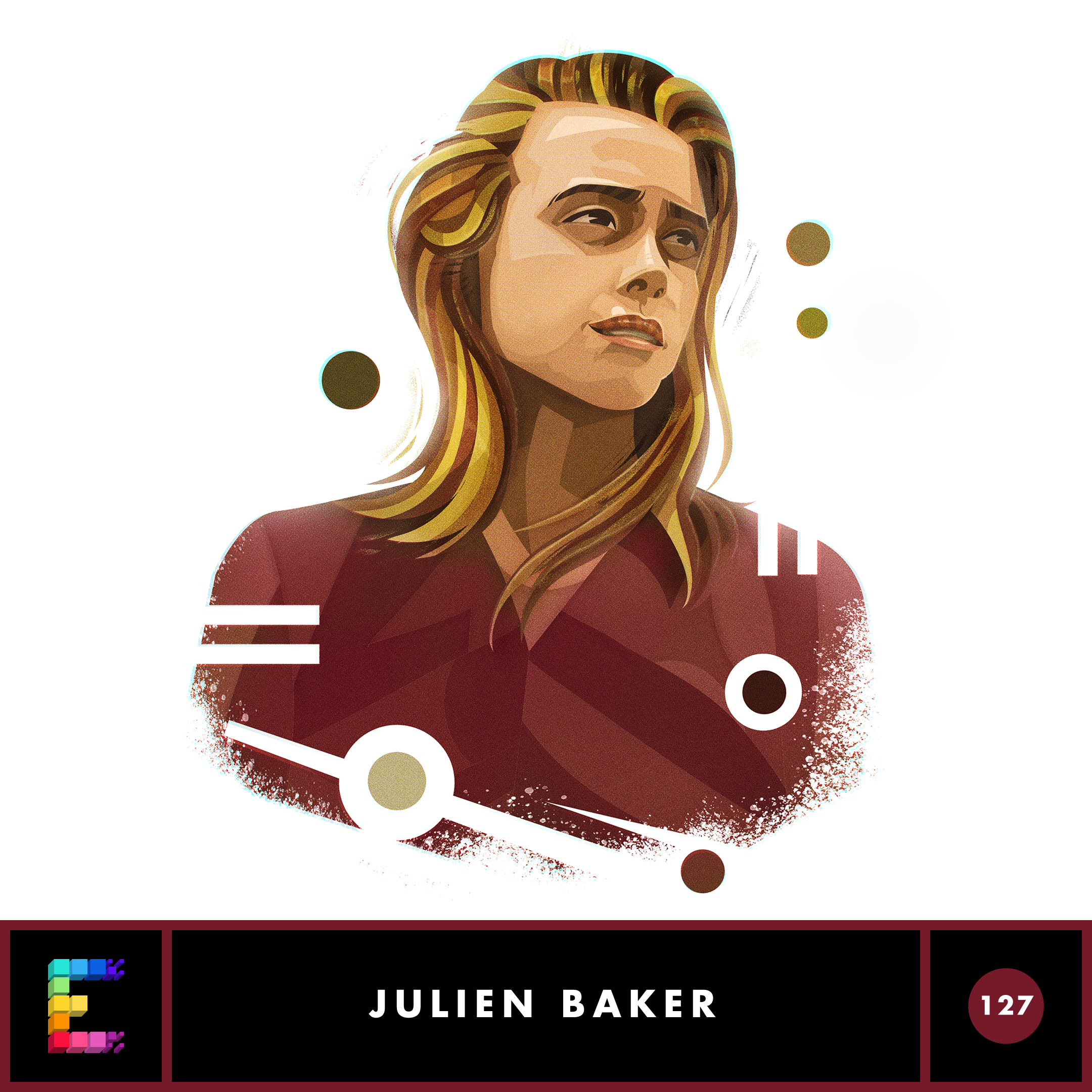
But I have to believe that it ends. Visit songexploder.net to learn more about Julian Baker. Song Exploder is produced by me, along with Christian Koons, with help from intern Olivia Wood. Carlos Lerma creates original illustrations for each episode of the podcast, which you can see on the website.
Song Exploder is a proud member of Radiotopia from PRX, a curated network of creative, independent podcasts made possible by listeners like you. Learn more at radiotopia.fm. If you want to share your thoughts on this episode, you can find Song Exploder on Facebook, Instagram, and Twitter at Song Exploder. My name is Rishi Keesh Herway.
Thanks for listening. Radiotopia from PRX. You've probably heard me say at the end of every episode that Song Exploder is a... proud member of Radiotopia, a network of independent, artist-owned, listener-supported podcasts.
Well, this is the time where the listener-supported part comes in. We're trying to reach 2024 donors before the year 2024 ends, and I really hope you'll be one of them. This show takes a lot of work to make, but that work is made possible thanks to monthly donations from listeners like you. If Song Exploder has meant anything to you, if you feel like you've learned something about a song that you've loved, or maybe you've learned something about creativity that you've been able to apply to your own practice, or maybe you just heard something from somebody's story that's inspired you, I hope you'll consider donating today at radiotopia.fm slash donate.
That's radiotopia.fm slash donate. And every gift makes a difference, no matter how small. $1 a month, or $5 a month, whatever you feel like you can contribute to keep shows like this going will be very appreciated. In fact, all the people who produce Radiotopia podcasts have put together a list of all of our favorite things, and everyone who donates will get a link to the list as a token of our thanks.
A bunch of great recommendations. So again, it's radiotopia.fm slash donate. Thank you so much.