
EPISODE · Dec 20, 2024 · 19 MIN
Junius Revealed: The Mystery, The Suspects, and The Power of Anonymous Dissent
from The Cogitating Ceviché Podcast · host Conrad T Hannon
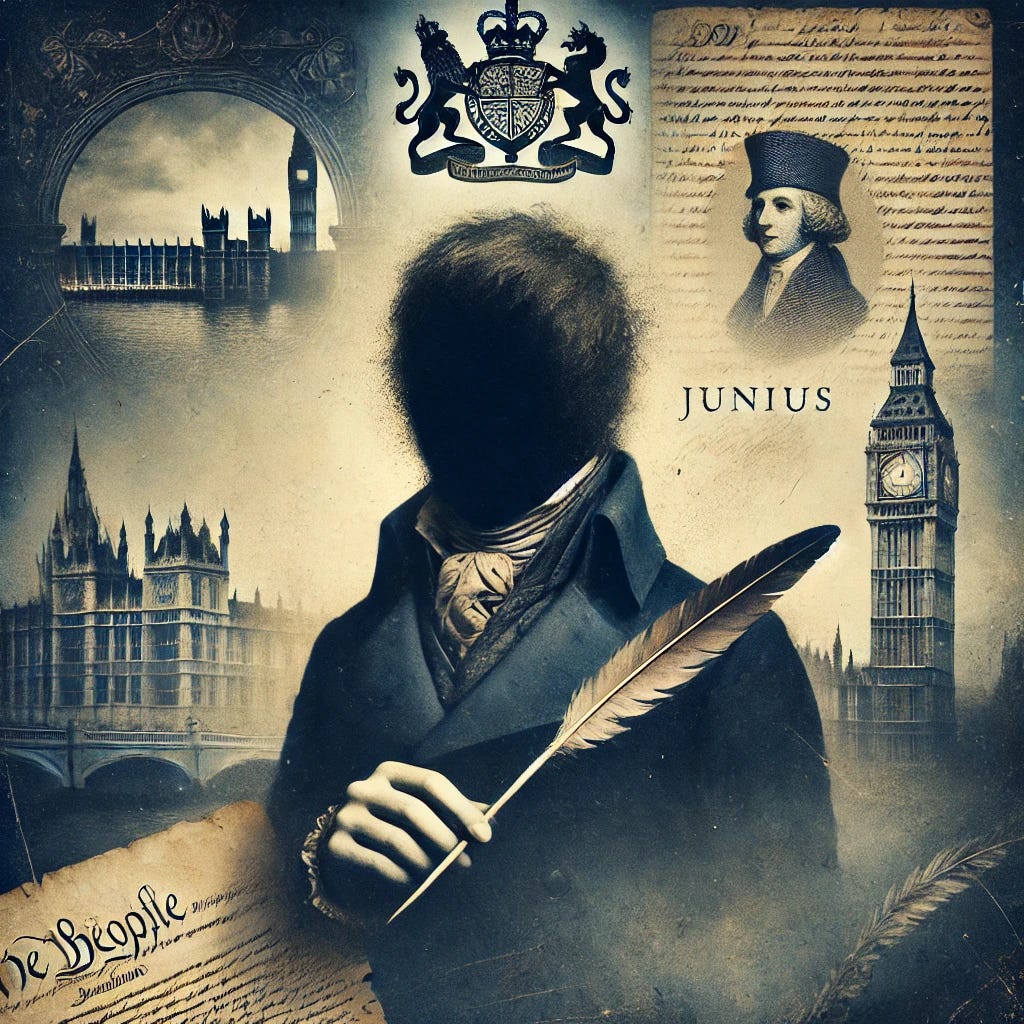
The Cogitating Ceviche PresentsJunius Revealed: The Mystery, The Suspects, and The Power of Anonymous DissentHonoring the Satirists and Thinkers Who Altered Our Perspectives #56By Conrad HannonNarration by Amazon PollyPrefaceThis article is the 56th installment in our series, "Honoring the Satirists and Thinkers Who Altered Our Perspectives." This series explores the lives and works of individuals who have used humor, intellect, and creativity to critique societal norms and illuminate universal truths. In this installment, we examine the enigmatic figure, Junius, a pseudonymous author whose letters shook the political establishment of 18th-century Britain. Though his identity remains a mystery, Junius’s impact is undeniable, and the speculation about who he truly was adds an enduring fascination to his biting critiques. Rather than a conventional biography, this exploration delves into the context of his writings and the most credible candidates for his authorship, shedding light on why his anonymous voice continues to resonate.The Rise of Junius: Historical Context and SignificanceThe story of Junius is rooted in the politically turbulent landscape of 18th-century Britain. Between 1769 and 1772, a series of letters appeared in the Public Advertiser, an influential newspaper at the time, fiercely attacking the British government and members of the monarchy. These letters were signed under the pseudonym "Junius," a reference that hinted at Roman history and classical republicanism, evoking an ideal of moral leadership over corrupt authority. Written with a remarkable command of language, wit, and knowledge of the inner workings of British politics, the letters gained widespread popularity and influence.Junius’s writings directly targeted key figures of the government, including the Duke of Grafton, King George III, and other leading politicians. He accused them of incompetence, corruption, and abuse of power, all while expertly disguising his true identity. The letters were bold and dangerous, and their publication came at a time when press freedom was limited, making their appearance all the more impactful. Junius became a champion of public accountability, a figure whose anonymity symbolized a voice unencumbered by personal interest, seemingly speaking purely for the people.Junius' anonymity was a crucial element of his power. It allowed him to level serious charges against some of the most powerful figures in Britain without fear of reprisal. This anonymity also turned the author into something of a folk hero—a figure beyond reproach who could criticize without the baggage of personal ambition. Yet, this secrecy led to endless speculation about his identity, with numerous individuals proposed as the possible author. The mystery surrounding Junius continues to captivate historians and literary scholars to this day.________________________________________The Writings of Junius: Themes, Techniques, and InfluenceJunius's letters are celebrated not only for their bold political stances but also for their literary craftsmanship. His writing combined a masterful use of irony, rhetorical questions, and classical allusions, which gave his critiques a timeless quality. Junius did not merely deliver accusations; he shaped his language to stir public emotion, incite reflection, and provoke change. The themes in Junius's writings reveal much about the priorities and grievances of the time.Critique of Corruption and Abuse of PowerOne of the central themes in Junius's letters is the critique of corruption among the ruling elite. For example, his attacks on the Duke of Grafton were scathing, pointing out his perceived incompetence, favoritism, and moral failings. Junius framed Grafton's actions as emblematic of a broader decay within the British government—a government that had lost touch with public service and accountability ideals. His relentless pursuit of exposing these abuses resonated with the public, who had grown weary of unchecked power and political misconduct.Junius's critiques were often framed in moral terms, painting his targets as men who had abandoned virtue in favor of self-interest. This moral framing was not accidental; Junius understood that his audience craved leadership rooted in honor and integrity. By contrasting the corrupt actions of British politicians with classical ideals of republican virtue, Junius positioned himself as a defender of a higher ethical standard. This approach bolstered the legitimacy of his arguments and allowed him to galvanize public sentiment against the government.Defense of Civil LibertiesAnother key theme in Junius's work was the defense of civil liberties and the importance of accountability. In his letters, Junius frequently emphasized the dangers of arbitrary power, whether exercised by the monarchy or Parliament. He was particularly concerned with the erosion of the rights of Englishmen, which he saw as the foundation of a just society. His letter to King George III is one of the most striking examples of this theme. Junius did not shy away from accusing the King of overstepping his bounds and undermining the rights of his subjects. This was a radical stance, particularly at a time when criticizing the monarchy was a dangerous endeavor.Junius also defended figures like John Wilkes, who had been persecuted for his outspoken criticism of the government. By aligning himself with the cause of Wilkes, Junius cast himself as a champion of free speech and political dissent. His arguments often invoked the principles of the English constitution, which he viewed as a bulwark against tyranny. Through his writings, Junius aimed to remind the public and those in power that liberty was not a privilege granted by the monarchy but a fundamental right that needed to be protected.Rhetorical Techniques: Wit, Irony, and Classical AllusionsJunius's rhetorical brilliance was key to the effectiveness of his letters. He employed irony to great effect, often using his adversaries' own words against them. His language was sharp, and his wit was cutting, making his critiques compelling and entertaining. This use of irony helped Junius to disarm his opponents and reveal the absurdity of their actions, all while keeping his readers engaged.Classical allusions were another prominent feature of Junius's writing. By drawing on references from Roman history and literature, Junius evoked an image of himself as a modern-day republican fighting against the corruption and decadence of a failing empire. This classical framing added a layer of intellectual authority to his arguments, positioning his critiques within a grand historical narrative of the struggle against tyranny.For example, Junius frequently referenced figures such as Cato the Younger and Cicero, both of whom were renowned for their resistance to autocratic power in Rome. These allusions enhanced his credibility and resonated with an educated readership that admired classical ideals. By aligning himself with these historical figures, Junius implicitly suggested that his fight against the British government was part of a larger, timeless battle for liberty and justice.Influence on Public Discourse and Political ReformThe impact of Junius’s letters extended far beyond their immediate political context. His work inspired a new level of public engagement with politics, encouraging ordinary citizens to question the actions of their leaders. The publication of Junius’s letters in pamphlet form allowed them to reach a wide audience, and they were widely discussed in coffeehouses and other public forums. In an era when political power was concentrated in the hands of the few, Junius’s writings gave a voice to the discontented many.Junius’s emphasis on accountability and transparency also contributed to the growing movement for political reform. His attacks on the ruling elite's corruption helped lay the groundwork for future demands for greater representation and the curbing of monarchical power. While Junius himself was not directly involved in the political reforms that would come later, his influence on the discourse surrounding the rights of citizens and the responsibilities of those in power was undeniable. Reformers of the late 18th and early 19th centuries often considered Junius, an early advocate for the principles they sought to enshrine in British law and governance.Sir Philip Francis: The Leading CandidateAmong the numerous suspects put forward as Junius, Sir Philip Francis stands out as the most credible candidate. Francis, a civil servant with a keen political interest and a flair for writing, fits many of the characteristics that could be attributed to Junius. Born in 1740, Francis was known for his sharp intellect, familiarity with the inner workings of government, and radical views that aligned with the content of the letters.Francis had direct access to some of the key political figures criticized by Junius, and he harbored deep grievances against the establishment, particularly the East India Company, which he saw as a bastion of corruption. He served as a clerk in the War Office, providing him with intimate knowledge of governmental affairs that would have been essential to write with the level of authority and specificity found in Junius’s letters.One of the most convincing pieces of evidence linking Francis to Junius is the similarity in writing style. Scholars and statisticians have analyzed the letters extensively, and linguistic evidence points to strong parallels between Francis's known writings and those of Junius. Both exhibited a penchant for irony, a complex sentence structure, and a deep familiarity with classical literature. In fact, the cryptographic analysis of phrasing and vocabulary has placed Francis at the center of most modern scholarly discussions on Junius.Another compelling argument for Francis’s authorship lies in his behavior. Francis was known for his ambition and dissatisfaction with the political climate. He later took a position in India, where his career was marked by controversy and political maneuvering, traits that seemed to resonate with the passionate, confrontational tone of the Junius letters. Though Francis himself never confirmed the authorship and maintained public silence on the matter, his candidacy remains the strongest among the proposed subjects, and many historians today consider him the likely author.John Wilkes: The Radical PoliticianAnother popular candidate is John Wilkes, a radical journalist, politician, and outspoken critic of the British government. Wilkes’s own history of political activism, defiance against censorship, and advocacy for civil liberties makes him a plausible author of the Junius letters. Wilkes was known for his confrontational style and willingness to stand up to power—qualities that align well with Junius's rhetoric.Wilkes had already made a name for himself as a firebrand, challenging the authority of King George III and the establishment through his publication, The North Briton. He was imprisoned for his writings, and his conflict with the monarchy and Parliament made him a symbol of resistance to government overreach. Given Wilkes’s own experiences with censorship and his deep animosity towards figures of authority, it is not difficult to imagine him using the pseudonym Junius to amplify his attacks from behind the veil of anonymity.However, there are some aspects that do not align perfectly between Wilkes and Junius. For one, Wilkes was not known for the polished and precise writing style that characterized the Junius letters. While his rhetoric was impactful, it lacked the measured, classical elegance evident in Junius's prose. Additionally, Wilkes was an individual who thrived in the public eye, relishing the attention and controversy surrounding his name. This characteristic seems somewhat at odds with the deliberate anonymity that Junius maintained so rigorously. Nevertheless, Wilkes remains one of the top contenders due to his position, motivations, and the overlap in political enemies with Junius.Edmund Burke: The Eloquent StatesmanAnother prominent figure often mentioned as a possible Junius is Edmund Burke, the celebrated statesman and political philosopher. Burke’s unmatched rhetorical skills and extensive involvement in politics made him a natural suspect. Burke, an Irish-born member of Parliament and a key player in British political life, had the intellect and the literary prowess to compose the Junius letters. His deep understanding of political philosophy and skill at dissecting government actions align well with Junius's criticisms.Burke’s writings, like Junius’s, were marked by a combination of moral fervor and biting satire. He was adept at exposing the flaws and corruption of political leaders and had an intricate knowledge of the British political system, which Junius clearly possessed as well. Moreover, Burke’s writings during this period, especially his critiques of the Crown’s overreach, echo similar themes to those in Junius’s letters.However, several factors make Burke’s authorship less convincing. First, Burke had a different approach to public discourse—he valued transparency and was committed to building a legacy through his political career and writings. Unlike Junius, who maintained an air of mystery and distance, Burke was eager to engage openly and was driven by a desire for recognition and reform from within the system. Moreover, as a public figure, Burke’s positions were already well-known, and it seems unlikely that he would have felt the need to hide behind a pseudonym. Despite these inconsistencies, the idea of Burke as Junius continues to intrigue scholars, primarily due to his eloquence and ideological alignment.Charles Lloyd: The Possibility of an InsiderA lesser-known but intriguing candidate is Charles Lloyd, a former private secretary to George Grenville, who was Prime Minister from 1763 to 1765. Lloyd’s candidacy as Junius hinges largely on his position within the government, which afforded him access to privileged information. The depth of governmental insight present in Junius's letters suggests that the author had connections within the corridors of power, and Lloyd, as a trusted secretary, had the means to acquire such information.Lloyd was known to be intelligent, well-read, and capable of the kind of analytical writing seen in the Junius letters. He had direct reasons for resentment, particularly against the Duke of Grafton, whose policies he opposed. His proximity to power also gave him a first-hand understanding of the political dynamics, rivalries, and personalities that Junius critiqued so effectively.However, Lloyd is not as widely considered as Francis or Wilkes, partly due to the lack of stylistic analysis directly linking him to the Junius letters. There is also little direct evidence of Lloyd possessing the particular rhetorical flair that Junius demonstrated. Nevertheless, Lloyd's unique access to governmental secrets makes him a credible candidate for those who believe Junius was an insider seeking to expose the inner corruption of the British government.Other Theories: The Enigma PersistsBeyond these leading candidates, there have been other suggestions, some more outlandish than others. The anonymity of Junius has spurred countless theories, with suspects ranging from Horace Walpole, the politician and writer, to Lord Chatham (William Pitt the Elder), a statesman with a known disdain for corruption. Even Edward Gibbon, the famed historian, has been proposed, although the evidence for his involvement is mostly circumstantial and remains tenuous at best.Some scholars have even posited that Junius could have been a collaborative effort rather than a single author. This theory suggests that several individuals, perhaps united by shared grievances against the government, contributed to the letters under the Junius pseudonym. Such a collaborative effort would help explain the extensive insider knowledge displayed in the letters and the diversity of tone and subject matter.The truth is that Junius's enigma endures precisely because no definitive proof has been found. Each candidate brings a compelling narrative and a set of inconsistencies that make it difficult to draw any firm conclusions. The mystery has become essential to Junius's allure, encouraging generations of scholars to engage in literary detective work that keeps his legacy alive.Impact and Legacy of Junius’s LettersWhile Junius's identity remains speculative, his letters' impact is unquestionable. Junius’s fearless critique of authority captured the public imagination and exemplified the power of the press to hold those in power accountable. The letters often influence public opinion against the government and promote greater demands for political transparency and reform. The enduring nature of Junius’s work lies not only in the skillful prose but in the embodiment of the struggle against unchecked authority.Junius’s influence extended well beyond his time. His writings have been cited by later reformers and activists as a pivotal example of anonymity's role in political discourse. By concealing his identity, Junius could speak truth to power without fear, inspiring others to do the same when faced with oppressive circumstances. The very name "Junius" became synonymous with the idea of fearless political critique, delivered in an eloquent and unyielding manner.The mystery of Junius’s identity also invites reflection on the nature of authorship and the power of anonymity. Unlike other satirists covered in this series, whose names became central to their legacies, Junius’s facelessness became part of his power. His anonymity allowed readers to focus on the message rather than the messenger, and it highlighted the universality of his concerns—his critiques were not about personal vendettas but about broader principles of justice, fairness, and accountability.ConclusionThe story of Junius is as much about the power of anonymity as it is about the content of his letters. Though we may never know with certainty who Junius was, his impact as a satirist and political critic is indelible. The candidates for his authorship—Sir Philip Francis, John Wilkes, Edmund Burke, Charles Lloyd, and others—each bring their own stories and motivations that enrich our understanding of this enigmatic figure. Junius remains a symbol of the power of the written word to challenge authority and demand accountability, and his legacy endures in the continued search for truth and transparency in public life.In honoring Junius, we celebrate not just his literary skill but the very concept of anonymous dissent—a powerful reminder that words, even without a face, can alter the course of history. The legacy of Junius is a testament to the strength of principled critique and the enduring quest for justice in the face of corruption and power. As we reflect on the letters of Junius, we are reminded that sometimes, the voice that refuses to be named is the one that speaks the most profound truths.Thank you for your time today. Until next time, stay gruntled This is a public episode. If you'd like to discuss this with other subscribers or get access to bonus episodes, visit thecogitatingceviche.substack.com/subscribe
Embed this episode
NOW PLAYING
Junius Revealed: The Mystery, The Suspects, and The Power of Anonymous Dissent
No transcript for this episode yet
Similar Episodes
No similar episodes found.
Similar Podcasts
No similar podcasts found.