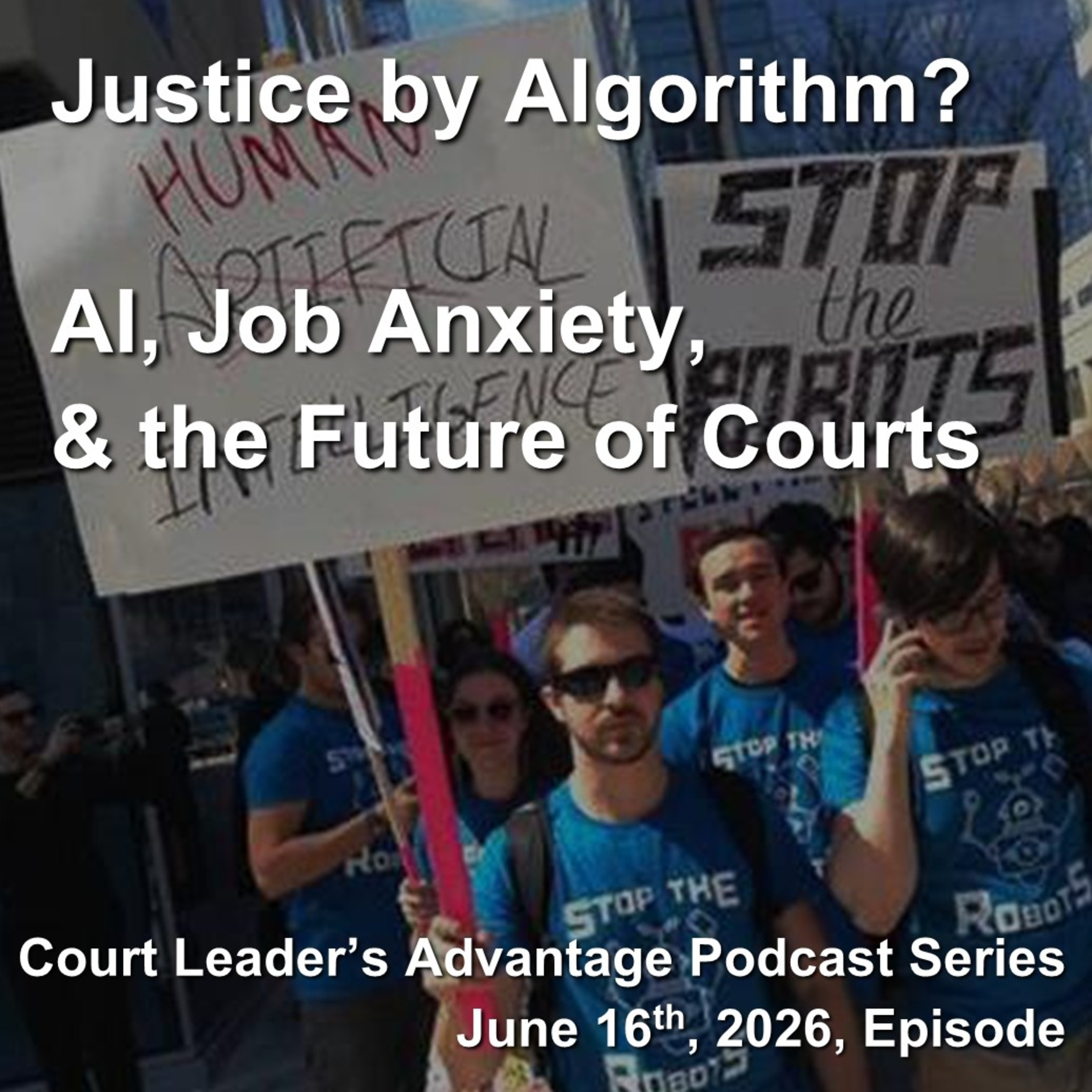
Justice by Algorithm? AI, Job Anxiety, and the Future of Courts episode artwork

EPISODE · Jun 16, 2026 · 29 MIN

Justice by Algorithm? AI, Job Anxiety, and the Future of Courts

from Court Leader's Advantage · host Peter C. Kiefer

June 16th, 2026, Court Leader’s Advantage Podcast EpisodeWhen former Google CEO Eric Schmidt, real estate executiveGloria Caulfield, and music executive Scott Borchetta praised artificial intelligence during recent commencement addresses, graduates responded not with applause but with boos. For a growing number of Americans, especially youngerworkers entering the workforce, AI is no longer viewed primarily as a tool of innovation and opportunity. Rather, it is increasingly seen as a threat to jobs, economic security, and public trust.The concerns are multifaceted. AI's massive demand forelectricity and water raises environmental questions. Its capacity to generate misinformation and "hallucinated" facts raises concerns about public trust and the integrity of information. Most significant for Generation Z, however, is the fear that AI will fundamentally alter the job market andundermine economic security.Many technology leaders appear largely unmoved by theseconcerns. Sam Altman, CEO of OpenAI, has argued that fears of widespread job displacement are overstated. Jensen Huang, CEO of Nvidia, contends that workers will not lose jobs to AI itself, but rather to workers who know how to use AImore effectively. Jeff Bezos, founder of Amazon, has similarly predicted that AI will increase productivity, create new opportunities, and improve living standards rather than simply eliminate jobs.The public remains unconvinced.A March 2026 Quinnipiac University poll found that 70% ofAmericans believe AI will reduce the number of available jobs. Among Generation Z, concern is even more pronounced, with 81% believing advances in artificial intelligence are likely to decrease employment opportunities.These concerns are fueled by highly visible workforcereductions. In 2025, Amazon announced approximately 14,000 corporate layoffs while acknowledging that AI-enabled efficiencies played at least a partial role in workforce reductions.[i] UPS announced plans to eliminate 20,000 positions. While the main reason for the reduction in force was a pullback by Amazon, CEO Carol Tomé also cited efficiencies from implementing AI.[ii] Cisco reduced itsworkforce by more than 4,000 employees while increasing its focus on AI-driven networking and security products.[iii] For many workers the message is unmistakable: artificial intelligence means fewer jobs rather than greater opportunity.Courts have historically been cautious adopters of newtechnology, and artificial intelligence appears to be no exception. Yet courts also face chronic staffing shortages, budget constraints, growing caseloads, and increasing pressure to improve efficiency. State legislatures, funding authorities, and court leaders may soon begin asking whether AI can help courts accomplish more with fewer resources.This month, we examine the growing backlash againstartificial intelligence. Is it a temporary reaction or the beginning of a lasting shift in public attitudes? Are court professionals and the public prepared for the inevitable transition? [i]Variety, "Amazon Says It Will Lay Off 14,000 Corporate Workers, Citing AI" (October 31, 2025)[ii] Gulf News, "AI Job Cuts: Major Companies Replacing Humans with Bots in 2025" (February 21, 2026)[iii] PBS (October 28, 2025), “Despite reporting record quarterly revenue of $15.8 billion — up 12% year-over-year —Cisco announced layoffs representing less than 5% of its global workforce, as the company realigned around AI-driven growth”Today's PanelTJ BeMent Court Administrator, 10th Judicial Administrative District Athens, GeorgiaRick Pierce Judicial Programs Administrator, Administrative Office of the Courts, Mechanicsburg, PennsylvaniaKarl Thoennes Court Administrator, Second Judicial Circuit Court, Sioux Falls, South DakotaCreadell Webb Diversity, Equity, and Inclusion Officer, 1st Judicial District of Pennsylvania, Philadelphia,Pennsylvania

June 16th, 2026, Court Leader’s Advantage Podcast EpisodeWhen former Google CEO Eric Schmidt, real estate executiveGloria Caulfield, and music executive Scott Borchetta praised artificial intelligence during recent commencement addresses, graduates responded not with applause but with boos. For a growing number of Americans, especially youngerworkers entering the workforce, AI is no longer viewed primarily as a tool of innovation and opportunity. Rather, it is increasingly seen as a threat to jobs, economic security, and public trust.The concerns are multifaceted. AI's massive demand forelectricity and water raises environmental questions. Its capacity to generate misinformation and "hallucinated" facts raises concerns about public trust and the integrity of information. Most significant for Generation Z, however, is the fear that AI will fundamentally alter the job market andundermine economic security.Many technology leaders appear largely unmoved by theseconcerns. Sam Altman, CEO of OpenAI, has argued that fears of widespread job displacement are overstated. Jensen Huang, CEO of Nvidia, contends that workers will not lose jobs to AI itself, but rather to workers who know how to use AImore effectively. Jeff Bezos, founder of Amazon, has similarly predicted that AI will increase productivity, create new opportunities, and improve living standards rather than simply eliminate jobs.The public remains unconvinced.A March 2026 Quinnipiac University poll found that 70% ofAmericans believe AI will reduce the number of available jobs. Among Generation Z, concern is even more pronounced, with 81% believing advances in artificial intelligence are likely to decrease employment opportunities.These concerns are fueled by highly visible workforcereductions. In 2025, Amazon announced approximately 14,000 corporate layoffs while acknowledging that AI-enabled efficiencies played at least a partial role in workforce reductions.[i] UPS announced plans to eliminate 20,000 positions. While the main reason for the reduction in force was a pullback by Amazon, CEO Carol Tomé also cited efficiencies from implementing AI.[ii] Cisco reduced itsworkforce by more than 4,000 employees while increasing its focus on AI-driven networking and security products.[iii] For many workers the message is unmistakable: artificial intelligence means fewer jobs rather than greater opportunity.Courts have historically been cautious adopters of newtechnology, and artificial intelligence appears to be no exception. Yet courts also face chronic staffing shortages, budget constraints, growing caseloads, and increasing pressure to improve efficiency. State legislatures, funding authorities, and court leaders may soon begin asking whether AI can help courts accomplish more with fewer resources.This month, we examine the growing backlash againstartificial intelligence. Is it a temporary reaction or the beginning of a lasting shift in public attitudes? Are court professionals and the public prepared for the inevitable transition? [i]Variety, "Amazon Says It Will Lay Off 14,000 Corporate Workers, Citing AI" (October 31, 2025)[ii] Gulf News, "AI Job Cuts: Major Companies Replacing Humans with Bots in 2025" (February 21, 2026)[iii] PBS (October 28, 2025), “Despite reporting record quarterly revenue of $15.8 billion — up 12% year-over-year —Cisco announced layoffs representing less than 5% of its global workforce, as the company realigned around AI-driven growth”Today's PanelTJ BeMent Court Administrator, 10th Judicial Administrative District Athens, GeorgiaRick Pierce Judicial Programs Administrator, Administrative Office of the Courts, Mechanicsburg, PennsylvaniaKarl Thoennes Court Administrator, Second Judicial Circuit Court, Sioux Falls, South DakotaCreadell Webb Diversity, Equity, and Inclusion Officer, 1st Judicial District of Pennsylvania, Philadelphia,Pennsylvania

NOW PLAYING

Justice by Algorithm? AI, Job Anxiety, and the Future of Courts

0:00 29:46

No transcript for this episode yet

We transcribe on demand. Request one and we'll notify you when it's ready — usually under 10 minutes.

TV 2 - Veien til EM TV 2 og Moderne Media Velkommen til TV 2's EM podkast. Dette er tidenes første EM-podkast fra TV 2. I dagene før kamper skal Jesper Mathisen, Jan-Henrik Børslid og Espen Solbakken m/gjester lade opp. God fornøyelse! For annonsering: [email protected] booking: [email protected] The Laura Ingraham Show Laura Ingraham The most-watched woman in the history of cable news brings her no-holds-barred political and cultural commentary to podcasting with The Laura Ingraham Show. A bestselling author, breast cancer survivor, and mother of three internationally adopted children, Laura was the most listened-to woman in talk radio before launching her own podcast. A trailblazer across media platforms, she brings a unique perspective to this twice-weekly show, drawing on her experience as a white-collar criminal defense litigator and a Supreme Court law clerk.New episodes drop twice a week—delivering the clarity, courage, and common sense America needs. Generally American (A Journey in American English) Christopher M. Chandler, Kris Schauer Hello, Hola, Guten Tag, Bonjour, こんにちは !Welcome everyone, this is a podcast for those wanting to learn about U.S. culture through Standard American English, also known as General American. We talk about various different topics related to the U.S. and the U.S.'s relations with other countries. My co-host and I would like to think of this as more of a journey because you never know where it’ll take us. Plus, since the journey’s more important than the end or the start, we hope that you’ll be willing to join us! Let’s see where it takes us! Rethinking Youth Ministry | A podcast for youth ministry leaders, pastors, volunteers, and anyone who cares about students OrangeStudents.com The Rethinking Youth Ministry Podcast is for youth ministry leaders, pastors, volunteers, workers, and anyone who cares about middle school and high school students. Each episode, we hope to raise the bar for youth ministry by asking questions, interviewing thinkers, and having real, honest conversations about what it looks like to lead the next generation. Rethinking Youth Ministry is a podcast from the Orange Students team. Our mission is to help you, the youth leader, influence the next generation. We do that through this podcast, other resources, and our weekly curriculum, XP3. If you'd like to learn more, check out OrangeStudents.com.

Frequently Asked Questions

How long is this episode of Court Leader's Advantage?

This episode is 29 minutes long.

When was this Court Leader's Advantage episode published?

This episode was published on June 16, 2026.

What is this episode about?

June 16th, 2026, Court Leader’s Advantage Podcast EpisodeWhen former Google CEO Eric Schmidt, real estate executiveGloria Caulfield, and music executive Scott Borchetta praised artificial intelligence during recent commencement addresses, graduates...

Can I download this Court Leader's Advantage episode?

Yes, you can download this episode by clicking the download button on the episode player, or subscribe to the podcast in your preferred podcast app for automatic downloads.
URL copied to clipboard!