
EPISODE · Apr 17, 2026 · 14 MIN
KRED Biocatalysis - The Green Pivot in API Manufacturing
from Biomanufacturing & Fermentation Technology · host prasad ernala
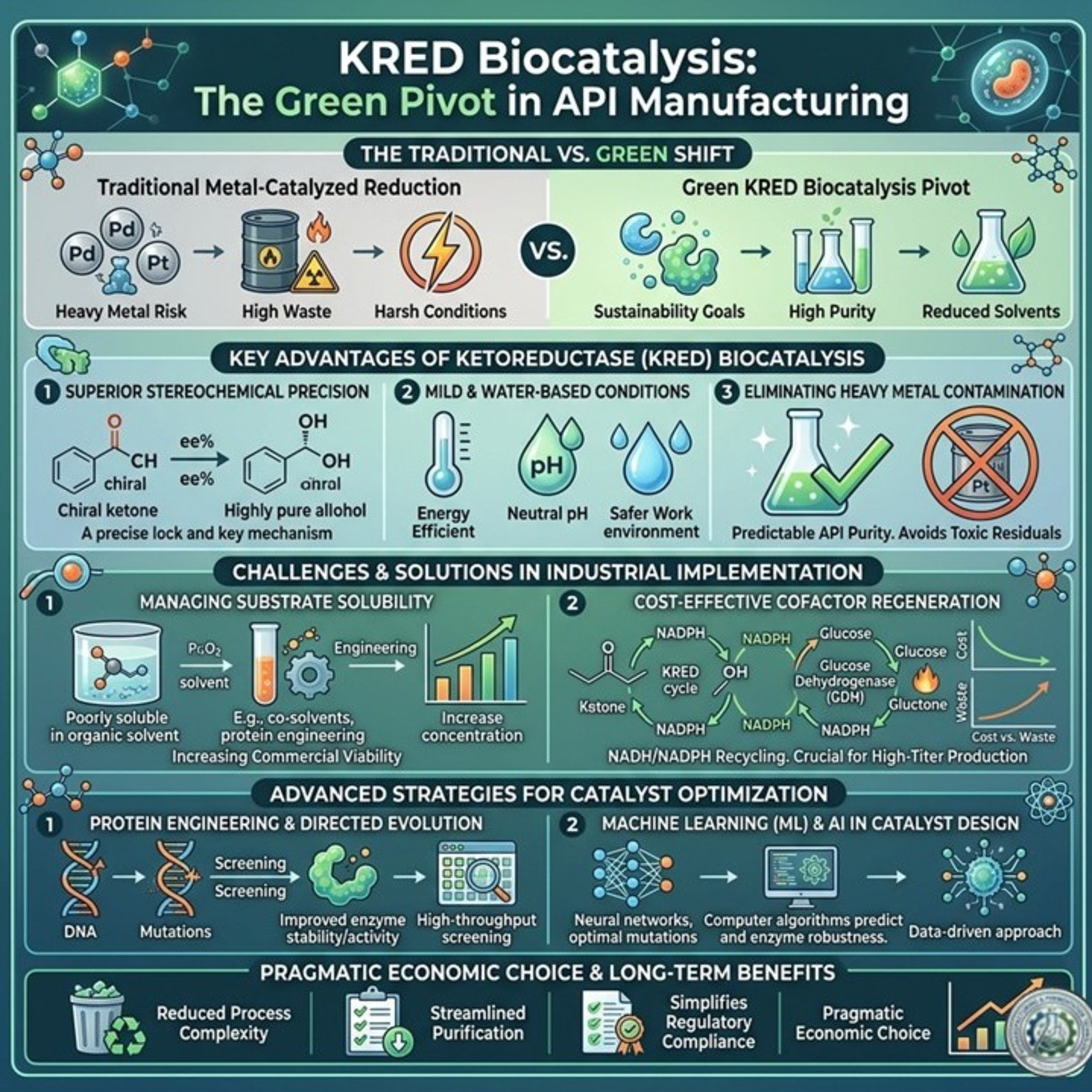
The provided discussion examines the strategic shift in pharmaceutical manufacturing from traditional metal-catalyzed reductions toward the use of ketoreductases (KREDs) to meet modern sustainability and purity standards. These biocatalytic proteins offer superior stereochemical precision and operate under mild conditions, effectively eliminating the risk of heavy metal contamination in active pharmaceutical ingredients. While the transition supports Green Chemistry goals by reducing waste and solvent consumption, the sources emphasize that successful industrial implementation requires managing substrate solubility and implementing cost-effective cofactor regeneration systems. Advanced techniques like protein engineering and machine learning are highlighted as essential tools for optimizing these enzymes for high-concentration industrial environments. Ultimately, the text argues that adopting KRED-based workflows is a pragmatic economic choice that simplifies regulatory compliance and streamlines downstream purification.#Bioprocess #ScaleUp and #TechTransfer,#Industrial #Microbiology,#MetabolicEngineering and #SystemsBiology,#Bioprocessing,#MicrobialFermentation,#Bio-manufacturing,#Industrial #Biotechnology,#Fermentation Engineering,#ProcessDevelopment,#Microbiology,#Biochemistry,#Biochemical Engineering, #Applied #MicrobialPhysiology, #Microbial #ProcessEngineering, #Upstream #BioprocessDevelopment, #Downstream Processing and #Purification,#CellCulture and #MicrobialSystems Engineering, #Bioreaction #Enzymes, #Biocatalyst #scientific #Scientist #Research
What this episode covers
The provided discussion examines the strategic shift in pharmaceutical manufacturing from traditional metal-catalyzed reductions toward the use of ketoreductases (KREDs) to meet modern sustainability and purity standards. These biocatalytic proteins offer superior stereochemical precision and operate under mild conditions, effectively eliminating the risk of heavy metal contamination in active pharmaceutical ingredients. While the transition supports Green Chemistry goals by reducing waste and solvent consumption, the sources emphasize that successful industrial implementation requires managing substrate solubility and implementing cost-effective cofactor regeneration systems. Advanced techniques like protein engineering and machine learning are highlighted as essential tools for optimizing these enzymes for high-concentration industrial environments. Ultimately, the text argues that adopting KRED-based workflows is a pragmatic economic choice that simplifies regulatory compliance and streamlines downstream purification.#Bioprocess #ScaleUp and #TechTransfer,#Industrial #Microbiology,#MetabolicEngineering and #SystemsBiology,#Bioprocessing,#MicrobialFermentation,#Bio-manufacturing,#Industrial #Biotechnology,#Fermentation Engineering,#ProcessDevelopment,#Microbiology,#Biochemistry,#Biochemical Engineering, #Applied #MicrobialPhysiology, #Microbial #ProcessEngineering, #Upstream #BioprocessDevelopment, #Downstream Processing and #Purification,#CellCulture and #MicrobialSystems Engineering, #Bioreaction #Enzymes, #Biocatalyst #scientific #Scientist #Research
NOW PLAYING
KRED Biocatalysis - The Green Pivot in API Manufacturing
No transcript for this episode yet
Similar Episodes
Apr 21, 2026 ·13m
Apr 19, 2026 ·16m
Apr 17, 2026 ·13m
Apr 13, 2026 ·11m
Apr 11, 2026 ·16m