
EPISODE · Feb 3, 2026 · 15 MIN
Leaky Buckets No More 💧➡️🔒 | Edge-Contact MoS₂ Memory Explained
from The Deep Dive Lab: Unraveling Materials Science · host Son Hoang
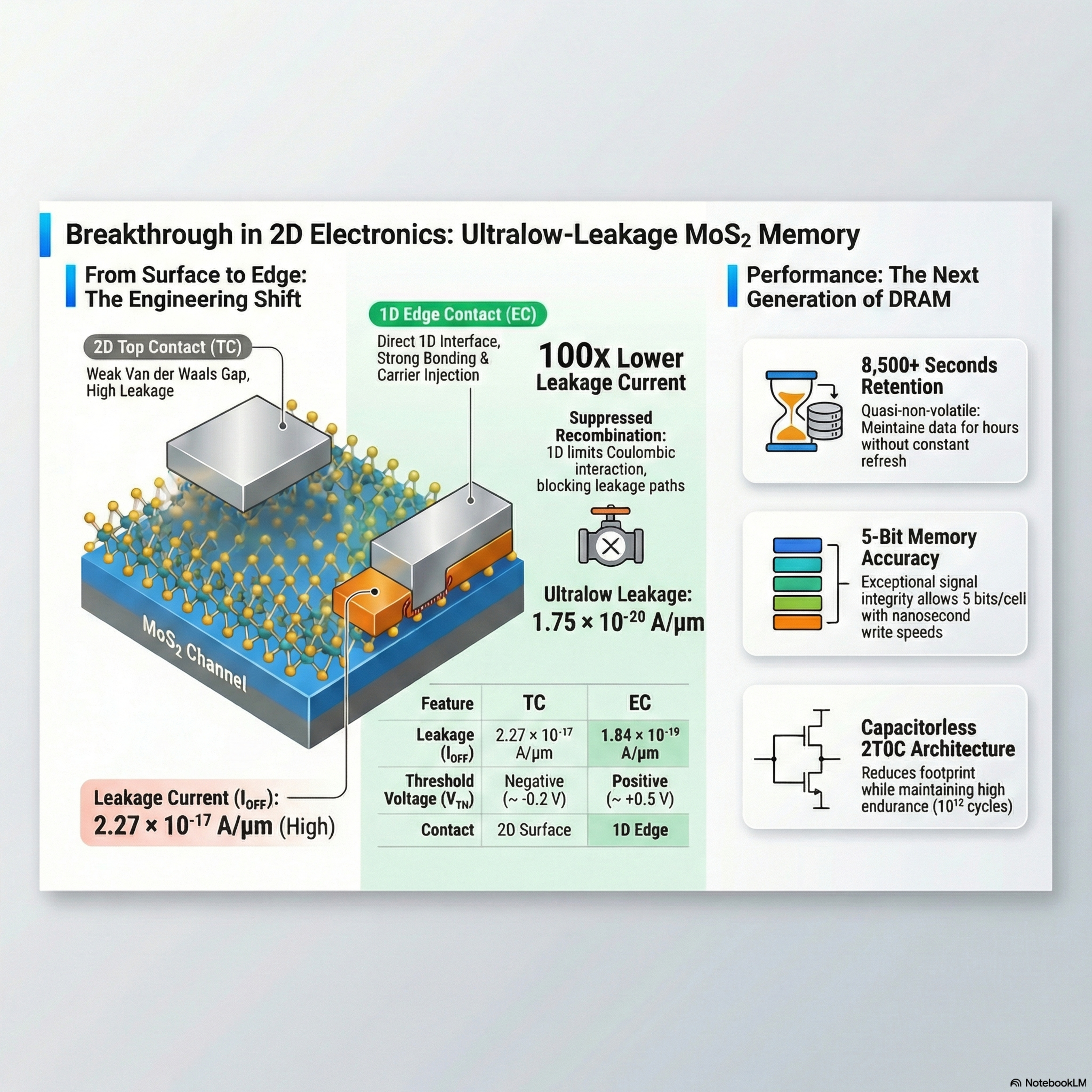
Imagine having to remind yourself of your own name thousands of times per second just to stay conscious. 🧠💥That’s the “invisible tax” modern DRAM (Dynamic Random-Access Memory) pays: because its cells behave like leaky buckets, data must be constantly refreshed—wasting a huge amount of energy and throttling performance.But in early 2026, researchers at Fudan University published a breakthrough in Nature Materials titled:👉 “Quasi-non-volatile capacitorless DRAM based on ultralow-leakage edge-contact MoS₂ transistors” (Nature Materials, 2026).They use molybdenum disulfide (MoS₂) and a radical edge-contact transistor architecture to create a quasi-non-volatile memory that marries the speed of DRAM with persistent retention.Key breakthroughs:⚡ Ultralow leakage currents orders of magnitude lower than previous designs⏳ >8,500 seconds retention with zero hold voltage🚀 Nanosecond-scale write speeds🔁 10¹² cycles endurance with no degradationThe secret? By bonding metal directly to the edges of a 2D semiconductor, the researchers cripple the quantum mechanisms (e.g., the Sommerfeld factor) that normally cause electrons to leak away.This isn’t incremental—it’s a post-Moore pivot point in memory technology. From ultra-efficient computing to massive in-memory caches, we may finally reclaim the power wasted on remembering what was done a millisecond ago.Citation:Quasi-non-volatile capacitorless DRAM based on ultralow-leakage edge-contact MoS₂ transistors — Nature Materials (2026).🔬💭#hashtags#MemoryTech #DRAM #MoS2 #Semiconductors #NatureMaterials #QuasiNonVolatile#InMemoryComputing #PostMoore #EdgeContactTransistors
Embed this episode
NOW PLAYING
Leaky Buckets No More 💧➡️🔒 | Edge-Contact MoS₂ Memory Explained
No transcript for this episode yet
Similar Episodes
No similar episodes found.
Similar Podcasts
No similar podcasts found.