
a superorganism or planetary superorganism is not necessarily a good thing. It can be the technocratic nightmare of the show is run by the superorganism. So we clearly need a benevolent superorganism, which can grow out only from the wisdom for studying AI. And when I say wisdom for studying AI, it's not an attribute of AI systems.
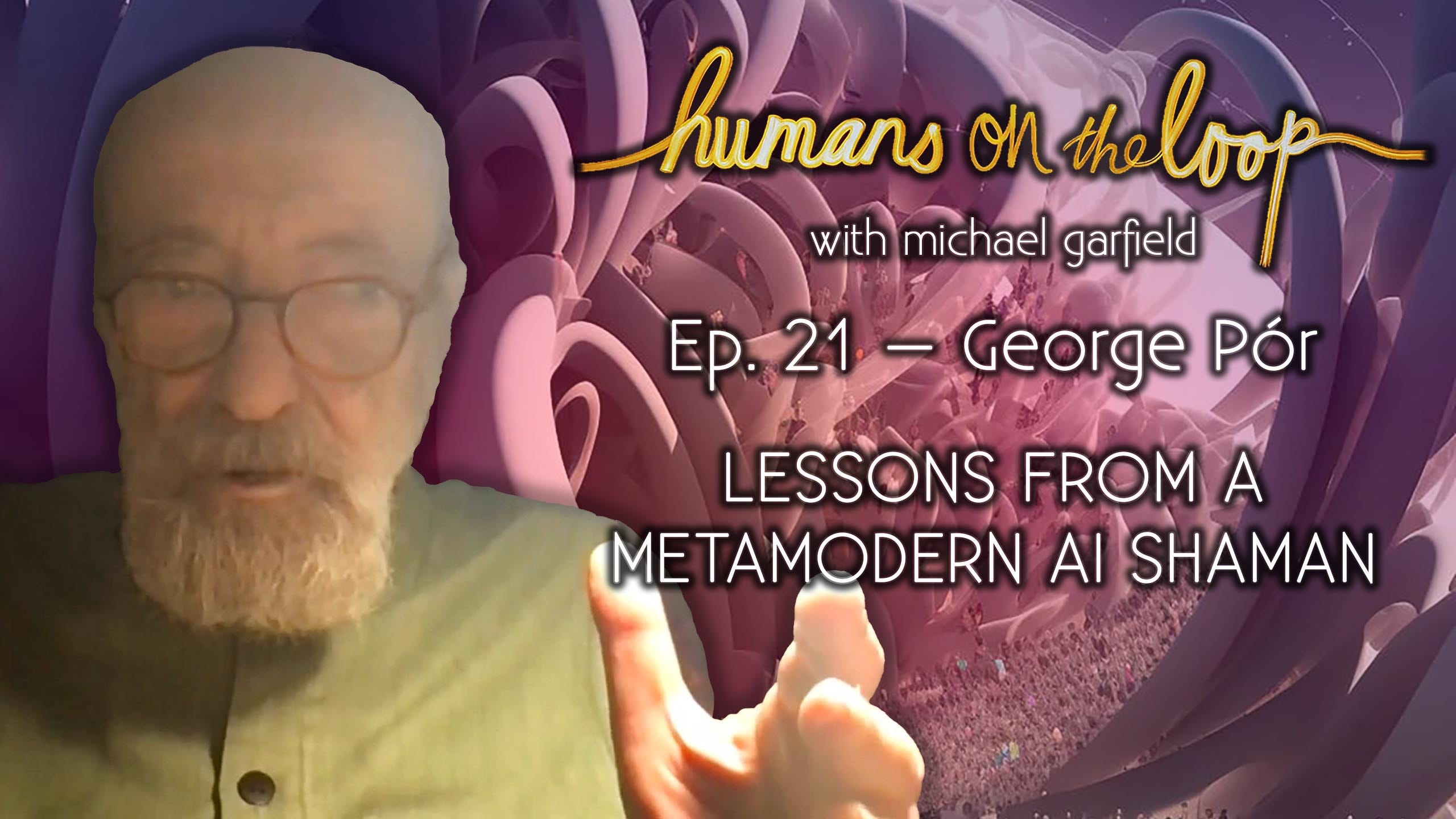
It is an attribute of the human and AI collaboration. So it is all responsibility whether the superorganism will be a toy for global governance with five or six megacorporations or whether it would be events of planetary design. Welcome to episode 21 of Humans on the Loop. I'm your host Michael Garfield and this week I have a true legend in the hot seat.
George Pore, mentee of computer pioneer Doug Engelbart, founder of Future How and Livening Edge and campus co-evolve, independent scholar with past academic posts at the London School of Economics, instead UC Berkeley, California Institute of Integral Studies and University of the Dipari, wisdom-guided AI advisor at River and consultant who has worked with an epic list of clients, including the UN Development Program, HP Greenpeace Intel, European Commission, Ford, the Banff Center for Arts and Creativity, the Global Leadership Academy, Shell, Siemens, Unilever, and the World Wildlife Foundation. George has played vital roles in our emerging understanding of collective intelligence, knowledge gardening, and online community. In this episode, we explore his latest iteration as a metamodern AI shaman. What that means, why he's promoting this approach for the cultivation of hybrid human machine wisdom and his theory of change for a reimagined human being in an age of collaborative planet-scale intelligence.
We had a delightful conversation. If you like it too, leave a comment and visit humansontheloop.com for nine years of additional episodes. Special thanks to new members Mike Crip, Patrick Marense, and Paul D'Nard and everyone else supporting this work of which the podcast is only one small part on sub-stack and Patreon or with tax-deductible donations at every.org slash humans on the loop. Some of you, those at the founding member level just got free access to all of the recordings and readings from my recent Weirdosphere course, How to Live in the Future.
Twenty hours of deep dives into the philosophy of technology, the evolution of culture and consciousness, the meta-disciplinary study of time, and the changing nature of selfhood in our emerging age of planetization. Plus, enough reading to inspire you for months. It's an honor and a privilege to devote so much of my time to synthesizing the big picture and exploring it with you, and I'm glad I get to share the amazing trip of that course. One more announcement, my first essay at Aon Magazine, Homo crustaceus, is now live on their website.
It's an excerpt from my upcoming book, an extensive exploration of our troubled relationship with language technology in the biosphere, laced with rifts on sci-fi, meme culture, military history, and the evolution of crabs. Their editorial board called it the most audacious contribution that had ever passed their desk. Find a link to the show notes to read it, and hang tight as I'm taking the month of July off from regularly scheduled community calls to work on research and writing. But those of you subscribed will have plenty more to soak up in the interim.
And that's all the news that's fit to print. Thank you for listening and enjoy this conversation with the insightful and delightful George Poor. Thank you. Okay, that has to be an award for the longest troubleshooting session of any show ever.
But it's worth it. It's worth it. That's incredible. How are you?
I'm good, man. You will see at the end whether it was worth it. It's good. Yeah.
Visily. I have an article due by midnight about the way of the metamodern AI shaman. But the problem is that my bedtime is at nine o'clock. So I will have to go beyond my bedtime.
Wait, what time is it there? I didn't. Oh, wow. Yeah, you will.
Special thanks then to sticking around and making this work. Yeah. Right. So I've got a ton of notes here on random scraps of paper because I listen to pretty much every available interview of yours that I could find.
And before we get into that, I would like to give people some context on you. I saw an older interview that you did with a Collectic Space Walk, which I'll link to in the show notes, which was more or less a biographical walkthrough. I don't think we need to do that exactly. But it would be good to tell people where you come from in terms of, I liked the graphic that Lehman Pescall had made of you in the four seasons of your life.
And you're just such a storied individual that I think it makes sense to take as much time as you feel is appropriate to lay out the path through hyperspace or the hyper trail as you put it that gets us to the person I'm speaking to now. And why does that you care about the things that you care about? Okay. I'm going to have a little bit of a hint that I can talk about in five minutes or in five hours.
So I guess I have to strike a balance on the between them. So I don't have a strong sense of who is your audience, but it seems to me that it's general intelligence, energy, energy, energy, people, and thinkers, and doers. Yeah. Why?
Okay. So what is your catalytic moment? Like what is your animating origin story? Well, that was something like how many?
60 years ago, I guess, you know, I'm a guy from the 60s. I was an organizer of the anti-government student movement in Hungary. And we were very much inspired by the American, Western European radical, domestic students and so I got trouble with the government. They called it anti-state conspiracy.
That was really what I organized some studies circles of political philosophy. So that was in my twenties, my awakening to social realities and also some kind of social commitment, engagement for standing up for stuff that I believed in. And then I was after spending 20 months in jail. I was exiled from Hungary.
I finished my academic degree in Paris. I started teaching sociology. I was a radical sociologist in the seventies. Then from there, I moved to India, like many people of my generation went to India seeking after some deeper truth than the academic institutions could give us.
So I spent half a year in the Australian education teacher. Then moved to California. That was an important moment in my life. I said that there is a bigger difference culturally between California and Paris where I was at the university.
Then France and then socialist Hungary. So I love California and I owe a lot of money. Guess what? I became a computer salesman.
Interestingly, my friends from my previous period of life, from the meditation feature life, they said that, George, I can't recognize you. You are in this trippy suit and you lost your charisma. Where is the sparks? Where the sparks were not flying?
I was trying to sell Macintosh computers. But the good thing was that I had my own first, my Apple tool in 1982. That was my first computer. And then the first Mac Intulition 84.
Then I told my friends that you guys, you don't get there. There is a red thread going through because what I was after in Paris in my psychedelic experimentations later with the meditation and know the computer is the same thing. It's expanding our consciousness because what computers allowed me is not, I was not very excited about this calc and those early software. With the computer, I was about a modem and the modem 300 modem.
It allowed me to connect through the phone line with people in not only around the town, but around the continent and make friends and start talking with folks from all over the world about stuff that I was interested in. And that became so a major shift in my life when I connected people through computer networks in the early mid-80s. So I was one of the pioneers of virtual communities. And that was something that took me to management of big companies where I used basically the selling of the use of computer networks with the language that they understood, which was you save money and you save time and all those good things.
But my real agenda was to let people connect with each other and store conversations that matter to them on their internet. So that led me back to Europe because in CR, it's a big business school in Ontario, but it's invited me to do a stint as senior research fellow. And basically the research that I wanted to do about automating the functions of facilitating computer-based collaboration, automating to the extent that it's possible. So then that basically from there I did more consulting work, but then it was more in the style of you must have the Frederick Lawlou and reinventing organizations.
So because I always like to support those people who I feel that they are going very good to have a high impact. So in support of the people movement, I founded the Enlivening Edge, which became the go-to place for the other organizations. And it still exists. I started it in 2015.
Yeah, that's even not true. So many stages of spiritual organization of technological, I like to stay on the moving edge of how evolution is taking us to the next stage in technology, in organization, social, evolution, spiritual development. And even naming these trends a little bit bizarre because they are not really separate strengths in my life. They are all intertwined.
Does it make sense for you? Yeah. But you say in some of your work that you associate wisdom with the ability to cultivate multiple perspectives, to inhabit multiple perspectives as a rudimentary example of this. I try to see things both instrumentally and intrinsically.
An action is just rewarding the way that Timothy Morton talks about the sacred as the feeling of biology. Like just being alive, even if you're ostensibly not having a good time, you can inhabit it in a way that makes it new, new, and rewarding. So there's that sort of whistle while you work piece. And then the other piece being that there's a way to look back on anything that you've done and review it and make sense of it retroactively and assign or generate meaning.
And so the way that I've been doing this is that the play and the work of the show is to demonstrate and to evoke the play of perspectives. And so when you're saying all of these things are related to you, that is very resonant with the way that in my own life, I've been saying people assign these categories that just don't hold up under scrutiny, art, science, religion, like I just mentioned work and play, or the idea of living in machinic, I think is also very suspect, right? That's just me agreeing at length with the way that one of the things that I like about what comes forward in your work is how you rotate things and braid them and the way that you emphasize being spacious enough to hold multiple different models and playful enough to try on different perspectives in your work. Yeah, gratefulness is really key ingredient in my life's work because part of my spiritual journey led through the Native American medicine world.
So I use the medicine world for pattern my circular life work on the eight directions of the medicine world. And I had this practice for something like 20 years now. Every year just before my birthday, I cast the circle of my life work in a personal ceremony, which includes figuring out what are the main directions, into which my creativity wants to flow. And you can also think of it as roles, what are my roles in the game of life or in Hola Krasse language, the roles and the capabilities.
But the playfulness comes in when I don't prescribe my activities in my calendar to those different functions. When I say functions, that's another way I relate to the different dimensions of my active life functions in the web of my relationships in the ecosystem of my relationships, in the ecosystem of life. What is the functions that I feel in? And then having a map, these mental models, it's never static.
First, it doesn't stay longer than a year. That's why every year I renew it. But even within the year, the map helps me to realize that, oh, no, it's the researcher part of me that wants to come out and play. Or no, it is the mentor or the toolmaker or the basket we were.
And I just let them play. I like to have this map and it worked for me until two years ago. Then I utterly became incapable to stick to name any roles because I just, my life became more fluid. I dropped all the roles and became just a guy who is doing this and that.
Whatever I receive, the challenges and opportunities from life that caused me, I respond to those that caused me the strongest. No, it is artificial intelligence. Not the technology per se, but what we can do with it. So I want to see if I can work into that transition in selfhood and unpack that a bit.
But I want to do it through the statement that you made earlier that the sparks were not flying when I was trying to sell Macintosh computers, which is, of course, hilarious. Yeah, in some of your other conversations, you mentioned doing this corporate management consulting and subversive culture change work at huge organizations like HP and Greenpeace. And you said specifically that you were trying to create liberated zones within hierarchical structures. One of the things I'm most curious about is how this relates across levels of organization.
You talk about enlivenment as a theory of change and the relationship between the enlivenment of oneself and one's relationships and one's society starting in the middle, but also working out from the structures in. And so in thinking about all of this, everybody I talked to has in some way had to reckon with what James C. Scott wrote that book, seeing like a state, you know, that the states and markets make only certain things legible. Like David Jay, formerly of Center for Humane Technology, wrote this book, Relationality, and that just came out.
David has been working within organizations to make the work of the people who are already enlivening relationships within the organization, which is of benefit to the entire institution. They're legible in a way that makes them more supported by the organization itself. But as soon as you make something legible, like suddenly you've created a new key performance indicator and now you're chasing it, and the actual juicy generative action of what was going on underground has to retreat back underground in order to not be bent into service of some new variable in the revenue model or some new measurement of regulatory control. The last piece I'll stack on this before kicking it back to you for your riffs is in the holistic technology and wise innovation discord server.
You cited a few interviews with K. Alotto McDowell, whom I adore. When K. and I spoke, we had this conversation about how the internet is like a living thing.
It's enormous and we're all participating in it. And the idea that you're like selling these walled apps to an individual person who is actually part of this enormous coral reef of stuff, it just becomes increasingly absurd. Yeah. And so I'd love to hear you speak more about how that articulates with the way that you think across scales in your theory of change and what you think that means in terms of the unrealized potential of communications technologies.
I have to step back one to look at the history of the relationship between technology and the evolution of human society. It's clearly co-evolution. I don't think that technology drives human and societal evolution. It's more like they are co-evolving human needs and the needs of commerce and production and governance make course to technologies which leads to new tools.
And of course, technology also has its own, its own line of development because academic papers in math and physics translates into new possibilities in decent technology. So that also happening at the same time. But the interesting thing that I observed when I got involved with technology first time in the APS that it actually can contribute to cultural change. When I say contribute, I emphasize that it's not technology that drives it, but the combination of internal change champions, those people who are for enlivening them, enlivening them of the rigid relations of hierarchy and communication tools and all.
So when technology enables that, then the response is that the new forms of organizing are calling for new technologies. So I see what the whole of co-evolution. There is the individual and collective intelligence is a double helix that the smarter we become individually, the smarter collective that we are part of can become. And the other double helix is of course the tool systems and the human systems.
So when I put these two double helix inside each other, that creates a vortex of spiraling of evolution. That's how I say in the broad picture in the current phase, who is designing AI, I'm less obsessed with the question that who is using it and for what? Because the current dominant mode of production and commerce and organizing work cannot further itself without creating the conditions of transcending it. The whole AI revolution can be seen as a result of capitals on seizing appetite for more productivity, more efficiency, more profit, but unbeknownst to them in the process, they are creating possibilities for more freedom, for higher or the coordination of complexity among three agents, which basically opens the door for a new social order.
That's what I believe in my good days. I appreciate this. I've got some friends that have been doing an amazing job. I know this guy, Ari Kushner and my friend Stephanie Lepp and both of them have been releasing these AI generated videos of various complicated and contentious people like Elon Musk and Mark Zuckerberg and Donald Trump.
My friend Stephanie Lepp calls them deep reckonings and it's doing something that until I saw her work, I'd never seen anyone else attempt, which was not the deep fake for disinformation but the deep fake for imagination. The ability to promote an opportunity for us to see a different way, to relate to one another in a different way, to find a narrative thread that has been until now invisible. But lately watching Ari's series, which were written very beautifully by David Savage, who's a professional empath and does a fantastic job of communicating what it must be like for Sam Altman to realize the ways that his decisions have complicated things for people and how it all roots down into some childhood experience. He just wanted to be special.
He just wanted to connect with people and you see that psychoanalytic time dimension behind all of this stuff. In that sense, it's really cool. But I've been talking with Ari about how I'm concerned that this series places too much emphasis on these charismatic celebrity figures with enormous power already. This is something that we do very well in society.
We do it very naturally. We defer to charismatic authority as social primates. We could be using these same tools to get a better grip on our own stories. There's a thread in the series on the notion that invention and innovation are like parenting in the respect that the inventor does not actually know in advance all of the ways that a tool can be used.
The thing that you end up patenting is inevitably taken up and repurposed in some other way. We live in a remix society now. What I would like to hear you talk about is this is our bridge to you talking about being an AI whisperer and an AI shaman. The fact that it is that you are already doing this work with chat GPT and these other enormous corporate language models.
I really appreciated the comments that you had made in some of your other conversations that you are less concerned about having your attention hijacked and bent to the will of others than a lot of the people I know that re-centering of agency in this self, which is a transfigured self in the way we've been describing, but because of that transfiguration, we're no longer as obsessed with kings and popes and barons of industry and so on. The floor drops out from all of that and into something deeper and weirder. I'd like to hear you talk about basically reclaiming agency. Yes, and I am thinking of the way of the metamodern AI shaman, which is a long journey to become one and then to practice it.
But as the tall says, a journey of 10,000 miles starts with begins with one step. Reclaiming agency is the first step and reclaiming agency. It starts with reclaiming our attention that attention, intention and energy these are the basic human attributes that we need to use, we need to take responsibility for starting with sensing as accurate sensing of what is as we can. And by the I don't mean only the individuals, but even more importantly, the as collectives, self-organizing collectives.
And then once we improving of our sensing reality, then we need to engage in better sense-making. So sensing and sense-making are not the same as using sense-making synonymus as meaning-making, but sensing is coupled with our sensory organs and what the signals or brain receive, then turn it into some meaning. So an agency is based on that we have more or less accurate sensing, good meaning-making with proper relevance, realization. And then we can have as Schmastonberg as likes to say on omnipositive choice-making.
So these three factors, sensing meaning-making and choice-making or action, is the foundation of wisdom and agency. And it can be trained. So the three vectors of emerging qualities of wisdom can be educated. And the way of the E.I.
Schulman is never solitary, high and vision, conveying in the near future, probably early next year, E.I. Schulman communities of practice. Because when the whole social system is designed to deprive us from our sovereignty, from our agency, they will need each other. We need each other on the journey from collective intelligence, collective wisdom, or to the other, as I started talking about it the last couple of months, not just wisdom guide the collaborative hybrid intelligence, but wisdom fostering collaborative hybrid intelligence.
That's really how I see the way to reclaim agency. So let's talk about how this looks in practice. I would love to hear about the way that you have been exploring and experimenting with wisdom fostering hybrid intelligence. I tend to spend a lot of time up in the theoretical on the show, but I want to give people some ideas that they can actually take and explore.
Because one of the things that I like about this idea of hypertrails, that's another thing that K.I.A.L.A.T.O. and I talk a lot about is whether it's the riff on this show or whether it's the narrative that is embedded in high dimensional semantic space in the associative networks of our brains that we then formalize into the story. The idea of leaving a tangible trail behind showing our work, making the process visible, making our own path to our own evolutionary journey open protocol, doing that in tandem with these systems is something I'd like to hear you speak to. What are your protocols and how are you making those more operable by other people?
Well, I don't want to give impression that I have well-developed role in the protocols, but I certainly had some interesting experiment practices from which I started extracting some principles and ultimately it may be lead to the development of some protocols. So now I can tell you about the practices that I've been involved as facilitator of meetings and workshops where they invited QAD GPT to act as a co-facilitator. And I started doing that a year ago that was rather unique, but not as it's quite widespread, this kind of experiment when people in the workshop can ask QAD GPT or other eyes or I was designing one of the workshops, then we encourage in the master from the QAD GPT ask provocative questions that correspond to the development of Germany that the group was in. So that was a step towards wisdom fostering AI because when AI is making up its minds, so to speak, to provoke the humans with a challenging question that is specific to the situation where the humans are and when we design those master problems with a mind of foreign development are stages, that's how I see that we can observe those practices and learn from it.
I don't believe that we can or we should develop protocols in abstract. We can extract some principles from our observations of the practice and those principles may or may integrate into higher level, more complex protocols, but we are not yet at that stage. But given how rapidly we are moving the team of people I am working with, I really believe that by the year you have some quite interesting protocols for different situations of course. You talk about this with Ross Dawson a bit on amplifying cognition, but I would like to clarify for people when you talk about the difference between an AI whisperer and an AI shaman, what you mean and then maybe we can use that to get into the way that you and Kay and I and many other people in this discussion are thinking about care.
I want to just peg into that that when you talk about the difference between knowledge management from like one of the earlier seasons when you were preoccupied with growing into this concept of knowledge ecology and knowledge gardening, you made a distinction that I really appreciated between collective intelligence the way that it is frequently used as a quantitative domain, a research domain in complexity science and collective intelligence which fundamentally comes from caring and I think to participate intentionally in collective intelligence means that one must be aware of the meta individual like the group or the collective within which one participates like a lot of evolutionary biology, the way that it's taught over the last century and a half actually departs rather profoundly from the way that Darwin himself was articulating it in that Darwin was concerned with the interiority with the life worlds of organisms that are participating in selection, you know, the whole rudiment of natural selection and sexual selection and the aesthetic domain and so like you can tell me what I might be missing here but it strikes me that the difference between knowledge management and knowledge ecology is like the difference between these two different perspectives on collective intelligence and is like the difference between being an AI whisper and an AI shaman in that there is a recognition of the you know if you want to talk about like as the good and the true or like the aesthetic and moral the experience of you know a transcendent concern or just care right yeah am I weaving this correctly yeah well let's instead victim the dichotomy of knowledge management and knowledge ecology I developed the concept of knowledge ecology in the 90s in response to the big waves of people dismissed from the job laid off and then when the management realized that there's a lot of knowledge working on the door that they tried to retain then they created the knowledge management low to snow, capturing the knowledge and that was not very successful but anyway I was just viscerally responding to that because I said in the finally I was a frequent speaker in the knowledge management conference circuit and I always started my talk saying that knowledge management is an oxymoron because knowledge is not a thing that can be managed it's not it's something that is between our two ears and the ecosystem that offered would be a more appropriate way of relating to knowledge gardening and so that's why I had the knowledge ecology fair in 1998 which was a virtual month more virtual fair on the internet so that was and at that stage the whole reality was between the technocratic mechanistic view of knowledge and the holistic ecosystemic view of knowledge no some 30 years later and I looked at what is happening with prone engineering and there are the engineers who are the back end guys of LLMs but there is also the users who are just putting prompts together they also sometimes call themselves AI V-spers and of course I like the term of the AI V-spers because it is closer to a holistic mindset that if you think of the integral matrix then an AI V-spers relates to both the right quadrants of the matrix and the left quadrants in the upper right quadrants is the actual knowledge expressed knowledge of the AI V-spers in creating prompts and master prompts and chain of thoughts and three of thoughts and more sophisticated prompting that creates result in the lower right still in the objective visible but there are all the courses all the conferences book the software itself and then what is interesting interesting for me the more of my attention goes is the less quadrant of course I do have to have some competence in the right quadrant but in the left quadrant the subjective invisible part is where my values my beliefs about the work that I am doing why I am doing it the self-observition the subjective part of who I am as an AI V-spers and then the lower left the collective is the lower of the collective believes and norms about how do we do that so that's what the committees of practice are tracking so that's about the AI V-spers but you asked me about AI Sherman and so I would say that an AI Sherman is an AI V-spers who is gaining for the well-being and the well-becoming of communities at increasing scale so the chairman of the pre-modern times was in charge to re-establish the balance of the community and the forces of the environment of life killing not only the individuals but hearing the community and the AI Sherman does the same with the tools of their class building on their competences as AI V-spers and coupling those competences with the axiological design axiological use of AI or as you said the care hearing for the whole ultimately can we just double click and expand because I don't think when I had Steven read on future fossils we had a nice long banter on axiological design but I think if anyone jumping into this episode might need a bit of unpacking about what you specifically mean there yeah there are different views about technology being value-laden or value-neutral schwachtenbergen or say that it's value-laden that technology has its own values and I am more on the side of believing that technology can be designed for performing functions for the benefit of human emancipation or for the benefit of slaving if you're stressing more juices or from employees but that's not inherent in the technology it's in the uses of it so the axiological design would be in there that we end the phase of evolution that can be described as blind evolution without intentional direction given by the human community when we end blind evolution and when we start intentional evolution then axiological design of technology can play a huge role because then we design technologies for maximizing its potential for human benefit for social benefit well all the big tech companies starting with open AI say that it's for the benefit of all humanity and in a very abstract sense well I think that it is acceptable but it goes parallel for the benefit of profit one doesn't exclude the other but when somebody is truly putting humanity and reaching the next stage a civilization of development when we put that on the top of our priority then we start designing AI systems and other systems with that priority in mind so that actually that goes to the Nobel Prize in economics that was just awarded this year two two of the three authors Asim Oglu and Johnson I'm getting this actually from a CNN piece that was shared by turquoise sound on her patreon just to give a shout out to turquoise she quotes it that two of those authors published power in progress a study of how technological innovations over the past thousand years have tended to benefit the elites rather than creating prosperity for all and this goes to undergraduate SFI researcher Elisa Mora who with Jeff West and Chris campus and a few other people a couple years ago decomposed the data on urban scaling and this argument that urbanization leads to super exponential wealth production and found that when you actually look at it across economic strata that the people in the lowest decile of city life are not actually any wealthier than if they were living out in rural areas but most of the wealth is produced for the top 10 percent it's like again Asim Oglu and Johnson said that the current path of AI is neither good for the economy nor for the democracy it strikes me that if open AI is about face to becoming a for-profit corporation were as smart as they think chat GPT is itself I feel like they would be whispering it in a way that would reveal to the corporation how to think of profit in new ways I keep thinking about like Kate Rayworth and donut economics and if you really want to optimize for profit then wouldn't the most profitable thing be to figure out how to recycle literally all of our waste that seems like the lowest hanging thing there is like how can we make spent nuclear cores into money how can we use them to regenerate the rainforest and I guess I'm just ranting on this because one of the things that I have appreciated you saying in all this is that if you're using AI and team meetings to improve collective wisdom of your team then you're asking AI what it is that you're not noticing I'd like to wrap it with you on kind of a two-parter one is what do you see as the road to making this particular application of not getting AI to do what you have already decided you want to do better but utilizing the fact that it is in some regards foreign or exotic or alien intelligence and so it can show us to ourselves in a way that we don't already see and that can generate an enormous amount of previously unimaginable opportunity like what is your vision for a world in which we're actually doing this like how do we get there and then the second piece is just what questions have I not been asking in this conversation that I could be or that might generate the most valuable new insights. It's interesting that relationships between the still questions asking AI what is that I didn't think of and you asking me so for the first this is becoming the practice regular in our team it was pioneered by a colleague of mine who kept asking AI which one she developed a very intimate almost soulful relationship and she kept talking AI with the kind of questions that what is that I didn't think of in this conversation challenged me disrupt me throw me a new perspective that is contradicting to the direction that I've been going so that's very interesting and that's a huge step towards wisdom for studying AI and I think that this will become a more widespread practice that my colleague is a trailblazer of present. No regarding our conversation the question that you didn't ask or maybe you asked it like a little pain of potential I don't know you will decide it is a whole my obsession almost like obsession about the AI visperals becoming AI shamans as a part of personal development on one hand and on the other hand my love affair with communities of practice all these two relate to the scaling the wisdom fostering collaborative hybrid intelligence of human and AI agent scaling that into the kind of superorganism that is becoming a new branch on the tree of life a new evolutionary phase that transcends and includes us as autonomous human beings I'm not talking about Borg I'm talking about the stream beyond coming out from the symbiotic relationship of human and AI agents warming the superorganisms planetary superorganisms in plural together becoming a new branch on the tree of life and I'm happy that you didn't ask because I wouldn't have much more to say about this because this is at the very edge of my knowing the frontier of between knowing and not knowing but it's definitely the edge that makes me passionate. Can I kind of twist that question for you as like a final button up thing because I actually talked about this with Matt Segal a little bit footnotes to Plato when we spoke for this and you know in the sort of zero episode of this show with Tim Morton back on Future Fossils which is it's sort of like what evidence do we have that it hasn't already happened right like we have in some sense been taken up into and become reproductively dependent on our institutions for as long as we have existed as what we would recognize as human beings so maybe the question that I would ask riffing on that unasked question is in what way is AI doing this in a qualitatively new genuinely emergent way rather than simply being a more kind of sophisticated or complex version if we're gonna say it's a planetary superorganism in what way is that different say from like the cybernetics inspired 20th century technocratic global economy yeah I appreciate that question because that's needs to be elucidated because a superorganism or planetary superorganism is not necessarily a good thing it can be the technocratic nightmare of the show is run by the superorganism so we clearly need a benevolent superorganism which can grow out only from the wisdom fostering AI and when I say visual fostering AI it's not an attribute of AI systems it is an attribute of the human and AI collaboration so it is all responsibility whether the superorganism will be a toy for global governance with five or six megacorporations or whether it would be a means of planetary adicaring so if I'm catching you maybe it gets back to that question of what Frances Coverilla talked about is like the calculus of self-reference and the way that you've talked about care that the difference would be one in which we are more aware of it as a distinct and unified entity within which we emerge as individuals rather than as an abstraction yeah I guess is like is the difference a figure ground reversal right where it's like where rather than us thinking there's me and there's the economy it's like there is the economy and I am of it or something like that yeah the visible hand yeah I just have to share that you what came up as I was listening to you that a couple of years ago in my meditation I discovered that I don't have a body I am the body and of course I am many other things as well but that background foreground thing similarly when I look up the night sky and see the Milky Way in the zillions of stars not as an outside object of my consciousness but something that I am so that the boundary between the whole and the self disappear not as a concept but as a lived experience that first happened to me back in the seven piece in my psychedelic explorations but the world that I discovered there was not hallucination I attribute as much reality to me as the ordinary reality so the way I perceive it now is that living in two universes one is the one in which the I and the whole separation disappears because I am it and it is me that's one universe and the other is the ordinary consciousness universe and I am oscillating between the two with increasing frequency so then the challenge that I enjoy taking on is moving freely and by choice between these two universes hanging all as much as long as I want in either of them and I guess I don't have to tell you that I do have a personal preference of which universe I enjoy most but I also exist in this physical body that connects me with the universe of distinct and separate forms so that's why the best I can do is just keep oscillating that's a fine place to end this George thank you I think if people come away from this with only one thing it would be your emphasis on the oscillation I think that's I really appreciate that thank you so much for the care and the attention that you've paid to this conversation by which I mean the broader discourse and to our personal interactions here and on the discord server and elsewhere I really admire and respect the way that you show up in community and keep moving the needle on these exchanges.
Like this was my most enjoyable podcast it always depends on the quality of the questions the quality of the awareness of the horse that makes the conversation alive and normally after being on the cold that long I feel exhausted and depressed and no as in energized so I just want to give shameless plug to my highest aspiration which is to develop my talent for helping metamodern E.I. audience to move between the two universes really by choice that's what I want to do next time with my life thank you. Thanks again for listening if you liked this episode dig into the archives and learn more about the myriad perks of membership at humansonaloop.com and to find your people join us in the wisdom and technology discord server linked in the show notes our next episode is with Rufus Pollock of Life itself and Second Renaissance exploring the primacy of being and the shifts in consciousness and culture that we need to thread the needle of this era's many crises until then take care and remember if you must think of nature as a resource attention is our greatest natural resource.