
EPISODE · Apr 18, 2026 · 48 MIN
Letter 11: Apes of Wrath
from The Campfire Renaissance · host Alexis Mordecai
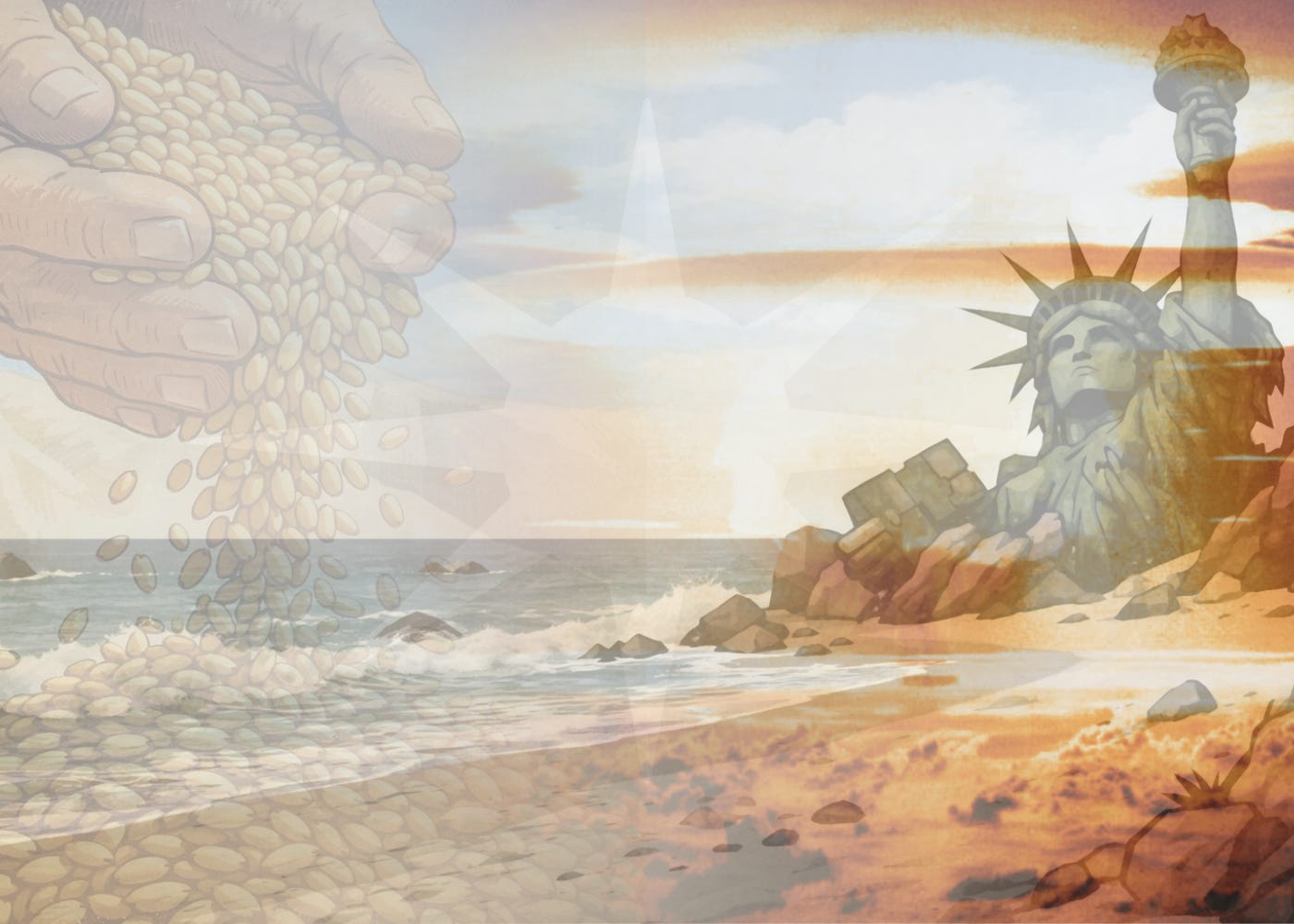
This is the Sixth and Final Renaissance Letter of Series 2: Planet of the Apes: (2-6: 11). Feel free to read in any order. If you want to read sequentially or want to peer at the Table of Contents: Click here.NOTE: Letter 11 was originally published in two parts; I have collated them into a single seamless piece here, and this will be the post listed in the table of contents. Warning—this article is 6,500 words, so if you would rather read this in manageable chunks, click below. Letter11a—Reign of GrainLetter 11b—Polaris Just like both posts obviously! Feel free to challenge or ask for opinions in the comment section. Letter 11: Apes of WrathOriginally Drafted: January 2026-April 2026Originally Published Letter 11a: 04/09/26 Letter 11b: 04/15/26 Complete: 04/18/26Last Updated: 04/18/26What's Right?You maniacs! You blew it up! Ah, damn you! God damn you all to hell!”—George Taylor (Charlton Heston), Planet of the ApesEnrico Fermi was a 20th-century Italian-American physicist who helped pioneer modern nuclear physics and worked on the Manhattan Project that developed the nuclear bomb. Five years after the Trinity Test, in 1950, Fermi returned to Los Alamos National Laboratory, and while chatting casually with colleagues over lunch, the conversation drifted to UFOs and the possibility of alien life. Considering the vastness and age of the universe, the number of galaxies and stars, life should be pretty common. After all, life is just chemistry and physics. If intelligent life is even moderately possible, and if a technological civilization can spread from star to star, then over millions of years, the galaxy should be teeming with life, full of at least detectable signs of it. We should see probes, radio chatter, megastructures, or at least … something—anything?! But…all we get is silence.This led Fermi to cut through his fellow physicists’ speculation with a blunt question: “So… where is everybody?” That disconnect between the mathematical probability of alien life and what we actually see has come to be called the Fermi Paradox, and it is a question we have grappled with ever since.One theory for why we don’t see alien life is known as the “Great Filter.” It proposes that somewhere between dead matter turning into life and a civilization becoming advanced enough to spread through the galaxy, there’s at least one brutally hard step that almost nobody makes it past, which is why the universe looks so quiet. It was proposed by economist Robin Hanson, in an essay he wrote in the late 1990s (“The Great Filter – Are We Almost Past It?”).Hanson posed it as a question, and then argued that the odds hinge on where the “hard step” is. If the toughest barrier is cellular (abiogenesis, complex cells, multicellularity, etc.), then we might be “almost past it”; if those steps are relatively common, then the filter is more likely ahead of us (self-destruction).Personally, I say, why not multiple great filters? I believe the jump from unicellular to multicellular life is one filter, and the capacity to understand and manage a species’ power is another. We passed the first one, but from 5:29 a.m on July 16, 1945, in the middle of the New Mexico Desert, with Fermi present, we reached the second one. And we were not ready. Nuclear weapons have given us the power of the gods for a species that is still trying to understand the implications of having the power of man. To be fair, we have done well avoiding nuclear apocalypse, outside of that one close call in 1962 over Cuba. Oh, and that one time in 1969 when Nixon was drunk and ordered the U.S. to nuke the DPRK in retaliation for a U.S. plane shot down over North Korea. Then there was that time in 1973 when Israel panicked and almost used them in the Yom Kippur War. That time in 1983 when NATO did a military exercise, and the Soviets nearly used them. And that is just the intentional close calls. This does not even get into the whoopsy-daisies, like that time in 1961 when a B-52 bomber carrying two 3-to-4-megaton nuclear bombs broke up midair near Goldsboro, North Carolina, dropping the nukes in the process, where, I shit you not, only a single switch prevented Goldsboro from becoming a crater. And it just goes on and on and on. I could give you fifteen more examples.Author’s Note: For that 1969 incident with the DPRK, it was Henry Kissinger, THE Henry Kissinger, who got Nixon to back off on that. Not only was this basically the only positive contribution of his lifetime, but how assured does that make you feel, knowing the only thing between you and nuclear winter is HENRY KISSINGER?I consider all of this to be suboptimal.The irony, of course, is that this type of shit was what we were trying to avoid when we first organized into societies. We didn’t create them for fun! It gradually emerged as the best way to avoid the constant threat of death and extinction. (…Oops.)So…what happened here? Well, that takes us back to that exponential growth of Letter 7. In fact, we pick up where we that left off—the Agricultural Revolution.If you want to check that out (after reading this), click here:Part 1: The Great Reign of GrainBefore agriculture, many humans lived in small, relatively egalitarian bands of hunter-gatherers. Leadership tended to be informal and temporary, grounded in skill and trust rather than durable authority. Anthropologists call these ‘band societies,’ where wealth and status rarely hardened into fixed classes. Many groups also practiced something like ‘reverse dominance’: collectively ridiculing, resisting, and sometimes ostracizing would-be strongmen to prevent them from consolidating power. In that sense, the pre-agricultural social world came with a kind of built-in freedom. So why would we give up such a free, decentralized system for something more restrictive?Let’s first take a look at our biological “gamer stats.”Strengths: We are big monkeys with big brains and high cognition. We are capable of coordinating and organizing. Unlike the other apes, we walk exclusively on two legs, and we can throw stuff at range and on target. We also sweat as a means of thermoregulation, which is absolutely elite. It gives us a massive endurance advantage.Drawbacks: We have to eat a shit-ton of calories. We can’t be like a crocodile, surfacing to snatch a meal every two weeks—we have to eat constantly. That means leaving the relative safety of the cave or dwelling to hunt and forage so we can fuel the industrial engine that is our brains and bodies. While we are skilled at both, walking the tightrope is a challenge. We are physically weak for animals of our size, and no amount of chicken, broccoli, or creatine can save you from that. That makes us more susceptible to injury, and because of how our bodies are built, it is hard to compensate for serious injuries on our own. Even something as simple as breaking your thumb can critically compromise your ability to hunt or defend yourself from being hunted.But because we have massive noggins, we can actually address such problems. Never underestimate the power of friendship. A lone person can hunt, gather, and survive for a while, but they cannot reliably absorb bad luck: injury, illness, drought, a failed season, or a tiger. The moment humans learned to cooperate at scale, they discovered a way to make randomness less lethal. By living together, sharing food, pooling labor, caring for the injured, and passing knowledge on, groups could stabilize the lower layers of life long enough to plan beyond tomorrow.However, because we are a live version of Pac-Man, we still have to keep eating, and since we are all living together, we are also all fucking each other and having kids.Human children are, from a survival perspective, useless. They are a one-way funnel of resources. They cannot hunt, they cannot forage, they cannot defend—unless the defense is sacrificing the child to whatever is chasing you—and, as any parent can attest, you have to watch them 24/7 because it almost feels like they are trying to kill themselves. As the number of these groups and children grew, the demand for resources increased, and the nomadic lifestyle became increasingly untenable.But what if, instead of eating the seeds we gathered while foraging, we collected them and planted the best ones? Now we do not have to move. Now we can plant a seed and, to some extent, make the plant grow where we want it to.Now you have agriculture. Agriculture creates a surplus that can be stored, enabling permanent settlement and specialization. Once people can stay put and coordinate, you get some people farming, some building, some defending, and some organizing.Now, as you probably know if you’ve ever had siblings or lived in a dorm, living in a shared space brings some… complications. People want different things, someone is salty, people feel slighted, and so on.To make sure we do not ruin the good thing we have going, people accept a trade: we give up some freedom to do whatever we want in exchange for the protections and benefits of shared life. You agree not to harm me, I agree not to harm you, and we both agree to the mechanisms that make that bargain real. Now we have a social contract.But a contract is not self-executing. Making it real requires coordination, and coordination requires decisions. Who farms the land (labor)? Who controls the land and owns the surplus (property)? Who sets prices (markets)?We need a shared set of standards so this whole arrangement can work. However, since we are no longer a small band but a collective working in tandem, we cannot rely as easily on a simple custom or a wise sage.If two people want the same chicken, one to eat and the other for eggs, well, we cannot exactly share. But we also do not want people handling the problem by killing each other, which kind of defeats the whole point of living together. So someone has to decide in a way that does not feel arbitrary. Perhaps some ground rules: laws. Now, who writes the rules (law)? Who enforces them (police)? What legitimizes the order (religion)? Who fights for it (military)? The moment these questions have answers, power exists, because someone is deciding and others are living with the decision.To carry those decisions across time and scale, societies build apparatuses that outlast any one person: institutions. They standardize rules, allocate resources, enforce obligations, and produce legitimacy. Institutions make cooperation reliable beyond family and immediate personal trust.Voilà: the birth of civilization. This is the gravitational pull of practicality at work, and it transformed everything. It also brought a lot of bad shit: hierarchy, slavery, patriarchy, stratification, class, and expropriation. During this research, there were a few moments when I genuinely caught myself thinking, Damn, society kind of sucks!Now there are two schools of thought about this:The first view is that societal institutions are the problem, that the apparatuses themselves are what hinder and enslave people. There is no way to build such institutions without their becoming oppressive; therefore, they must be eliminated. That is the anarchist approach and, to a lesser extent, the Randian and libertarian approach, also known as the wrong approach.The second view is that the decline in societal stability stems from a failure to uphold the social contract, which in turn leads to misaligned incentives and the calcification of power. It treats it as a problem of institutional design, also known as the right approach.Institutions are easy to dismiss when things are going well. You barely notice them when shit works: when shelves are full, the lights stay on, and the pipes work. It is when things get tight and resources shrink that you feel them. That is when the absence of durable coordination and enforcement, combined with an uneven distribution of consequences, leads to breakdown. When scarcity is shared, solidarity can hold. When scarcity is uneven, THAT is when the blood flows. Trust breaks down, suspicion and backstabbing rise, and people, in both good and bad faith, leverage their positions in the supply chain to secure more supply or more influence. Then death piles up, and it piles up fast. It can devolve very quickly into a Lord of the Flies, every-man-for-himself situation. In the humanity business, we call that bad.Society and institutions exist to make survival less random, to keep things from falling apart when conditions get tight. Even if I grant the argument that we never should have built civilization and institutions to this degree, we are so far past that decision that there is no clean undo button. Modern population levels depend on large-scale systems such as agriculture, logistics, sanitation, medicine, and basic order, which can only be maintained through centralized distribution. Pull those systems apart completely, and billions of people die. Billions, with a b. I am not trying to be dramatic. I just genuinely do not see how you avoid the math. To me, those losses are unacceptable.So the real question is not whether society helps or hurts. It is what society is built for and what its limits are. Do those limits protect flourishing, or do they enforce domination? That is a question of purpose and design. So, how do we design this so we don’t blow everything up (what I like to call “The Big Stupid”) and don’t erase what we have built?How can we build without complete implosion? Part 2: A North Star/SDN10A common theme in this series is our relationship to our chimpanzee and bonobo cousins. As a reminder, chimps tend to live in environments where food is scarcer, competition is fiercer, and aggression is a workable survival strategy. Bonobos, with richer and more stable resources, can more often afford social bargaining, de-escalation, and cooperation.Being related equally to both, where do humans lean? It depends on the conditions, doesn’t it? We are in constant tension with opposing biological pulls, so the environment tends to be the deciding factor, as it often is in biology. When we think resources are running out, the mind narrows, and instinct takes the wheel: more suspicion, more territorial behavior, a greater appetite for force, and a greater willingness to accept “necessary” cruelty. When resources feel stable, we can afford diplomacy, patience, bargaining, and empathy.Author’s Note: Notice how this grafts onto reactionary and progressive ideologies. Reactionary politics tends to assume chimp conditions: scarcity, threat, zero-sum competition, and the need for discipline, hierarchy, boundaries, and force to keep order. It leans on rhetoric about being exterminated, overtaken, and replaced. It even ties back into sex, unspoken fears about cuckoldry, reproduction rates, and who gets to “carry the future.” Progressive ideologies tend to lean more into the bonobo side: diplomacy, freedom, and peace. That often invites ire in a world that feels, and is by design, very cutthroat.Lobster Boy (Jordan Peterson… remember when this was about him—no? Check it out after.) was not wrong because he appealed to biology as a plane of understanding. He is wrong because he forgot, or intentionally excluded, that a great deal of biological behavior is dependent on environmental conditions. For once, and only once, we will appropriately incorporate Darwin into a political discussion. The whole “survival of the fittest” thing is the one best suited to the environment, not the “strongest”. Survival goes to those who adapt, not those who dominate.Environment shapes behavior, and humanity has the special ability to shape that environment. It is kind of our thing, for better or worse.Over the last thousand years, we have built an environment made for domination and conquest. While diplomacy is usually cheaper than brute force in the long run, our perspective and long-term focus do not usually extend beyond the length of a human lifetime. And to be fair, both strategies proved relatively effective for humans until the turn of the twentieth century. Then the two world wars happened, a lot of people died, we built weapons that could level cities, and then spent the next fifty years making them stronger and more numerous. Perhaps ironically, in our pursuit of domination, we unknowingly turned everything on its head, rendering that avenue incapable of supporting the species’ future prosperity. We changed the environmental conditions on this planet—and now we must adapt.The stakes of the game have changed, and you can see it everywhere. Aggression as a means of achieving political ends is diminishing in value with each passing day.Hey, how is that Iran War going, btw?The problem is that, in their failure and incompetence, leaders will slowly lose control of their own situations and fall back on what they understand: conquest and destruction. But now that destruction implicates the entire species.Now there is a big red button in the middle of a room, and if anyone presses it, the room explodes and kills everyone. That “feels” like enough incentive, but that assumes people value life over winning. But what happens when someone realizes they cannot win, and the goal becomes making sure no one else wins either? When a leader who gambles on aggression loses and faces personal or political ruin, they may decide they have nothing left to lose and, in one final act of nihilism, say fuck it and launch nukes at their enemy, or simply burn the house down with them.So now we are playing a game of keep-away from the person who really wants to press the button, while also trying not to press it ourselves, because it does not take much pressure. At the same time, you cannot de-escalate by giving in to demands just to avoid pressing the button. That only makes every player more likely to threaten it whenever they want something, which in turn makes it more likely that someone eventually presses it. “Give me X, Y, or Z, or I will turn the world into a parking lot.”This is not a tenable long-term solution. Even if there is only a 5% chance of the worst happening, the more situations we create, the more we keep flipping the coin; the greater the chance that one of those flips lands on tails.And all it takes is one unlucky flip, and then we are fucked. I do not think we will go “extinct,” but we will set ourselves back a millennium. This is not an inevitability, but like a current, we are slowly drifting towards this reality.Luckily, diplomacy and cooperation are the conditions on which we built society in the first place. It is how it started, and we have now come full circle. A society’s ethos shapes its incentives and institutions, and those institutions shape human behavior in return. Humanistic values tend to foster humanistic behavior, which in turn produces humanistic outcomes. Punitive values encourage punitive behavior and produce punitive outcomes. I think society is best understood, and functions best, when it tries to manufacture bonobo-like diplomacy to limit chimp-like aggression.To get bonobo-like diplomacy, you need bonobo-like conditions. That means conditions that are less environmentally strenuous, more resource-rich, and where needs are easier to meet. Bonobos can get by with some shelter and a cornucopia of fruit. Humans need a little more.From Maslow, we learned that people require physiological needs like food, water, and air, along with safety, love and belonging, esteem, and self-actualization. Yet that sense of purpose is sharpened by Self-Determination Theory’s three core “nutrients”: autonomy, competence, and relatedness.And what does society get in return? I think it gets what Maslow later described as his “bonus” sixth layer: self-transcendence. Beyond self-actualization, people seek meaning outside themselves through service, unity, spirituality, or devotion to a higher cause. People who feel invested in and supported are statistically more likely to support others and feel worthy of support.This relationship is what makes such a society possible and sustainable. It is the return on investment that keeps the relationship reciprocal rather than one-sided. So what would a society built around human needs look like? The more the social contract demands of people, the more it owes them. More rules mean more restraint, more compliance, and more obligation. In return, society owes protection, stability, fairness, and real opportunity.This is the basis for the SDN10, or the “Societal Charter,” of Social Democratic Nationalism. It’s not a policy platform so much as a skeletal outline of what we want society to accomplish and intend to build.The Societal Charter/SDN10Simply put, to create a functional, cohesive, and free society, its institutions must:* Guarantee the 4 securities,* Protect the 3 freedoms,* Build the 2 capacities* Serve the 1 mandate.Now let’s go through it: first in list form, and then with slightly more explanation in outline-style sub-notes.In ShortI. Guarantee the Four Securities* Personal Security— Protection from violence* Economic Security— Protection from desperation* Institutional Security— Protection from oppression* Political Security— Protection from repressionII. Protect the Three Freedoms* Individual Freedom — The freedom of autonomy* Public Freedom — The freedom of expression* Practical Freedom — The freedom of practiceIII. Cultivate the Two Capacities* Agency— the capacity to think and act independently* Community—the capacity to think and act collaborativelyIV. Serve the One MandateTo secure, to the fullest extent possible, the conditions necessary to create an interdependent society through democratic institutions with distributed power that serve all its people.Slightly ExpandedTo create a functional, cohesive, and free society, that society and its institutions must:I. Guarantee the Four Securities* Personal Security — Protection from violence* Protection from physical violence by individuals AND the state.* This is the bare minimum for which society was created. If you cannot do this, you might as well not even pay taxes.* Economic Security — Protection from desperation* Protection from economic insecurity. This must include publicly provided access to the bare necessities required to function in a modern society with any real degree of capacity. This includes the Core 5:* Nutritional food* Clean water* Stable shelter* Education* Unconditioned health treatment.* Institutional Security — Protection from oppression* Protection within and from legal institutions: rule of law, due process, equal protection, rehabilitation, and defined civil liberties.* Because power becomes most dangerous when it is institutionalized. A free society must ensure that its legal institutions do not merely maintain order, but are themselves bound by law, reciprocity, and human dignity.* Once institutions are seen as self-serving, captured, or beholden to those who run them, legitimacy evaporates. It is no longer a social contract. A society built on obligations without reciprocity is just oppression. Institutions must provide what people cannot reliably secure on their own.* Political Security— Protection from repression* The right and genuine opportunity to participate in, and be represented by, an open democratic government.* This requires a stable and functional system amid competing factions, with reliable transitions of power.* It also requires a balance between maintaining workable majority rule and preserving meaningful minority representation.* To be blunt, shit will always be happening. There will always be some reason to clamp down on opposing factions and limit them. The strength of a political system is measured by its ability to function under pressure without stripping individuals or factions of their rights.* Political suppression, whether physical, such as cracking down on protesters, or bureaucratic, such as gerrymandering, creating obstacles to voting, making it impossible to run for office, or limiting the powers of an office before an opponent assumes it, is antithetical to this security interest.* This is very much a means-over-method standard. The will and freedom of the people are not defined by technicalities.II. Protect the Three Freedoms* Individual Freedom — The freedom of autonomy* The freedom of privacy, conscience, faith, and identity, free from surveillance and arbitrary interference.* “Arbitrary” means restrictions based on anything other than conduct that actively infringes on the rights of others.* This means you have the right to practice and live by your own norms and values, whether religious or otherwise, but not to govern or conduct yourself in ways that limit the rights of others.* I do not care if you are straight, gay, trans, bi, catholic, Jewish, Christian, or Muslim, or whatever. We want to encourage people to show up as the best version of themselves, and that means the one most authentic to each person.* The same obviously applies to race if it can be said to “apply.”* Public Freedom — The freedom of expression* The freedom of speech, expression, creation, organizing, and dissent around any cause, for any reason.* I am much closer to a free speech absolutist than not. But again, it cannot be used directly to repress others’ public freedom.* This is one of the few places where I think the current American implementation of the First Amendment is the proper standard.* Practical Freedom — The freedom of exercise* This embraces positive freedom, meaning the actual ability or capacity to do something; in other words, the freedom to exercise the other two freedoms.* Freedom in principle is not the same as freedom in practice. If society makes those freedoms impossible to exercise, then they are not meaningfully free.* This takes many forms. For examples* In America, this often takes the form of debt.* While Americans have a certain degree of formal freedom, if all meaningful ways to exercise it are behind a paywall, you are not free.* In socialist and communist countries such as China, Vietnam, Cuba, Venezuela, Laos, or North Korea, this often takes the form of political oppression.III. Cultivate the Two Capacities* Agency— the capacity to think and act independently* Provide people with the tools, education, skills, and sense of personal identity necessary to function with confidence and competence. This requires a meaningful degree of independence and healthy individualism.* A person must be able to form an identity apart from the collective. No single identity should rule over others. Healthy individualism is indispensable to collective growth.* Community—the capacity to think and act collaboratively* Cultivate the capacity to think and act collaboratively by creating and investing in mutual, nurturing environments that foster reciprocal bonds across races, genders, and identities.A healthy society does not treat people as isolated units nor cogs in a machine.* It teaches them how to live with, care for, and build alongside one another. Community is what turns coexistence into solidarity.IV. Serve the One Mandate:To secure, to the fullest extent possible, the conditions necessary to create an interdependent society through democratic institutions with distributed power that serve all its people.* Rewritten to state the implicit explicitly: To secure, to the fullest extent possible, the conditions necessary to create an integrated and interdependent society through pluralistic, democratic, and responsive institutions that serve all its people, with power distributed, transparent, and contestable, so no single entity (office, agency, party, or private actor) can control the conditions of life.I hope that makes sense.Because it will never be as simple as I just put it for the rest of our lives.Part 3: Biology of an IdeologyI recognize that when most people say they are going to write a manifesto, which already is not most people, but regardless, they usually do not start by trauma-dumping and then pivot into lessons in biology, psychology, and metaphysics. Usually, you would start with income inequality, capitalism, why white people are superior, stuff like that. But we need to understand the seeds before the trees.I start with humanity because every ideology begins with a fundamental premise on human nature, and the premise of Social Democratic Nationalism, or New Social Democracy, is that humanity is interdependent. From there, it asks the next question: what would an interdependent society look like? That is the SDN10. Then it asks the most pressing one: from where we are, how do we build it?There is a biological principle called phylogenetic, or evolutionary, constraint. Evolution can only modify what already exists. Species develop through inherited structures and available pathways; they do not leap straight to their final form. Political development works much the same way. You cannot cut something out completely; you can only transform it from what it is.To a certain degree, this applies to capitalism, with emphasis on that degree. In case you didn’t know…we live in a capitalist society. Like super-duper capitalist. It extends to every single aspect of our lives. We cannot quarantine it, eliminate its influence, or even pretend there is a way to completely avoid its pull.To believe capitalism can simply end because we declare it so is to misunderstand the development of human civilization and the way people and institutions actually work. You cannot simply create something out of thin air and think that because you have different values, you are going to build something different. Attempts to ignore that reality often reproduce the same oppressive institutions under different names.I always point to Russia as a great example. The Russian Empire was a totalitarian state run by a few, suppressing its population and treating human life as cheap in pursuit of imperial glory. The Soviet Union, in practice, became a totalitarian state run by a few, again treating human life as cheap, this time in pursuit of proletarian revolution. Those are largely just word changes. Trading a tsar for a general secretary makes little difference to me. The substance is everything.To Lenin’s credit, which is not something I give often, when the Bolsheviks took power, he did try to institute some of the revolutionary changes. But nothing in Russian society had any real basis or organization for what he was calling for. So he immediately fell back on what it had been built for: autocracy. Less dramatically, this same shit happened in the 1990s with the chaotic imposition of capitalism. Lenin promised peace, land, and bread, and yet the first fifteen years of the Soviet Union were dominated by war, displacement, and starvation. If anything, it was worse because now it was centralized, planned destruction under the guise of the greater good. The Bolsheviks thought they would need to teach the workers, but I do not believe they ever considered that they first needed to educate themselves on what they were taking over, or the extent to which their own “bourgeois” biases were imprinted upon them. This reality is not inherently bad, but pretending you are above it because you have read enough theory is.We are in an endless state of evolution and transition, which means any new order must be constructed from the imperfect conditions already before us. To build something in name, you must build it in substance. If something is truly necessary, it has to be developed with what we have, no matter how flawed the current thing may be.That is really what SDN is: a transitional framework shaped by the constraints of the world we currently inhabit. It is aware of its own impermanence. SDN only works as an ideology if it understands itself within the broader context of human development and our understanding of the universe. It is part of a larger theory of civilizational change. That is what turns it from a civic-nationalist version of social democracy into something unique, a distinct ideology altogether. It becomes three-dimensional and alive. It is the ideological embodiment of that phrase I said somewhere in these diatribes: keep one foot planted in the earth and one hand reaching for the stars. The goal of such an ideology is to promote something that makes sense across numerous levels of reasoning while leaving the door open to evolution.That is a difficult balance to strike, but in finding it, we open doors you did not even know existed. It almost becomes unfair because we now do what can only be described as political alchemy. You can be a nationalist and an internationalist simultaneously. You can lean into America’s rich, if troubled, history without abandoning broader global intentions. You can make a convincing argument that SDN is the future you want, whether you are a capitalist, a socialist, a nationalist, or a moderate.That is why I say all roads lead back to Social Democratic Nationalism. I also think it is politically effective and lends clarity and confidence to what we want and how to achieve it. We believe it, we can see it, we can imagine it, and we can place it in perspective.I am a nationalist, but I know nations are not real. I do not see the nation-state as the final political form, but I do see it as the level at which we have to begin, because it is the level people can identify with now and the one that can be tailored most closely to what we are trying to build. I think America is special, but not inherently. It is just the best, if not the only, place to model a prototype for a broader global society. And if we can do it in this country, with this history, with this size, with this government (with reforms), then there is literally no excuse for anyone else. Figure it out.But that balance relies on two things: direction and navigation. A North Star to show you where true north is, and a torch to light the way and keep the fire going. Our North Star is the SDN10. And our torches are the principles to which we adhere in pursuit of such a revolution.The torch marks the end of one series and the beginning of another as we close the book on this one. We, the Great Apes—the ones who left the trees, overcame every bottleneck, and faced every challenge head-on—stand at a crossroads and need to light the way toward the next step. It is a challenge, absolutely, but we have faced many in our incredibly brief yet storied history on this rock. We have endured before, and we must endure now.Because at the end of the day, when Enrico Fermi posited the question of why we do not see alien life, it was not a challenge to become a living example of why. It was a challenge for humanity to become the kind of civilization that can endure long enough to answer it.I will see you in Series 3.‘Till Next,Alexis MordecaiPrevious Letter:Beginning of Series 2: Where it All Began:Next Letter: Series 3: TBD: This is a public episode. If you would like to discuss this with other subscribers or get access to bonus episodes, visit americanrenaissanceproject.substack.com
NOW PLAYING
Letter 11: Apes of Wrath
No transcript for this episode yet
Similar Episodes
Dec 5, 2025 ·50m
Oct 9, 2025 ·33m
Oct 3, 2025 ·40m
Sep 11, 2025 ·31m
Aug 27, 2025 ·39m
Aug 18, 2025 ·54m