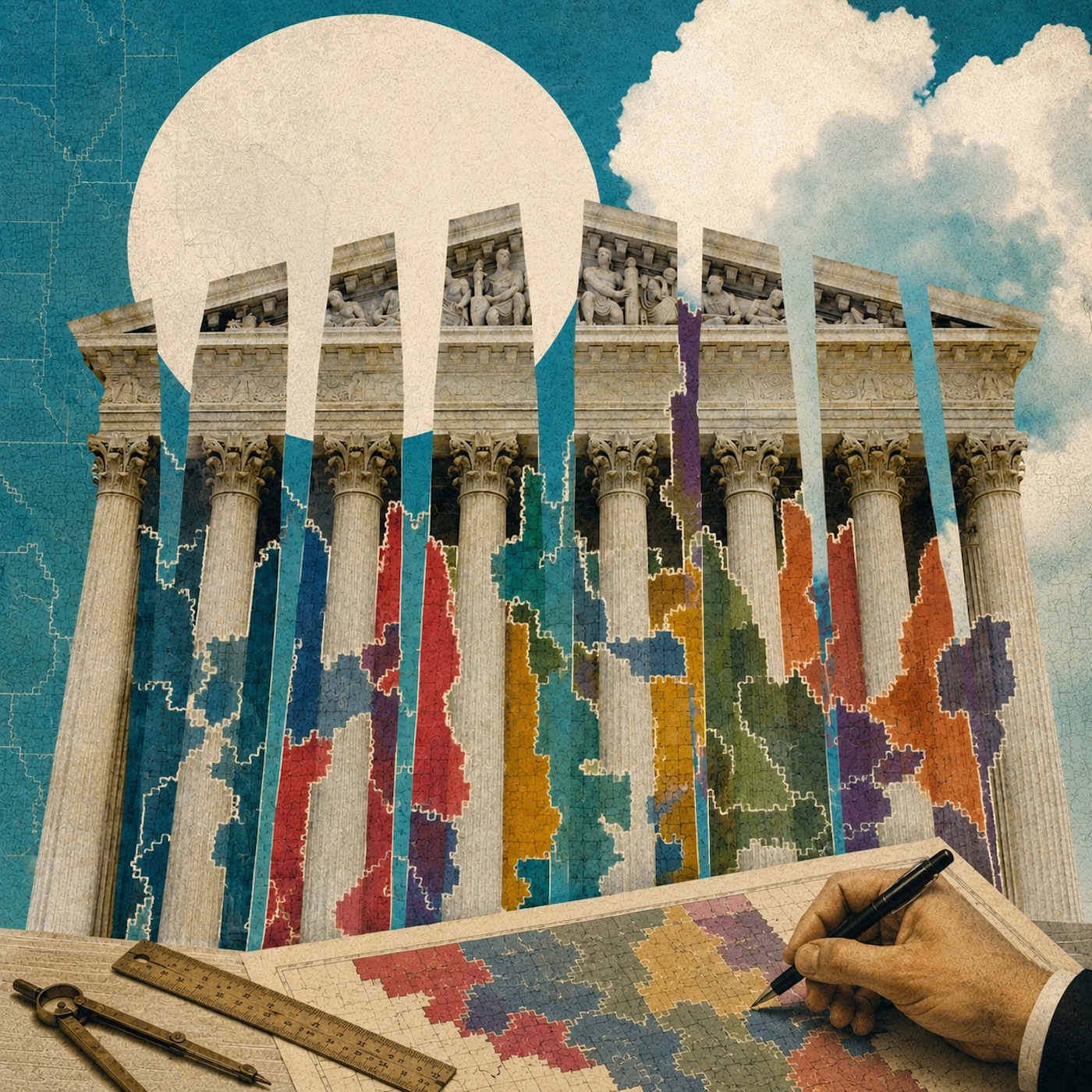
Majordoma episode artwork

EPISODE · May 7, 2026 · 1H 1M

Majordoma

from Divided Argument

The Court’s latest Voting Rights Act decision, Louisiana v. Callais, narrows Section 2 in a way that could reshape redistricting, weaken majority-minority districts, and intensify the fight over how race and partisanship interact in elections. We unpack what the Court said, what it quietly overruled, and why the reasoning matters far beyond Louisiana.We walk through the statutory text, the long-running collision between the Voting Rights Act and the Court’s racial gerrymandering cases, and the practical consequences for future election-law litigation. Along the way, we debate whether this is best understood as a textual decision, a constitutional avoidance move, or a major shift in how the Court treats political power and racial representation.The conversation also covers the Court’s emergency procedural move after judgment, Justice Kagan’s forceful dissent, and the broader question of whether the decision is likely to help one party more than the other in the short run. The result is a sharp, candid look at one of the term’s most consequential rulingsKey Topics[00:00:20] - Introduction to the episode and SCOTUS Blog partnership update[00:03:06] - Brief Supreme Court news: mifepristone litigation and shadow-docket timing[00:05:20] - Louisiana v. Callais and why the case is a major Voting Rights Act decision[00:11:35] - Voting Rights Act history: Section 2, Section 5, and Shelby County[00:13:39] - The collision course between racial gerrymandering doctrine and Section 2[00:16:17] - Allen v. Milligan and how the Court shifted course[00:21:21] - Procedural background of the Louisiana map challenge[00:23:02] - Is the decision constitutional, statutory, or both?[00:24:28] - Section 2’s text and the 1982 amendments[00:29:14] - The Court’s reading of “less opportunity” and the role of partisanship[00:41:46] - How the majority treats Allen v. Milligan and prior precedent[00:43:06] - Constitutional avoidance and the Section 5 enforcement-power question[00:46:28] - The Court’s “updated” Gingles framework and why that matters[00:52:29] - Likely effects on majority-minority districts and partisan gerrymandering[00:54:25] - Justice Kagan’s dissent and the Court’s broader democracy critique[00:56:04] - The post-judgment timing dispute and Justice Jackson’s separate dissent[00:58:55] - Final assessment of the decision and its likely consequencesRelevant LinksRick Pildes's post on the decision: https://democracyproject.org/posts/supreme-court%E2%80%99s-gutting-of-voting-provision-was-long-time-comingTravis Crum Amicus Brief: https://www.supremecourt.gov/DocketPDF/24/24-109/373625/20250903201226237_2025.09.03%20Callais%20Crum%20Amicus%20Brief.pdf

NOW PLAYING

Majordoma

0:00 1:01:14

No transcript for this episode yet

We transcribe on demand. Request one and we'll notify you when it's ready — usually under 10 minutes.

THE PROFESSOR EXPLAINS

May 15, 2026 ·27m

THE MAN IN SPECTACLES

May 15, 2026 ·34m

THE DUEL

May 15, 2026 ·34m

THE EARTH IN ANARCHY

May 15, 2026 ·31m

Party Animal Party Animal The Honorable Jason Lewis (R-MN) represented Minnesota’s 2nd Congressional district during the 115th Congress. Lewis prioritized working with the Trump administration’s America First agenda and was a “leader in the battle to pass” health care and tax reform. He also co-authored the Juvenile Justice Reform Act of 2018 which passed Congress and was signed into law by the President. Prior to serving in Washington, Lewis was a broadcaster for 25 years hosting The Jason Lewis Show. Lewis holds a Bachelor’s degree from the University of Northern Iowa, a Master’s degree from the University of Colorado-Denver and is the author of the 2010 book, Power Divided is Power Checked—The Argument for States Rights. Chabad.org - Daily Torah Study Chabad.org Classes on Tanya, divided according to the daily schedule; the book of Rambam - Maimonides and his Sefer Hamitzvos, also divided according to the daily study cycle. Man Who Was Thursday, A Nightmare, The by G. K. Chesterton (1874 - 1936) LibriVox In a surreal turn-of-the-century London, Gabriel Syme, a poet, is recruited to a secret anti-anarchist task force at Scotland Yard. Lucian Gregory, an anarchist poet, is the only poet in Saffron Park, until he loses his temper in an argument over the purpose of poetry with Gabriel Syme, who takes the opposite view. After some time, the frustrated Gregory finds Syme and leads him to a local anarchist meeting-place to prove that he is a true anarchist. Instead of the anarchist Gregory getting elected, the officer Syme uses his wits and is elected as the local representative to the worldwide Central Council of Anarchists. The Council consisting of seven men, each using the name of a day of the week as a code name; Syme is given the name of Thursday... (Summary from Wikipedia) Philosophy for Beginners Oxford University Philosophy has been studied for thousands of years. It involves the use of reason and argument to search for the truth about reality - about the nature of things, ethics, aesthetics, language, the mind, God and everything else. This series of five introductory lectures, aimed at students new to philosophy, presented by Marianne Talbot, Department for Continuing Education, University of Oxford, will test you on some famous thought experiments and introduce you to some central philosophical issues and to the thoughts of some key philosophers.

Frequently Asked Questions

How long is this episode of Divided Argument?

This episode is 1 hour and 1 minute long.

When was this Divided Argument episode published?

This episode was published on May 7, 2026.

What is this episode about?

The Court’s latest Voting Rights Act decision, Louisiana v. Callais, narrows Section 2 in a way that could reshape redistricting, weaken majority-minority districts, and intensify the fight over how race and partisanship interact in elections. We...

Is there a transcript available for this episode?

Yes, a full transcript is available for this episode. You can read the complete transcript on the episode page.

Can I download this Divided Argument episode?

Yes, you can download this episode by clicking the download button on the episode player, or subscribe to the podcast in your preferred podcast app for automatic downloads.
URL copied to clipboard!