
Every episode of NPR's It's Been A Minute Podcast starts with a question about how culture shapes our lives. Are we spending too much on other people's weddings? Is social media bad for your mental health? We're here for your right to be curious.
One big question at a time. Follow It's Been A Minute wherever you get your podcasts. This is Fresh Air, I'm Terry Gross. As remarkable as it is that my guest Malala Yousafzai won the Nobel Peace Prize when she was 17, there are remarkable ways she's been living her life since then.
Let's start with the famous part of her story. She was born in 1997 and grew up in a remote region of Pakistan, Swat Valley, near the Afghanistan border. In 2008, after the Taliban invaded her town, terrorizing the people, they banned girls' education. She publicly spoke out for her right and the right of all girls to go to school.
As payback in 2012 when she was 15, she was shot in the head by a Taliban gunman. She was flown to a hospital in England where she continues to live. Her recovery was miraculous. It's when I read her recent memoir, Finding My Way, that I learned how the bullet changed the course of her life, thrusting her into a new culture, and changing her in ways that didn't quite fit her public image as an inspirational hero and top student, and sometimes even challenged her own self-image.
When she was admitted to Oxford University, a dream come true. She wanted to live the life of a teenager and find time to make friends, have fun, have adventures, including jumping from her dorm roof to the campus bell tower. She defied some of her culture's traditions and her parents' expectations from how she dressed to who she married. At the same time, she was experiencing PTSD and panic attacks for the first time, recovering from her multiple surgeries and continuing to raise money for the foundation she co-founded with her father to advocate and raise money for girls' education in places where that is banned.
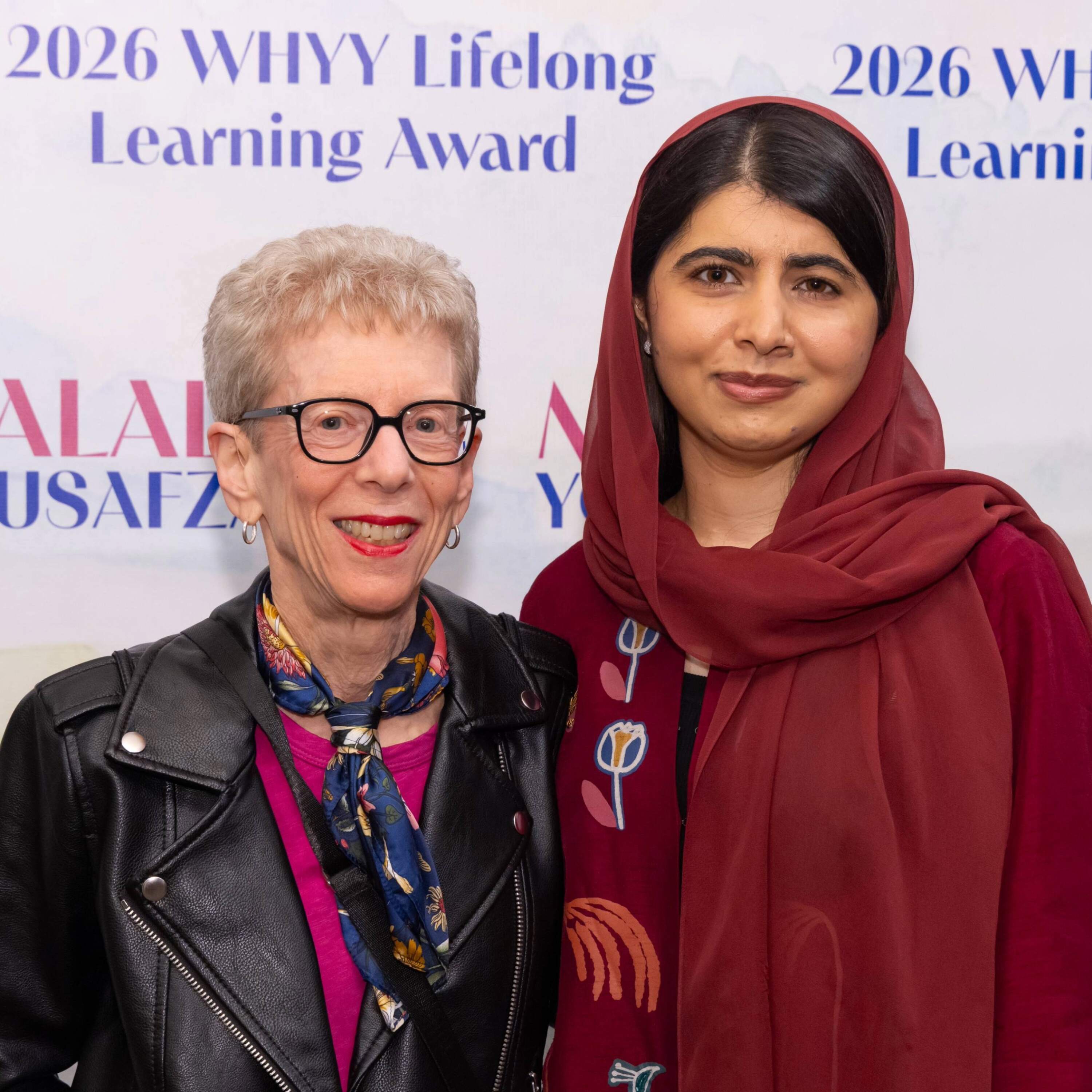
All this took time from her college studies, and she felt like a fraud, a symbol of female education, who was barely passing some of her classes. Another thing I learned from her book and from hearing her speak is that she's very self-aware, introspective, and funny. I spoke with her last Tuesday evening in front of an audience at WHYY, where she was given this year's Lifelong Learning Award. Well, it is such an honor to have you here tonight.
I'm so excited to have the opportunity to talk with you. It's so nice to be here. Thank you so much. Thank you for the honor and good evening, everyone.
It's always so nice to be in this beautiful, warm, welcoming city. So you and I are, we're different generations, we're from very different cultures. There's so much in your book that I really related to in a much more insignificant way than your life. But one of the things I really related to was if you're lucky enough to go to college and it's away from home, you have a chance to figure out who you are independent of your family, independent of the friends who knew you when you were a child, and you can grow and transform and take risks, try out different selves and figure it out.
But that can mean defying your parents' expectations, which I had to do in my own little insignificant way, and you had to do in a pretty major way, because you were in a different culture and you were young, you were a teenager. And when you defy your parents, there's a price you pay. You know, they're the people who love you most in the world and you love them, but you're rejecting some of their values and going your own way. And you risk hurting them, you risk creating a rift that won't heal.
I related to that. So my question is, which is more difficult defying your parents or standing up to the Taliban? I think it wasn't just the pressure of my parents, it was the pressure of the school community that they feel they represent, even though we were thousands of miles away from Pakistan. But they were still worried about what would our relatives think if they see me wearing jeans in college, if they see me with some friends enjoying some music in college or climbing a rooftop in college.
And for them, it was always this anxiety that when rumors start about women, it is like the biggest dishonor you can face in the community, just to share one story, which is something I shared in the book. One day, I went rowing in college, I was trying new things, and I said, let's give rowing a try. That was my first and last experience trying rowing, never went back to it. But I was just wearing jeans and a nice bomber jacket, and somebody took a photo and uploaded it.
And that photo went viral, and it caused this huge social media backlash where people were criticizing me from the Pakistani South Asian diaspora for wearing jeans. They thought it was not Islamic enough, this was against our culture, that I wasn't wearing traditional clothes, that somehow I wasn't just an ambassador for girls' education, but I was also an ambassador of the culture, the faith and everything else, that I had to meet everyone's expectation, that I was somehow upsetting everybody. And I remember my parents panicking, and they are asking me if I would issue a statement defending myself, and I would say something, and I told my parents, no, I'm not going to respond to this at all. I said that when my brothers moved to the UK, they switched to jeans right away.
Nobody had any problem with that. But as soon as a girl decided to wear a pair of jeans, it became a whole issue. So I said, the best way for me to respond to this is to keep wearing jeans. And it's also about women making choices for themselves.
It should not be someone else deciding it for them. And you also write in your book, and this is something I also related to, that you felt with your parents, if you didn't draw the line, that you would always be compromising on giving in. And I'm sure a lot of people listening to this relate to that as well. But again, we didn't have a whole culture attacking us for it.
Yeah, I mean, it was hard, and sometimes the best, you know, protection for me was that my parents were just not with me at college. You know, it's like, they just don't know, and that's the best thing ever. I loved my college time, because I was away from home, and this was the first time that I had been on my own. And I was so curious about life, and I know that these things sound quite basic, like climbing a roof door, or hanging out with friends or staying up late.
These are not like some big crazy things. But to me, it felt like I was climbing a mountain, that this was something huge that I was doing in my life, because I was making my own choices, and I felt that nobody was watching me, and that was such a relief. But yeah, when my parents read the book, then they found out that there was quite a lot happening here. So tell us a little bit about what your education was like, and I'll preface this by saying, you describe your father as a feminist before he knew the word feminism.
And he believed in girls' education, and he wanted to teach. So he created a school that started with three students. That's the school you went to when you were a girl. What was your education like?
Because you say that when you got to England and went to high school there, and then college, that you were taught to memorize facts, and not critical thinking. It's suddenly you were being asked to do critical thinking. So what did you learn? What was your education like when you were young?
In Pakistan, it's very focused on sciences and then learning English and math. A lot of it is like Islamic studies, social studies, Pakistan studies, but that was about it. It's very textbook focused. So in Pakistan, by age 15, I had only read 8 or 9 books outside my school curriculum.
It's only because somebody gifted those books to me. So I had the alchemist and one or two other books like that, and I was so proud of myself. When I moved to the UK, I realized that kids have big libraries in their schools, and they're encouraged to read fiction and books outside their school curriculum. I also found out in the UK that they actually had science labs.
So they were not just learning about an experiment by just reading about the experiment. Like this chemical meets this chemical, and then this thing happens, and I wonder what that looks like. Kids here can actually see what it looks like. So when I would be in a biology class in the UK and in a chemistry class, and I could see these things happening right in front of my eyes, I just wish more and more kids in Pakistan can also see that experiment.
It's such a privilege. So your mother didn't go to school. She went to school for one day and decided her friends were in school, and she'd rather play with her friends than go to school. And she was illiterate.
How did she feel about you becoming an education activist on behalf of girls' education when she never went to school herself? Of course my mother is very proud of the work that I am doing and that my father is doing, and I do believe that it is her support and her strength behind us and both my father and I to keep on fighting. But I saw her real resilience and commitment to education when we moved to the UK. Because now she was in a completely different country, a new culture, a new language, and she suddenly became a dependent on others.
If she had to call a cab, if she had to see a doctor, if she had to speak to somebody at the grocery store, she needed somebody with her to speak in English. And she felt very helpless. So she started taking English classes, and she's been learning English for the past seven or eight years. And it's always such a beautiful moment for me at home when I'm helping my mom with her homework.
It is, you know, parents helping their kids. But in our house, it's a daughter helping her mother, and it's such a beautiful moment. She loves her education. I mean, she's like a role model to students out there.
She never misses her homework. She impresses her teachers. And now she can call a cab on her own. She can go to a grocery store on her own.
She can manage a doctor's appointment. She's no longer dependent on any family member. And that's because of her education. So, you know, your father, as I mentioned, founded a school.
It was a school you went to. So he was passionate about education and passionate about it for girls. And when the Taliban came and took over your area, they had a deadline for when they were going to close down the schools. It was the 15th of January, 2009.
And you attended school until the last day, even though I think you were only allowed to go up to fourth grade and you were in fifth grade? Yes. And we were, you know, we would wear just our home clothes. We could no longer wear our school uniform.
It would give you away. Yeah. We said like the Taliban should never know that girls are daring to go to a school. We would wear these long, hefty like scarves and just, you know, wrap them around our body.
So we could hide our school bag like any bag will sort of hide. So there's no proof of us daring to walk to a school. And we said that if they ever asked us what grade we were in, let's say they found out. We'll just tell them we were in fourth grade.
They could never prove it. So we said, you know, we're just, we're still like little girls and, but girls were risking their lives to be in a classroom. Right. So during that period, I think it was during this period, a journalist from the BBC after a volunteer from your school to keep a journal that the BBC could draw on or publish.
I'm not sure which. And one girl volunteered and then her father came the next day and said, I'm not allowing her to do this. It's too risky she could get killed. And then your father says to you, Malala, would you like to volunteer?
How did you feel about that? I'm asking you to volunteer? You knew it was a great risk. I mean, it was an anonymous pseudonymous journal.
You wrote it under a pseudonym. But how did you feel knowing you were taking on this risk? And this was before you got shot by a Taliban? Yes, I was 11 years old.
And when I heard that so young, yes, yes. How could you even comprehend the risk that you would take it? You know, my, my honest reaction to a question like this is that, like, I wish I was a child. I wish I knew nothing about these things.
I wish, like, I didn't have to write a blog. I wish I didn't have to become an activist. But that was the lived reality of girls. At 11 years old, they're telling you that just because you are a girl, you cannot step into a classroom.
You cannot have an education. And I know that, you know, like, when I look back, I'm like, yes, that was a crazy thing that I did. I put my life at risk. But at the time, what scared me more was a life without an education, as a girl.
It terrified me. And I think about women's struggle for equality, for justice everywhere around the world. You know, we are fighting to protect ourselves against violence, against oppressions. Women are literally being murdered and killed.
You know, that's how extreme it is. And I said, you know, education is that pathway, that hope that I can have, that I can have a better future. So the best thing I can do is actually speak out and see if there is, you know, some hope that things would change for us. Looking back at your 11-year-old self and your father back then, do you think he did the right thing and asking you to volunteer?
I think he did the right thing. I'm so grateful to have a father who never stopped me from doing what I wanted to do. And it wasn't just one BBC blog. I wanted to speak to every media platform.
I wanted to speak to every journalist. And I remember that my father would always tell me before every interview that, don't mention the Taliban, don't name anybody, and just just focus on talking points about going to school and not be like, yes, dad. And then I would go and speak to the journalist and say everything. I'm like, you know, it is the Taliban.
They're not letting us be in school. And I would name them. I'm like, what are our leaders doing about this Taliban leader and that Taliban leader? So sometimes you don't listen to what your father's telling you.
You actually see what they do and what they say and you follow that. Tell the story of how you got your name, Malala. So Malala is the name of this famous Afghan heroine. She was in the late 1800s, and she is participating in the second Anglo-Afghan war.
The Afghan soldiers are about to walk away. They're losing the battle. And she walks up to the top of this mountain and she raises her voice and tells the soldiers that if you do not struggle today, you will live the rest of your life in shame. So she encourages the soldiers that this is truly a day where they can prove their honor and they can fight for their freedom.
And supposedly that's, you know, how the story goes, that the soldiers fight back and she loses her life at that battle. So the name of Malala of my one, so she's a heroine from Afghanistan, is very famous in our Pashtun community. The actual literal meaning of the name is grief, stricken or sad, but we don't go with that. We just go with the good meaning.
What message did it send to you that you were named after a martyr after a teenage girl who inspired fighters to keep fighting and died herself in that battle? I was just imagining that battle happening today. And this is a battle that we are fighting for children to have access to education. We're not fighting through swords.
We're not fighting through weapons. This is a fight through books and pens. And we want every child to have the opportunity to be able to go to school. So this is different.
And my goal is that, you know, the soldiers of today are like all of us, all of us to come together and ensure that we help every child have access to education. I will remind you she dies in the battle. So far, I'm doing okay. And yeah, my story didn't go that way and I'm very grateful for that.
I think it's when you were living in the area where your parents grew up, which is very remote and very mountainous. I think it was then that you were on a school bus when you were shot. It was in 2012 that they attempted to kill me. And you weren't expecting that, right?
You didn't think that you would be a target? It wasn't that I never pictured it. I had pictured it many times that this could happen. I had pictured it at school.
I had pictured it at school bus. I had pictured it on the street where I used to walk to school. I knew that the Taliban could do anything. And I used to wonder, like, could I save myself?
Like, you know, how could I make them understand that I'm actually not a threat? I actually want education for myself, for girls, even for their children. When the day arrived, it was the 9th of October, 2012. It was a normal school day for me.
And when we were driving back to our home in our school bus, that's when everything pauses in my memory. I don't remember anything. I had different visuals, different flashbacks. But I'm never sure what I really saw and what I'm sort of picturing because of what I heard.
But my best friend tells me that story because they were on the school bus with me and my very best friend when he was sitting on my right. And she tells me this story that two gunmen stopped the school bus. And this one guy, he walks to the back of the bus and asks, who is Malala? And I was not covering my face.
And he looked at me and then he pointed a gun at my head and pulled the trigger. And I asked my friend, I said, like, did I scream? Did I say anything? How was I reacting in that moment?
And she said, you just held my hand really tight. You were silent. You were looking at that person, but you were not saying anything. And you just held my hand really tight.
That I could feel the pain for days. And then you fell into my lap. So they also went through a lot of trauma because I was recovering from the Taliban bullet injury. It had caused facial paralysis, hearing loss, and swelling in my head as well.
So I had to replace the skull piece with the titanium plate. I had to go through a lot of recovery things. And surgeries, many surgeries. But my friends actually saw what happened.
Your friend, Noniba, who was threatening next to you on the bus, she later told you she was covered in blood after you got shot. And she really thought that she must have gotten shot too. Because there was so much blood on her. And she was traumatized.
She had nightmares all the time. And I could never compare the two. Like, I was carrying the pain and they were carrying the memories. So I always talk to my friends, you know, I ask her for the same story again and again.
And I'm like, tell me what happened that day. And every time I hear it, I'm like, I just, I can't believe we all saw it that day. So I also really admired their resilience. We're listening to the interview I recorded with Malala Yousafzai last week at an event where she received W-H-Y's Lifelong Learning Award.
A recent memoir is called Finding My Way. We'll hear more of the interview. After a short break, I'm Terry Gross, and this is Fresh Air. This message comes from WISE, the app for international people using money around the globe.
You can send, spend, and receive, and up to 40 currencies with only a few simple taps. Be smart. Get WISE. Download the WISE app today or visit wise.com.
Teas and C's apply. Your father has said, and there's a documentary about you, quote, he named me Malala. And in that documentary, he says that he felt like you and he were so close. It's as if you shared a soul.
And I'm wondering, as we were discussing earlier, when you tried to become independent. If it was especially hard to become independent of your father, knowing how profoundly close you were, so close that he felt that you shared the same soul. And knowing that he felt that way, for you to become independent of him, what you need to do when you grow up. Not to stop loving him, not to have him stop loving you, but to be your own person.
To practice activism, your own way, to be a woman and not just a daughter. That transition has happened. I remember my first flight without my dad. There were so many moments.
My first trip without my dad. And he's been watching me. He's been very supportive. And when I got married, so he was speaking to my husband, Usher.
And he was telling my husband that now I'm assigning this role of looking after my daughter to you. And he said, just remember one thing. Here's her lip balm. Just carry her lip balm.
With you all the time. That's all you need. So in these recent years, I have also felt a lot closer to my mom, which wasn't the case when I was growing up. I was very much closer to my dad because, of course, you were supportive in all of that.
But in our community, if you were a girl, you wanted to be like a man. Because you had more rights, more privilege. And that was an ideal world for me, like just being like your father. I think we can't talk about education without also talking about marriage.
Because part of the reason why you wanted to be educated is you didn't want to be given away to a man at a young age. And especially when the Taliban took over, they were looking for wives. And so families were marrying off their daughters very early, like 10, 11, 12, to prevent them from being taken for a wife by a member of the Taliban. And you said that at age nine, you refused to learn how to cook.
Because you thought, like, what kind of crazy man would want a wife who can't cook? So you were determined not to learn? So disappointment for the mother-in-law. What did marriage mean to you?
I hated it. And I said that I would never get married. And even in college, I was telling my friends that I would never get married, at least until I'm like 34. I was like, I'll just consider it later, but I'm not going to even think about marriage.
And I discouraged all of my friends from getting married. So I was the first one in my friend's group to get married. When your parents found out that you were going to get married, your father was okay. Your mother was really upset.
She insisted that you had to marry somebody who was a Pashtun, who spoke Pashto. And your husband, although he's from Pakistan, is not Pashto. So he's from Punjab in Pakistan, so they speak Punjabi language, and Udu language. And I'm from this other side of Pakistan, from Khabra-Bakhtun-Kwa, and we speak Pashto language.
And we have more languages in Pakistan, like Sindi, Balochi. And we are a very diverse country. But my mom said, I'm just very upset. I don't like this guy.
Why can't he speak our language? And I said, mom, I'm supposed to speak with him every day. And I said, it would be a good opportunity for you to practice your English. You can practice your English with him.
And then she eventually agreed. So at some point, people found out that you were in a relationship. And there was so much controversy in Pakistan that you were getting married in a way that showed equality, which was anti-tradition, anti-Islam. I mean, this wasn't everybody who thought that.
But this was what social media was giving back to you. What was the occasion for all that? We're even like legislators were debating what to do about what you'd said. Oh, this is when you said you didn't believe in marriage.
It just came to me. Yes. That was the British Walk piece. And it happened six months before our marriage.
So I was interviewed by this journalist, and I just graduated from college. I'm still dating us, and I'm still very confused about marriage. And this journalist asked me from British Walk, what do you think about marriage? Do you want to get married?
And I was like, no, I don't want to get married. I was like, in my head, I'm like, who told you? I'm thinking about it. So I got really defensive.
And I said, I don't know why people have to get married. You know, can it just be like an open relationship? You didn't mean like an open marriage where you don't have a lot of partners. I had no idea what I meant.
I just said it. Because I was like, just why marriage? Why these traditions? Why these ceremonies?
Why are we expected to take these roles? Why these expectations? Can't we just be together? Can we just be together?
Technically, it was just me saying out loud what was on my mind. And then when that interview came out, it was a brilliant interview. But some people just highlighted those lines and they started this whole debate that I am against marriage. I'm against Islamic marriage.
I'm against Nika. All of these traditions and the culture and everything. I'm like, I never said that. Literally never said that.
I'm just asking a question. And any 23-year-old should be allowed to ask these questions about anything in life. Marriage, boyfriends, relationships. And then six months later, I got married.
So they got their answer. We're listening to the interview I recorded last week with Malala Yousapzai at the event where she received WHY's Lifelong Learning Award. A recent memoir is called Finding My Way. There's more of the interview after a break.
This is fresh air. So let's get to the flashback. So one of the things you did in college is you took some hits from a bong at the encouragement of your friends. And then you had this really bad flashback to something you didn't even remember in the first place, which was getting shot by the Taliban gunman.
Would it be triggering if I asked you to describe it? No, not at all. And I wanted to share this story because I wish somebody had told me that this is something that could have happened. Post-traumatic stress.
This was a thing. And it happened to me seven years after that attack. That's something that I could not fathom. I said, I was okay this whole time.
Why is it happening to me now? So when I tried that bong, like time slowed down. And I felt like I was stuck. I couldn't move.
And I was reliving the Taliban attack once again. I thought it was all happening. And I couldn't understand if I was alive or not. And it was a really terrible experience.
And I started getting panic attacks after that. And that's when I realized that I actually need help. So I started sharing with my friends as well that I was not feeling okay. I was not enjoying the social events or anything.
And it still took me a few months. And then a friend of mine suggested that I start seeing a therapist. And that's when I started getting therapy. I had never received a therapy before.
Well, you said that even in the past two language, there's no word for anxiety. I can't imagine that. So it must have been really terrifying. And also did a challenge your own identity.
You always thought of yourself as like, I'm really brave. Everybody tells me I'm brave. I don't think, I don't remember the experience of being shot. I'm still not afraid.
And suddenly you were afraid to go to sleep. You were afraid to dream. You were afraid of a lot of things. How did it challenge your sense of yourself?
I did feel very disappointed with myself that I was no longer living up to the expectation of being brave and courageous. But I had to unlearn a lot this whole time. That actually true bravery is when you keep fighting for what you believe in, even when you are scared. So it helped me think very differently.
Do you still have flashbacks and panic attacks? Yes. And I think I try to look after myself. And it has just helped me understand that if I want to do my work in the best way possible, I have to make sure that I look after my mental health and my physical health.
I'm raising awareness about therapy as well, that we should get therapy, and especially for women from communities where I come from, like the South Asian community, Muslim community, Muslim community, encouraging it in those places as well. And in therapy sessions, of course, those things really help you. But then I also thought it's also about the physical health. I thought like if you are an activist, you're not allowed to get sleep or you're not allowed to eat well or not allowed to look after yourself because it's just all about work and work.
And then I realized I was actually not doing that job well because I was not in the best shape. So when I started looking after my physical health as well, I started going to the gym now. I do weightlifting and running. And when it's leg day, my husband and I go together.
So leg day is my favorite day. And he's literally crying because I'm like, we have to lift heavier weights. He doesn't like it, but I love it. So you go to Oxford University.
You're still recovering from surgeries. This is still more surgeries to come. You were schooled at first and your father's school in a fairly remote region of Pakistan. You didn't get the kind of education that most Oxford students get, and yet you were held to the same standard.
And I understand why the leaders of the university would not want to make like you a special student with a different standard, and you probably wouldn't have wanted that for yourself either. However, it seems to me so unfair that you who were, you know, nearly killed, who was still recovering from that psychologically, emotionally, physically, and who didn't have the same education as the other students, were held to the same standard in the same timetable. And you were falling behind. You were used to being like really smart.
Now it's part of your identity. And you were like the girl activist standing up for education and suddenly you were barely passing your classes. Nearly feeling. What do you think they maybe could have done to help you during that time or to better understand what you were going through?
I wish I had spoken to you back then. So we could have written it to the university. At the time I had a lot of work that I needed to do for Malalafans, the Education Advocacy. So I remember in just like...
You had donated your, with your Nobel Prize money, you and your father created a fund to support girls' schools. Yes. So you had to keep vigilant about that in addition to all the other stuff that I mentioned. Yeah, so I remember that week and half in college, when one day I was in Lebanon with Tim Cope where they announced grants to support Malalafans' work, which was very important because with those grants we could then help girls in Lebanon and Pakistan and Afghanistan and Nigeria.
And then in a few days I was at Davos and I had shared the stage with Justin Trudeau. And from those conversations we helped secure more than two billion dollars for girls' education. It was a big commitment for financing for girls' education. And then a week later it was like another event where I was sharing my story and all of that.
So to me it felt like all of these things were important and I thought I could manage it. But when my teacher saw my performance, she was very concerned. She said, you are behind on your essays, you're not attending the lectures and you will literally fail if you keep doing it like this. So she wrote a letter to everybody in my circle and said, Malalah will not be allowed to travel during college time.
It's like you have to be in college just because you don't take your attendance. It doesn't mean you can travel to Lebanon or all of these places. And I also realized that there was a whole academic support system at college. I was hesitant to consider it because I thought I might be the imposter here.
I might be the only one who's getting it. But when I reached out they told me that students have challenges because of different reasons and it's completely okay to ask for help. Because this college is built to help you learn. So what did I do to her?
Let's just help me understand how to better prepare for my essays, how to divide my time, how to do the reading in a way that's more efficient. Plan the essay before jumping into the reading. All of these small tips that really helped me. And then I improved.
I improved in my studies. I did not become like an excellent top student right away. I didn't really become that student. But I was doing okay.
And I was just happy with doing okay where I was having good time with my friends. I was socializing and I was also managing my studies as well. I was in the end very happy with that. Did you accept the fact that you weren't like in the upper tier of the ultra smart academic students?
Obviously I wasn't being hard on myself. Even though like I wish to. In an ideal world you want all of it. You want to be that unicorn who's just good at everything is getting a top grade and having a social life and getting good sleep and all of that.
But in Oxford they tell you you can't have it all. You have to really choose. And I thought you know if there's one thing I were to pick in these college years that would be to have a social life. I did not have a friends in high school.
I had only made one friend and that's because she fell out with her best friend. So I just filled in the gap. Because I was so new to the culture. Even though I could communicate in English but it wasn't my first language.
I was still speaking the text book English. I was still familiarizing myself with the phrases and any of these like trending words that they use. And I sort of felt like I was not cool enough to make friends. I thought my story was very boring and I thought a Nobel Prize can't get you friends.
So yeah and I also even at school I ran for the head girl position. Because I was working really hard. I wanted to be part of every club every society. So when I heard about the school head girl position I ran for that.
And I lost. And that like made me so upset because you want to be embraced and accepted by your college students. By your school friends it means so much because I was still young. I was still very young even though I received the Nobel Prize before I had even completed my high school.
But in the end I'm still 17. And you just want to be in the cool friends group at the same time. You were 15 when you won the Nobel. No.
17. Yeah a bit too late. Were you expecting that as a possibility? No.
Did you know that you were like among the people being considered? Of course it was in the news. But I remember that day when the announcement was supposed to be made. And my father said that I should skip my school day because what if they announced?
And I said dad like everybody who thinks that I'm going to win this is crazy. And I said I'm going to go to my school and I was in my chemistry class. And my school's deputy teacher walked in and she called me outside. And she usually calls you when you are in trouble.
So I was praying for myself. And then she told me that I had won the Nobel Peace Prize. And it was like the most insane thing I could ever hear from a school teacher. And then I was told that you should go and like do a press conference and go home.
And I said like no. I went back to a physics class and I finished my school day. And I said if you get a Nobel Peace Prize for education. You have to finish your school day.
Did that make you cool in school? Because you said you weren't cool. Just for a day. Seriously didn't know.
So I died down the next day. I was like give me another award. A Grammy next or something. The Oscars.
Who knows. We're listening to the interview I recorded last week with Malala Usepsi at the event where she received WHYY's Lifelong Learning Award. A recent memoir is called Finding My Way. There's more of the interview after a break.
This is fresh air. This is fresh air. Let's get back to the interview I recorded last week with Malala Usepsi in front of an audience at WHYY where fresh air is produced. A recent memoir is called Finding My Way.
Getting back to the Taliban. I feel like you've won and you've lost. You've lost in the sense that the Taliban are back in power in Afghanistan. And that's very upsetting.
And you've also lost faith in political leaders because as you say like they all wanted it photo ops with you and praise your work and your bravery and so on. But when you called them and you were trying to get your people to safety it was only women leaders who helped you and the men didn't and it made you more cynical. And you learned that change is harder than it seems. So what is the lesson for you about how difficult change really is in terms of what you can contribute to change?
Witnessing the Taliban takeover of Afghanistan has been the most difficult experience I have ever had because I just could not imagine what an 11 year old Afghan girl is going through when she cannot imagine entering a classroom. But in this time I have also learned that giving up is not an option. You have to keep fighting. And for me it was just like starting with something.
I thought just do whatever you can. We have been supporting underground secret schools for girls because Afghan girls are not giving up on learning and they're risking their lives but they're there to listen to lessons on the radio. They're secretly passing cassette tapes to each other. It is the resilience of these Afghan girls that inspires me.
And I care about this because it is important not just for women in Afghanistan but women everywhere. You know the Taliban are erasing women from public life but we need to do everything we can to make them visible and ensuring that there is a protection for women in the international law. It gives me hope that these crimes that the Taliban are committed would not be repeated against women and girls anywhere in the world. So I said you lost in the sense that the Taliban took over again in Afghanistan.
But you won in the sense that they didn't kill you. You survived and you've gone on to oppose them in so many ways. Many of which you've enumerated during this conversation. And you've raised billions of dollars to support what they're against.
Girls education. Rights for women. I wish I could agree with you but for me when I think about millions of Afghan women and girls who still have to live under the Taliban and 11 year old girl is terrified just as I was. And they are not just like limiting them.
They're threatening them. They're punishing them. They're putting them in prisons. It scares me and for me true win is when it doesn't happen to me and to any girl in the world.
I will qualify what I said and say it wasn't a complete victory. But your survival and your activism is a victory against the Taliban. I always say they shot the wrong person. They made a big mistake.
So we're on this journey to ensure that we change the world for us. Well I just want to say I think you're really an inspiration for the work that you do for the risk that you take. But also believing in living a full life that welcomes joy and love and fun. You know being a full human being while participating in your activism.
Thank you all for your support and it's truly an honor to be here and to share the stage with you as well. And I just want to say one thing to Philly. Go birds. Thank you.
Thank you. Thank you. My interview with Malala Yousafzai was recorded last week on stage at WHYY where she received WHYY's Lifelong Learning Award. Malala's recent memoir is titled Finding My Way.
Our thanks to Nancy Staski, Yvette Murray, and Gianna Tripodie Bise for producing this event and to everyone else who helped make it happen, including audio engineer Charlie Kyer, who is edited for broadcast on Fresh Air by Theresa Madden and Susan Yucundi. Tomorrow on Fresh Air, Oscar Isaac talks about season two of Netflix's Beef where he plays a country club manager who's polished exterior is hiding a crumbling marriage and a financial secret. He'll also reflect on his Golden Globe-nominated role as Victor Frankenstein and what playing a man with no constraints taught him about his own. I hope you'll join us.
To keep up with what's on the show and get highlights of our interviews, follow us on Instagram at NPR Fresh Air. Fresh Air's executive producer is Sam Brigger. Our technical director and engineer is Audrey Bentham. Our interviews and reviews are produced and edited by Phyllis Myers and Ray Boltenato, Lauren Crenzel, Theresa Madden, Monique Nazareth, Leah Chaloner, Susan Yucundi, Anna Bauman, and Nico Gonzales Whistler.
Our digital media producer is Molly Seveen Espers. Roberta Shorock directs the show. Our co-host is Tanya Mosley. I'm Terry Gross.