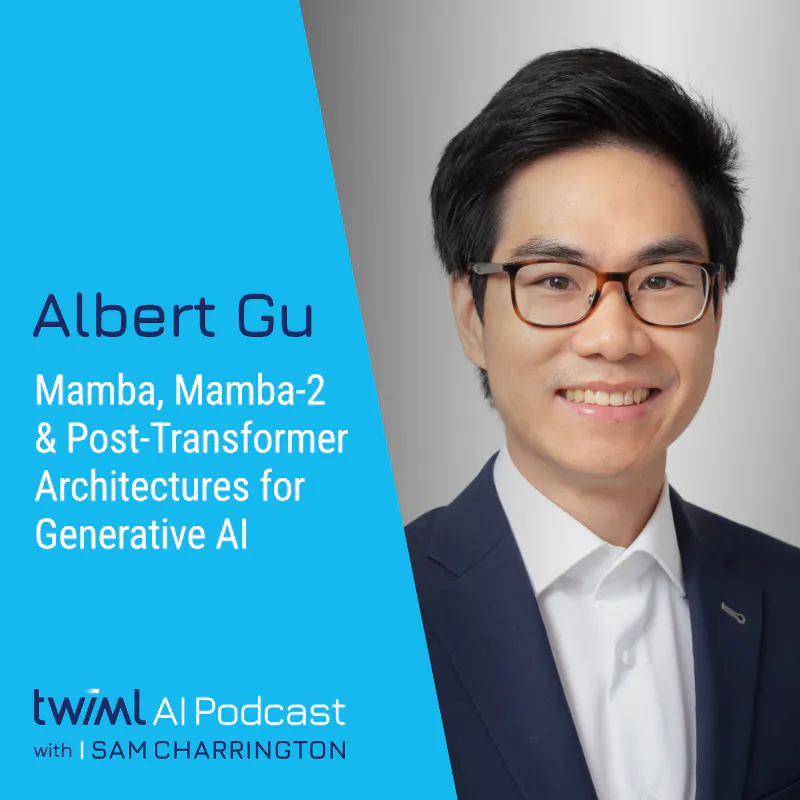
Mamba, Mamba-2 and Post-Transformer Architectures for Generative AI with Albert Gu - #693 episode artwork

EPISODE · Jul 17, 2024 · 57 MIN

Mamba, Mamba-2 and Post-Transformer Architectures for Generative AI with Albert Gu - #693

from The TWIML AI Podcast (formerly This Week in Machine Learning & Artificial Intelligence) · host Sam Charrington

Today, we're joined by Albert Gu, assistant professor at Carnegie Mellon University, to discuss his research on post-transformer architectures for multi-modal foundation models, with a focus on state-space models in general and Albert’s recent Mamba and Mamba-2 papers in particular. We dig into the efficiency of the attention mechanism and its limitations in handling high-resolution perceptual modalities, and the strengths and weaknesses of transformer architectures relative to alternatives for various tasks. We dig into the role of tokenization and patching in transformer pipelines, emphasizing how abstraction and semantic relationships between tokens underpin the model's effectiveness, and explore how this relates to the debate between handcrafted pipelines versus end-to-end architectures in machine learning. Additionally, we touch on the evolving landscape of hybrid models which incorporate elements of attention and state, the significance of state update mechanisms in model adaptability and learning efficiency, and the contribution and adoption of state-space models like Mamba and Mamba-2 in academia and industry. Lastly, Albert shares his vision for advancing foundation models across diverse modalities and applications. The complete show notes for this episode can be found at https://twimlai.com/go/693.

Today, we're joined by Albert Gu, assistant professor at Carnegie Mellon University, to discuss his research on post-transformer architectures for multi-modal foundation models, with a focus on state-space models in general and Albert’s recent Mamba and Mamba-2 papers in particular. We dig into the efficiency of the attention mechanism and its limitations in handling high-resolution perceptual modalities, and the strengths and weaknesses of transformer architectures relative to alternatives for various tasks. We dig into the role of tokenization and patching in transformer pipelines, emphasizing how abstraction and semantic relationships between tokens underpin the model's effectiveness, and explore how this relates to the debate between handcrafted pipelines versus end-to-end architectures in machine learning. Additionally, we touch on the evolving landscape of hybrid models which incorporate elements of attention and state, the significance of state update mechanisms in model adaptability and learning efficiency, and the contribution and adoption of state-space models like Mamba and Mamba-2 in academia and industry. Lastly, Albert shares his vision for advancing foundation models across diverse modalities and applications. The complete show notes for this episode can be found at https://twimlai.com/go/693.

NOW PLAYING

Mamba, Mamba-2 and Post-Transformer Architectures for Generative AI with Albert Gu - #693

0:00 57:54

No transcript for this episode yet

We transcribe on demand. Request one and we'll notify you when it's ready — usually under 10 minutes.

Frequently Asked Questions

How long is this episode of The TWIML AI Podcast (formerly This Week in Machine Learning & Artificial Intelligence)?

This episode is 57 minutes long.

When was this The TWIML AI Podcast (formerly This Week in Machine Learning & Artificial Intelligence) episode published?

This episode was published on July 17, 2024.

What is this episode about?

Today, we're joined by Albert Gu, assistant professor at Carnegie Mellon University, to discuss his research on post-transformer architectures for multi-modal foundation models, with a focus on state-space models in general and Albert’s recent Mamba...

Can I download this The TWIML AI Podcast (formerly This Week in Machine Learning & Artificial Intelligence) episode?

Yes, you can download this episode by clicking the download button on the episode player, or subscribe to the podcast in your preferred podcast app for automatic downloads.
URL copied to clipboard!