
EPISODE · May 2, 2025 · 10 MIN
Mark Lemon (1809–1870): The Humorist Who Institutionalized Satire in Print
from The Cogitating Ceviché Podcast · host Conrad T Hannon
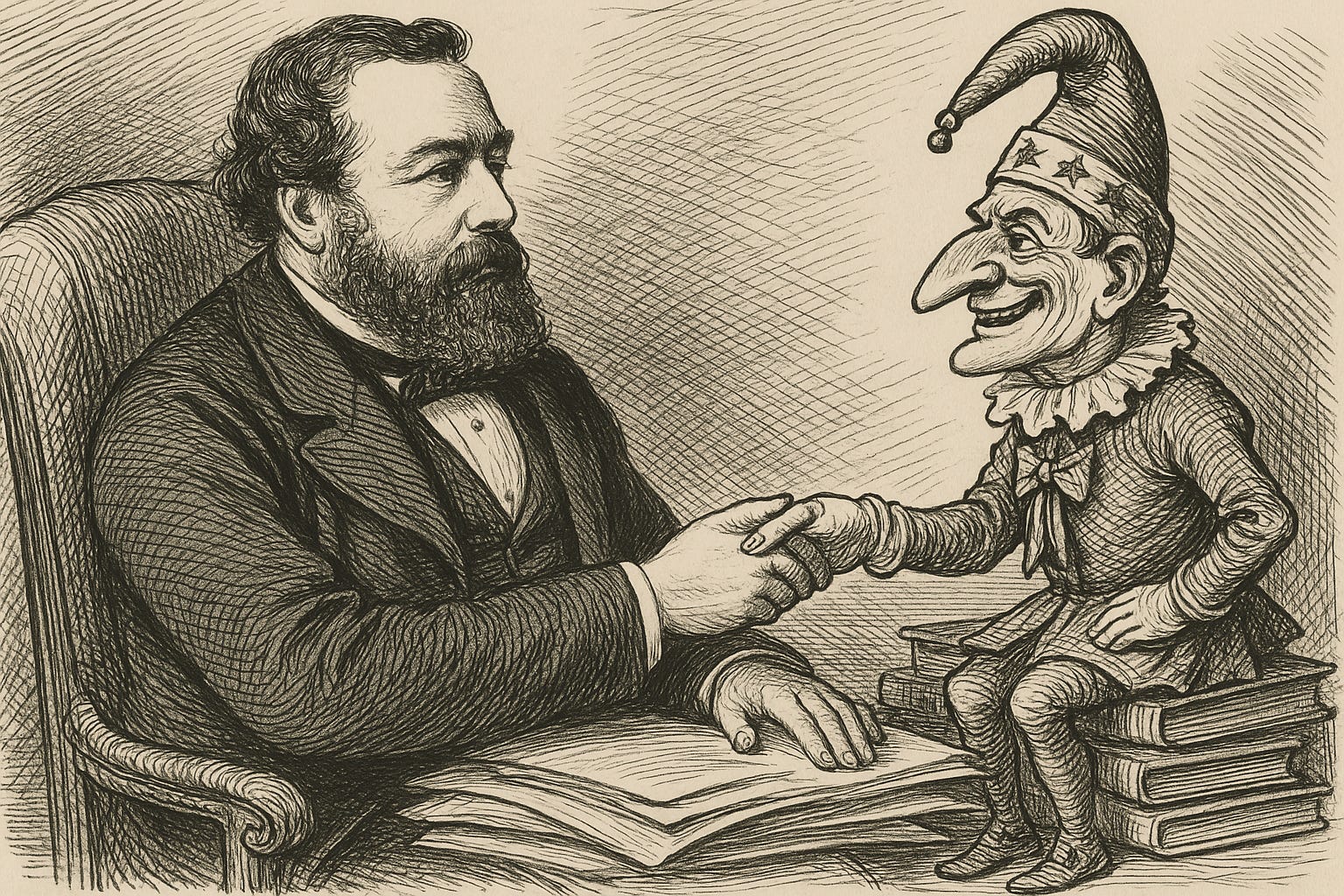
The Cogitating CevichePresents Mark Lemon (1809–1870): The Humorist Who Institutionalized Satire in Print75th Entry – Honoring the Satirists and Thinkers Who Altered Our Perspectives By Conrad Hannon Narration by Amazon PollyPrefaceTo understand how satire gained its foothold in the public consciousness of Victorian Britain, one must look to Punch—not merely a magazine, but a cultural institution that reframed how a nation laughed at its own absurdities. And behind its establishment stood a man who, though less flamboyant than some of the writers and artists he published, exerted quiet but profound influence: Mark Lemon. As founding editor of Punch, Lemon helped codify satire into the language of journalism. He led with a steady editorial hand, a sense of theatrical timing honed from years in drama, and a sharp instinct for how humor could puncture the swollen egos of the age. While his name may not elicit immediate recognition today, his legacy can be traced in every editorial cartoon, every satirical column, and every magazine that uses wit to question power.Early Life and InfluencesMark Lemon was born on November 30, 1809, in London, into a family of modest but respectable means. His father, a hop merchant, died when Mark was still a child, leaving the family in financial hardship. This early brush with economic precarity—coupled with the forced move from urban to rural life and back again—offered him a layered view of class distinctions and the fragile scaffolding of social status. The family relocated to Lincolnshire to live with relatives, and the contrast between London’s energetic urbanism and the slow rhythms of the countryside shaped Lemon’s understanding of Britain as a country with one foot in tradition and another in rapidly advancing modernity.His formal education at Cheam School was brief. Family finances required him to work early, which he did with industriousness and a touch of theatricality. From an early age, he demonstrated a knack for both writing and performance. He wrote poetry, plays, and sentimental tales, submitting them to magazines and theaters, gradually building a reputation as a reliable—if not always radical—entertainer. These years of grinding work were invaluable: he gained fluency in the conventions of serialized storytelling, learned to write on deadline, and, perhaps most importantly, developed a nose for what audiences found funny, comforting, or provocative.By the 1830s, Lemon had become a well-established playwright and contributor to periodicals. He wasn’t yet revolutionary, but he was gaining traction among readers and editors as a skilled wordsmith who could blend humor with narrative clarity. His plays, though often moralistic in tone, frequently featured stock characters, exaggerated situations, and farcical reversals—all early training grounds for the satirical instincts that would later blossom in Punch.Major Works and ThemesThe Birth of PunchIn 1841, Lemon co-founded Punch, or The London Charivari, alongside publisher Henry Mayhew and engraver Ebenezer Landells. The title was a deliberate nod to Le Charivari, the French satirical magazine, but Punch soon developed its own distinctly British voice—urbane, whimsical, ironical, and unmistakably Victorian in its preoccupations.Lemon’s role was not simply administrative. As editor, he curated tone, mentored contributors, and managed the balance between comedic entertainment and political commentary. He created a forum where the best illustrators and writers of the time—such as John Leech, William Makepeace Thackeray, Shirley Brooks, and eventually John Tenniel—could ply their trade in the service of something more pointed than idle amusement. Lemon's editorial touch ensured that while Punch could be savage, it was rarely mean-spirited; while it mocked pretension and power, it did so with an implicit moral compass.Satirizing the Victorian MachineUnder Lemon, Punch turned a knowing eye on the contradictions of British society. Industrialization, empire, rigid class structures, the hypocrisies of Parliament—all were fair game. The magazine excelled at lampooning the disjunctions of a society that claimed to be rational and moral while tolerating child labor, colonial violence, and extreme social stratification.Political cartoons became the magazine’s calling card. Though Lemon was not himself a cartoonist, he elevated the form to a major journalistic genre. He coordinated closely with artists and writers to pair images with biting captions and narratives, introducing visual satire to an audience more accustomed to long-winded editorials. The term "cartoon" in its modern sense—meaning a humorous or satirical drawing—was popularized by Punch under his leadership.Lemon understood that humor alone was not enough; it needed an aim. Whether skewering Lord Palmerston or lampooning social climbers and bureaucrats, Punch used wit to spotlight absurdity and encourage reform. It held a mirror to the inconsistencies of the age, from the empty pieties of the wealthy to the pomposity of the newly literate middle class.Humor With a ConscienceWhile Punch often targeted the follies of politicians and high society, Lemon ensured it retained a basic sympathy for the common man. The magazine’s jokes rarely punched down. Instead, it exposed the ways systems—be they governmental, ecclesiastical, or industrial—created or exacerbated suffering. Punch took a stance on issues like sanitation reform, public education, and the plight of urban workers, albeit with a light touch that kept it palatable to a wide readership.One of the defining elements of Lemon’s editorial ethos was his belief that humor could elevate rather than degrade. He did not equate vulgarity with insight. He preferred the gently mocking smile to the guffaw of cruelty. In this, he laid the foundation for a style of satire that prized intelligence and restraint—what might today be called Horatian, but with occasional flashes of Juvenalian bite when provoked.Theatrical Roots and Literary Cross-PollinationLemon’s roots in the theater were crucial to his approach. He viewed satire as performance: timing, rhythm, and audience engagement mattered as much as ideological content. He authored over sixty plays—comedies, melodramas, and adaptations—which often featured exaggerated characters and moral quandaries. These dramatic instincts informed his pacing and structure as an editor. Punch issues often read like carefully composed acts, with rising tension, comedic climax, and thematic resolution.Beyond Punch, Lemon contributed to other journals, wrote Christmas stories with Charles Dickens, and co-founded the Guild of Literature and Art. His collaborations with Dickens were especially notable, not only for their mutual respect but also for their shared belief that humor had an ethical function. They both saw storytelling—and by extension satire—as a vehicle for stirring empathy as much as laughter.Controversies and CriticismsLemon's tenure was not without challenge. In the early years, Punch flirted with financial failure. It was sustained in part by the revenues from Lemon’s own theatrical work and by the shrewd business sense of his co-founders. The magazine also drew its share of ire from public figures who felt its barbs too pointed or its portrayals unjust.Some critics found Punch too safe, too middle-class in its moral sensibilities. It rarely went for the jugular in the way radical papers did. Others charged Lemon with being overly cautious, particularly in foreign affairs, where the magazine's positions often aligned with establishment sentiments. But it was this very equilibrium—between provocation and respectability—that enabled Punch to last. Lemon knew the boundaries of acceptability and how far to push them without losing his audience or provoking censure.Ironically, what some saw as timidity could also be interpreted as strategic brilliance. Lemon understood that for satire to reach broad readership and influence real conversations, it had to wear the mask of decorum even as it whispered subversion.Impact and LegacyWhen Mark Lemon died in 1870, he left behind more than a successful magazine; he left behind a blueprint. Punch under his leadership had created a hybrid genre—part political forum, part literary revue, part visual comedy showcase. It was a model replicated across Europe and North America in publications like Puck, Judge, and later The New Yorker.His influence also extended into the evolution of editorial cartoons. Before Punch, caricature had been a lower art, often associated with libel or scandal. Lemon helped elevate it, not just in aesthetic terms, but in moral ones. Cartoons became a way to contribute to national debate, to encapsulate hypocrisy in a single frame, to tell a joke that mattered.Lemon’s commitment to style, clarity, and wit helped shape Victorian literary culture. He mentored many young writers, opened doors for illustrators, and modeled how editors could both steer and serve the creative voices around them.Though Punch would change under later editors—becoming more conservative, more insular—it never lost the structure Lemon gave it. His belief in satire as a civilizing force, one that pokes holes in pomposity but resists descending into nihilism, remains an ideal for editorial humorists to this day.ConclusionMark Lemon is proof that editorial influence can be as revolutionary as artistic genius. He didn't shout; he shaped. He didn’t scandalize; he sustained. As the founding editor of Punch, he created a platform that mocked, moralized, and mirrored its society—one laugh at a time. His legacy lies not only in the jokes printed under his watch but in the enduring idea that satire, when wielded with skill and conscience, is one of the most effective tools a society has to examine itself.In honoring Mark Lemon, we acknowledge the architect behind a century of British wit and remember that every great satirical institution begins with a man willing to print the joke that might change how a nation sees itself.Thank you for your time today. Until next time, stay gruntled. This is a public episode. If you'd like to discuss this with other subscribers or get access to bonus episodes, visit thecogitatingceviche.substack.com/subscribe
Embed this episode
NOW PLAYING
Mark Lemon (1809–1870): The Humorist Who Institutionalized Satire in Print
No transcript for this episode yet
Similar Episodes
No similar episodes found.
Similar Podcasts
No similar podcasts found.