
EPISODE · Jun 16, 2026 · 20 MIN
Market Targets and Biological Scaling Limits
from Biomanufacturing & Fermentation Technology · host prasad ernala
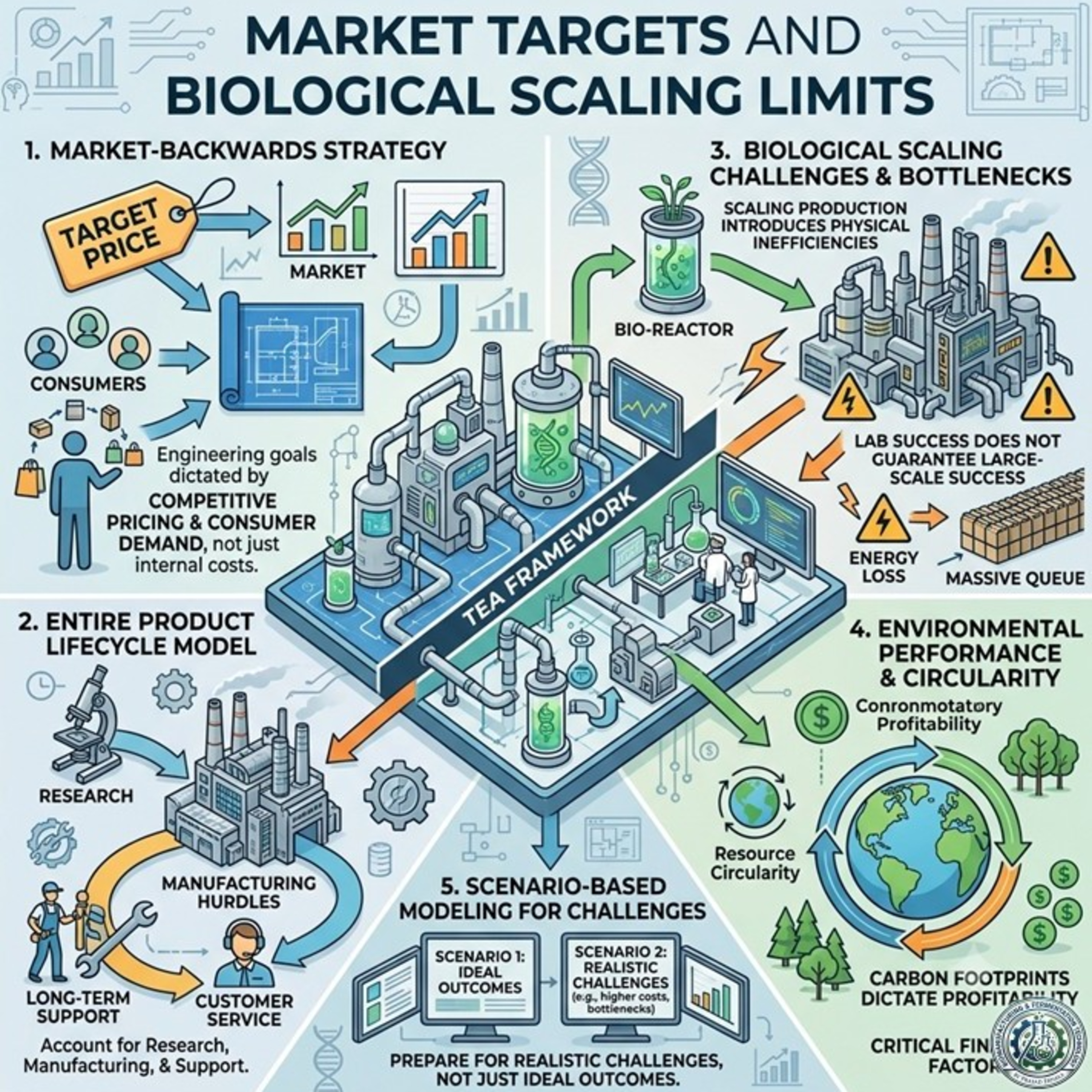
The provided episode outlines a modern framework for techno-economic analysis (TEA), emphasizing that industrial success requires more than just basic cost estimation. This approach advocates for a market-backwards strategy where engineering goals are dictated by competitive pricing and consumer demand rather than internal production costs. A viable economic model must account for the entire lifecycle of a product, including research, manufacturing hurdles, and long-term support. Furthermore, the text warns that scaling production introduces physical inefficiencies and bottlenecks that are often overlooked in initial theories. Environmental performance is also highlighted as a critical financial factor, suggesting that carbon footprints and resource circularity will soon dictate profitability. Ultimately, the source suggests that projects should utilize scenario-based modeling to prepare for realistic challenges instead of relying solely on ideal outcomes.#Science#Bioprocess #ScaleUp and #TechTransfer,#Industrial #Microbiology,#MetabolicEngineering and #SystemsBiology,#Bioprocessing,#MicrobialFermentation,#Bio-manufacturing,#Industrial #Biotechnology,#Fermentation Engineering,#ProcessDevelopment,#Microbiology,#Biochemistry,#Biochemical Engineering, #Applied #MicrobialPhysiology, #Microbial #ProcessEngineering, #Upstream #BioprocessDevelopment, #Downstream Processing and #Purification,#CellCulture and #MicrobialSystems Engineering, #Bioreaction #Enzymes, #Biocatalyst #scientific #Scientist #Research
What this episode covers
The provided episode outlines a modern framework for techno-economic analysis (TEA), emphasizing that industrial success requires more than just basic cost estimation. This approach advocates for a market-backwards strategy where engineering goals are dictated by competitive pricing and consumer demand rather than internal production costs. A viable economic model must account for the entire lifecycle of a product, including research, manufacturing hurdles, and long-term support. Furthermore, the text warns that scaling production introduces physical inefficiencies and bottlenecks that are often overlooked in initial theories. Environmental performance is also highlighted as a critical financial factor, suggesting that carbon footprints and resource circularity will soon dictate profitability. Ultimately, the source suggests that projects should utilize scenario-based modeling to prepare for realistic challenges instead of relying solely on ideal outcomes.#Science#Bioprocess #ScaleUp and #TechTransfer,#Industrial #Microbiology,#MetabolicEngineering and #SystemsBiology,#Bioprocessing,#MicrobialFermentation,#Bio-manufacturing,#Industrial #Biotechnology,#Fermentation Engineering,#ProcessDevelopment,#Microbiology,#Biochemistry,#Biochemical Engineering, #Applied #MicrobialPhysiology, #Microbial #ProcessEngineering, #Upstream #BioprocessDevelopment, #Downstream Processing and #Purification,#CellCulture and #MicrobialSystems Engineering, #Bioreaction #Enzymes, #Biocatalyst #scientific #Scientist #Research
NOW PLAYING
Market Targets and Biological Scaling Limits
No transcript for this episode yet
Similar Episodes
Apr 21, 2026 ·13m
Apr 19, 2026 ·16m
Apr 17, 2026 ·13m
Apr 13, 2026 ·11m
Apr 11, 2026 ·16m