
EPISODE · Dec 3, 2024 · 11 MIN
Mary Anning: Fossil Hunter in the Age of Extinction and Evolution
from The Cogitating Ceviché Podcast · host Conrad T Hannon
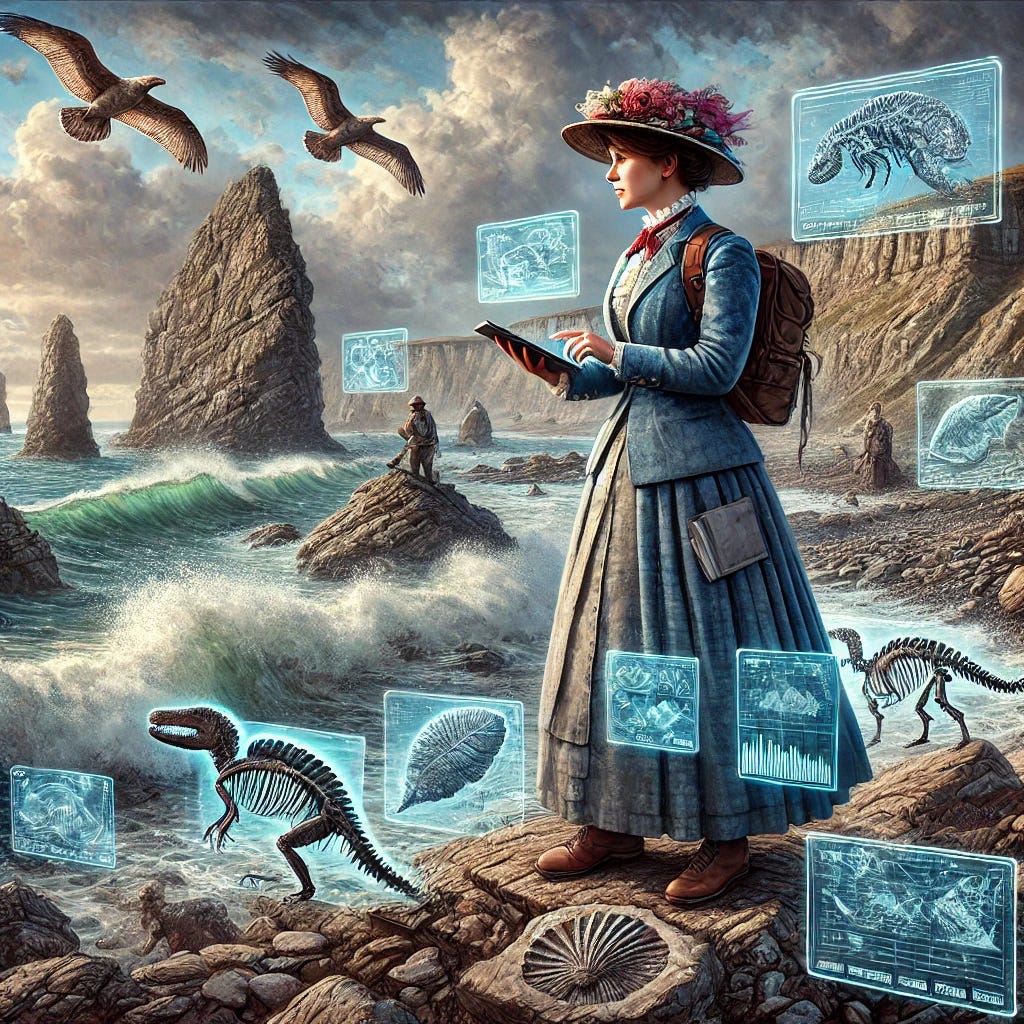
The Cogitating CevichePresentsMary Anning: Fossil Hunter in the Age of Extinction and EvolutionPast Forward: Historical Icons in the Digital Frontier #37By Conrad HannonNarration by Amazon PollyPrefaceWelcome to the thirty-seventh entry in our ongoing series, Past Forward: Historical Icons in the Digital Frontier. This series explores how history’s most influential figures might interact with the modern world, imagining how their timeless talents and insights could shape contemporary society. In this installment, we bring Mary Anning—the pioneering fossil hunter and self-taught paleontologist—into the 21st century. Imagine Anning stepping into the fields of modern paleontology, climate change research, and genetic de-extinction, where her passion for uncovering the past takes on new dimensions in the fight to preserve Earth’s future. How would Mary Anning respond to the complexities of today’s environmental challenges, or the ethical debates surrounding de-extinction? Let us accompany Mary Anning as she unearths insights into the ancient past and the modern world, leaving an enduring mark on how we understand our planet’s history and its fragile ecosystems.IntroductionMary Anning stands on the edge of a rugged cliff, staring out at a familiar yet transformed coastline. The waves crash against the rock formations, just as they did along England’s Jurassic Coast in her time. But here in the present, the world of paleontology has evolved into a complex tapestry of science, technology, and environmental concern. As she takes in her surroundings, she notices a team of researchers a few yards away, working with tools that look like something out of a dream—drones, ground-penetrating radar, and digital scanners mapping the cliffs she once scoured by hand.Anning, who became famous in the early 19th century for discovering fossils like the ichthyosaur and plesiosaur, was self-taught and largely unrecognized by scientific institutions of her time. Yet her finds reshaped the field of paleontology, challenging the prevailing views on Earth’s history and evolution. Now, standing among modern scientists, she’s captivated by the tools, theories, and ethical questions that guide the field she helped pioneer.With unbridled curiosity, Mary Anning prepares to dive into the depths of today’s paleontology, examining the mysteries of Earth’s history through the lens of modern technology, climate science, and genetics.The New Era of Fossil Discovery and Digital PaleontologyMary Anning’s first stop is a paleontological dig site, where she watches scientists using drones and high-resolution ground scanners to map fossil beds. These devices can detect fossils without disrupting the earth, allowing for less invasive excavation. The team explains how digital technology now enables the cataloging and analysis of entire ecosystems from millions of years ago. Anning watches in awe as a screen lights up with images of fossils detected underground, each mapped with stunning precision.Reflecting on her own experiences digging fossils out of the cliffs with her hands, Mary marvels at the accessibility these tools provide, recognizing that they allow for a level of detail that was beyond her wildest dreams. She recalls the long, dangerous hours spent hammering rock formations and the thrill of unearthing creatures that hadn’t seen light in millions of years. Yet these digital renderings offer a new kind of discovery—a holistic glimpse into prehistoric worlds, allowing scientists to reconstruct ancient ecosystems without removing a single rock.Anning quickly embraces the potential of these tools, advocating for their use in places where fossils might otherwise be inaccessible. She joins a research team digitizing an entire coastal area, amazed at how each scan can reveal layers of the past. But she also sees value in the hands-on work that first sparked her love for paleontology, cautioning her colleagues not to abandon the tactile aspects of fossil hunting. For her, the experience of touching and holding a fossil—a direct connection to an ancient world—remains an irreplaceable part of discovery.Climate Change Research and Ancient EcosystemsAs Mary delves into modern environmental science, she learns that paleontology is now a key discipline in understanding climate change. Scientists explain how fossil records reveal patterns of past climate shifts, extinction events, and ecosystem changes that can inform current climate models. Her discoveries—once isolated finds that fascinated Victorian audiences—are now pieces of a larger puzzle, helping researchers understand the impact of today’s warming climate on biodiversity and ecosystems.Anning is particularly captivated by studies on the Permian-Triassic extinction, an event that wiped out a majority of marine and terrestrial life. She learns that paleontologists study fossilized plant and animal remains from that time to understand how life rebounded after the “Great Dying.” Scientists explain that by understanding these ancient extinctions, they can better predict the resilience and vulnerability of modern species under stress from climate change.Inspired, Anning joins a team of climate researchers who study ancient ocean temperatures, collecting core samples from seabeds. She marvels at how these samples preserve layers of history, each centimeter of sediment revealing shifts in ocean chemistry, species composition, and temperatures. Mary’s eyes shine with excitement as she realizes that her work has a direct impact on understanding the future of Earth’s ecosystems. She sees herself not only as a fossil hunter but as a steward of the planet’s history and a protector of its future.Her passion for conservation grows as she immerses herself in these efforts, advocating for the use of fossil records to inform modern conservation policies. She works with ecologists, urging them to learn from ancient extinctions and develop strategies to protect vulnerable species today, knowing that the survival of life on Earth may depend on understanding the patterns hidden in rocks.Genetic De-Extinction and Ethical DilemmasAn unexpected opportunity arises when Anning is introduced to the world of genetic de-extinction—an emerging field that seeks to bring back extinct species using preserved DNA. She’s fascinated by the idea that science could potentially “resurrect” animals like the woolly mammoth or passenger pigeon. Researchers explain how ancient DNA can be extracted from well-preserved remains and combined with the genetic material of modern relatives to recreate extinct species, offering new tools for ecosystem restoration.Yet Anning is cautious. Her life’s work revolved around uncovering the natural history of Earth, understanding the ebb and flow of life across millennia. She questions the ethics of reintroducing species into environments that may no longer support them and wonders whether these species, separated from their natural contexts, could even survive. While the allure of seeing extinct creatures walk the earth again intrigues her, she worries that humanity’s desire for novelty may lead to unintended consequences.Mary debates these ideas passionately with geneticists, ultimately proposing that efforts should focus first on preserving endangered species before attempting de-extinction. She sees value in conserving modern biodiversity, arguing that the resources for de-extinction might be better spent protecting habitats that are disappearing. Her perspective prompts a thoughtful conversation in the scientific community about the ethical implications of genetic intervention and the responsibilities of scientists to prioritize sustainability over spectacle.Public Engagement and Education in PaleontologyMary Anning soon becomes a popular figure in the field, admired for her intuitive approach to fossil hunting and her deeply personal connection to the natural world. She’s invited to speak at museums and universities, where she shares her experiences and inspires students, especially young women, to pursue careers in science. Her talks cover not only the technical aspects of paleontology but also the importance of curiosity, resilience, and a hands-on connection to nature.One of her favorite activities becomes leading interactive fossil hunts with children and amateur fossil hunters, teaching them the art of “reading” rocks and recognizing ancient life forms embedded in stone. Her enthusiasm is infectious, and she quickly garners a following on social media, where she shares insights about paleontology, environmental stewardship, and the value of discovery. Through her posts and videos, she builds a community of nature lovers and budding scientists, reminding them that Earth’s story is written in the rocks, waiting for those who are willing to look.In a world where scientific fields often feel inaccessible, Mary’s accessible and warm approach brings people closer to paleontology. She emphasizes that the past is not merely a chapter in a textbook but a vibrant history that shapes our understanding of the present. Her legacy as a self-taught fossil hunter who dared to challenge established norms becomes an inspiration for anyone drawn to science, regardless of background or formal training.Conclusion: Mary Anning’s Enduring ImpactAs Mary Anning prepares to return to her own time, she reflects on the profound journey she has taken through modern science and the evolution of paleontology. Her experiences with digital tools, climate research, and ethical debates on genetic de-extinction have expanded her understanding of how fossils do more than tell us about the past—they hold clues to the future.Mary’s final words to her colleagues are filled with gratitude and a sense of responsibility. She urges them to continue seeking answers in the rocks, to respect the lessons embedded in Earth’s ancient history, and to use that knowledge to protect the future of life on our planet. Her legacy as a pioneer in paleontology lives on, reminding us that while the mysteries of the Earth may be ancient, our duty to uncover and preserve them is as urgent as ever.Mary Anning leaves the 21st century with a renewed sense of purpose, knowing that her passion for fossil hunting has evolved into a global mission—a mission that transcends time, reaching into the future as an unbreakable bond between humanity and the Earth itself.Thank you for your time today. Until next time, stay gruntled. This is a public episode. If you'd like to discuss this with other subscribers or get access to bonus episodes, visit thecogitatingceviche.substack.com/subscribe
Embed this episode
NOW PLAYING
Mary Anning: Fossil Hunter in the Age of Extinction and Evolution
No transcript for this episode yet
Similar Episodes
No similar episodes found.
Similar Podcasts
No similar podcasts found.