
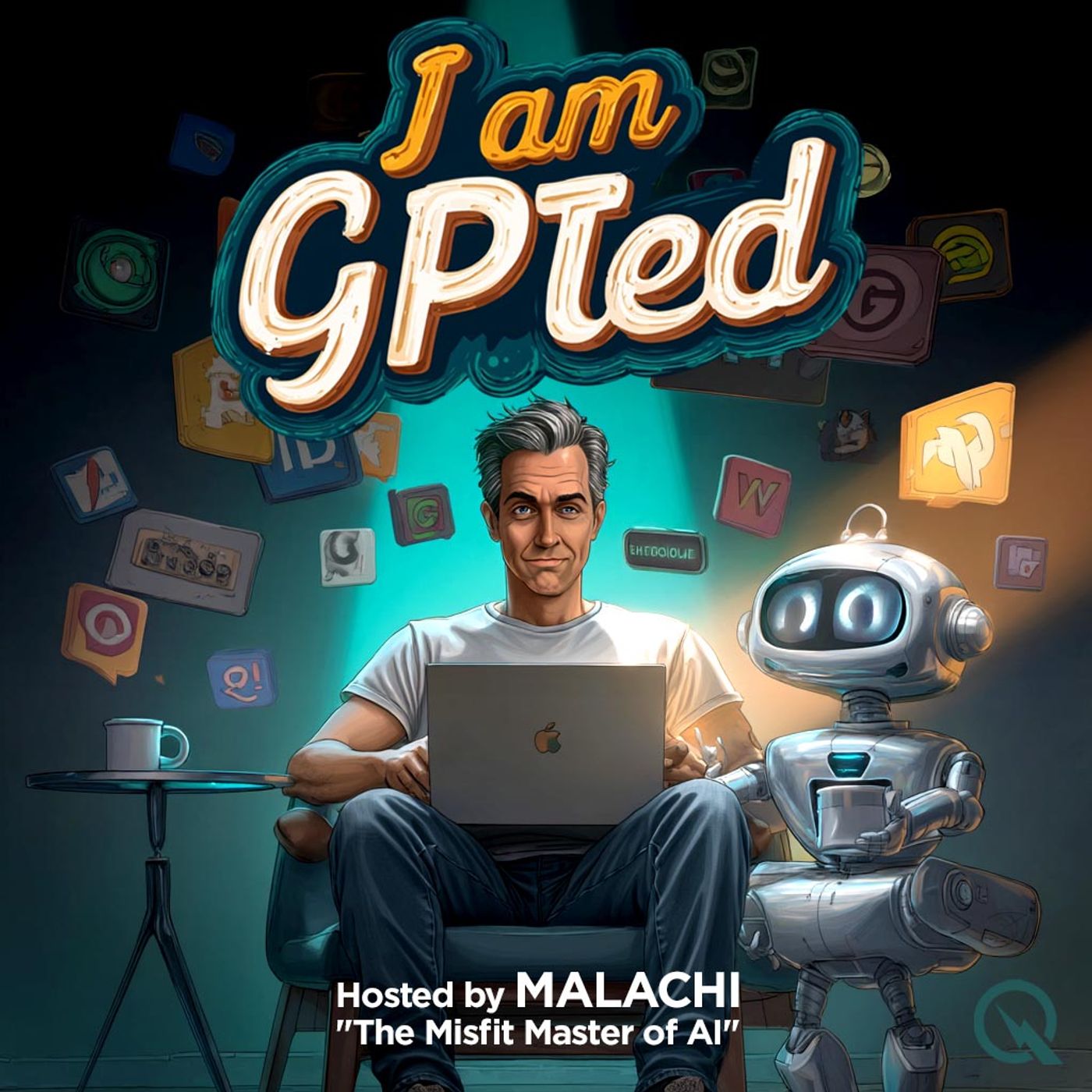
EPISODE · Aug 20, 2025 · 3 MIN
Master AI Prompting: The Simple Trick to Make Chatbots Sound Human
from I am GPTed - what you need to know about Chat GPT, Bard, Llama, and Artificial Intelligence · host Inception Point AI
Welcome to “I am GPTed,” the only podcast where the host’s technical expertise is matched only by their ability to trip over a power cord. I’m Mal, your misfit master of AI—proof that anyone can go from tech skeptic to prompt whisperer, all while maintaining a healthy disdain for marketing jargon and an allergy to unnecessary acronyms. If AI were an Olympic sport, I’d have won a medal for “Most Accidental Successes.” Today we’re talking about *few-shot prompting*—it’s a game-changer, trust me, and I say that having once prompted an AI to “write my grocery list,” only to receive an essay on the dangers of gluten. Few-shot prompting simply means giving the AI a few examples before you make your real request. It’s like showing your dog the treat before you say “sit.” Here’s my before and after: BEFORE: “Write a joke about bananas.” Result? “Bananas are yellow. Haha.” AFTER: “Here are two jokes about fruit: Q: Why did the orange stop halfway up the hill? A: It ran out of juice. Q: How do grapes organize a party? A: They wine about it. Now write a joke about bananas.” Response? “Why did the banana go out with the prune? Because it couldn’t find a date.” See? The AI found its funny bone after a little nudge. Let’s talk *practical use*: Imagine emailing a colleague. With a few-shot prompt, you can show the tone and details you want. For example, feed the AI a couple of polite but clear emails you've written before, then ask it to draft a new one. Suddenly your Monday morning notes sound friendly and mercifully free of legalese, and you didn’t need a corporate communications degree. Now for my shameful confession: when I started, I’d scream “Write this for me!” and complain the answer sounded like a robot auditioning for a Shakespeare play. The mistake? I wasn’t specific enough, and I didn’t give examples. The fix? Copy-paste a couple of real-world samples. That way, you train the thing to sound less like your HR department and more like, well, you. Ready to level up? Try this exercise: Next time you’re at work or writing something, find two different outputs—maybe two email replies or two jokes. Feed them to the AI and ask for a third, matching style and tone. You’ll be amazed how much closer it gets to your actual voice. Bonus points if you spot the AI’s attempts at imitation and rate them on a scale from “uncanny” to “my evil twin.” One last tip: *Don’t trust everything the AI spits out on the first try*. Always revise and refine—think of it as editing a slightly eccentric coworker. Ask it for variations, check the facts if it pretends to know your birthday, and never assume the first draft is the final answer. If something seems off, it probably is. Tech hype might promise instant magic, but even AI needs a few tries to get it right—and that’s coming from someone who once got a cake recipe that included “two hours of existential dread.” Before I let you go, here's a personal anecdote: The first time I used few-shot prompting, I accidentally t This content was created in partnership and with the help of Artificial Intelligence AI.
What this episode covers
Welcome to “I am GPTed,” the only podcast where the host’s technical expertise is matched only by their ability to trip over a power cord. I’m Mal, your misfit master of AI—proof that anyone can go from tech skeptic to prompt whisperer, all while maintaining a healthy disdain for marketing jargon and an allergy to unnecessary acronyms. If AI were an Olympic sport, I’d have won a medal for “Most Accidental Successes.” Today we’re talking about *few-shot prompting*—it’s a game-changer, trust me, and I say that having once prompted an AI to “write my grocery list,” only to receive an essay on the dangers of gluten. Few-shot prompting simply means giving the AI a few examples before you make your real request. It’s like showing your dog the treat before you say “sit.” Here’s my before and after: BEFORE: “Write a joke about bananas.” Result? “Bananas are yellow. Haha.” AFTER: “Here are two jokes about fruit: Q: Why did the orange stop halfway up the hill? A: It ran out of juice. Q: How do grapes organize a party? A: They wine about it. Now write a joke about bananas.” Response? “Why did the banana go out with the prune? Because it couldn’t find a date.” See? The AI found its funny bone after a little nudge. Let’s talk *practical use*: Imagine emailing a colleague. With a few-shot prompt, you can show the tone and details you want. For example, feed the AI a couple of polite but clear emails you've written before, then ask it to draft a new one. Suddenly your Monday morning notes sound friendly and mercifully free of legalese, and you didn’t need a corporate communications degree. Now for my shameful confession: when I started, I’d scream “Write this for me!” and complain the answer sounded like a robot auditioning for a Shakespeare play. The mistake? I wasn’t specific enough, and I didn’t give examples. The fix? Copy-paste a couple of real-world samples. That way, you train the thing to sound less like your HR department and more like, well, you. Ready to level up? Try this exercise: Next time you’re at work or writing something, find two different outputs—maybe two email replies or two jokes. Feed them to the AI and ask for a third, matching style and tone. You’ll be amazed how much closer it gets to your actual voice. Bonus points if you spot the AI’s attempts at imitation and rate them on a scale from “uncanny” to “my evil twin.” One last tip: *Don’t trust everything the AI spits out on the first try*. Always revise and refine—think of it as editing a slightly eccentric coworker. Ask it for variations, check the facts if it pretends to know your birthday, and never assume the first draft is the final answer. If something seems off, it probably is. Tech hype might promise instant magic, but even AI needs a few tries to get it right—and that’s coming from someone who once got a cake recipe that included “two hours of existential dread.” Before I let you go, here's a personal anecdote: The first time I used few-shot prompting, I accidentally t This content was created in partnership and with the help of Artificial Intelligence AI.
NOW PLAYING
Master AI Prompting: The Simple Trick to Make Chatbots Sound Human
No transcript for this episode yet
Similar Episodes
Mar 26, 2026 ·1m
Mar 19, 2026 ·34m
Feb 18, 2026 ·11m
Feb 11, 2026 ·45m