PodParley PodParley

Meet the author - Hugh Mackay

Hugh Mackay was in conversation with Alex Sloan o…

An episode of the Experience ANU podcast, hosted by Experience ANU, titled "Meet the author - Hugh Mackay" was published on November 17, 2025 and runs 59 minutes.

November 17, 2025 ·59m · Experience ANU

0:00 / 0:00

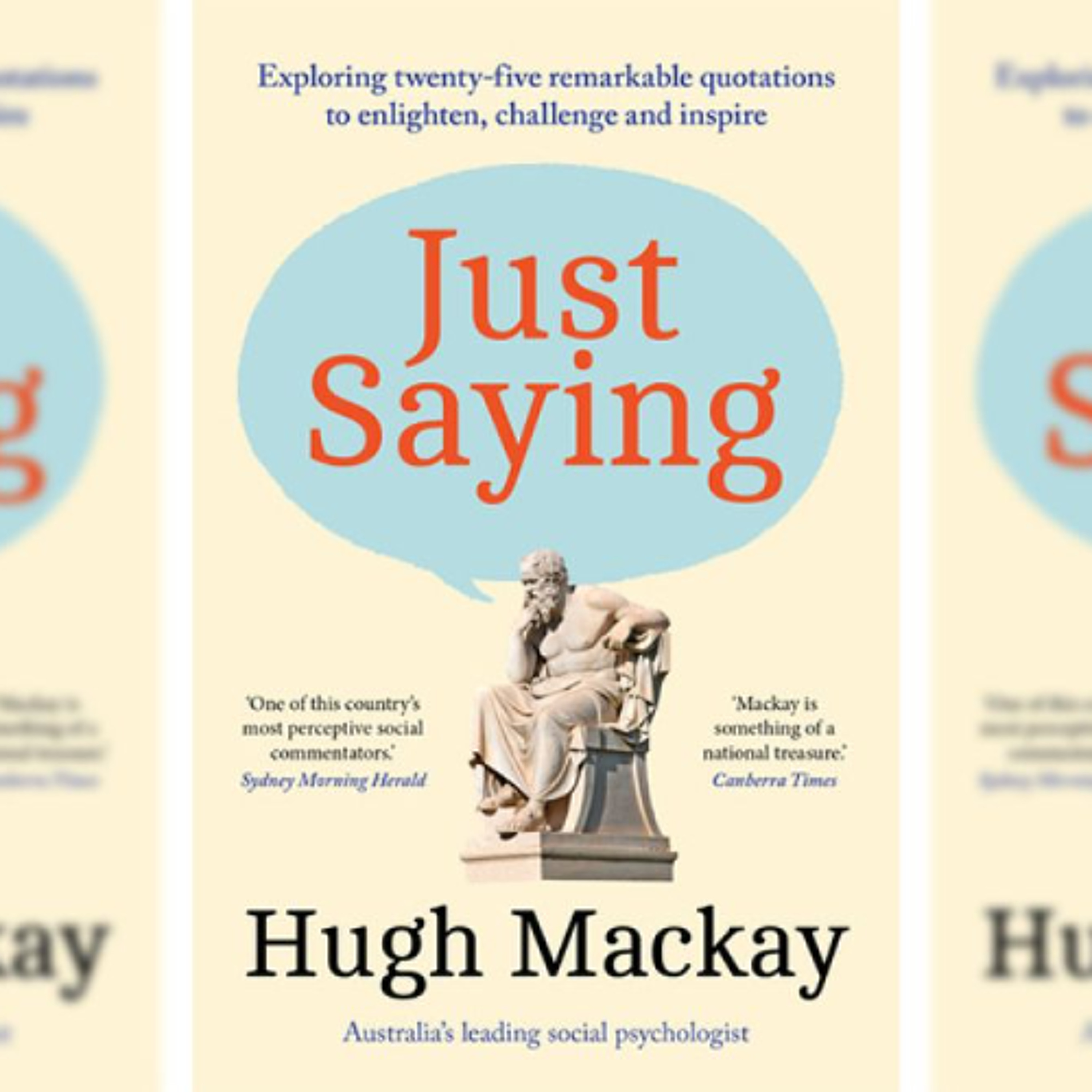
Hugh Mackay was in conversation with Alex Sloan on his new book Just Saying. Exploring twenty-five remarkable quotations to enlighten, challenge and inspire, in which Hugh reflects on profound sayings, ancient and modern. Warm, witty, wise – and occasionally challenging – Just Saying encapsulates Hugh Mackay's highly personal reflections on 25 quotations from some of the world's greatest thinkers and writers, from Confucius and Plato to Susan Sontag and Miles Franklin; from Samuel Johnson and Mary Wollstonecraft to Bertrand Russell and Gloria Steinem. Interpreting our world and inspiring us to do better, Hugh explores themes ranging from kindness and humility to power and prejudice; from gender equality to ethnic diversity; from coping with change to the damage inflicted on ourselves by revenge, and the great gulf between propriety and virtue. 'Writing these reflections has felt a bit like the beginning of a conversation . . . now it's over to you.' Hugh Mackay Hugh Mackay AO is a social psychologist and bestselling author. His non-fiction. including The Way We Are and The Kindness Revolution. covers social analysis, psychology, communication and ethics. He is also the author of nine novels. Hugh has had an over 60 year career in social research and was a weekly newspaper columnist for 25 years. He is a fellow of the Australian Psychological Society and the Royal Society of New South Wales and has been awarded honorary doctorates by five Australian universities. He is currently an honorary professor in the School of Medicine and Psychology at the Australian National University. Alex Sloan AM is an award winning journalist, panellist, MC and commentator whose extensive media career spans 30 years, including 27 years with ABC Radio. Alex is a Director and Deputy Chair of Australia's think-tank, The Australia Institute and a Director of The Winston Churchill Memorial Trust. In 2017 Alex was named ACT Citizen of the Year and in 2019 was made a Member of the Order of Australia. The vote of thanks was given by Frank Bongiorno AM, Professor of History ANU and President of the Council for the Humanities, Arts and Social Sciences

Hugh Mackay was in conversation with Alex Sloan on his new book Just Saying. Exploring twenty-five remarkable quotations to enlighten, challenge and inspire, in which Hugh reflects on profound sayings, ancient and modern. Warm, witty, wise – and occasionally challenging – Just Saying encapsulates Hugh Mackay's highly personal reflections on 25 quotations from some of the world's greatest thinkers and writers, from Confucius and Plato to Susan Sontag and Miles Franklin; from Samuel Johnson and Mary Wollstonecraft to Bertrand Russell and Gloria Steinem. Interpreting our world and inspiring us to do better, Hugh explores themes ranging from kindness and humility to power and prejudice; from gender equality to ethnic diversity; from coping with change to the damage inflicted on ourselves by revenge, and the great gulf between propriety and virtue. 'Writing these reflections has felt a bit like the beginning of a conversation . . . now it's over to you.' Hugh Mackay Hugh Mackay AO is a social psychologist and bestselling author. His non-fiction. including The Way We Are and The Kindness Revolution. covers social analysis, psychology, communication and ethics. He is also the author of nine novels. Hugh has had an over 60 year career in social research and was a weekly newspaper columnist for 25 years. He is a fellow of the Australian Psychological Society and the Royal Society of New South Wales and has been awarded honorary doctorates by five Australian universities. He is currently an honorary professor in the School of Medicine and Psychology at the Australian National University. Alex Sloan AM is an award winning journalist, panellist, MC and commentator whose extensive media career spans 30 years, including 27 years with ABC Radio. Alex is a Director and Deputy Chair of Australia's think-tank, The Australia Institute and a Director of The Winston Churchill Memorial Trust. In 2017 Alex was named ACT Citizen of the Year and in 2019 was made a Member of the Order of Australia. The vote of thanks was given by Frank Bongiorno AM, Professor of History ANU and President of the Council for the Humanities, Arts and Social Sciences
Interviews with Anupama Chopra Film Companion Anupama Chopra is a film critic, television anchor and book author. She has been writing about Bollywood since 1993. Her work has appeared in publications such as The New York Times, Hindustan Times, The Los Angeles Times and Vogue (India). Here you can find all of her interviews and conversations with Bollywood and Hollywood's leading actors and filmmakers. In short, everything you need to enhance your cinematic experience.Millions of listeners seek out Bingepods (Ideabrew Studios Network content) every day. Get in touch with us to advertise, join the network or click listen to  enjoy content by some of India's top audio [email protected] | Apple Taittriyaka Upanishad by Unknown Loyal Books The word Upanishad (upa-ni-shad) consists of, "Upa" means "near;" "ni" means "down;" "shad" means "to sit." Thus, Upanishad is to sit down near the teacher to discuss, learn, practice, and experience. There are some 200 or more Upanishads. Some are lost and are only known about because of being referenced in other Upanishads. Most of the Upanishads were kept secret for centuries, only passed on to others orally in the form of Shloka (a category of verse line developed from the Vedic Anustubh meter).Taittiriya is a Sanskrit word that means "from Tittiri". The root of this name has been interpreted in two ways: "from Vedic sage Tittiri" or a collection of verses from mythical students who became Tittiris (birds, partridges) in order to gain knowledge.This Upanishad is divided into three sections called Vallis: Siksha (Pronunciation /Instruction) Valli , Ananda (bliss of Brahman) Valli , and Bhrigu (son of Varuna, the god of all water elements) Valli.The chronology of Taittriyaka Upanish Katha Upanishad by Unknown Loyal Books The word Upanishad (upa-ni-shad) consists of, "Upa" means "near;" "ni" means "down;" "shad" means "to sit." Thus, Upanishad is to sit down near the teacher to discuss, learn, practice, and experience. There are some 200 or more Upanishads. Some are lost and are only known about because of being referenced in other Upanishads.Most of the Upanishads were kept secret for centuries, only passed on to others orally in the form of Shloka (a category of verse line developed from the Vedic Anustubh meter).Katha-Upanishad is one the 11 principal Upanishads. Its chronology is contested as being between fifth century BCE and 1st millennium BCE.Katha (Sanskrit: कठ) literally means "distress". Katha Upanishad uses words that symbolically embed and creatively have multiple meanings. For example, a closely pronounced word Katha (Sanskrit: कथा) literally means "story, legend, conversation, speech, tale". All of these related meanings are relevant to the Katha Upanishad.The text presents Death as the T Brihadaranyaka Upanishad Unknown The word Upanishad (upa-ni-shad) consists of, "Upa" means "near;" "ni" means "down;" "shad" means "to sit." Thus, Upanishad is to sit down near the teacher to discuss, learn, practice, and experience. There are some 200 or more Upanishads. Some are lost and are only known about because of being referenced in other Upanishads. Most of the Upanishads were kept secret for centuries, only passed on to others orally in the form of Shlokas (a category of verse line developed from the Vedic Anustubh meter).The Bṛhadāraṇyaka Upanishad (Sanskrit: बृहदारण्यक उपनिषद्) is one of the oldest, mukhya (primary) Upanishads. It is contained within the Shatapatha Brahmana (Brahmana is a collection of ancient Indian texts with commentaries on the Vedas.), which is itself a part of Shukla Yajur Veda. Brihad means great. Aryanka (Snskrit) आरण्यक means means pertaining to the forest. Aranyaka in the Upanishadic context refers to a treatise to be read or expounded by anchorites in the quiet of the fo
URL copied to clipboard!