
EPISODE · Feb 11, 2026 · 1H 22M
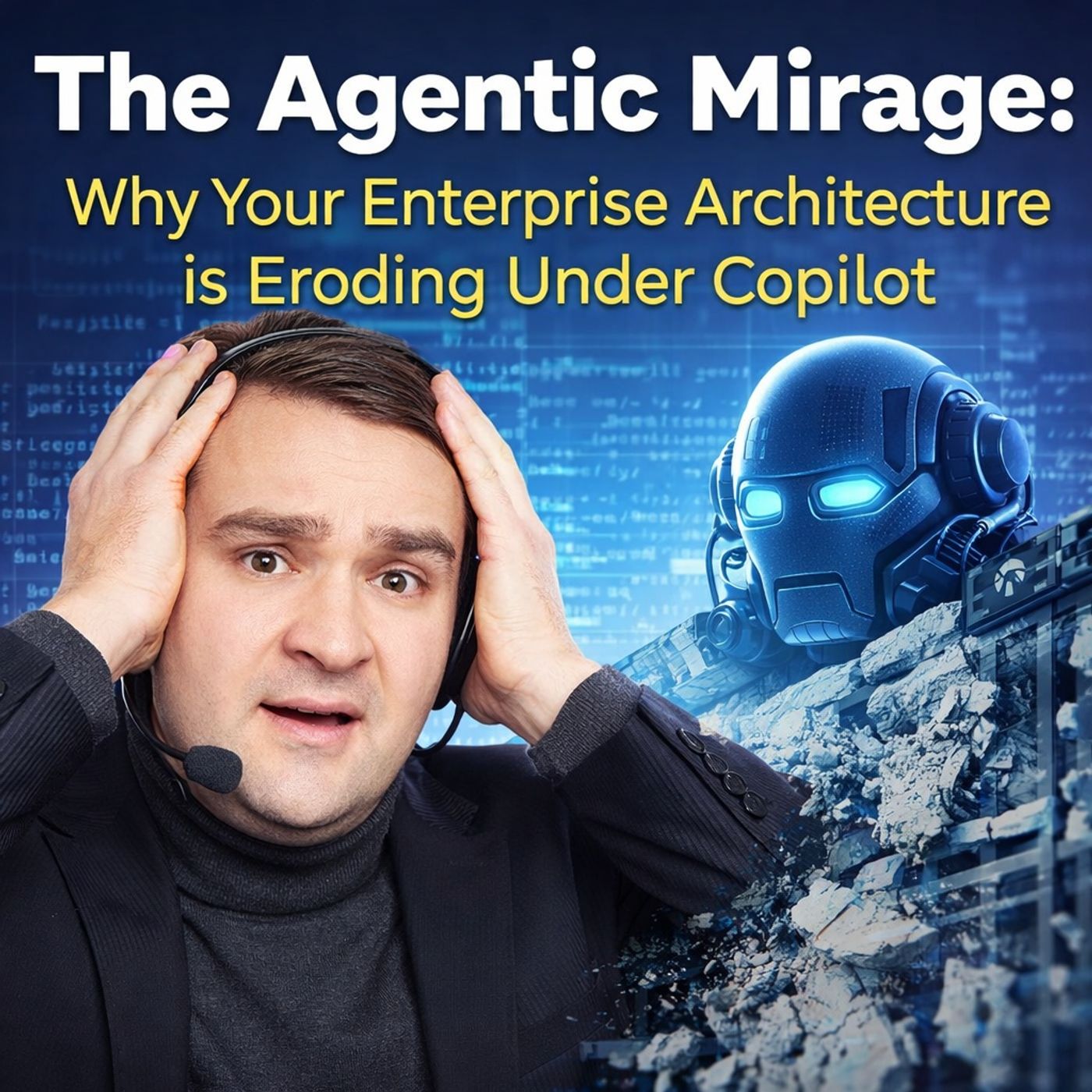
Microsoft Copilot Goes Agentic: Why Your Enterprise Architecture is Silently Eroding
from M365.FM - Modern work, security, and productivity with Microsoft 365 · host Mirko Peters - Founder of m365.fm, m365.show and m365con.net
In this episode of m365.fm, Mirko Peters explains what most organizations miss the moment Microsoft Copilot stops answering questions and starts taking actions. The assumption that Copilot is a better search box or a faster PowerPoint intern breaks down completely when agents become agentic — and authority starts multiplying across your Microsoft 365 tenant without anyone explicitly approving it.Agentic behavior is not a feature you opt into. It is a state your Microsoft 365 environment enters the moment Copilot can trigger workflows, access data, modify documents, or initiate processes autonomously. When that happens without architectural safeguards, you are not running an AI assistant anymore. You are running a distributed decision system that your governance model was never designed to control.WHAT YOU WILL LEARNWhat agentic behavior in Microsoft Copilot actually means for your enterprise architectureHow authority multiplies silently across Microsoft 365 when agents act without explicit approvalWhat the three critical failure modes are that shut down agentic Copilot programs in enterprisesHow to design safeguards in Microsoft 365 that let agents scale without eroding governanceWhat a Minimal Viable Agent architecture looks like for Microsoft 365 enterprise environmentsWhy most Microsoft 365 governance models are not designed to handle agentic AI behaviorTHE CORE INSIGHTThe shift from Copilot-as-assistant to Copilot-as-agent is not a product update. It is an architectural transition that most enterprises are unprepared for. When an agent can act — not just respond — every decision boundary, permission model, and governance framework in your Microsoft 365 environment is suddenly load-bearing. If those boundaries were never explicitly designed, the agent will find the gaps and operate through them.The Agentic Mirage is the belief that because Copilot feels controlled — because it shows you its outputs, because it asks for confirmation, because it looks like a chat interface — the architecture underneath is safe. It is not. Safety in agentic Microsoft 365 systems is not a UX property. It is an engineering property. It requires explicit scope, defined ownership, observable behavior, and a governance model that was designed for autonomous execution, not human workflows.WHY AGENTIC COPILOT ERODES ENTERPRISE ARCHITECTUREMicrosoft 365 permissions were designed for human users, not for agents with autonomous execution scopeThere is no ownership model for what an agent is allowed to decide, modify, or triggerCopilot agents operate across Microsoft Graph, SharePoint, Teams, and Power Automate without unified governanceObservability gaps mean agent behavior is only visible after it has already caused side effectsGovernance teams are not involved in agent design because agents are treated as productivity tools, not infrastructureKEY TAKEAWAYSAgentic Copilot behavior requires architectural safeguards that most Microsoft 365 environments do not haveAuthority multiplication is the most dangerous and least visible risk of agentic AI in Microsoft 365A Minimal Viable Agent architecture defines scope, ownership, and observability before deploymentMicrosoft 365 governance must be redesigned for autonomous execution, not adapted from human workflow modelsThe question is not whether your agents work — it is whether your architecture can govern them when they doWHO THIS EPISODE IS FOREnterprise architects and IT leaders responsible for Microsoft 365 and Copilot governanceSecurity and compliance teams evaluating the risks of agentic AI inside Microsoft 365Microsoft 365 platform owners designing safeguards for Copilot Studio agent deploymentsAnyone responsible for ensuring that AI autonomy in Microsoft 365 stays within defined boundariesTOPICS COVEREDAgentic Microsoft Copilot Architecture & Governance DesignMicrosoft 365 Authority Boundaries & Agent Scope ControlCopilot Studio Safeguards & Minimal Viable Agent DesignMicrosoft Graph Permissions for Agentic AI SystemsEnterprise Governance for Autonomous Copilot BehaviorABOUT THE HOSTMirko Peters is a Microsoft 365 expert, architect, and host of m365.fm. He works with organizations from small businesses to large enterprise environments, focusing on Microsoft 365 architecture, security, AI integration, governance design, and system architecture. His work centers on designing context-driven systems that reduce complexity, enable autonomous execution, and create scalable performance across modern enterprises.Become a supporter of this podcast: https://www.spreaker.com/podcast/m365-fm-modern-work-security-and-productivity-with-microsoft-365--6704921/support.
Embed this episode
NOW PLAYING
Microsoft Copilot Goes Agentic: Why Your Enterprise Architecture is Silently Eroding
No transcript for this episode yet
Similar Episodes
No similar episodes found.
Similar Podcasts
No similar podcasts found.