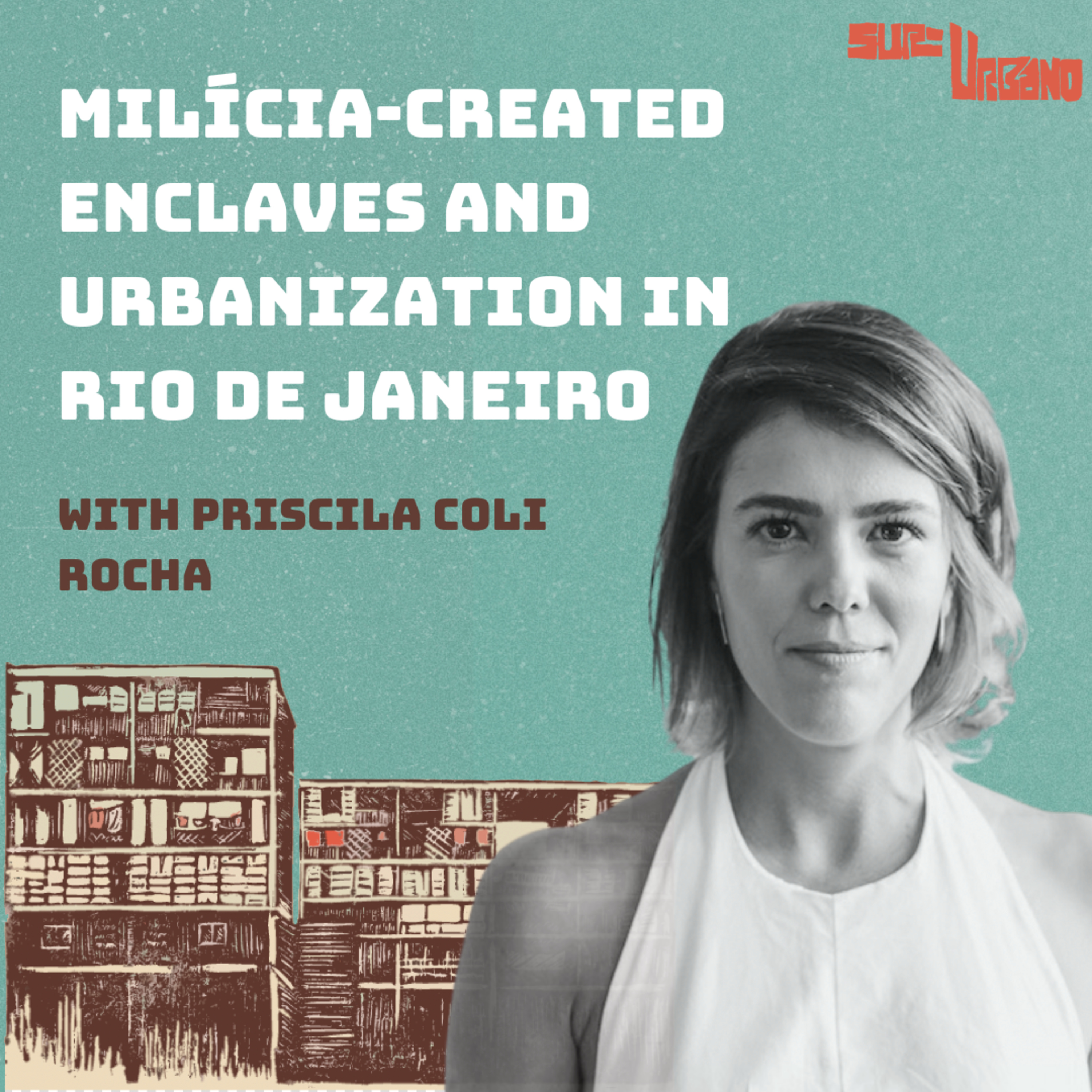
Milícia-created Enclaves and Urbanization in Rio de Janeiro with Priscila Coli Rocha episode artwork

EPISODE · Apr 30, 2026 · 1H 15M

Milícia-created Enclaves and Urbanization in Rio de Janeiro with Priscila Coli Rocha

from Sur-Urbano · host Latin American Cities Working Group

In today’s episode, we look at the the criminal actorsshaping urban enclaves in Rio. I wanted to provide a little backstory, because this actually connects to work and research I was deeply involved with before starting my PhD. As part of the bureaucratic deployment resulting from the 2016 peace agreements signed between the armed revolutionary forces of Colombia (FARC) and the Santos government in Colombia, I was lucky enough to live in the amazon region of Caquetá on and off for several years. As I worked with coca-growers there in the Caguán region, I was researching the process of urbanization of the main city in the Colombian Amazon, Florencia after the coca boom of the 1970s, and I found that many of the newly created guerrillas of the period, including the FARC and the M-19, had included city-making in their political repertories and helped found one of the biggest informal neighborhoods of the city. A little later, I also researched the construction of hundreds of miles of road network by collaborations between the FARC, the local government, and coca communities in this same region.  I mention these because I think there is a risk ofthinking that criminal governance – and all its variants – are extra-ordinary and for that reason marginal phenomena. Like this is something that happens at the geographic and political margins of our cities and our countries, and that, while interesting, it ultimately is not that central to the praxis of urban planning, partly because it happens outside of the state.  I think this is wrong on both fronts. First of all, theseare not minor issues -  a recent cross-national study of 18 Latin American countries found that almost 15% of respondents lived under some form of criminal governance; which adds up to between 70 and 100 million people. Second, this is not something that happens “outside” thestate, but in relationship to it in ways that overlap, conflict, and relate in specific situated ways. My work with the Amazon cities and road networks showed me not only that the border between legal and illegal can be very porous, but ultimately that the process of state-formation can be intimately enmeshed with the governance of these armed actors.   Furthermore, “Planning” is not something only done withinCity government offices; or that the forms of territory-making outside of those offices lacks a logic or coherence. Instead, we need to seriously reckon with the fact thatin our Latin American cities, criminal organizations – as well as amultiplicity of other actors which also include the residents themselves – are all part what goes into making our cities; and that only by acknowledging this reality can we begin to think about what we should do about it. And in that context, I bring you Priscila Coli Rocha’s brilliant ethnography, titled Making the City, Making a Constituency:Milícias-created Enclaves and Urbanization in the Peripheries of Rio de Janeiro, Brazil. Priscilla undertook years of field work in Rio’s peripheries, where criminal governance of different actors, including the Milícias, has been an important phenomenon for decades now. Among her contributions, Priscilla argues that there is a typology of milícia which not only governs parts of the city, but with distinct origins and ways of operation that include the active production of enclaves in the city.  Priscila Coli holds a PhD in City and Regional Planning from theUniversity of California, Berkeley. She is currently an Assistant Professor at PUC-Rio and the Federal University of Rio de Janeiro, and her research focuses on the role of criminal organizations in urbanization processes in the Global South.

In today’s episode, we look at the the criminal actorsshaping urban enclaves in Rio. I wanted to provide a little backstory, because this actually connects to work and research I was deeply involved with before starting my PhD. As part of the bureaucratic deployment resulting from the 2016 peace agreements signed between the armed revolutionary forces of Colombia (FARC) and the Santos government in Colombia, I was lucky enough to live in the amazon region of Caquetá on and off for several years. As I worked with coca-growers there in the Caguán region, I was researching the process of urbanization of the main city in the Colombian Amazon, Florencia after the coca boom of the 1970s, and I found that many of the newly created guerrillas of the period, including the FARC and the M-19, had included city-making in their political repertories and helped found one of the biggest informal neighborhoods of the city. A little later, I also researched the construction of hundreds of miles of road network by collaborations between the FARC, the local government, and coca communities in this same region.  I mention these because I think there is a risk ofthinking that criminal governance – and all its variants – are extra-ordinary and for that reason marginal phenomena. Like this is something that happens at the geographic and political margins of our cities and our countries, and that, while interesting, it ultimately is not that central to the praxis of urban planning, partly because it happens outside of the state.  I think this is wrong on both fronts. First of all, theseare not minor issues -  a recent cross-national study of 18 Latin American countries found that almost 15% of respondents lived under some form of criminal governance; which adds up to between 70 and 100 million people. Second, this is not something that happens “outside” thestate, but in relationship to it in ways that overlap, conflict, and relate in specific situated ways. My work with the Amazon cities and road networks showed me not only that the border between legal and illegal can be very porous, but ultimately that the process of state-formation can be intimately enmeshed with the governance of these armed actors.   Furthermore, “Planning” is not something only done withinCity government offices; or that the forms of territory-making outside of those offices lacks a logic or coherence. Instead, we need to seriously reckon with the fact thatin our Latin American cities, criminal organizations – as well as amultiplicity of other actors which also include the residents themselves – are all part what goes into making our cities; and that only by acknowledging this reality can we begin to think about what we should do about it. And in that context, I bring you Priscila Coli Rocha’s brilliant ethnography, titled Making the City, Making a Constituency:Milícias-created Enclaves and Urbanization in the Peripheries of Rio de Janeiro, Brazil. Priscilla undertook years of field work in Rio’s peripheries, where criminal governance of different actors, including the Milícias, has been an important phenomenon for decades now. Among her contributions, Priscilla argues that there is a typology of milícia which not only governs parts of the city, but with distinct origins and ways of operation that include the active production of enclaves in the city.  Priscila Coli holds a PhD in City and Regional Planning from theUniversity of California, Berkeley. She is currently an Assistant Professor at PUC-Rio and the Federal University of Rio de Janeiro, and her research focuses on the role of criminal organizations in urbanization processes in the Global South.

NOW PLAYING

Milícia-created Enclaves and Urbanization in Rio de Janeiro with Priscila Coli Rocha

0:00 1:15:55

No transcript for this episode yet

We transcribe on demand. Request one and we'll notify you when it's ready — usually under 10 minutes.

Ils nous gavent ces écolos Raje Chronique réalisée par Jenny Bernard.« Ils nous gavent ces écolos » est l’émission pour celles et ceux qui écrasent les araignées car elles sont moches ou qu’elles font peur, qui pensent que les moustiques ne sont sur terre que pour piquer ou qui aiment les animaux, surtout bien cuits ! Ces épisodes de quelques minutes ont pour objectif de faire changer leur regard sur la biodiversité avec humour et légèreté ! On va refaire le monde X "En mode coach" Lola Bon. J’ai décidé d’aborder des sujets dont on ne parle pas, par peur du jugement de l’autre, par pudeur, par insignifiance, ou par manque d’envie.Le sexe est pourtant partout. Il fait partie intégrante des relations humaines, qu’elles soient amoureuses, amicales, professionnelles, cordiales ou même fortuites. Et pourtant, on n’en parle pas, ou pas assez, ou juste pas de la bonne manière.Moi, je veux parler du sexe, du vrai, celui qui est là, devant nous, et qu’on ignore…Bienvenue sur : On va refaire le monde X En mode coach. Et Merdre ! Martin Poirot Et Merdre ! Votre émission vivante consacrée aux spectacles du même genre !Découverte des coulisses de toute les formes de créations artistiques du spectacle vivant : mise en scène, scénographie, jeu, écriture, expositions... Dans chaque émission retrouvez un artiste, un spectacle, un lieu, ou un festival. Aussi disponible en vidéo sur YouTubeUne émission animée par Martin PoirotRéalisée par Zachary GuerenneurIllustrée par Carole MarietHébergé par Ausha. Visitez ausha.co/fr/politique-de-confidentialite pour plus d'informations. Hasheur Hasheur Bienvenue sur ma chaîne ! Je me présente, Owen Simonin (alias Hasheur), je vulgarise sur Youtube différentes technologies, techniques et stratégies complexes du monde du Business. Principalement à travers la Blockchain et les Cryptomonnaies (bitcoin), je décortique même les méthodes de paris en ligne, le trading et les autres types d'investissements ou rendements passifs. Mon objectif est de simplifier les sujets et les investissements les plus complexes du milieu afin de permettre à tous de ne rater aucune opportunité.

Frequently Asked Questions

How long is this episode of Sur-Urbano?

This episode is 1 hour and 15 minutes long.

When was this Sur-Urbano episode published?

This episode was published on April 30, 2026.

What is this episode about?

In today’s episode, we look at the the criminal actorsshaping urban enclaves in Rio. I wanted to provide a little backstory, because this actually connects to work and research I was deeply involved with before starting my PhD. As part of the...

Can I download this Sur-Urbano episode?

Yes, you can download this episode by clicking the download button on the episode player, or subscribe to the podcast in your preferred podcast app for automatic downloads.
URL copied to clipboard!