
EPISODE · Jan 27, 2026 · 14 MIN
Mrs. GREEN APPLE - Darling (ダーリン)Lyrics Meaning & Analysis | NHK 18 Fes
from Japan Lyric Room · host Japan Lyric Room
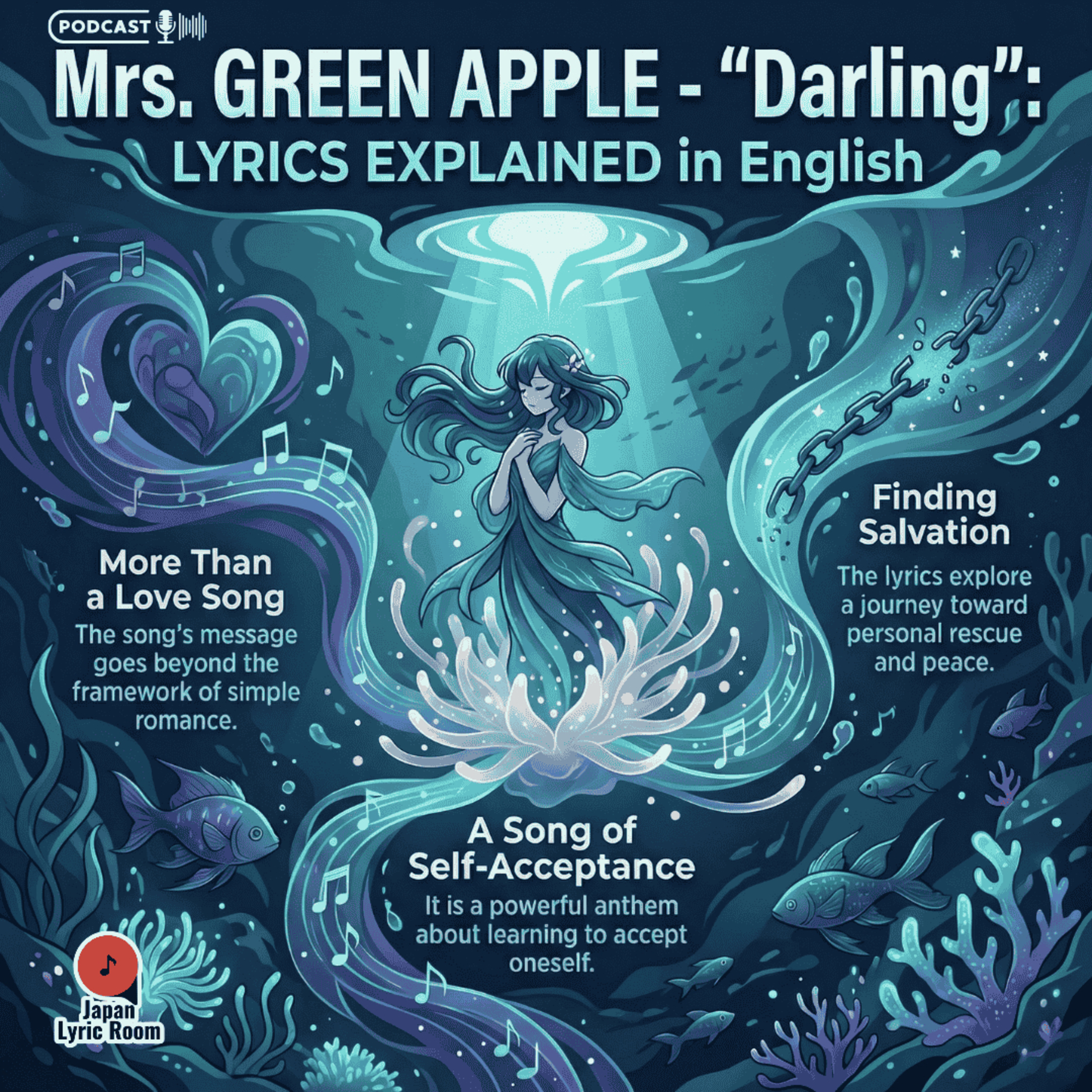
“Darling” isn’t a love song in the usual sense—it’s a survival hymn for the age when you’re most allergic to comparison. Written for NHK’s “18 Fes,” the track treats distance as self-defense and honesty as something you have to excavate, not declare. When the lyric calls the pain of everyday life “膿 (umi)”—pus—it refuses pretty metaphors and chooses bodily truth: wounds don’t vanish just because you smile through them. The repeated “darling” becomes an intimate second-person mirror: not necessarily a lover, but the self you keep postponing. “本当の音 (hontō no oto)” reads like “your true sound”—the private frequency you bury under “shoulds,” timelines, and other people’s wins. In that sense, the song’s tenderness is not romance; it’s permission. Even if the pus won’t fully drain, you can still keep swimming—carrying your fragile self across a deep, unforgiving sea. 📝 Full Written Analysis & Cultural Context: 📌 https://www.japanlyricroom.com/songs/darling⏳Chapter0:00 Masterclass: Mrs. GREEN APPLE "Darling" Complete Guide & 18 Fes Creative Process3:04 Chapter 1: How to Build "Unshakable Strength" - Self-Esteem & Lyrics Breakdown4:47 Chapter 2: Deciphering "Yarusenai" - Deep Sea Metaphors & Emotional Vocabulary6:11 Chapter 3: The Futon Philosophy - Dealing with Vulnerability & Mental Health Struggles7:33 Chapter 4: Overcoming "The Person I Wanted to Be" - Why Identity Regret Occurs8:47 Chapter 5: Stop Feeling Stuck - The "Kusuburu" Cycle & How to Move Forward9:51 Chapter 6: The Psychology of "Wadakamari" - Why Common Advice Often Fails11:13 Chapter 7: The Science of Catharsis - Using the "Pus" Metaphor for True Healing12:33 Summary: 5 Life-Changing Lessons on Radical Self-Acceptance & Mental Growth📝 Q&A for "Darling" by Mrs. GREEN APPLE☁️ Q1. What is the emotional core of Mrs. GREEN APPLE's "Darling"?A: At its heart, "Darling" explores the modern struggle of "social comparison" and the longing for self-worth. It captures the pain of feeling inferior in a society that constantly judges and compares. The lyrics express a desperate plea to be loved for who you truly are, not for how you measure up against others. It is a song for anyone who has ever felt "left behind" or "hollow."📢 Q2. What does the phrase "Listen to my true sound (Honto no Oto)" signify?A: This phrase is the song’s emotional climax. In the lyrics, "sound" acts as a metaphor for "one's true inner voice" or "true feelings." Amidst the noise of the world and the pressure to conform, the protagonist asks their "Darling"—representing a loved one or perhaps their own inner self—to ignore the superficial exterior and listen to the raw, unpolished honesty of their soul.🕯️ Q3. Why is "Darling" considered a "lifesaving" song for young listeners?A: The song resonates because of its "vulnerability." Motoki Ohmori writes about the "shame" and "loneliness" that people usually hide. By acknowledging that "it’s okay to be weak" and voicing the desire to "cling to something in the middle of the night," the song provides a sense of companionship. It doesn't offer a shallow solution but stands beside the listener in their darkest moments.☕ Support the show (Buy Me a Coffee): https://buymeacoffee.com/japanlyricroom
Embed this episode
NOW PLAYING
Mrs. GREEN APPLE - Darling (ダーリン)Lyrics Meaning & Analysis | NHK 18 Fes
No transcript for this episode yet
Similar Episodes
No similar episodes found.
Similar Podcasts
No similar podcasts found.