
EPISODE · Apr 2, 2026 · 30 MIN
Naming Christian Nationalism with Andrew Whitehead
from The Forum with Josh Cowen Podcast · host Josh Cowen
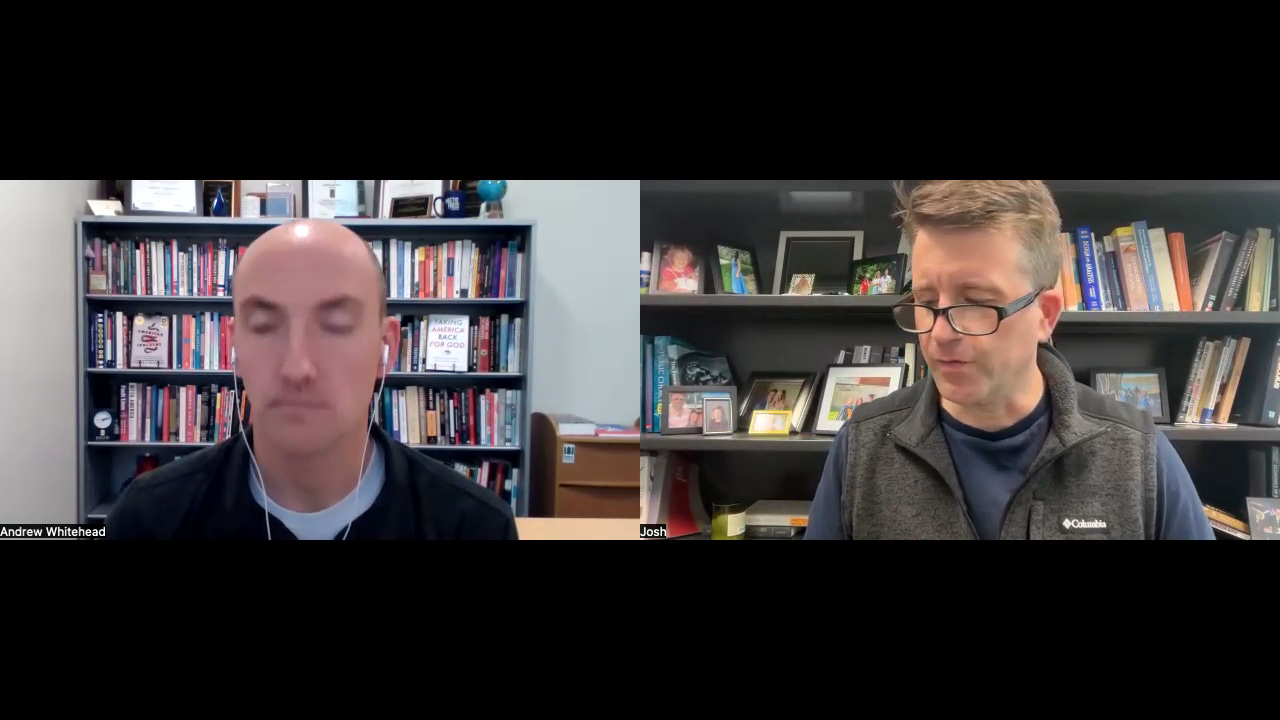
Tonight marks Holy Thursday, or Maundy Thursday, in the Christian Tradition. It’s the night we commemorate the Last Supper, and Jesus Christ’s Agony in the Garden. Last night, Passover began in the Jewish tradition, commemorating the end of slavery and exodus from Egypt for the ancient Israelites. It’s an incredibly important spiritual week for many Americans—both those who support what Donald Trump and his regime are doing to this country, and those who are working actively to oppose it.I’ve been writing and speaking about Christian Nationalism for several years now, but my expertise is more specific to the policy side of their priorities: education plans, programs concerning families and children, that sort of thing. My first book, The Privateers, was about a very important Christian Nationalist policy priority: school vouchers for religious education. To mark this week for this newsletter, I wanted to talk to someone who’s a true expert in Christian Nationalism more generally and ask: what is Christian Nationalism? What are its goals? Where is the movement going? How do we think about what’s happening right now in the United States?So today I’m talking with the sociologist Andrew Whitehead, author of American Idolatry: How Christian Nationalism Betrays the Gospel and Threatens the Church and, with Samuel Perry, Taking America Back for God: Christian Nationalism in the United States. I think Andrew is one of the sharpest writers and thinkers on this topic working today, and I’m glad we’ve had a chance to connect this week, of all weeks, to learn what he has to say. Watch the video or read our chat below—as always, only lightly edited for length and clarity.A Conversation with Andrew WhiteheadWe’re talking about Christian Nationalism today. Let’s level-set. I’m a political scientist and a policy analyst by training so when I talk about Christian Nationalism I’m especially focused on the idea that various right-wing organizations want to use politics and policy to remake America in the image of this very specific, evangelical and white-centered version of “Christianity.” But I’m wondering what’s your working definition of Christian Nationalism for starters here?It's good to be with you. I think when we’re talking about Christian Nationalism, there’s a number of ways that we can kind of think about it and look at it. So [one is] the way that you’re talking about it, too, this network of people and groups that have this specific aim, and they’re working at high levels, well-funded—that type of thing. So it is this network.But the work I’ve been involved in for quite some time now, too, is also looking at Christian Nationalism as this ideology: how prevalent is it among the American public, right? Because you can have groups, but can they actually speak to a particular group of people, get them out to vote? Those types of things. And I’m focused on, too, with everyday Americans, what what do they see and think? And so Christian Nationalism, the empirical definition, after all these different surveys and research, is an ideology that’s committed to fusing together a very particular expression of Christianity with American civic life. It demands that government at all levels preserve and defend this fusion as being central to our national identity, and determining which Americans truly belong.Because what you’ll see a lot of times is folks, politicians, whoever else, religious leaders saying, well, Christian Nationalism, this is something that’s just made up by whoever—the left academics, that type of thing. Like, I’m a Christian, and I am patriotic, and that’s all Christian Nationalism means.But that isn’t what we find over and over in the research. The key here is that, as you stated too, the desire is to infuse what they would call biblical principles into American civic life. And it may seem innocuous, but the question then is, well, which biblical principles, why those principles, and then how are we excluding people who aren’t religious, who aren’t Christian? And so, when we’re looking at Christian Nationalism, again, the key is it’s a desire to privilege a very particular expression of Christianity, and using the lever of government to really defend and preserve that.Christian Nationalism is an ideology that’s committed to fusing together a very particular expression of Christianity with American civic life. It demands that government at all levels preserve and defend this fusion as being central to our national identity, and determining which Americans truly belong.—Andrew WhiteheadI understand you grew up in an evangelical community. I grew up in a Catholic community and in fact one affiliated with the same Catholic covenant community as Amy Coney Barrett. But there was some real emphasis on mission work, on poverty, and on maintaining your intellect—in the service of God, yes, but not at a loss of your own humanity. I look at so much of the Christian Nationalist support for Trump—embrace of Trump—and it’s not only horrific but it’s manifestly un-Christian. Do you see Trump and Christian Nationalism as necessary to each other right now in American politics? Is there any other way this could have gone?Yeah. In in my second book, American Idolatry, I am kind of writing to a Christian audience as somebody who grew up in this space, northern Indiana, a very religious area, and it really was kind of the the air that everyone was breathing, right? There was no reason for me to question this idea of, yeah, the United States is a Christian nation, and everything we do is, you know, because God is on our side, that type of thing. And so, growing up in that space, I really knew it from the inside out. And then as I went off to college and then went to graduate school and started learning sociology, social science, and that methodology, I was really interested in how culture shapes religion and how religion shapes culture.I knew that viewing the world in this way, just because I had grown up in it and how powerful it is: when you believe the U.S. is a Christian nation, that is going to affect how you see war, economic policy, school policy, that you’re an expert in, right? All these different areas, it’s going to affect it. And so I just kind of then turned and used those [social science] methods to kind of examine this.And what we found and what I found over and over is that it really is powerful in shaping how folks see almost every aspect of social life. It is an organizing principle for the way they see the social world. And then I think in regard to the current moment, it really is necessary [to understand] what we’re living through.Christian Nationalism has been with us, obviously, for centuries, in this country, and even before. But this iteration of it is really flavored by the rise of the Religious Right in the 1970s, as they were responding to the cultural upheaval of the 1960s. And so Trump really is just a very natural endpoint to what was happening with the Moral Majority and trying to draw evangelicals, but particularly white evangelicals, into the Republican fold. To really bring this together as a voting bloc within the Republican Party. And Trump is the perfect distillation of the work that they were doing. Because for them it was truly about political power. And while GOP presidents from Reagan to both Bushes would talk about our country and its religious roots, and also be religious themselves, Trump really is all about, yeah, I’ll give you power. And that’s what this group wants: political power to be able to leverage, to ensure that their particular expression of Christianity is privileged. And so it isn’t about Trump being necessarily religious. But that he’s the one that’s going to put them close to the levers of power. And they have celebrated that. So if we remember, Tony Perkins, head of the Family Research Council, when Trump was a candidate the first time, he’s like, we just want somebody to punch the bully in the mouth. We don’t need somebody that’s religious like us, we need somebody who’s gonna fight for us. And I think that’s where Trump is at for them in this current moment.[Ed Note: for more on the Family Research Council in education policy, and its relationship to the DeVos family, see my book The Privateers; for a more general analysis, see Katherine Stewart’s book The Power Worshippers]I want to talk about Pete Hegseth who is, in my mind, the most prominent Christian Nationalist in power. JD Vance is something else—we can do another chat on him one day! But Hegseth is out there right now sporting Bible quotes to justify the war in Iran and specifically the violence in Iran. But not just any Bible quotes. The stuff that summons warfare, strength, power: Christ as King and Conqueror, not the Christ who humbled himself, not the Christ who wept at Lazarus’s grave. What do you make of Hegseth in general and his use of the Bible right now from the Pentagon podium?I think this is a great question. I think Pete Hegseth, and then Mike Johnson as well is another person that we’ve been tracking, that kind of in these top positions of power that really embody what Christian Nationalism is, and shows what it’s all about.You made a point there that I think is really important, where the Bible is a very flexible resource, right? So no matter what expression of Christianity, the Bible can be drawn upon to show and define this is what we should do and how we should do it.Christian Nationalism really is about making space to protect “true American citizens,” from whatever threats might be out there. And again, defining those as key. And so Christian Nationalism really provides a framework to do that through the threat of violence or through violence to defend, yourself, your family, your country— because the world within this cultural framework is viewed as a dangerous place. And sometimes we need good guys with guns to go in and restore order.A really great book, I know that you’re obviously familiar with, and probably many of the folks that follow you is Kristin Du Mez’s book, Jesus and John Wayne. She’s following the thread of this militant masculinity within American Christianity, and that is wrapped up in the cultural elements of Christian nationalism, where over and over again, we’re looking for: who are our enemies, right? And defining who we are against them. Because the quickest way to know what we’re all about is to know what we’re not, and to kind of sow fear and threat from those groups, that we need to fight back, protect ourselves. So we look to movies like Gladiator or Braveheart and these Christian leaders were like, we need to be like this, right? Through violence, you protect your group, the in-group. And then—I’m sure you heard these stories, too—I know I did growing up in Christian spaces of David and Goliath, or Israel’s battle in the Old Testament. God was always on their side. They needed to use violence to restore order, to restore God’s hierarchy, and His plans. And sure, they say, Jesus never fought back, but how realistic is that today? We can look to the future, because when Jesus comes back—as they interpret the Book of Revelation—He’s going to come back and destroy his enemies. We’ll look to that Jesus, not the one that had to die and proclaim peace and serve our enemies. So they look to the Bible, as they find those places that help reinforce the narratives that they’re into and want to forward: it’s good over evil through violence if and when necessary. And to use that violence to protect power. To serve the in-group. So altogether, Christian Nationalism provides that framework of, we want power to serve us, we’re afraid that they’re gonna come take it, so we need to use violence in order to protect and enact that power.One thing that we find over and over in the empirical data is that both race and gender are central cultural elements of Christian Nationalism. —Andrew Whitehead I don’t think you can go wrong looking for a through-line around the issues of race, especially, but also gender when it comes to motivating right-wing politics right now. This kind of stupid, performative masculinity that’s anything but biblical: you have to go back to David and to my namesake, Joshua, to find warrior-heroes in the Bible and you have to ignore that Jesus revealed his resurrected self to women. How do you connect race and gender in American politics right now to the world Christian Nationalists want to make or remake?One thing that we find over and over in the empirical data is that both race and gender are central cultural elements of Christian Nationalism. And what I mean by that is, again, when we define Christian Nationalism, it’s this desire to elevate one particular expression of Christianity. And what that means is that when Americans hear this idea, or see the words, you know, “Christian nation” or advocating Christian values, we’re able to determine what what’s going on in their minds when they see Christian there.What we know is that it isn’t just about the divinity of Jesus or the kind of other Orthodox aspects of the historic Christian faith. When they see “Christian,” this other—what I like to call this extra-cultural baggage—comes with it, that is particular to that particular expression of Christianity within Christian nationalism.And so there are two aspects, two cultural elements that are key. One is a desire for traditional social hierarchy. And this tends to revolve around gender and sexuality. There are people at the top, in the middle and at the bottom of American society. But the strongest nation, right? The U.S., if it’s going to be strong, it needs to have men leading, women submitting and supporting men—and they need to be married. But only heterosexual married. Marriage, having lots of kids, the pronatalists. And this is a key to a strong nation. So those families and people that represent this ideal will have the easiest access to civil rights and social benefits. Those that are further out? They can live here, but they won’t be the true Americans that we want to see. So there’s one aspect. Another is a commitment to strong ethno-racial boundaries. A lot of this is due to when Christianity first came to these shores, having to make sense of the Brown people that we need to push off this land, and the Black people that we’re enslaving. How do we understand what we’re doing to these groups? So this idea of this Christian group and nation is that, well, being white and Christian is God’s design and desire for this people group. We see over and over that Americans who embrace Christian Nationalism are more likely to see, you know, racial diversity as a hindrance to this nation. Or that immigrants and refugees aren’t true representations of what it means to be an American, because of their skin color, not because of their religion. So when we look at Project 2025, for example, and the racial and gender and sexuality aspects of that, you see these two central cultural elements of Christian Nationalism at work.I’ve been interested in Hegseth since well before he became Secretary of “War.” This is guy who wrote a book called “Battle for the American Mind” in 2022, just basically an entire screed against democracy as an American value, the need to return to what can only be called a Christian Nationalist vision of American culture, and the need to use education and schools to do that. I have my own thoughts on this but curious where you think education falls into the policy and political priorities for these folks.Honestly, I’ve learned a lot from you working in this area and helping to connect those dots. But it is central, as you point out. Many see the education of the next generation as central to taking this country back or ensuring that this nation stays on the right track to reach that aspiration of this Christian nation. Looking at the history of the Religious Right—the current moment really is flavored by the rise of the Religious Right—we know with that history that education and schools have been central and that connects, too, to the question we were just talking about with race. Brown v. Board of Education and integrating public schools was a formative event in galvanizing this response for the political and Religious Right. Then a little bit later, well, you know, all these private segregation academies pop up. The IRS revoking the tax-exempt status of Bob Jones University was also central to the rise of the Religious Right. It gets couched in this idea of the federal government imposing itself upon you. Nothing to do with race, necessarily. It’s the fact that the federal government is imposing itself when in fact it actually had to do with race. And so, yeah, schools have been a flashpoint for we need to ensure that we’re teaching this future generation our culture, our values, our beliefs. So creating alternatives to public schools, weakening public schools, alternative curriculums, free educational materials, making that widely available that really tell “the truth” about American greatness and who we are.This has been a formative aspect of evangelicalism, focusing on schools and education. But as we look even more broadly, the creation of kind of alternative institutional structures is key to what we see happening here.Yeah, with Christian nationalism. Yeah, it’s been a key part of what they see for the future to ensure that we’re on the right track and ensuring that the next generation is in line with what they want to see take place.This has been a formative aspect of evangelicalism, focusing on schools and education. But as we look even more broadly, the creation of kind of alternative institutional structures is key to what we see happening here with Christian Nationalism.—Andrew WhiteheadI want to close with a wrap-around question around wealth and power. Jesus talked about wealth more than any other issue in the Gospels accept the kingdom of heaven. The longest conversation he has on record, to use a modern term, is with the Samaritan woman at the well. We have a Pope now who is directly challenging notions of wealth and power and the use of Christian faith to pursue both. But that’s pretty directly going against the organizing principle of Christian Nationalism, is it not? Where do you think this all heads going into not only the second half of Trump’s term but what comes next for this country?There’s a lot there to work with, because as we look at Christian Nationalism, and I write about in American Idolatry, three of the central idols of Christian Nationalism are power, fear, and then violence. Wealth and power are wrapped up together, and as we look at our history, much of the desire for self-interested power, defending power for “us,” is to defend and preserve unequal access to resources and wealth, right? So freeing slaves means that we would lose all this economic benefit, and so we don’t want to do that, or pushing native peoples off their lands means we now have access to their resources. And if you look globally, this is happening too. So I think those are always tightly intertwined. Then through the 20th century, Kevin Kruse, in his book, One Nation Under God, is really great, looking at capitalism and how that plays a central role. Billy Graham was tapped to help spread the gospel of capitalism as God’s perfect economic system by really wealthy capitalists who were like, we need to defend our wealth against these creeping ideals of the New Deal and socialism and communism and all those things. And so, this is part of that history in the modern iteration of Christian Nationalism.That’s actually another central cultural element is this preference for neoliberalism and capitalist ideals. As you’re pointing out. And something that I explore and write about, too. One of my most read posts on Substack is titled “Christians Will Have Power” and Other Things Jesus Never Promised, right? Because as He goes into the wilderness, the Deceiver says, hey, I can give you every kingdom of the world, and He says no. His relationship to power and turning away from that is key, but many Christians, and I think Christian Nationalism, really is so centrally focused on power and defending access to it because it defends wealth. That’s always going to be a key part of it. As we look towards the future and where we’re going in this country, you know, Christian Nationalism and those cultural elements will still be really powerful in motivating people towards this desire for particular ethno-racial boundaries around national identity—a traditional social hierarchy. And lifting up capitalism and neoliberalism, which really does tend to benefit those with a lot of resources already. That’s going to continue to be a part of it, and we’re going to see that taking place. And so I think for folks of all or no religious faith, [the question is]: how do we live in this moment, or what do we do to respond to Christian Nationalism?I think it really is focused on exercising the reach that we have to political power now within the democratic process to ensure that those who are marginalized are brought into the discussion.What can we do to leverage the power and privilege and everything that we have to ensure that this country works for all, right? Liberty and justice for all, and not just the “us” or the “we?” Because Christian Nationalism is ultimately focused on earthly power, self-interested power that serves us at the expense of othersWhereas a lot of expressions of Christianity, and of other world religions, and folks that are non-religious at all: a lot of those folks want to leverage political power and access to it to benefit those that don’t have power—for the benefit of others. That’s the way that we can think of how to respond and push back. Similar to, as you said, the Pope, who knows a thing or two about this.Andrew L. Whitehead is Professor of Sociology and Executive co-Director of the Association of Religion Data Archives (theARDA.com) at Indiana University Indianapolis. He is a research fellow with the Charles F. Kettering Foundation and author of the award-winning books American Idolatry and Taking America Back for God with Samuel L. Perry. His Substack is titled American Idolatry.Thanks for visiting The Forum with Josh Cowen! Subscribe for free to receive new posts and support my work. This is a public episode. If you'd like to discuss this with other subscribers or get access to bonus episodes, visit joshcowen.substack.com/subscribe
Embed this episode
Ready to play
Naming Christian Nationalism with Andrew Whitehead
No transcript for this episode yet
Similar Episodes
No similar episodes found.
Similar Podcasts
No similar podcasts found.