
EPISODE · Jul 20, 2022 · 21 MIN
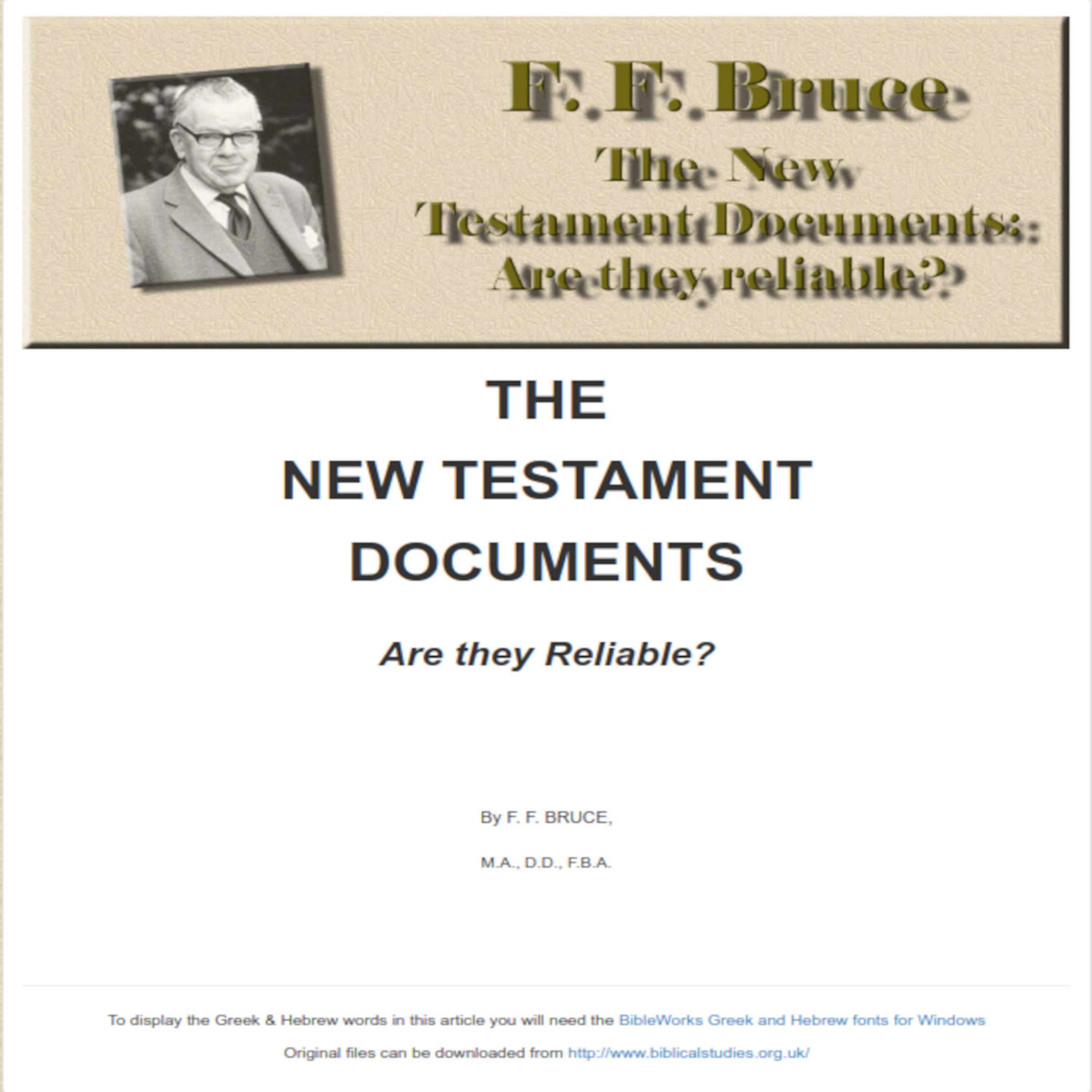
New Testament Documents - Are They Reliable, By Frederick Fyvie Bruce, Chapter 9
from Down to Earth But Heavenly Minded · host Irving Risch
New Testament Documents - Are They Reliable By Frederick Fyvie Bruce Table of Contents TITLE PAGE PREFACE TO THE FIFTH EDITION Chapter 1 DOES IT MATTER Chapter 2 THE NEW TESTAMENT DOCUMENTS: THEIR DATE AND ATTESTATION Chapter 3 THE CANON OF THE NEW TESTAMENT Chapter 4 THE GOSPELS Chapter 5 THE GOSPEL MIRACLES Chapter 6 THE IMPORTANCE OF PAUL'S EVIDENCE Chapter 7 THE WRITINGS OF LUKE Chapter 8 MORE ARCHAEOLOGICAL EVIDENCE Chapter 9 THE EVIDENCE OF EARLY JEWISH WRITINGS Chapter 10 THE EVIDENCE OF EARLY GENTILE WRITERS SUGGESTIONS FOR FURTHER READING Reliable as what?' asked a discerning reviewer of the first edition of this little work by way of a comment on the title. His point, I think, was that we should be concerned with the reliability of the New Testament as a witness to God's self-revelation in Christ rather than with its reliability as a record of historical fact. True, but the two questions are closely related. For since Christianity claims to be a historical revelation, it is not irrelevant to look at its foundation documents from the standpoint of historical criticism. When the first edition of this book (my literary firstborn) appeared in 1943, I was a lecturer in classical studies and had for long been accustomed to viewing the New Testament in its classical context. When I was invited from time to time to address audiences of sixth formers and university students on the trustworthiness of the New Testament in general and of the Gospel records in particular, my usual line was to show that the grounds for accepting the New Testament as trustworthy compared very favorably with the grounds on which classical students accepted the authenticity and credibility of many ancient documents. It was out of such talks that this book originally grew. It has (I am told) proved its usefulness to the readers for whom it was intended, not only in English-speaking lands but in German and Spanish translations as well. The historical and philological lines of approach have, of course, their limitations. They cannot establish the Christian claim that the New Testament completes the inspired record of divine revelation. But non-theological students (for whom the book was written) are, in my experience, more ready to countenance such a claim for a historically reliable work than for one that is not. And I think they are right. It is difficult to restrict a discussion of the New Testament writings to the purely historical plane; theology insists on breaking in. But that is as it should be; history and theology are inextricably intertwined in the gospel of our salvation, which owes its eternal and universal validity to certain events which happened in Palestine when Tiberius ruled the Roman Empire. I welcome the opportunity to give the book a thorough revision (not thorough enough, some of my friends may think); and in sending it forth afresh, I continue to dedicate it to those university and college students throughout the world who, singly or in groups, maintain among their colleagues the apostolic witness to Jesus Christ our Lord. F. F. B. April 1959
NOW PLAYING
New Testament Documents - Are They Reliable, By Frederick Fyvie Bruce, Chapter 9
No transcript for this episode yet
Similar Episodes
No similar episodes found.