PodParley PodParley

Next Stop, Greenwich Village

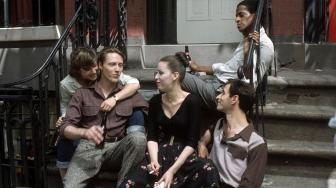
Next Stop, Greenwich Village, a 1976 film written and directed by Paul Mazursky, is a finely observed autobiographical portrait of youth in its first stirrings of freedom. Aspiring actor Larry Lapinsky (played by Lenny Baker) leaves his Brooklyn home, and domineering mother (played by Shelley Winters), to live in the off-beat, interesting world of Greenwich Village in 1953. That’s mostly all there is to it—there’s no linear narrative in the usual sense, only a series of vignettes, often comic, but sometimes touching or even tragic, about life on the fringes in 1950s New York, and the oddball bohemian characters and behavior in this special world. Baker is very funny and appealing in his only major role (he died far too young, of cancer, in ’82), and he has great chemistry with Ellen Greene, as his girlfriend Sarah, who gets an abortion but has to pretend to Larry’s mother that she’s never slept with him. There is a great deal of comic business involving Shelley Winters as the Jewish mom, who shows up at Larry’s apartment at the most inopportune times. (“She invented the Oedipus complex,” her son says.) There’s no denying that this pushy, hysterical type was already a cliché in ’76, but Winters is at the top of her game—very funny indeed. Christopher Walken is impressive as a charismatic, arrogant artiste; Jeff Goldblum is on hand as a ridiculously bad actor; and Antonio Fargas charms as a gay Village denizen calling himself Bernstein. The characters alternately support and tear down each other, depending on the fleeting status of the relationships, and this is more true to the way younger people are with each other than you often see in movies. It’s also rare to see such careful attention paid to a group of artists and intellectuals, pretentious sometimes, but full of promise. The film memorializes a specific time and place in New York that has a lot of resonance for the generation that revitalized American film in the 70s. The picture has been criticized for being shapeless, but I think that’s an element of its appeal. Mazursky shows us the milieu, and the romance of an actor’s lifestyle at that time—with the nostalgic glow of hindsight, to be sure, but tempered by the kind of sharp, witty dialogue that lends the characters three dimensions with only a few deft strokes. The frankness, the bright alertness of the humor, is very refreshing. Beautifully timed, with no dead space or unnecessary exposition, the scenes flow naturally from one to the next with gentle humor and grace. Next Stop, Greenwich Village is smart, fun entertainment, with a wise yet unjaundiced view of life, and a sense for the better possibilities in our nature.

An episode of the Flicks with The Film Snob podcast, hosted by Chris Dashiell, titled "Next Stop, Greenwich Village" was published on March 13, 2014.

March 13, 2014 · Flicks with The Film Snob

0:00 / 0:00

Next Stop, Greenwich Village, a 1976 film written and directed by Paul Mazursky, is a finely observed autobiographical portrait of youth in its first stirrings of freedom. Aspiring actor Larry Lapinsky (played by Lenny Baker) leaves his Brooklyn home, and domineering mother (played by Shelley Winters), to live in the off-beat, interesting world of Greenwich Village in 1953. That’s mostly all there is to it—there’s no linear narrative in the usual sense, only a series of vignettes, often comic, but sometimes touching or even tragic, about life on the fringes in 1950s New York, and the oddball bohemian characters and behavior in this special world. Baker is very funny and appealing in his only major role (he died far too young, of cancer, in ’82), and he has great chemistry with Ellen Greene, as his girlfriend Sarah, who gets an abortion but has to pretend to Larry’s mother that she’s never slept with him. There is a great deal of comic business involving Shelley Winters as the Jewish mom, who shows up at Larry’s apartment at the most inopportune times. (“She invented the Oedipus complex,” her son says.) There’s no denying that this pushy, hysterical type was already a cliché in ’76, but Winters is at the top of her game—very funny indeed. Christopher Walken is impressive as a charismatic, arrogant artiste; Jeff Goldblum is on hand as a ridiculously bad actor; and Antonio Fargas charms as a gay Village denizen calling himself Bernstein. The characters alternately support and tear down each other, depending on the fleeting status of the relationships, and this is more true to the way younger people are with each other than you often see in movies. It’s also rare to see such careful attention paid to a group of artists and intellectuals, pretentious sometimes, but full of promise. The film memorializes a specific time and place in New York that has a lot of resonance for the generation that revitalized American film in the 70s. The picture has been criticized for being shapeless, but I think that’s an element of its appeal. Mazursky shows us the milieu, and the romance of an actor’s lifestyle at that time—with the nostalgic glow of hindsight, to be sure, but tempered by the kind of sharp, witty dialogue that lends the characters three dimensions with only a few deft strokes. The frankness, the bright alertness of the humor, is very refreshing. Beautifully timed, with no dead space or unnecessary exposition, the scenes flow naturally from one to the next with gentle humor and grace. Next Stop, Greenwich Village is smart, fun entertainment, with a wise yet unjaundiced view of life, and a sense for the better possibilities in our nature.

nextstop Next Stop, Greenwich Village, a 1976 film written and directed by Paul Mazursky, is a finely observed autobiographical portrait of youth in its first stirrings of freedom. Aspiring actor Larry Lapinsky (played by Lenny Baker) leaves his Brooklyn home, and domineering mother (played by Shelley Winters), to live in the off-beat, interesting world of Greenwich Village in 1953. That’s mostly all there is to it—there’s no linear narrative in the usual sense, only a series of vignettes, often comic, but sometimes touching or even tragic, about life on the fringes in 1950s New York, and the oddball bohemian characters and behavior in this special world.
Baker is very funny and appealing in his only major role (he died far too young, of cancer, in ’82), and he has great chemistry with Ellen Greene, as his girlfriend Sarah, who gets an abortion but has to pretend to Larry’s mother that she’s never slept with him. There is a great deal of comic business involving Shelley Winters as the Jewish mom, who shows up at Larry’s apartment at the most inopportune times. (“She invented the Oedipus complex,” her son says.) There’s no denying that this pushy, hysterical type was already a cliché in ’76, but Winters is at the top of her game—very funny indeed. Christopher Walken is impressive as a charismatic, arrogant artiste; Jeff Goldblum is on hand as a ridiculously bad actor; and Antonio Fargas charms as a gay Village denizen calling himself Bernstein.
The characters alternately support and tear down each other, depending on the fleeting status of the relationships, and this is more true to the way younger people are with each other than you often see in movies. It’s also rare to see such careful attention paid to a group of artists and intellectuals, pretentious sometimes, but full of promise. The film memorializes a specific time and place in New York that has a lot of resonance for the generation that revitalized American film in the 70s.
The picture has been criticized for being shapeless, but I think that’s an element of its appeal. Mazursky shows us the milieu, and the romance of an actor’s lifestyle at that time—with the nostalgic glow of hindsight, to be sure, but tempered by the kind of sharp, witty dialogue that lends the characters three dimensions with only a few deft strokes. The frankness, the bright alertness of the humor, is very refreshing. Beautifully timed, with no dead space or unnecessary exposition, the scenes flow naturally from one to the next with gentle humor and grace. Next Stop, Greenwich Village is smart, fun entertainment, with a wise yet unjaundiced view of life, and a sense for the better possibilities in our nature.

Future Flicks with Billiam The SomewhatNerdy Podcast Network Future Flicks is a podcast about flicks that come out, wait for it, in the future! In this podcast your host Billiam from SomewhatNerdy.com will go over all the movies coming out during the week, tell you his pick, and throw in his thoughts and occasionally trivia and news. He’ll also throw in a movie review every podcast or two for a suggestion on what to watch during a night in. So check out Future Flicks because why use Google to tell you what movies are coming out when you can have an opinionated Nerd do it for you. Box Office Premiere Podcasts Box Office is a weekly film show on Virgin Media Two, which takes a look at the pick of the flicks in cinemas, along with a host of fun film features. Flick Switch Flickswitch Flick Switch is far more than a rigging rental company. We have built our business on delivering high quality solutions with years of experience in a wide variety of markets, including film, television, live events, international touring and theatre.With our years of experience in audio, lighting, screens, sets, (and the list goes on) we can go further than just the support rigging. We are also able to rig the equipment too. Planning and installing the power and data distribution, fixtures, fly systems and other equipment, fine tuning, focusing and operating.When you engage Flick Switch yo Mark Fricks - The Road Less Traveled Mark Fricks Federal Employees - The Retirement Road Less Traveled with Financial Adviser and Federal Employee Advocate Mark Fricks. Mark Shares the mission behind the 2nd edition of The Book "The Road Less Traveled." This is a Financial Roadmap for Federal Employees seeking a secure retirement.
URL copied to clipboard!