
EPISODE · Apr 8, 2026 · 1H 15M
No Kings, No Excuses: From Conservative Hypocrisy to Predator Pipelines — What This Moment Demands of Us
from Education is Elevation · host The Conscious Lee
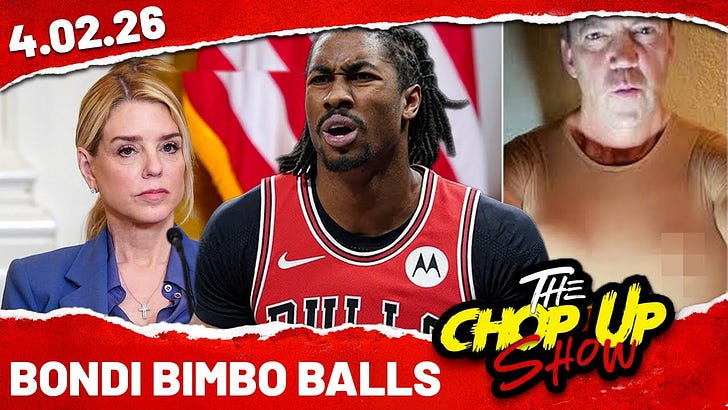
Education Is Elevation is a reader-supported publication. To receive new posts and support my work, consider becoming a free or paid subscriber.When I tell y’all that the conservative contradictions are writing themselves at this point, I need you to understand I’m not being hyperbolic. I’m reading receipts. And this week, we got a whole dossier.Let me set the stage. We’re sitting down on The Chop Up Show — me, Toya G, and Domo aka Political Plug — and within the first ten minutes we’re touching Kristi Noem’s husband getting caught cross-dressing with an immigrant sex worker, the largest protest in American history, Pam Bondi getting fired, Donald Trump publicly embarrassing Caroline Levitt, a basketball player weaponizing Christianity to dehumanize queer people, and a legendary R&B singer laughing on camera about the statutory logistics of sleeping with a teenager. And somehow, all of these things are connected. That’s the part I need y’all to sit with.Research over MeSearch. Always.The Conservative Contradiction MachineLet’s start where the contradictions are loudest. Kristi Noem’s husband, Bryon Noem, got caught in a scandal involving cross-dressing — the very behavior that the conservative movement has spent the last several years criminalizing through legislation targeting drag queens and transgender individuals. We’re talking about actual laws that were passed. Legislation that criminalized the very act that the DHS Secretary’s husband was engaging in privately with an immigrant sex worker.Now here’s the play. I believe the Trump administration already knew this was coming down the pipeline. That’s why Noem was being repositioned before the story broke. But the hypocrisy doesn’t stop at the personal scandal — it’s structural. The Supreme Court just ruled that conversion camps are protected under freedom of speech. So my question becomes: does Kristi Noem’s husband now have to attend the conversion camps that his wife’s political allies championed? Probably not. And that selective moral outrage is the whole game.What we’re witnessing is not inconsistency. It’s architecture. The cisgender conservative white man believes he has the right to do everything he wants while criminalizing those same behaviors in others. That’s not a contradiction — that’s a feature of the system.And it’s not just Noem. Pam Bondi — Trump’s attorney general — was fired. If you recall, Trump fired Jeff Sessions in 2018 because Sessions wouldn’t obstruct the Mueller probe. Same pattern, different pawn. Then Trump publicly humiliated Caroline Levitt, his own press secretary, joking about his 97% negative press coverage being her fault. Three prominent white women in the Trump administration, and all three treated as disposable.Let’s not forget: 53% of white women voted for Donald Trump — the only majority of women to do so. And he showed them exactly what that loyalty purchases: a front-row seat to your own disposability. You praise a king, you get treated like a pawn.No Kings Day 3.0 and the Underutilization of ProtestEight million people showed up for No Kings Day 3.0 — the largest protest in United States history. And the first thing I heard from folks was: what’s the point?I want to challenge that. I’ve been rethinking the utility of protests, and here’s where I’ve landed. Protests are big-ass meetings. They’re not just about standing next to each other singing and chanting the same phrases. They should be networking opportunities. Communication hubs. Strategic planning sessions. Especially when we know the internet has been infiltrated and surveilled.The problem isn’t that protests don’t work. The problem is that we don’t have the organizational infrastructure to capitalize on what happens when millions of people are physically together. We’re underutilizing the capacity of collective presence. The question is always going to be: whose directions are we following? What structures are we legitimizing? Those are questions about moral conscience, ethical compass, and strategic viability — and they require a level of intentionality that most protest movements haven’t achieved yet.Jaden Ivey and the Anatomy of Christian PsychosisNow let’s talk about Jaden Ivey, because this situation is a case study in everything I’ve been warning about at the intersection of religion, nationalism, and the recruitment of Black athletes.The Chicago Bulls released Ivey for conduct detrimental to the team. The specifics: he went on 40-minute Instagram rants steeped in anti-queer rhetoric. He categorized teammates as “righteous” and “unrighteous.” He told team doctors that Jesus healed his knee injury — an injury the MRI confirmed was still present. He destroyed locker room culture with persistent, condemnatory preaching that the Bulls organization formally described as “weirdness in the workplace.”Now, here’s where it gets nuanced, and this is the part I want y’all to think deeply about because we’re thinking deeply about shallow s**t on this one.Everything Ivey was criticized for — the witnessing, the bearing testimony, the sacred declaration, the chastising of the unrighteous — these are actual tenets of evangelical Christianity. Bearing witness is what Christians are called to do. The Bible talks about the fire burning at the altar and never going out. Many Christians interpret themselves as the altar — mobile vessels carrying the fire and the fear of Christ to share with the world. Sacred declaration — speaking life and not death, the whole notion that life and death are in the power of the tongue — that is foundational doctrine. Even the righteous-versus-unrighteous classification has biblical license. The text gives believers authority to chastise and bring people into the faith.So here’s the question I posed to the crew: is this religious psychosis, or is this a man living his faith? And the distinction matters.Religious psychosis involves hallucinations and fixed false beliefs with religious themes — believing one is a deity, a prophet, or possessed. It’s not a specific diagnosis, but a recognized form of psychosis. Now, I do think Ivey is displaying attributes consistent with religious psychosis. But here’s the critical move: I’m not diagnosing him. Psychosis and diagnosis are not the same thing. You can identify the attributes of a phenomenon without pretending you’re a clinician.And here’s where Domo brought the fire. He said something I want everyone to sit with: one of the biggest issues with religion is that it gives people excuses to be bad people. They wrap their “fucked-up-ness” in the guise of holiness. Because there are Christians who can hold their beliefs without condemning another person’s lifestyle or identity. That type of Christian exists. Which means the bigotry is not unique to Christianity — it’s that bigoted people find Christianity a convenient vehicle for their bigotry.What’s extremely dangerous about Ivey’s jersey sales skyrocketing after his expulsion is what it reveals: we’ve entered an era where bigots view the rejection of bigotry as oppression. Folks are framing pushback against hate as persecution. And Ivey’s situation folds perfectly into the white Christian nationalist playbook. He can now claim he was persecuted by the NBA, which feeds directly into Trump’s “anti-Christian bias” narrative. This is how Christian nationalism recruits Black folks — specifically Black athletes — into a movement that was never designed to protect them.Freedom of Speech Is Not What You Think It IsA lot of people conflated this with freedom of speech, and I had to set the record straight live on the show. So let me lay it out:First, you can have freedom of speech without that speech entailing the condemnation of an entire group of people. Second, freedom of speech protects you from the federal government — not from private entities. The NBA is a private organization. Third, I dare any of y’all to walk into your job tomorrow and declare an entire group of people unrighteous. You’ll be in HR before lunch, if not fired on the spot. Fourth, a lot of people are being loud, proud, and wrong when they try to play pseudo-intellectual with First Amendment arguments.And as Domo put it: rights don’t exist in a vacuum. Your rights are bounded by their interaction with other people’s humanity. When your speech creates an environment that produces material outcomes detrimental to another group, people have the right to push back. Hate speech turns into real-life material violence. It starts in the language and then it turns into people doing things. Freedom of speech is not freedom from consequences. Bernie Mac told you: there gon’ be some consequences and some repercussions.Brandy, Wanya Morris, and the Predator PlaybookNow let me transition to the part of the conversation that requires a trigger warning, because we’re getting into grooming, age of consent, power imbalance, and the infrastructure that allows grown men to secretly date teenage superstars in plain sight.Brandy confirmed in her 2026 memoir Phases that she dated Wanya Morris of Boyz II Men beginning around 1994-1995, when she was 15-16 years old and he was 22. Before I even get into the analysis, let me ground this with definitions, because I don’t play the game where we’re debating things without agreeing on what words mean.Grooming: a deliberate process where an older or more powerful person builds trust, emotional dependency, or secrecy with a younger or less powerful person to exploit them, often sexually.Age of consent: the legally defined age at which a person can consent to sexual activity, varying by state, typically 16 to 18.Informed consent: agreement that is freely given by someone with the maturity, knowledge, and autonomy to understand what they’re agreeing to and its consequences.A 16-year-old navigating fame under the guidance of a 22-year-old mentor is, by definition, operating within limited capacity for informed consent.Now, in a 2014 Breakfast Club interview, Wanya Morris was asked directly about the relationship’s legality. When the interviewer noted Brandy was young, Morris said, “She wasn’t that young.” When pressed that Brandy said she was 15, he corrected to 16 or 17. When asked if the relationship was legal in the state they were in, he joked — joked — “We did it in the states where it was legal.” He said they had a “nomad relationship.” And his Boyz II Men bandmate Shawn sat there wide-mouthed laughing through the whole exchange.Let me tell you what that interview revealed about this man’s character. At the height of his career — “I’ll Make Love to You,” all the sex music, could have had any woman in the country — he decided to pursue a 16-year-old. And his defense was jurisdictional shopping. That tells you everything. When someone treats statutory age-of-consent laws as loopholes to navigate rather than boundaries designed to protect children, you’re not looking at a love story. You’re looking at a predator who did the research.As I told the crew: we’ve all done research to figure out loopholes and workarounds for things we knew weren’t above board. There was a level of consciousness about both the act and the potential consequences. The same logic applies here. You don’t accidentally research which states have lower ages of consent. That level of intentional contemplation about the act and its consequences, followed by proceeding anyway, is what separates a mistake from predation.Education Is Elevation is a reader-supported publication. To receive new posts and support my work, consider becoming a free or paid subscriber.The Mentor-to-Lover PipelineBrandy wrote in her memoir: “What began as admiration had transformed into something else. It seems to me that he weaponized my admiration, shaped my friendship into dependence, my respect into desire.”That right there is the grooming playbook articulated by the survivor herself.The mentor-to-lover pipeline is especially dangerous for child entertainers because of the adultification baked into the industry. These kids aren’t living regular teenage lives. They’re not being socialized normally. They’re isolated from their peers and surrounded by adults. When you’re 16, you’re looking for your equals — your clique, your people. But celebrity strips that away. So you pivot to non-familial relationships with the adults around you. And when one of those adults is young, attractive, successful, and willing to “put you on” — the manipulation is almost baked into the infrastructure.Domo broke it down perfectly: you think he’s giving you game, but he’s grooming you. You think he’s putting you on, but he’s shaping you to hang on his every word. He’s telling you how the game goes, how to move, how to think — and he’s programming you with the emotional and sexual expectations of the 22 and 25-year-old women he should be dealing with. That’s grooming par excellence.And celebrity worship is the lubricant that makes it all frictionless. We are too trusting of celebrities because they are celebrities. We are too quick to suspend our logic to justify the people we’re fans of. And when it comes to children in Hollywood, that’s where the greatest danger lives — because celebrity becomes a shield for predatory behavior.The Epstein ParallelI drew a direct line on the show, and I’m drawing it here: the Epstein files revealed a network of powerful men who exploited their access, wealth, and fame to prey on minors while an entire ecosystem of assistants, managers, and media looked the other way. What structural similarities exist between that ecosystem and the 1990s music industry that allowed grown men to secretly date 16-year-old superstars in plain sight?Every argument Wanya Morris made on The Breakfast Club — the jurisdictional maneuvering, the age minimization, the “she wasn’t that young” deflection — those are the same arguments that defenders of Epstein-adjacent figures deploy. The ability for people to defend what Wanya did to Brandy is the same hubris that makes it hard to hold anyone in those files accountable. And it wasn’t just Wanya. Aaliyah was also being passed around as a child by overgrown men who felt entitled to possess her beauty. The industry infrastructure facilitated all of it.The “Fast Girl” Narrative and Adultification BiasBrandy wrote: “I was not a fast girl with a crush. I was not a dramatic teenager who couldn’t handle rejection. I was not an unstable, obsessive fan. I was a child, and he was an adult.”The “fast girl” narrative has been weaponized against Black girls specifically to justify the sexual behavior of adult men. And the scope is staggering. Girls are labeled “fast” for wearing shorts, having nail polish, understanding their own bodies, posting pictures, walking with a natural hip movement, being interested in fashion, or simply existing as developing human beings.Here’s where the double standard gets lethal: boys are encouraged — sometimes by their own parents — to pursue, to date, to prove their masculinity. But if a girl initiates or reciprocates any of the same behaviors, she’s automatically “fast.” We’re raising hypersexual young boys and then policing the very girls they’re pointed toward. And the fastest way to silence a victim is to say she brought it on herself.Research from the Georgetown Law Center on Poverty and Inequality in 2017 documented what scholars call adultification bias — the finding that Black girls are perceived as needing less nurturing, less protection, and more accountability than white girls of the same age. That’s not opinion. That’s data. And it maps directly onto how Brandy’s experience was processed by the culture — minimized, laughed about, normalized.What This Moment DemandsIf you got a problem with either conversation — the Jaden Ivey situation or the Brandy-Wanya accountability discussion — and you think there are “more important things to talk about,” I think you’re speaking from a position of privilege. People who experience homo-negative violence don’t have the luxury of saying this doesn’t matter. People who experience the gender violence embedded in these age-gap dynamics don’t have the privilege of dismissal.We are the generation shaping the next generation. We’re not the kids anymore. And a lot of these conversations matter to us precisely because they didn’t matter when they should have mattered for us. We had to grow up and realize that the traditions we inherited produced a lot of harm. That the things people were okay with in the ‘80s and ‘90s — things we witnessed — are things we refuse to adopt and pass forward.F**k celebrity worship. If you don’t get anything else from this piece, get that.And as Alicia Marie reminded us in the live chat: while the adultification of young girls is a critical issue, it is even more so the refusal to hold the patriarchy accountable for their own thoughts, their own decisions, their own actions — which equal and equate to abuse. Being perceived as “fast” does not equal sexual entitlement for the person doing the perceiving. The question is always what she had going on instead of what he had going on. And no, it’s not all men — but it’s always men. Until we redirect the gaze from what the victim was wearing to what the perpetrator was choosing, we are maintaining rape culture, not dismantling it.We have to talk about how young girls get a chance to see themselves and understand themselves. And we have to talk about how young boys are programmed to participate in the negative ways they see feminized beings, if not women in particular. These are not separate conversations. They are the same conversation.Research over MeSearch. Always.BECOME A PAID SUBSCRIBERI’m fighting to fill a critical void left by the retreat of public education media. I document and teach the histories, legal frameworks, and cultural knowledge that are being systematically erased or distorted. With no corporate backing or wealthy sponsors, this work depends entirely on readers like you. As a Black educator and researcher my work depends entirely on a community of readers, not corporate sponsors. If everyone reading this became a paid subscriber, we could build a full-time digital sanctuary: a new, independent source of PBS-depth reporting and curriculum, centered on Black expertise. But right now, less than 1% of my followers are paid subscribers.This week alone, we broke down the legal architecture of age-of-consent loopholes, the Georgetown research on adultification bias, the First Amendment distinctions between government and private entities, and the structural parallels between 1990s industry predation and the Epstein ecosystem. That’s the kind of work that takes hours of preparation and years of study. If this work fills a gap in your understanding — if it arms you with language and evidence you didn’t have before — I’m asking you to invest in its continuation. Subscribe. Share. And if you’re already here, upgrade to paid. This is how we build the thing that replaces the thing they took away.Education Is Elevation is a reader-supported publication. To receive new posts and support my work, consider becoming a free or paid subscriber.5 KEY TAKEAWAYS1. Conservative contradictions are structural, not accidental. The same political movement that criminalized cross-dressing and championed conversion camps now quietly absorbs the scandal of Kristi Noem’s husband engaging in those very behaviors. Meanwhile, three prominent white women in the Trump administration — Noem, Bondi, and Levitt — have been publicly discarded by the man 53% of white women voted for. Selective moral outrage is not hypocrisy; it’s the operating system.2. Jaden Ivey’s expulsion exposes the Christian nationalism recruitment pipeline for Black athletes. Every behavior Ivey was criticized for — bearing witness, sacred declaration, classifying people as righteous or unrighteous — has roots in evangelical doctrine. But when those practices are deployed to dehumanize queer people, they serve the same function as white Christian nationalism’s broader project. His expulsion becomes a “persecution” narrative that feeds directly into Trump’s “anti-Christian bias” rhetoric, revealing how Christian nationalism recruits Black bodies to advance a white supremacist political agenda.3. The rejection of bigotry is not oppression. Freedom of speech protects citizens from government censorship — not from consequences imposed by private entities, employers, or communities. The NBA, like any workplace, has the right to enforce standards of conduct. When bigots frame accountability as persecution, they are constructing a victimhood that empowers further harm. Hate speech produces material violence. Pushing back against it is not censorship; it’s self-preservation.4. Wanya Morris’s Breakfast Club interview is a masterclass in how predators narrate their own behavior. The jurisdictional maneuvering (”we did it in the states where it was legal”), the age minimization (”she wasn’t that young”), and the casual laughter from his bandmates all reveal a system where powerful men can publicly confess to predatory behavior and have it processed as entertainment. The mentor-to-lover pipeline that Brandy describes — admiration weaponized into dependence, respect groomed into desire — is the same infrastructure that protected figures in the Epstein files.5. The “fast girl” narrative is a weapon of adultification bias that protects predators by blaming children. Georgetown Law’s 2017 research confirmed that Black girls are perceived as needing less nurturing, less protection, and more accountability than white girls. That bias turns every natural adolescent behavior — fashion interest, body awareness, social media presence — into a justification for adult male predation. Brandy’s memoir declaration — “I was a child and he was an adult” — is the corrective the culture desperately needs. The question should never be what she had going on. It should always be what he chose to do.BIBLIOGRAPHY / RELATED READINGS* Georgetown Law Center on Poverty and Inequality. Girlhood Interrupted: The Erasure of Black Girls’ Childhood. 2017. [Available at law.georgetown.edu]* Collins, Patricia Hill. Black Feminist Thought: Knowledge, Consciousness, and the Politics of Empowerment. Routledge, 2000.* Whitehead, Andrew L. and Samuel L. Perry. Taking America Back for God: Christian Nationalism in the United States. Oxford University Press, 2020.* Butler, Anthea. White Evangelical Racism: The Politics of Morality in America. University of North Carolina Press, 2021.* Gorski, Philip and Samuel Perry. The Flag and the Cross: White Christian Nationalism and the Threat to American Democracy. Oxford University Press, 2022.* Epstein, Rebecca, Jamilia J. Blake, and Thalia González. “Girlhood Interrupted: The Erasure of Black Girls’ Childhood.” Georgetown Law Center on Poverty and Inequality, 2017.* Morris, Monique W. Pushout: The Criminalization of Black Girls in Schools. The New Press, 2016.* Crenshaw, Kimberlé, et al. Black Girls Matter: Pushed Out, Overpoliced, and Underprotected. African American Policy Forum, 2015.* American Psychiatric Association. Diagnostic and Statistical Manual of Mental Disorders, 5th Edition (DSM-5). 2013. [Relevant sections on psychotic disorders and religious/cultural considerations.]* Davis, Angela Y. Women, Race & Class. Vintage, 1983. [Historical analysis of the intersection of sexual exploitation and racial oppression.]* hooks, bell. Ain’t I a Woman: Black Women and Feminism. South End Press, 1981.* Brandy Norwood. Phases. [Memoir, 2026.]* The Mann Act (White-Slave Traffic Act). 18 U.S.C. §§ 2421–2424. 1910, amended. [Federal law on transportation of minors across state lines for sexual purposes.]* Marsh v. Alabama, 326 U.S. 501 (1946). [Foundational case on First Amendment application to private entities.]* Manhattan Community Access Corp. v. Halleck, 587 U.S. ___ (2019). [Recent ruling clarifying First Amendment constraints apply to government, not private organizations.] This is a public episode. If you'd like to discuss this with other subscribers or get access to bonus episodes, visit theconsciouslee.substack.com/subscribe
Embed this episode
NOW PLAYING
No Kings, No Excuses: From Conservative Hypocrisy to Predator Pipelines — What This Moment Demands of Us
No transcript for this episode yet
Similar Episodes
No similar episodes found.
Similar Podcasts
No similar podcasts found.