
What? What? What? What?
What? Um, uh, is... GADIO-Lab. Lab, Lab, Lab.
From Phung. C-O-C. And... Two homosexuals.
That was so funny. How's that hilarious that you were like, before you listened to this, Jack? I need to sit down and talk to you. We know about how you feel.
It's so funny. We've both been our boss, at one time, different times. I feel like we talk about you almost like concerned parents sometimes. If you've seen Jack lately, he's eating.
So before we launch into the show today, we want to introduce you to a couple of folks. I'm Kathy. And I'm Chobin. We are the co-hosts of a new show from WNYC Studios, called Nancy.
Why'd you call it Nancy? Is that code for something? Is that someone's mom? It's whatever you want it to be.
I'll stop it. Nancy is like a real old-school term for a gay man. It's like sort of back in the day, someone might be called a Nancy Boy, for like, such a Nancy. Okay, so Nancy, as you can probably gather, is a show about...
We are very interested in LGBT stories. You know, being LGBT. Sexuality, gender, all the stuff that comes with it. And the stories run the gamut.
Here's a very quick preview. One of the stories I'm working on, which will be early in the season, is a search for the first gay Asian porn star. And Tobin says, at one point, he was talking to the director who claims to have discovered this guy. Director's name is Shishi Laroo.
If you've ever tried to have a conversation about racism and porn with a porn director, it's fascinating because really it just inspires them to pitch more movies. Blackberry Black, I brought her with you a latin guy and we have a panda bear. And we can have the polar bear as the white bear. Oh my god.
Okay, brilliant. I feel like I'm listening to you create... I am not creating right now. I'm just like, the wheels are turning in my head.
No, Kathy. In one of the episodes, you have this incredible conversation with your mom. Can you talk about that? So I keep coming out to my mom and then we do the classic thing of we don't talk about it anymore because it's uncomfortable for her.
So I guess... I keep coming out to your mom. Yeah, I keep bringing it up because I want it to be a normal thing for us. What's going on?
This is how I feel. Now, wait a minute. Why did you come this way? Why did you choose this?
I don't know. You mean it's not easy? Is it because your family influenced you? Why do you think this way?
Wait a minute. Why? It's not something you choose. You just are.
I don't have the capability of falling in love with men. Do you know what that means? Capacity. Capacity.
It's not possible for me to fall in love with men. Why? I don't know. Those are just two clips.
I mean, in the series, you also, Tobin and Kathy, also dive into the world of gay Republicans, which right now is rapidly changing under President Trump. You hear a truly incredible conversation between HIV positive men of different generations and the whole thing is driven by a really lovely curiosity. I think there's assumptions that we must know everything there is to be about being queer because we are gay, you know, but we are queer. But the reality is like, there's so much about other people that I don't know within the community.
And I think the show provides an opportunity to have those conversations. So this is as much about you guys learning as it is about you guys. Oh, absolutely. Oh, yeah.
We're all just figuring it out together. Nancy's first season is 12 episodes at Lands April 9th, but you can subscribe right now if you go to iTunes or wherever you get podcasts. And I hope you do because I think it is going to be great. Wait, you're listening to RadioLab from WNYC.
That's your name again? Cedric. I'm going to write that down. And they're online now, so you'll be able to talk to them.
So how can you hear? Yeah. Hi. Okay.
I'm Robert Coolich. I'm Jonathan Russ. This is RadioLab. And a little while ago, producer Latif Nasser brought us a story about a guy.
My name is Harold Herring. I used a mill initial L for Louis in honor of my father. Who asked a question? There's a pretty simple question.
Maybe a dangerous question. Maybe a dangerous question. Certainly just the mere asking of a pretty much ruined the man's life. And he never got an answer.
No. But today on RadioLab, we are going to re-ask Harold's question. And this time, we get an answer. And Latif Nasser takes it from here.
Yeah. So our main guy, Harold, he's former military and he's 81 years old. I'm staying pretty active. I'm competing at a national and world level at Duathlon competition.
Wow. And right off the bat, this is the kind of guy you could tell he just does not give up. I really am not supposed to be competing because I've had both knees replaced. But anyway.
So Harold grew up in this tiny town called Brown's Illinois from a poor family. He was the eldest of 11 kids. When he was growing up, he would always hear Air Force planes flying overhead. And that's why, from when he was very young.
He always wanted to be an Air Force pilot. So why don't you just talk a little bit about your military background? Well, most of my career was with the Air Rescue Service. This was in Southeast Asia during the Vietnam War.
And if an Air Force pilot went down. Got shot down. Whatever. Harold and his team would jump into their helicopters.
To draw the green, heavy left helicopters. It'd fly men, hover over the survivors on the ground. Lowering the place cable. And then a pair of rescue men would climb down to the forest floor, find the injured soldier, and attach the cable to him.
Yeah. And while that was happening, Harold had to hold the helicopters steady. He had to hold his hover. And a lot of times the enemy would wait until that process started before they opened fire.
Look at that water. Look at that water. I had some wonderful experiences. Probably chief among them was my crew and I.
We picked up a pilot that ejected into the North Sea at night in the wintertime. Wow. 200 miles out the sea. And we picked him up and brought him back.
So it was a super high risk, high adrenaline kind of job. And I had an outstanding record. And then, well, he got old. How old were you around this time?
About 30. I was old. That's my age. And with my experience, we're putting into desk jobs.
And I wanted to be on the front line, if I could. This was 1973, middle of the Cold War. So Harold decided that the way for him to be on the front lines, without actually having to be on the front lines, you know, because he couldn't anymore, was to go into training to become a missile leader. Missile launch officer.
Those are the people who sit in an underground bunker and just wait to get an order to turn their key and unleash a nuclear attack. And training, I mean, the information I can remember just virtually verbatim is that each missile launch officer has, under his direct control, more firepower than all generals in all wars in the history of warfare. And so, Harold started his training at the Vandenberg Air Force Base in California. Nixon was president at the time, and at the time, the prospect of nuclear war felt very real.
And a lot of responsibility there. And there's no room for error. And so, in Harold's training, we were a very small class. He learned all about the technical stuff.
You know, all the mechanical stuff and emergency procedures that were involved. All the nitty gritty details of how a missile actually launched. Where he learned about the chain of command and all the different safeguards and checks. So imagine that he gets an order to launch.
That order has to be decoded. So he would decode the order. And then his partner would decode the order. And then they would verify it with one another.
So one guy would be like, okay, I got the order. Alpha Bravo 124. And then his partner would say, I confirm, Alpha Bravo 124. And then they launch.
So neither of them has the power to launch on his or her own. And both of you are armed. You carried a sidearm with you. Why?
Well, you know, it's serious business. You had someone that was, you know, if they threatened your life. If one of the officers wanted to just go rogue. You had a sidearm too.
Well, I took my gun and pointed it. You said turn the key, Harold. I wouldn't do it. I may go down, but I'd be drawing my weapon.
At least keys have to be turned simultaneously. So if I shoot you, turn my key, then we'll ever get your key and turn your key. It's too late. Right.
That has to be simultaneous. Yes. Yes. So the whole point is the system is designed so that no one person can launch a nuclear attack.
I was very pleased, very satisfied with the checks and balances at the crew member level. You know, the bottom where they're turning the keys. I was not concerned about that at all. But then a few weeks into training.
Preemptive strike. Real quick. Obviously, if someone launched a nuclear attack against the US, we would be able to strike back, you know, in response. But a preemptive strike would be where we, for whatever reason, decided to strike first.
And that raised the hair on the back of my neck a little bit. You know, it's just, I thought we're receiving all of this information about all these elaborate checks and balances within the system. But they never got any information about how things worked at the presidential level. There's a complete void or blackout at the level that the order is initiated.
Well, you had this thought that you say to the other classmates? No, I didn't. It wasn't my intent to try to create a scene by involving other people, students, whatever. So Harold waits until the end of class, walks up to the front of the room and asks the instructor a question.
A very reasonable question. He's like, just checking. There's a safety net in place that the president is making a crazy decision, right? I wanted to find out more about checks and balances at the top level.
And the instructor pauses, looks at him and says, can you put that in writing, please? Okay. And so he did. You do your best to have everything ready to go.
No, no, no, no. Take your touch. Yeah. Oh, here it is.
Okay. There's presently a degree of doubt in my mind as to whether I might someday be called upon the launch nuclear weapons as a result of an invalid unlawful order. This is part of the letter that Harold wrote explaining his question. I asked myself, how will I know?
Or can I be sure I'm in part there spending on a justifiable act? In his letter, he says that if he were ordered to turn his key, he would absolutely do so. But because he had not been told what the checks and balances are for the president, he would be doing so with a conflict of conscience. Which of underline, that would be required to assign blind faith values to my judgment of one man, the president, values which could ultimately include health, personality and political considerations.
This just should not be. So we've got a guy trained to be the person who pulls the trigger and he's sitting there wondering, okay, there's a lot of checks on me, but who's checking the president? And this struck us as a really kind of serious question, because right now we have a president Trump who is clearly interested in nuclear weapons. He talks about it constantly.
You got the thing with North Korea? Yeah, escalating tensions with North Korea, Syria for Christ's sakes sort of makes you stop and think like, okay, if and when these decisions get made, how are they made? Is there someone else in the room? Yeah, and who?
If the president is determined, if he's ready to go, is there somebody there who can turn to the president and say, stop, that is a great question. This is historian Alex Wellerstein. He is the one who introduced us to Harold. He wrote an article in the Washington Post about this very topic.
Am I at the right place? Yeah, you tend to want to be just like a fist length away. Yeah, perfect. And he has spent so much time in just archives, behind microfilm readers and foying documents and doing all kinds of different things to figure out the history of our relationship to this uniquely destructive weapon and what he found was a kind of tug-of-war between the military and the president that has gone back more than 70 years.
As the nation is pondered at the morning by President Roosevelt's death, Harry S. Truman becomes president. Truman learned he had a bomb the day that Roosevelt died. This is April 1945.
At this point, America has been at war with Japan for over three years. It was impressed upon Truman that this was not just another weapon, that this was something that could be bigger and better than any other weapon before. There's no point at which somebody says, hey, Mr. President, should we bomb Japan with this bomb?
It's assumed. Of course, you're going to do it. You have the bomb. You have the enemy.
And in fact, nobody ever goes to Truman and says, should we do this? Really? They go to him and they say, we are doing this. So Truman writes in his journal, we're going to use the atomic bomb, but we will not use it on a civilian target.
We will use it on a purely military target. That's the term, purely, merely. Now, we can't get into his head to know exactly what he was thinking, but that is what he wrote in his journal at the time. And then he says, we will not be killing women and children.
So the first atomic bomb is going to be dropped by a president who thinks that he's dropping it on soldiers only. He's somewhat congratulating himself on that no women and children will be killed in this attack. The world will note that the first atomic bomb was dropped on Hiroshima, a military day. That's part of Truman's announcement after they dropped the bomb.
The day after they get casualty estimates from the Japanese, and he realizes this is not purely a military base. There is reason to believe that the Japanese city of Hiroshima approximately the size of Memphis or Seattle or Russia to New York no longer exists. The total death toll was almost 200,000. So there's a real switch that happens between Truman talking about the bomb and also everything he says about the bomb before he hears about the casualties, it tells about the greatest thing ever, and it says the greatest day in history, and he's so proud and so happy.
And then he hears about the casualties, and he hears about the women and children, and suddenly it becomes a burden. Now what happened? So on August 10th, he gets a message from General Groves, that says, we drop two bombs, we're going to have a third one in a week, just FYI. And it's not clear that Truman knew that two bombs were going to be dropped so soon.
So he has just learned that Hiroshima is a city when he just learns that another city is destroyed. He is not in control. And he has immediately written back to them and says, just stop, knock it off. You are not going to drop another bomb without express permission of the president of the United States.
So the major theme of Truman's approach to nuclear weapons is to keep them out of the hands of the military. Why? He believes that the military, if you give them a new weapon, they will use it. It's not a crazy idea.
So they actually start to design and build these bombs to make sure the military can't launch them on its own. The nuclear parts of the bomb have to be in the possession of the civilians. The nuclear parts. So the plutonium.
The plutonium. The core. Right. And the early bombs allow you to do that.
The fronts of them actually open up and allow you to stick the core in and close it back up. Oh. So the civilians walk into the room with the explosive parts. The soldiers open the lid.
Yes. The civilians put the explosive part in, close it, or now you have an active bomb. So it's like putting in a battery or something almost like into your walkman? Why do I have that analogy?
Am I like 80 year old? Where does the president put the nuclear part? They have their own faults with their own guys with their own guns and their job is to shoot anybody who tries to take a core without presidential authorization. Wow.
So for the rest of his presidential term, Truman doesn't budge. The nuclear power is his and his alone. But the technology starts to make it trickier to do this. If you want a very small atomic bomb, you can't separate the pit out from that.
It's just not going to happen. It's physically glued to the explosives and things like that. So it's 1953, just a few years before Harold entered the military. President Eisenhower comes to power.
And he's a former general. Right, exactly. And so he's a little bit less concerned about who has control over these nuclear weapons. So he eases up a little bit.
And he says in his administration, atomic weapons, small ones are to be treated as basically any other kind of weapon. This is archival footage from 1960 when President Eisenhower is getting a first look at some of the newest additions to the nuclear arsenal. At that time, they were getting really creative with their new nuclear weapons. Does he continue to maintain the fire over the bigger bombs?
He allows them to be transferred to the military, but he says, don't drop them without my permission. But there are some cases in which he says, under really bad circumstances, you can use some of these weapons without my permission. So compared to Truman, he's really shifting that power back to the military. Yes.
But by the time Kennedy is the president. It is an ironic, but accurate fact. 1961, Harold is 24. He's a pilot in the Air Force.
But the two strongest powers are the two in the most danger of devastation. The Soviet capabilities are greatly increased. You get real anxieties, and some of these anxieties bubble up and popular. These are kind of out there.
At this point, popular culture is saturated in nuclear fear. People are building bomb shelters. Kids in classrooms are practicing hiding under their desks. They have bombers flying from the United States and on these routes that take them near the Soviet borders.
And the problem is you put up a lot of bombers. It's only a matter of time before you'll expect one to crash or have a malfunction. A back B-52 will carry in hydrogen the initiative. And so indeed, there are a bunch of accidents where bombers crash with hydrogen bombs on board.
They crash in Spain and drop hydrogen bombs. One of them gets dropped in Greenland. They crash in the United States numerous times. There's one in the south where a bomb basically lands on somebody's house.
And a atomic bomb landed on someone's house. A atomic bomb breaks loose from an offing shackle and a B-47 jets over far in South Carolina. It didn't detonate. It didn't detonate.
The home of Walter Greg was turned into a shackle. Oh my God, that would be the most terrifying thing. Imagine you're just brushing your teeth and then atomic bomb. Atomic bomb.
And there's a knock on the door and excuse me, we're going to remove this. So there's all these accidents. And on top of that, America is keeping a bunch of its bombs and bases all over the world. And they start to worry that some of these bases are not American bases and there aren't many Americans on them.
For instance, some nukes are kept at a base in Turkey. Turkey's our friend, right? Not a problem. But they're like two American guys guarding these things.
They have the keys to turn these missiles on. What do you need to do if Turkey wants to become a nuclear power? I need to hit these guys over the head with a hammer and take the keys. Now Turkey's a nuclear power.
Whoa. Yeah, this is more or less what Kennedy says. Yeah. So Kennedy actually has the exact same instinct that Truman did.
He issues a directive which says no weapons can be kept overseas unless they have locks on them. And the first versions of these are very crude. They're like literally combination locks. They're pretty simple.
So you're doing this technological enabling of this kind of vast political metaphor that the president is in control of these nuclear weapons at all times. So it's like Truman wanted it close to the chest and then Eisenhower wanted it out there and then Kennedy now is pulling it back in. Exactly. At the time this felt safe.
Who better to trust than the president with something so powerful again in the world? And even after Kennedy, the laws around this solidify the power stays with the president. Yes. But then you get this guy.
People have got to know whether or not they're president or truck. Richard Milhouse Nixon and this feeling of safety and really all trust in the presidency just starts to erode. So in the last days of his presidency, there's the Watergate break in there, all the investigations. Nixon was drinking more than the president perhaps ought to.
He was under an intense amount of stress. He did a few things that made people uncomfortable. The most infamous moment like this happened in the summer of 1974 when all the Watergate stuff was really coming to a hat. He was talking with two congressmen and he was trying to impress upon them what a waste of time this quote, little burglary was.
And to give an example of how minor this was, he explained that his responsibilities were huge. If he wanted to, he could go into the other room, pick up a telephone and in 20 minutes, 60 million people would be dead. Wow. He said this.
He said this. And that's exactly the kind of situation Harold was thinking about when he asked his question. Like, since I'm the guy with my hand on the key, just kind of curious here, is there a system for making sure a president doesn't just walk into the other room, pick up the phone and order me to kill 60 million people? There's presently a degree of doubt in my mind.
So he asked this question first out loud, then he does it in writing. And then I was pulled out of training, I think it was about six days before graduation. That leads to a series of meetings with superior officers where they basically tell him that I need to have more faith in our leaders, you know, not to question them. And I was told that I didn't have a need to know that leads to a trial where he has this one meeting with this military judge who basically says, here I have your question in my hand.
I will tear it up and we can all forget this ever happened. But I still wanted the question answered. And then that leads to appeals and he's writing letters. I would spend days and nights virtually continuously writing to congressmen, writing and writing to the president.
But it really didn't matter at all what I had to say. At that point, he's basically like, okay, fine, I don't want to be a launch officer anymore. I asked to be, you know, reassigned if they weren't going to give the information. But instead of reassigning him, my promotional tenant colonel was withheld.
I was removed from flights data so I no longer would get flight pay. I was then permanently disqualified from the human reliability program. And along with that, my top secret security clearance was taken away from me. And once you have a security clearance removed and you're permanently disqualified, there's no hope for your career.
I pursued every avenue available to me to have my military record corrected and to have the findings reversed and to remain in the air force. Only after I exhausted all of my appeals was I ordered to be retired. What? Why?
I mean, I know that like the whole military thing, you got to stay in your lane, you don't question your superiors. But why would they? Just ask a question. Why?
Why? Why? What's wrong with him asking the question? Why is it such a threat?
Well, I'll tell you right after we take a break. This is Timothy Franza calling from Stillwater, Minnesota. Radio Lab is supported in part by the Alfred P. Sloan Foundation, enhancing public understanding of science and technology in the modern world.
More information about Sloan at www.slon.org. Hello, you beautiful radio lab listener, you. I'm here to say we want your help. We want to make the show better for you and to do that, we have this wild thought.
What if we ask you how? So we came up with a survey and if you're up for taking, I don't know, 15 minutes out of your day, your feedback can help us make the show better. What do you love? What do you want less of?
What do you want more of? We are ready. Our skin is thick. We want your honest take to help out.
Go to radiolab.org slash survey. Again, that's radiolab.org slash survey. Thank you in advance to those of you who go click the click and write the things. Bye.
Hey, I'm Jadab and Rod. I'm Robert Crowwick. It's his radio lab. And so a lot of why was Harold's question such a threat?
Well, here's how it was put to me. You know, the other side has to know, the only reason, the only way that, let me rephrase it this way. Sure. The whole premise is deterrence.
That has been our founding philosophy since we developed these things. This is Dr. Sonia McMullen. And I'm a former Air Force Miss Leer.
She had her hand on the nuclear keys from 1997 to 2001. And by deterrence, she means there was only world peace. Where there was power to preserve order along nation. We keep other countries from nuking us by making clear that if they do, the missiles are ready.
We'll nuke them right back. But if the other side doesn't believe that you will respond in kind, then it doesn't work. You have to believe my threat is legit. I have to be credible.
So if you're the guy whose hand is on the key, when the order comes down to launch, there can't be any doubt that you will do what you are ordered to do. Exactly. So the problem with somebody like Harold is that you're in, if you start allowing people to at the bottom to start making up their mind, then it's not a credible threat. So do you understand in your own mind why they had to have a committee to sit in judgment on him and review some sort of fact or, I don't know what, I mean, no, I haven't seen their side of it.
I'm filing to get access to that side. We'll see how that goes. Right. So I found this.
I actually just, we got this this morning. So we actually ended up finding a statement by the Commander-in-Chief of Strategic Air Command, General Russ Doherty. I don't know if you have seen it, Harold, but it's going to be fair. We thought we should let Harold respond to it.
Do you know what I'm talking about? No, but he was the things that Commander-in-Chief is Strategic Air Command. Right, right. I'll tell you what he said.
Sure. The Major's hesitation initiated extensive hearings and administrative procedures. Later he professed that he really would turn keys and that his hesitation had been misunderstood. I examined the record thoroughly and discovered that, for a fact, he had repeated several times in the record that he would readily turn keys, but then in each instance, his affirmative assertion was followed immediately by a personal subjective qualification.
Yes, he would turn keys upon receipt of an authentic order from proper authority if he thought the order was legal, if he thought the circumstances necessitated an ICBM launch, if he was convinced that it was a rational moral necessity, and so on. The affirmative answer was qualified by a subjective condition. No, no, no. I did not say that anywhere.
No where did I say that? No where did I use those words? And I'm sorry, but that's just false. That doesn't surprise me.
According to Harold, he never wanted to doubt an order coming from the President. I assumed that there had to be some sort of check and balance so that one man couldn't just want to win or to launch a nuclear weapon. He just wanted to be told that something like that existed so that he and his fellow launch officers would not have to have a conflict of conscience. And that we not put anybody in a position where they're just following orders and throwing our conscious to the forewind.
I think it's in a front to play the game of you don't have the need to know of someone that's doing one of the most serious grave jobs that there is in the armed forces. And so since Harold never got an answer to his question, we decided to make it our question. Where do you get somebody who's allowed to question the President? We know that by the time he gets to the bottom, there's no way that that's possible.
So what about the guy above them? Let's say there's an officer who's one more up the tier. Is he going to question the order? Well, I don't know.
He's getting it from the generals who coordinate all of the nuclear attacks. If it got to him, it must be a legitimate order, right? Maybe those top level major heads of the military branches, maybe they get to. I don't know.
And so my question is, where, if anywhere, if the President issues an order, can they will they say no? After a lot of digging around, Alex says that he thinks, my guess is you're not allowed to question the President more than a couple steps down from the very top. If you're allowed to question the President at all, maybe the Secretary of Defense can do it. But when we talk to Sonia McMullen, our missile leader, she also thought that the Secretary of Defense could probably provide a check.
The Secretary of Defense is the first person to say, hey, let's think about this. Let's think about this in detail. All right. We're ready.
Okay. This is Bill Perry, formerly Secretary of Defense, 19 Secretary of Defense in the United States. So we decided to ask an actual Secretary of Defense. William Perry served under President Clinton from 1994 to 1997.
Yeah. Let's just pretend for a moment that the President issues you an order that you disagree with because you don't think the President is of right mind or sober or whatever. What authority do you have as Secretary of Defense, if any? Well, the system is set up so that only the President has the authority to order a nuclear word.
Nobody has the right to counterman that decision. He might choose to call the Secretary of Defense or the Secretary of State or the Chairman of the Joint Chiefs of Staff to get his advice as counsel. But even if he does that, he may or may not accept that counsel. If you as Secretary of Defense say to the President, he says, let's go and you say, let's not.
First of all, if he calls me. Yeah. Mr. President, that would be a very serious mistake.
Don't do that. He might or might not accept my advice. Are you necessary to launch? No.
No. Suppose everybody in the room thought that it was a bad idea. Would he still be able to do it? Yes.
He has the call directly to the strategic area of command to do the launching. And they will respond to his orders. They don't call the Secretary of Defense or the Chairman and say, should I do this? They do it.
Yeah. So in our training, we were conditioned almost like a Pavlovian talk. This is Dr. Bruce Blair.
He was a missile launch officer at the exact time that Harold was training to become one. And ever since then, he basically spent the whole rest of his career studying nuclear command and control. I wrote studies so classified that the Pentagon demanded that I not be allowed to read them anymore. And we asked him, like, why does it work like this?
Why would we give one person that much power? It's always been set up that way. Why would that be? What's the reason?
It came out of the Cold War, you know, in the 1960s? I don't know. It's by the 1960s, the US and the Soviet Union were building ICBMs, which are these nuclear missiles that could go from a silo in one country to a target in the other in the matter of minutes. So if the Soviets ever launched their missiles at us, if we're under a missile attack, there's very little time to assess the attack, to brief the president on his options.
Because the assumption was that the Soviets would target our missiles. Our ICBMs. And they would be the first to go. And so therefore, the president has to decide whether to launch our ICBMs before the other missiles land for any incoming missiles could destroy the command and control system.
And that forces the president to make a decision on how to respond immediately because missiles are flying in at four miles per second, he has about six or seven minutes to make that decision. The decision process just is too short for any kind of thoughtful or serious deliberation. And the pressure is intense. And there, I think you would find that different presidents would respond differently.
And their character, their temperament, are they thinking people or are they intuitive people who respond instinctively? And so, you know, you would see a lot of variation in the way presidents react to a nuclear emergency. The president of the United States now for 50 years has followed at all times, 24 hours a day by military aid carrying a football. This is then Vice President Dick Cheney, also of former Secretary of Defense, talking on Fox News Sunday back in 2008.
He could launch the kind of devastating attack the world's never seen. He doesn't have to check with anybody. He doesn't have to call the Congress. He doesn't have to check with the courts.
He has that authority because of the nature of the world we live in. It bothers me immensely that the only area that there is not a check in balance is the one that can literally result in the end of the world. That seems strange to me. Have you thought about this at all and wondered whether there's a better way to do this?
Yes, I have. What would you suggest? I have specifically proposed and continued to propose unsuccessfully. Again, former Secretary of Defense William Perry.
So we phased out our ICBMs and to the extent we had to have a nuclear deterrence, we limited submarines and airplanes because they don't have to launch in five minutes or six minutes or seven minutes. And when it comes to preemptive strikes, he says, we have before the Congress now a bill making a modification, which says unless the United States has been verifiably attacked, then the president has to before he launches his nuclear weapons, has to go to Congress for permission. So our bill is very simple. This is Congressman Ted Liu and he and Senator Ed Markey are the guys who authored the bill.
It basically says, before the president can launch a nuclear first strike, the president must first get a declaration of war from Congress. I believe that you introduced this bill before the election. Is that right? Absolutely.
Senator Markey, I believe we need a structural fix. We believe actually Hillary Clinton was going to be president, so this bill would have applied to her. And that's because the fate of humanity in our world should not rest on one person. And so are you seeing this as just as you sizing this up?
Is this a systemic problem or is this a problem with one person who just happens to have the office right now? It's absolutely a systemic problem and it's also a problem with the current person in the office of the president. But you can see future presidents that could be elected with judgment or temperament issues or maybe they simply go to advanced age and get Alzheimer's or some other sort of issue. That's why we can't have a system where there's so little checks and balances.
Do you know about this bill or have you heard it? No, actually I don't. That's interesting. That is a very interesting bill.
Let me say it this way. On one hand I agree because again I always like to have checks and balances. On the other hand I also think that it says to a potential adversary now there's doubt. So there are two values here.
One is your humane interest in making sure that the end of the world, if it comes to that, is happening for good reason and a just reason, as best you can define it. And the ongoing hope that by making this system credible that we will never have end of the world. My question to you is how do you weigh those together? Well, that's a dilemma.
That's a dilemma. So after the military forced Harold to retire he became a truck driver. And once I got that job I made up my mind that I was going to devote my time to making a living for my family and to that company and I wasn't going to be off dealing with the subject anymore. And eventually he started doing addiction counseling at the Salvation Army, mostly with homeless people.
What's your sort of emotional state around all this right now? And how often is this something you still think about? How do you feel right now? Well, I'm just, I think that common sense I think the goodness in human beings begs for a resolution of this.
I just think that the need for that is at least as great now as it's ever been in the history of our republic. And I might add on a personal level that I had, I mean, I was really committed to the military, to the Air Force, volunteered several times, you know, to do my duty with respect to Vietnam War. And I just felt that I had asked a very reasonable question that deserved an answer and it was not for me alone, but it was for all of us. I keep thinking about those six minutes, not a long time.
Big props to reporter Latif Nasser. This story was produced by Anne McEwen with production help from Simon Adler. And a big thank you to historian and reporter Ron Rosenbaum, whose research we relied on in some part for this story. And to our special consulting researcher, Alex Wellstein, who is by day a nuclear historian at the Stevens Institute of Technology in New Jersey.
And to the US Air Force to Captain Chris Mezzanard and to Carla Pampi and to Lieutenant Esther Willette and to Lieutenant Veronica Perez. Also thanks to Elaine Scary, Ryan Pettigrew at the Nixon Presidential Library, Ryan Furcamp, Robin Berry and Lisa Berry, Tom Woodruff, Dorian DeBroom and Ray Peter. And finally, the Tampa Bay Times, who we worked with over the past two years on the previous two episodes we put out about police violence, their project, called Why Cops Shoot, is now online. Definitely, definitely check it out at Tampa Bay dot com slash Y Cops Shoot, that's Tampa Bay dot com slash Y Cops Shoot.
I'm Jad Abumran. I'm Robert Krowich. Thanks for listening. I'll be happy to share whatever I may remember this took place early in the morning of March 1st, 1954.
So it's been a while. So a couple weeks back, the writer Sam Keene put us in touch with this guy. But it was quite chromatic and hard to forget. How old were you on that day?
In 1954, I was nine years old. Nine years old? Okay, good. All right.
His name is Tony DeBroom. He is an ambassador for the Marshall Islands in the North Pacific. And he tells his story about a particular moment that happened when he was nine on a day very early in the morning. At that moment, in that early morning hours, I was out fishing with my grandfather.
It was customary. It was customary where the village that we lived in to go to net fishing, pro net fishing for scat. Tony says he and his grandpa were out on the beach before the sun had risen and they waited through the water, tossing their net, pulling it back, tossing it out, pulling it back. And after they've done that for a while, the sun was beginning to rise from the east and I was carrying the basket.
He was throwing the net in the flash right now. We were temporarily blinded by the flash. It was as if someone had walked up to you with a flash camera and took a shot right in your inches from your eyes. I cannot, with any certainty, tell you how many seconds passed.
But he felt a shot. It was like the very first of wind going through the land. He says he turned away from the light back towards the shore. And you can see the vegetation move.
It's indescribable. I thought it was the end of the world. But Tony didn't know. Is it 300 miles away the U.S.
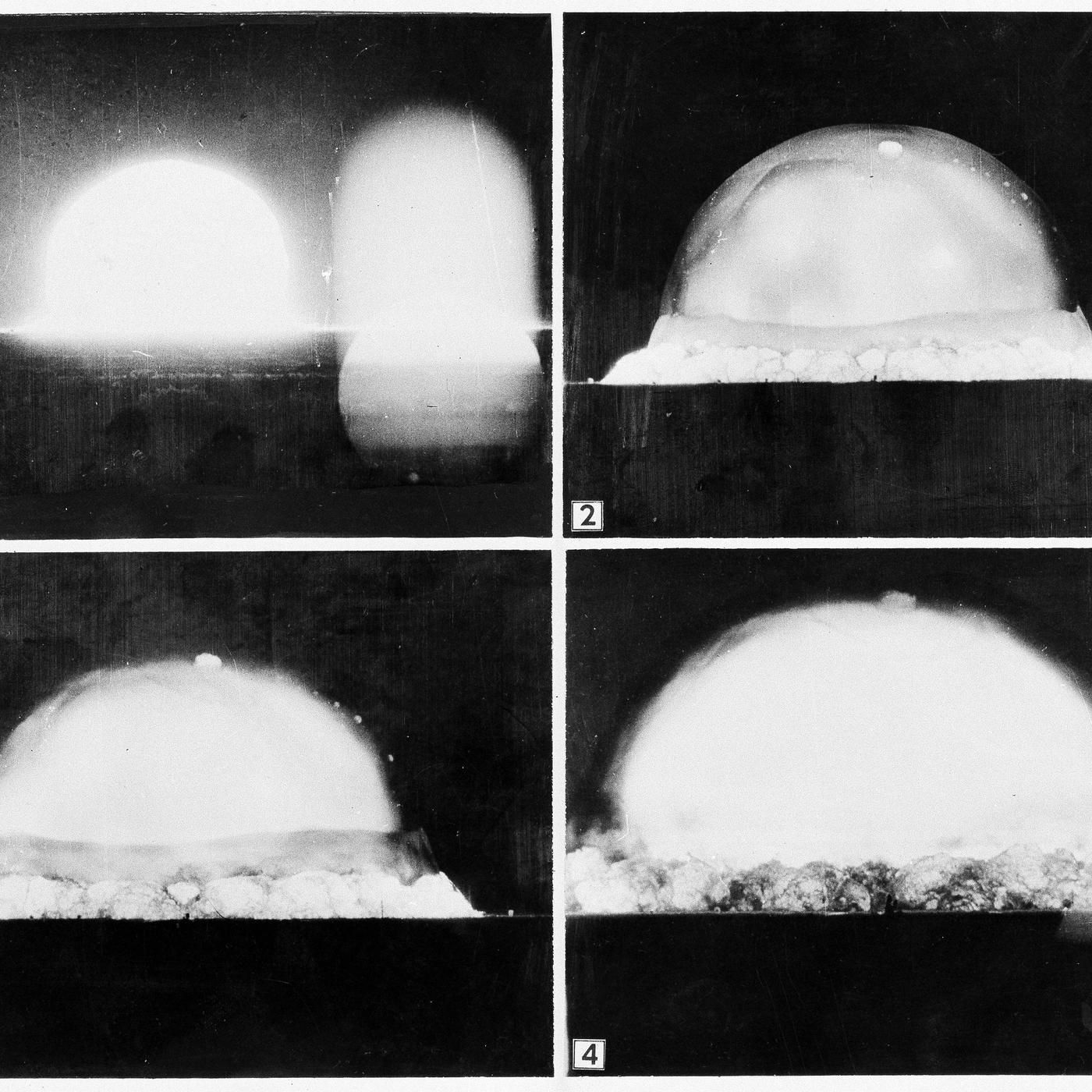
had just tested a bomb they called. Castle Bravo. It was a hydrogen bomb, about a thousand times as strong as the bomb dropped on Hiroshima. And then the rumble and the roar and the thunder of the sound of the explosion.
Because it was not one big explosion that goes just boom and that's it. The chain reaction caused it to roll like thunder. And then he says the sky erupted. Everything turned red.
The sky turned red. The ocean was red. The sand was red. My grandfather was red.
The whole atmosphere, the whole hemisphere, the effect was like you standing under a glass pole and somebody called Blood over. We were terrified. That explosion and the many others like it would poison the martial islands, poison its people. But in that moment, Tony says he and his grandpa just stood there listening to the explosions and staring at the blood red sky.
It seemed to have lasted for what seemed like ours. I am now 72 years old and every time I speak about this my skin still crawls and I still get goosebumps.