
EPISODE · Nov 14, 2024 · 33 MIN
Oaks to Wetland Trail Soundwalk
from Soundwalk · host Chad Crouch
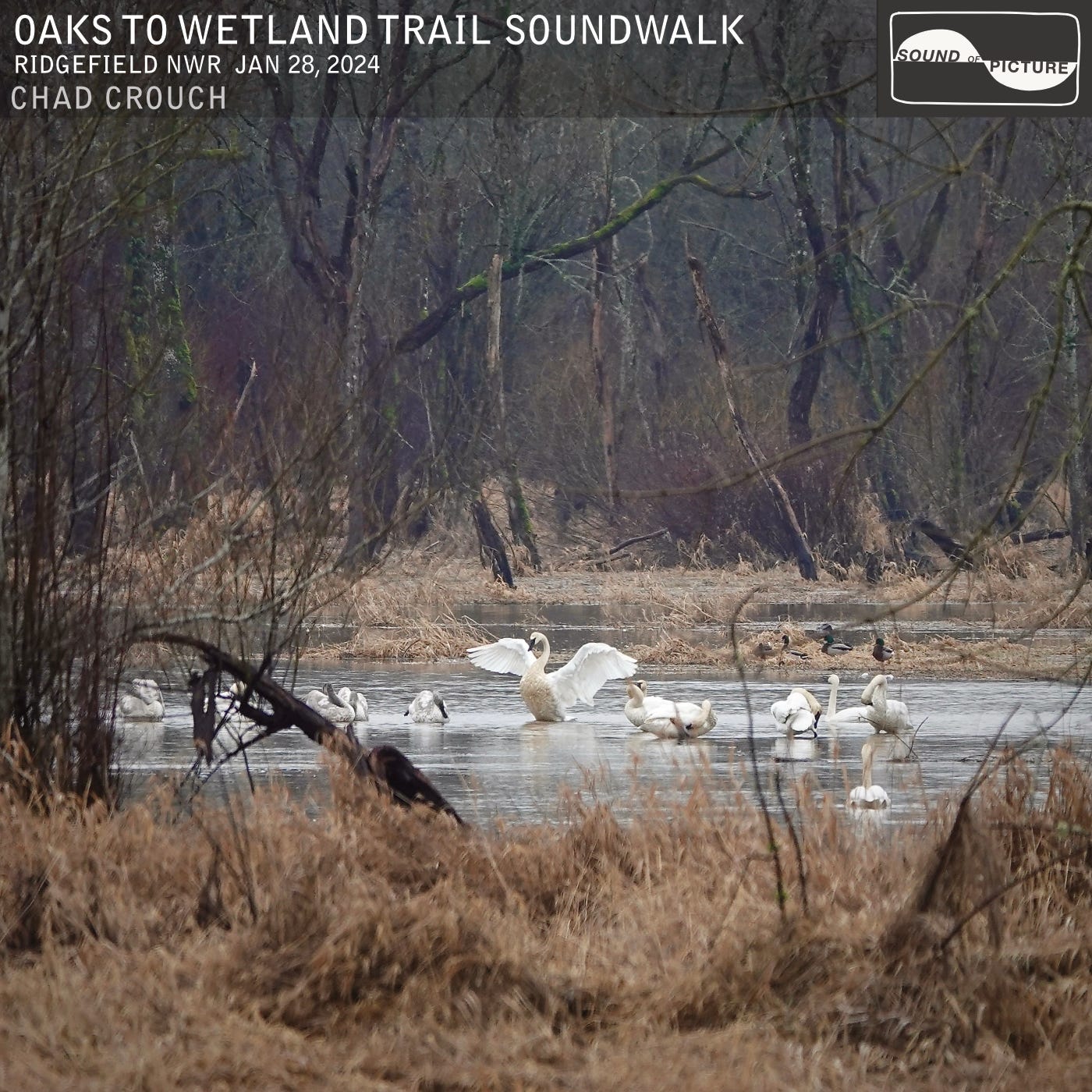
This week we are crossing the river from Sauvie Island in Oregon to Ridgefield National Wildlife Refuge (NWR) in Washington state. The Northern tip of the island is directly across from where we are walking today: on recently restored trail in the refuge known as the Oaks to Wetland Trail. In 2019 hundreds of Douglas Fir trees were felled and removed from this area to encourage “oak release”. An oak woodland used to reign supreme here, thanks to low-level fires managed by the indigenous people, keeping the land relatively clear for game grazing and promoting berry plants.Remember how I was complaining Oregon state agencies presently provide almost nothing in terms of education and memorialization on Sauvie Island about what was once may have been the most densely populated area of Native Americans in what is now the United States? Ridgefield NWR has done something pretty remarkable in contrast, by facilitating the construction of the Cathlapotle Plankhouse. The building is based on more than a decade’s worth of archaeological research at the site, which began in the 1990s where a large village of the Cathlapotle Nation once stood. It took over 100 volunteers two years to complete it, and the official opening ceremony was conducted on March 29, 2005. (nps.gov)For the past 20 years the Cathlapotle plankhouse has served the modern Chinook Tribe as the site of their annual winter gatherings. Standing up close to the structure one has to marvel at the sheer density of the plankhouse. The planks for the roof and walls are >2 inches thick, and >2 feet wide old-growth Western redcedar. Both the trees, and 3500 hours of volunteer labor were all donated. If one had to itemize the cost of the project at market prices today, it would likely have a multi-million dollar price tag. To the layperson it resembles so many old barns that dot the surrounding rural landscape, but to those with an understanding of construction materials, and the added time and cost of working in the old ways, it’s truly a marvel; something the many contributors can be proud of. Our soundwalk begins more or less here, at the plankhouse among Oregon white oaks, looking out over a landscape of lakes and wetlands. Not far off the remains of Cathlapotle village (numbering fourteen houses with an estimated population of 900 in 1806) slumber in the soil, just out of sight, near the Columbia River shore.Cathlapotle was one of the largest of the Wapato Valley villages—of at least 16 villages in all—sharing a common dialect, and ways of life. Explorers Lewis & Clark put it this way:All the tribes in the neighborhood of Wapato island, we have considered as Multnomahs, not because they are in any degree subordinate to that nation; but they all seem to regard the Multnomahs as the most powerful.Multnomah, on Sauvie Island, as we discovered a few weeks ago had a population of some 2400 in 1806, diminished by the introduction of smallpox in the 1780’s. In the late 1830’s the village was burned to the ground following a devastating malaria epidemic that left too few survivors to tend to the dead. “River erosion, development and looting have destroyed virtually all of the Chinook town sites. But Cathlapotle was spared,” said Kenneth M. Ames, PSU professor of anthropology who lead the archeological investigation that took place in the 1990’s. Ames’ excavation revealed:*Radiocarbon dates on charcoal from hearths place occupation from at least 900 years ago to the 1840s.*Various pieces of evidence indicate possibly two occupations of the site, with the last one having been continuously occupied for 1,500 years by up to 1,400 people, Ames said. He believes there was an earlier occupation as far back as 2,000 years ago. (The Oregonian, Aug 7, 1994)As I walked the trail beneath a cloudy sky, I tried to imagine the area in that pre-contact state, as I usually do. I think it would have looked similar, but of course it would have sounded much different. There would have been no leaf blowers or dogs barking from the expanding residential areas over the hill. No airplanes overhead. And, perhaps most distinctly for this site, there would have been no trains rumbling past. Access to this section of the refuge requires a short walk on a pedestrian bridge over train tracks. Trains glide by frequently. My quiet to loud ratio here was about 65 / 35. As usual, I spliced together the quiet sections of my walk to create this idealized pre-industrial soundwalk soundscape. I used my binaural Sennheiser Ambeo Headset for this recording, which performs quite well in the rain, if it’s not too windy. The mics were tucked into the concavity of my ears, sheltered from rain drops. The soundscape is really quiet and tranquil. Tundra Swans and Varied Thrushes sound so reverberant and sweet. My score is textural, spacious, and plaintive, I would say. It occurred to me that I could chain together the out-takes for an alternate “selectively industrialized” version. Voila: Four Trains Soundwalk was released a couple days ago as a flipside to this one. This was a surprise hit in my own listening habits. I found myself oddly soothed by the low frequency rumbles at bedtime, lulled by the anticipation of the iron beast transits.That’s it for this week. Once again, thank you for indulging me, for being here, for listening. Oaks to Wetland Trail Soundwalk is available on all streaming platforms (Spotify, Apple, Tidal, Amazon, YouTube…) tomorrow, Friday, November 15th. This is a public episode. If you'd like to discuss this with other subscribers or get access to bonus episodes, visit chadcrouch.substack.com/subscribe
NOW PLAYING
Oaks to Wetland Trail Soundwalk
No transcript for this episode yet
Similar Episodes
Mar 27, 2026 ·46m
Nov 28, 2025 ·25m
Nov 28, 2025 ·20m
Nov 28, 2025 ·23m
Nov 28, 2025 ·22m
Sep 9, 2025 ·28m