
EPISODE · Apr 17, 2026 · 11 MIN
Open a PDF, Lose Your System: Adobe Zero-Day Exploit (CVE-2026-34621)
from IT SPARC Cast
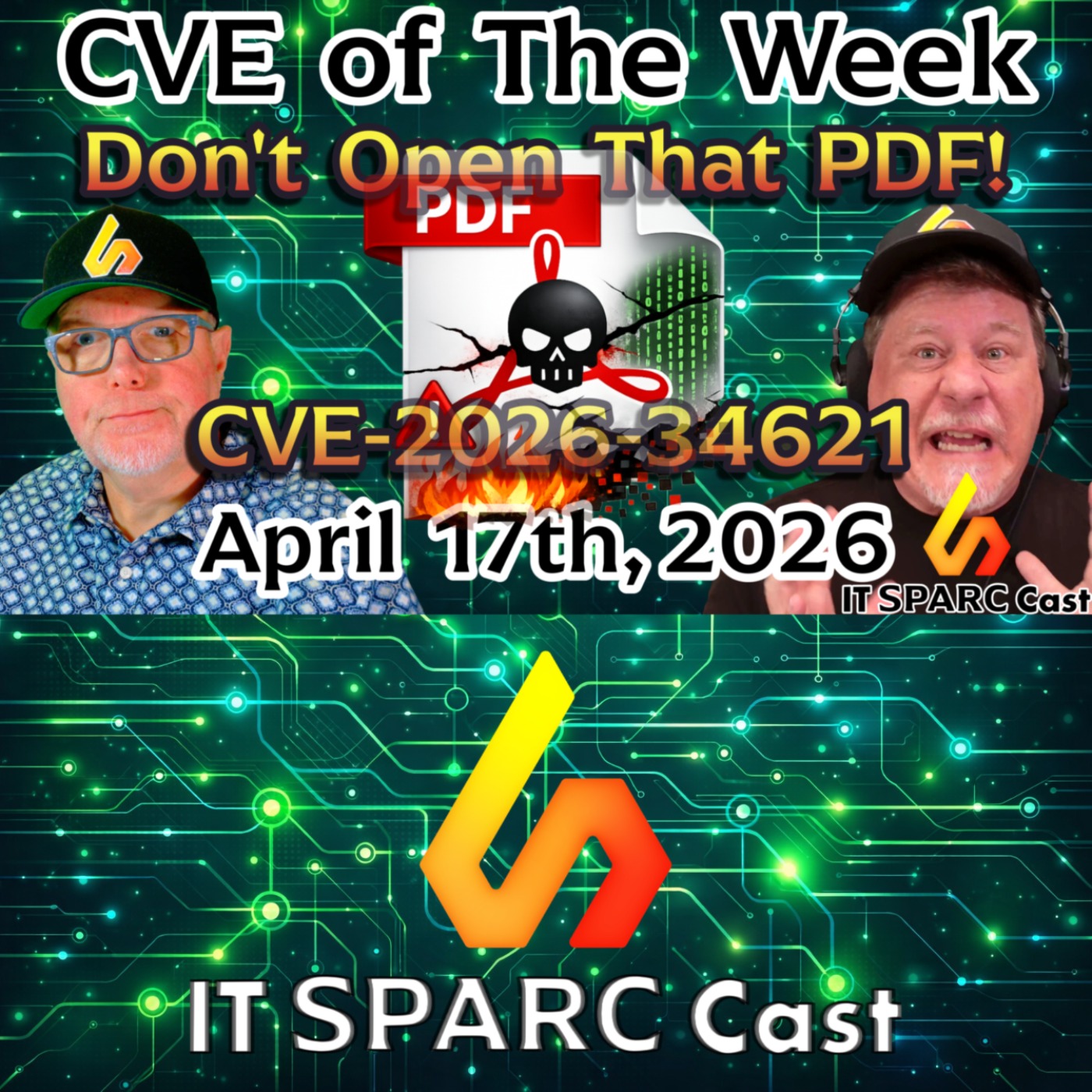
A dangerous Adobe Acrobat zero-day vulnerability (CVE-2026-34621) is actively being exploited—allowing attackers to compromise systems simply by getting users to open a malicious PDF. In this episode of IT SPARC Cast – CVE of the Week, John and Lou break down how it works, why it’s so dangerous, and what enterprise IT teams must do immediately.⸻📄 Show Notes🚨 CVE of the Week: Adobe Acrobat Zero-Day (CVE-2026-34621)This week’s vulnerability is about as bad—and as common—as it gets. A zero-day flaw in Adobe Acrobat Reader is actively being exploited in the wild, requiring nothing more than opening a malicious PDF to trigger a full system compromise.🔍 What Happened•CVE ID: CVE-2026-34621•Type: Zero-day (actively exploited before patch release)•Severity: CVSS 8.6 (High, but misleading in practice)•Attack Vector: Malicious PDF file•Impact: Remote Code Execution (RCE), data theftAdobe issued an emergency out-of-band patch, signaling the urgency and severity of the threat.⸻⚠️ Why This Is So DangerousThis exploit is particularly concerning because:•No user interaction required beyond opening a file•Works through phishing and email attachments•Targets one of the most widely used enterprise tools (PDF readers with ~60–75% market share)Once triggered, the vulnerability exploits a memory corruption flaw (e.g., use-after-free or buffer overflow), allowing attackers to execute arbitrary code on the system.⸻🔗 The Real Threat: Exploit ChainingOn its own, this vulnerability is severe—but in modern environments, it’s even worse:•Attackers use phishing to deliver the malicious PDF•Gain access to a user endpoint•Pivot into:•Cloud infrastructure•Container environments•Internal systems👉 This is how a “medium-high” CVSS score becomes a critical enterprise breach⸻🤖 AI and the Acceleration of AttacksThe pace of exploitation is changing:•Exploits are now being weaponized within minutes of disclosure•Attackers can deploy automated agents at scale•AI-driven reconnaissance reduces time-to-exploit dramaticallyThis creates a world where patch latency = exposure window.⸻🛠️ Mitigation & RecommendationsImmediate Actions:•✅ Patch Adobe Acrobat immediately (no delay)•🚫 Do NOT wait for standard patch cycles•📧 Treat all PDF attachments as potential attack vectorsEnterprise IT Best Practices:•Enforce auto-updates and forced patching policies•Consider network access restrictions for unpatched devices•Implement:•Zero Trust architectures•Endpoint monitoring and anomaly detection⸻🧠 Strategic Takeaways•User behavior is still the weakest link•Patch cycles must shift from scheduled → real-time response•Vendors must improve update mechanisms:•Fewer forced reboots•Better “do not interrupt” intelligenceWe are entering a phase where patching speed is a primary security control, not a maintenance task.⸻💬 Listener FeedbackThanks to listener IAPX for pointing out a technical clarification from last week:•The Docker vulnerability discussed was rooted in Moby, not Docker directly•Docker remains the primary exposure vector due to its widespread useGreat catch—and exactly the kind of feedback we appreciate.⸻📣 Wrap UpHave thoughts on this vulnerability? Are we underestimating the impact of PDF-based attacks?📧 Email: [email protected]🐦 X: @itsparccast💬 YouTube: Drop a comment—we read them all⸻🔗 Social LinksIT SPARC Cast@ITSPARCCast on Xhttps://www.linkedin.com/company/sparc-sales/ on LinkedInJohn Barger@JohnBarger on Xhttps://www.linkedin.com/in/johnbarger/ on LinkedInLou Schmidt@loudoggeek on Xhttps://www.linkedin.com/in/louis-schmidt-b102446/ on LinkedIn Hosted on Acast. See acast.com/privacy for more information.
Embed this episode
Ready to play
Open a PDF, Lose Your System: Adobe Zero-Day Exploit (CVE-2026-34621)
No transcript for this episode yet
Similar Episodes
No similar episodes found.
Similar Podcasts
No similar podcasts found.