
EPISODE · Mar 1, 2025 · 1H 28M
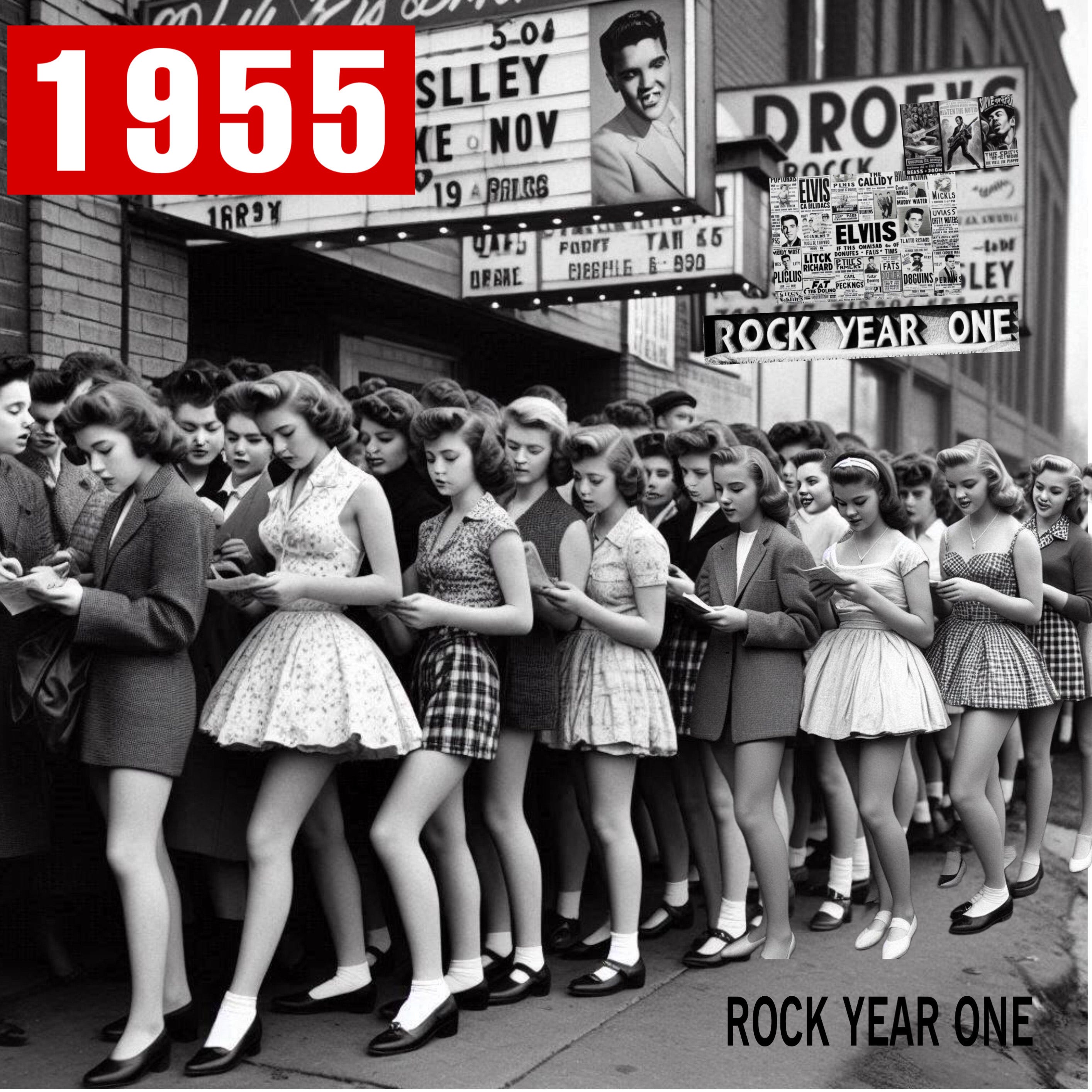
OS79-1955 Rock Year One
from The Yellow Wallpaper Fairy Book · host Professor Mikey’s OLD SCHOOL
“My man rocks me with one steady roll.” – Trixie Smith, 1922Today’s lesson is going to be especially fun to listen to in our special flying version of a 1955 Chevy hot rod.Pinning a start year on the first year of rock ‘n’ roll is difficult for most music histories. As we learned in episode 58: Pre-Rock Pre-Roll. There was evidence of the storm already hitting the airways in the late 40s and certainly in the early 50s. If you haven’t heard it, I have a link at the end of this page so you can soak up some of that 1951-54 early mojo.In this episode, we rock 1955. And it rolls over us.Coupling was at the heart of the newly developing genre. Rhythm and blues had taken jazz onto the dance floor. Country western was for hillbillies, but as it moved into rough and rowdy ways, a new Texas bop earned the name Rockabilly. Destiny kicked in, the rhythm aces hooked up with the cowboy rockers, and the results were usually too hot to handle.DJ Alan Freed had popularized the term that had come out of the bluesy southern juke joints, where it was a euphemism for motions people in love made in bed when they weren’t sleeping. Censors missed the connotations completely while music fans welcomed the perfect hybrid. White meets black, blues meets country, it has a good beat and you can dance to it. Rock and roll. Year One.Which gets us to the changing times of 1955. Bill Haley and His Comets had their song featured in the first rock and roll high school classic “The Blackboard Jungle.” It prompted the newly recognized teen market to rock around the clock. Elvis was still a year away from adopting a hound dog, Dick Clark wouldn’t take to television with American Bandstand until 1957. This is the equivalent of cave drawings highlighted by the original intelligence of Little Richard, Big Joe Turner, Chuck Berry, Bo Diddley.Controversy came with this meshing of cultures. White teens craved black artists, which rattled the anti diversity, equity, and inclusion crowd. Especially in the South. Then black artists pointed out to white legislators that Pat Boone and others had no problem not only covering black artists but also heavily borrowing arrangements and attitudes, adding a little honky zest and Brylcreem.The mixing of the music took a giant leap for mankind between 1954 and 1956. That’s why this lesson plan is entitled “1955: Rock Year One.” There are a handful of hits included. Remember, there are people who have never heard anything from 1955. Just like there are those who haven’t listened to any new music since 1955.This might be a good time to EASILY share this with some rocker you love:So here comes American music at a pivotal time. Rock and roll is far from taking over. The December merging of unions will give the AFL-CIO a total of 15 million members. The Salk vaccine has entered the war on polio. Cat on a Hot Tin Roof just won a Pulitzer for Tennessee Williams. The hot book is the Mad Men of the day, The Man in the Gray Flannel Suit. American kids are spending their allowances on Batman, Superman, and gross out horror comics, which are selling to the tune of one billion in 1955. That works out to a hundred million dollars at a dime a book, four times the budget of all U.S. libraries combined.The Dodgers of Brooklyn beat the Yankees in the World Series. Racial segregation on interstate trains and buses has been banned by the Interstate Commerce Commission. Employment is nearing the 100% mark, and there is still a shortage of 141,000 teachers. The USA has a stockpile of 4,000 atomic bombsAnd the top selling record of the year?“The Ballad of Davy Crockett.”Elvis in 1955 is still an up and coming young country western star at Sam Phillips’s Sun Studios in Memphis, as well as an up and coming attraction on the Louisiana Hayride in Shreveport. For his 3rd single Elvis recorded a blues piece made famous by Kokomo Arnold during the Depression. “Milkcow Boogie” on the A Side and “You’re a Heartbreaker” on the B. Let’s hear them both.Sun Records’ Carl Perkins had a career that needed a kick in the pants, and he got it from the man in black. Johnny Cash was telling him a story one day about an incident he had seen in Germany after the war, when someone in the dinner line happened to trip over the shoes of one C. V. White. “Hey man,” he said. “I don’t care what you do with my fraulein, don’t step on my blue suede shoes.” Granted the line needed a little editing, but Perkins was on his way. The Single itself was recorded by many others, including Elvis, and when the 60s rolled around, the flipside was covered by the Beatles.One of the biggest lessons of rock music’s unofficial Year One is how confusing cover versions muddied the waters. For instance, I’m going to play the first recording of “I Hear You Knocking but You Can’t Come In,” written by Dave Bartholomew, known for his collaborations with Fats Domino and Chuck Berry. No sooner had Smiley Lewis, also from New Orleans, released his version, Gale Storm, star of TV’s “My Little Margie” produced a cover version. It shot up to #2 on the Billboard charts, earning her a gold record. Blues writer Bill Dahl recalled that that Storm’s version killed Lewis’s version, writing that “Storm swiped his thunder for any crossover possibilities with her ludicrous whitewashed cover of the plaintive ballad.” To make matters worse Lewis earned the tag of a “bad luck singer” because every cover dimmed the success of his original. English singer Jill Day recorded the song in 1956, Connie Francis followed in 1959. The last nail was driven in 1961 when Bartholomew produced Fats Domino's remake of the song. I’ll play a little of the Gale Storm version, then the original of “I Hear You Knocking but No Doors are Opening for Smiley Lewis.”And then there was Elvis Aaron Presley, the 18-year-old Memphis truck driver who wandered into Sun Records in the summer of 1953 and paid four dollars for the time in the studio it would take to record a couple of songs for his mother. We know now that Elvis would not invent rock and roll, he would merely change the world.In 1954 he recorded Arthur “Big Boy” Crudup’s “That’s All Right” and the earth moved under all feet. Coming up we will hear a song he released on December 29, two days before 1955. Then another that came out in summer, as he toured with the Louisiana Hayride. The timing was right and soon after RCA would buy his contract for an incredible sum at the time of $40,000.Coming up, two songs released on Sun Records by Elvis in 1955 Rock Year One. The first was an original blues piece released by Kokomo Arnold during the great Depression and titled the “Milkcow Blues Boogie.” It opens like no other Elvis record. Then it’s all aboard for a 1953 B-Side and Presley’s favorite Junior Parker song in a year of change and musical mystery. It’s impossible to hear as it must have sounded then, with no hint at the times that were about to be changing. What a rush.It’s impossible to play every vital critical blast off of a rocking song from 1955. Nothing was important and everything mattered. Elsewhere on the first rock planet, Castro organized his revolution in Cuba. Disneyland opened, so did McDonalds. Bill Gates and Steve Jobs were born, Albert Einstein died, . The first Johnny Carson TV show debuted on CBS, and Sony introduced their transistor radio. Harmon Killebrew hit his first home run. Rosa Parks refused to give up her seat on a bus in Montgomery, Alabama. James Dean picked up his Porsche and took it out for his last test drive.Youth culture had it’s first martyr, it’s first hero, a righteous cause for civil rights, and a new way to blow off steam.I’m, Professor Mikey, thanks for listening to Old School #79. 1955: Rock Year One.Any music you may have heard in this session resides within the public domain or is used within the guidelines of fair use provided for in Section 107 of the copyright act of 1976. Podcast carriers compensate artists directly.Every unexpurgated episode of Old School originates on Substack, where you can subscribe for free at professormikey.substack.com and receive not only the podcast but additional material, playlists, and pictures. The podcast is also heard on Apple, Spotify, Stitcher, Pandora or wherever you get your podcasts. Select episodes are also available on my YouTube Channel, where a like or a subscription would always help.Professor Mikey's OLD SCHOOL is a reader-supported publication. To receive new posts and support my work, consider becoming a free or paid subscriber.Bill Haley and His Comets formed in 1947 and played until Haley’s death in 1981, recording nine top 20 singles, one in particular that reached number one. They originally recorded and released Rock Around the Clock in 1954, but the earthquake impact was delayed almost a year until it was included in the 1955 film Blackboard Jungle. It was number 1 on the pop charts for two months and went to number 3 on the R&B chart. It’s a fitting close to a year like no other. 🎸 1 9 5 5 Tutti Fruitti LITTLE RICHARD Maybelline CHUCK BERRY At My Front Door THE ELDORADOS Good Rockin’ Daddy ETTA JAMESY Bo Diddley BO DIDDLEY Only You THE PLATTERS My Boy Flat Top DOROTHY COLLINS Rock and Roll Wedding THE MIDNIGHTERS Don’t Be Angry NAPPY BROWN All Around the World LITTLE WILLIE JOHN She Put the Whamee On Me SCREAMIN’ JAY HAWKINS Earth Angel THE PENGUINS Blue Suede Shoes/Honey Don’t CARL PERKINS The Seventh Son WILLIE MABON Dust My Blues ELMORE JAMES I Hear You Knocking but You Can’t Come In SMILEY LEWIS Too Much BERNARD HARDISON Flip, Flop, and Fly BIG JOE TURNER When You Dance THE TURBANS Speedo THE CADILLACS Ain’t It a Shame FATS DOMINO I Got a Woman RAY CHARLES Red Hot BILLY “THE KID” EMERSON Mannish Boy MUDDY WATERS Milkcow Boogie/Mystery Train ELVIS PRESLEY Rock Around the Clock BILL HALEY AND HIS COMETSNeed more ROCK? Here’s the prequel to 1955 Rock Year One: This is a public episode. If you'd like to discuss this with other subscribers or get access to bonus episodes, visit professormikey.substack.com/subscribe
Embed this episode
Ready to play
OS79-1955 Rock Year One
No transcript for this episode yet
Similar Episodes
No similar episodes found.
Similar Podcasts
No similar podcasts found.