
EPISODE · Mar 28, 2024 · 1H 8M
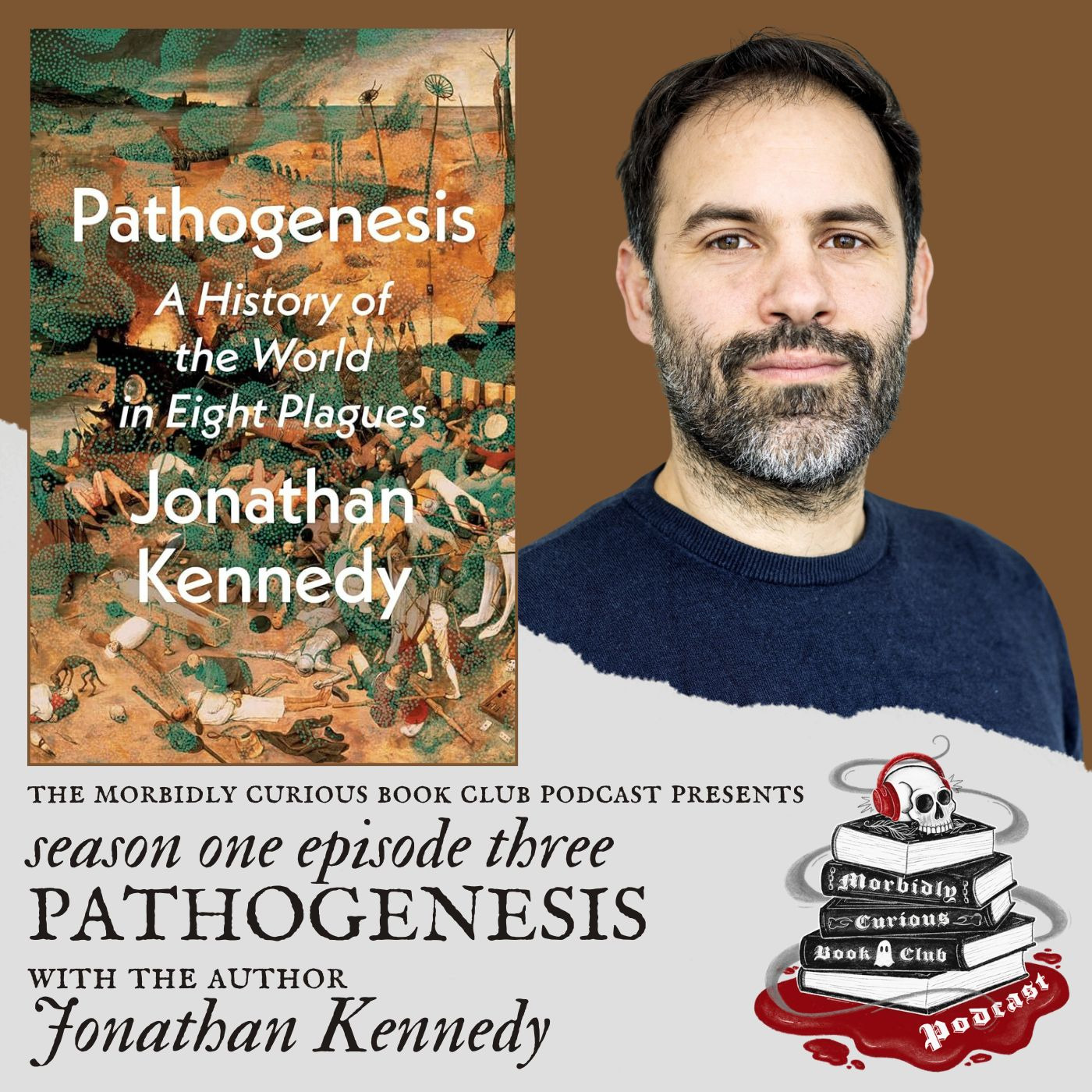
Pathogenesis: A History of the World in Eight Plagues by Jonathan Kennedy
from Morbidly Curious Book Club Podcast · host Morbidly Curious Book Club®
Join the Morbidly Curious Book Club Today: https://www.morbidlycuriousbookclub.com/“In medicine, pathogenesis refers to the origins and development (genesis) of a disease (pathos), with a particular focus on the way that pathogens infect our cells and the effect this has on our bodies. In the pages that follow, we will explore how viruses, bacteria, and other microbes impact aggregations of bodies–that is, the body politic, body economic, and body social … Over the last couple of years, COVID-19 has affected all our lives to such an extent that it has become a cliche to say that the pandemic is unprecedented and extraordinary. But when we place coronavirus in its historical and scientific context, it becomes very clear that there is little about it that is new or remarkable. Recurring outbreaks of infectious diseases have been a feature of human existence for millennia … We don’t make history in circumstances of our own choosing … It’s a bacterial world, and we’re just squatting here.”Welcome to the Morbidly Curious Book Club’s Podcast! In this episode, we are discussing our March 2024 book pick, “PATHOGENESIS: A History of the World in Eight Plagues” by Jonathan Kennedy.“In medicine, pathogenesis refers to the origins and development (genesis) of a disease (pathos), with a particular focus on the way that pathogens infect our cells and the effect this has on our bodies. In the pages that follow, we will explore how viruses, bacteria, and other microbes impact aggregations of bodies–that is, the body politic, body economic, and body social … Over the last couple of years, COVID-19 has affected all our lives to such an extent that it has become a cliche to say that the pandemic is unprecedented and extraordinary. But when we place coronavirus in its historical and scientific context, it becomes very clear that there is little about it that is new or remarkable. Recurring outbreaks of infectious diseases have been a feature of human existence for millennia. Epidemics have played a critical role in, among other things, the transformation from a planet inhabited by multiple species of humans to one in which jomo sapiens reigned supreme; the replacement of nomadic foraging with sedentary agriculture; the decline of the great empires of antiquity; the rise of new world religions; the transition from feudalism to capitalism; European colonialism; and the Agricultural and Industrial revolutions. In other words, bacteria and viruses have been instrumental in the emergence of the modern world … We don’t make history in circumstances of our own choosing … It’s a bacterial world, and we’re just squatting here.”Welcome to the Morbidly Curious Book Club’s Podcast! In this episode, we are discussing our March 2024 book pick, “PATHOGENESIS: A History of the World in Eight Plagues” by Jonathan Kennedy.About: This humbling and revelatory book shows how infectious disease has shaped humanity at every stage, from the first success of Homo sapiens over the equally intelligent Neanderthals to the fall of Rome and the rise of Islam. How did the Black Death lead to the birth of capitalism? And how did the Industrial Revolution lead to the birth of the welfare state? In this revelatory book, Dr Jonathan Kennedy argues that the myth of human exceptionalism overstates the role that we play in social and political change. Instead, it is the humble microbe that wins wars and topples empires. Infectious diseases are not just something that happens to us, but a part of who we are. The only reason humans don't lay eggs is that a virus long ago inserted itself into our DNA. In fact, 8% of the human genome was put there by viruses. We have been thinking about the survival of the fittest all wrong: human evolution is not simply about our strength and intelligence, but about what viruses can and can't use for their benefit. Drawing on the latest research in fields ranging from genetics and anthropology to archaeology and economics, Pathogenesis takes us through 60,000 years of history, exploring eight major outbreaks of infectious disease that have made the modern world. Bacteria and viruses were protagonists in the demise of the Neanderthals, the growth of Islam, the transition from feudalism to capitalism, the devastation wrought by European colonialism, and the evolution of the United States from an imperial backwater to a global superpower. Even Christianity rose to prominence in the wake of a series of deadly pandemics that swept through the Roman Empire in the second and third centuries: Caring for the sick turned what was a tiny sect into one of the world’s major religions. By placing disease at the center of his wide-ranging history of humankind, Kennedy challenges some of the most fundamental assumptions about our collective past—and urges us to view this moment as another disease-driven inflection point that will change the course of history. Provocative and brimming with insight, Pathogenesis transforms our understanding of the human story by confronting our ongoing battle with infectious diseases globally. Kennedy shows how germs have been responsible for some of the seismic revolutions in human history, and how the crises they precipitate offer vital opportunities to change course.Join the Patreon page here to donate: https://patreon.com/TheMorbidlyCuriousBookClub?utm_medium=clipboard_copy&utm_source=copyLink&utm_campaign=creatorshare_creator&utm_content=join_linkInquiries: [email protected] Inquiries: https://redcircle.com/brandsPrivacy & Opt-Out: https://redcircle.com/privacy
What this episode covers
Our March pick for The Morbidly Curious Book Club -- "Pathogenesis" with author Jonathan Kennedy Join the Morbidly Curious Book Club Today: themorbidlycuriousbookclub.com “In medicine, pathogenesis refers to the origins and development (genesis) of a disease (pathos), with a particular focus on the way that pathogens infect our cells and the effect this has on our bodies. In the pages that follow, we will explore how viruses, bacteria, and other microbes impact aggregations of bodies–that is, the body politic, body economic, and body social … Over the last couple of years, COVID-19 has affected all our lives to such an extent that it has become a cliche to say that the pandemic is unprecedented and extraordinary. But when we place coronavirus in its historical and scientific context, it becomes very clear that there is little about it that is new or remarkable. Recurring outbreaks of infectious diseases have been a feature of human existence for millennia. Epidemics have played a critical role in, among other things, the transformation from a planet inhabited by multiple species of humans to one in which jomo sapiens reigned supreme; the replacement of nomadic foraging with sedentary agriculture; the decline of the great empires of antiquity; the rise of new world religions; the transition from feudalism to capitalism; European colonialism; and the Agricultural and Industrial revolutions. In other words, bacteria and viruses have been instrumental in the emergence of the modern world … We don’t make history in circumstances of our own choosing … It’s a bacterial world, and we’re just squatting here.” Welcome to the Morbidly Curious Book Club’s Podcast! In this episode, we are discussing our March 2024 book pick, “PATHOGENESIS: A History of the World in Eight Plagues” by Jonathan Kennedy. About: This humbling and revelatory book shows how infectious disease has shaped humanity at every stage, from the first success of Homo sapiens over the equally intelligent Neanderthals to the fall of Rome and the rise of Islam. How did the Black Death lead to the birth of capitalism? And how did the Industrial Revolution lead to the birth of the welfare state? In this revelatory book, Dr Jonathan Kennedy argues that the myth of human exceptionalism overstates the role that we play in social and political change. Instead, it is the humble microbe that wins wars and topples empires. Infectious diseases are not just something that happens to us, but a part of who we are. The only reason humans don't lay eggs is that a virus long ago inserted itself into our DNA. In fact, 8% of the human genome was put there by viruses. We have been thinking about the survival of the fittest all wrong: human evolution is not simply about our strength and intelligence, but about what viruses can and can't use for their benefit. Drawing on the latest research in fields ranging from genetics and anthropology to archaeology and economics, Pathogenesis takes us through 60,000 years of history, exploring eight major outbreaks of infectious disease that have made the modern world. Bacteria and viruses were protagonists in the demise of the Neanderthals, the growth of Islam, the transition from feudalism to capitalism, the devastation wrought by European colonialism, and the evolution of the United States from an imperial backwater to a global superpower. Even Christianity rose to prominence in the wake of a series of deadly pandemics that swept through the Roman Empire in the second and third centuries: Caring for the sick turned what was a tiny sect into one of the world’s major religions. By placing disease at the center of his wide-ranging history of humankind, Kennedy challenges some of the most fundamental assumptions about our collective past—and urges us to view this moment as another disease-driven inflection point that will change the course of history. Provocative and brimming with insight, Pathogenesis transforms our understanding of the human story by confronting our ongoing battle with infectious diseases globally. Kennedy shows how germs have been responsible for some of the seismic revolutions in human history, and how the crises they precipitate offer vital opportunities to change course. Join the Patreon page here to donate: https://patreon.com/TheMorbidlyCuriousBookClub?utm_medium=clipboard_copy&utm_source=copyLink&utm_campaign=creatorshare_creator&utm_content=join_link Inquiries: [email protected] Advertising Inquiries: https://redcircle.com/brands Privacy & Opt-Out: https://redcircle.com/privacy
NOW PLAYING
Pathogenesis: A History of the World in Eight Plagues by Jonathan Kennedy
No transcript for this episode yet
Similar Episodes
Dec 5, 2025 ·50m
Oct 9, 2025 ·33m
Oct 3, 2025 ·40m
Sep 11, 2025 ·31m
Aug 27, 2025 ·39m
Aug 18, 2025 ·54m