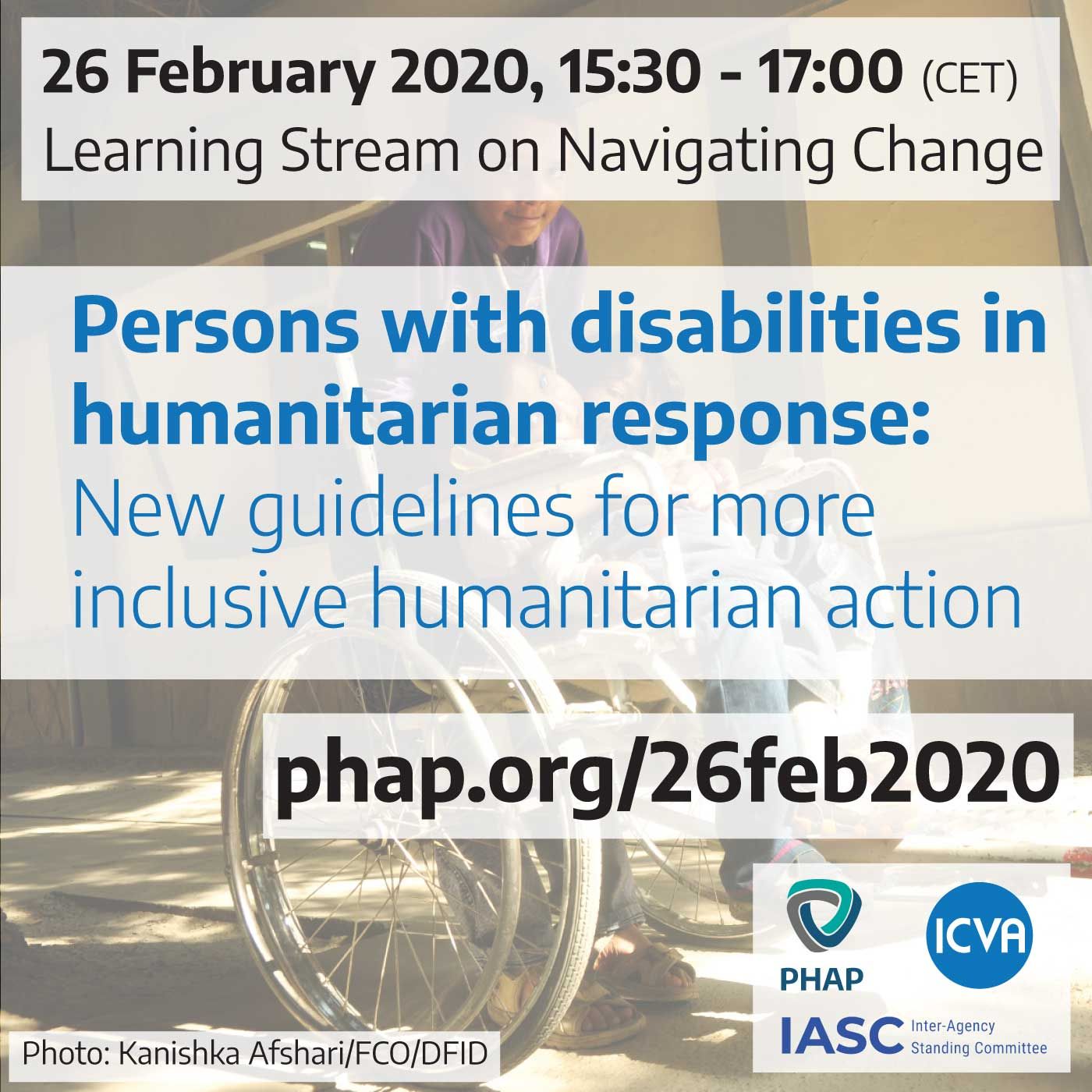
Persons with disabilities in humanitarian response: New guidelines for more inclusive humanitarian action episode artwork

EPISODE · Mar 2, 2020 · 1H 40M

Persons with disabilities in humanitarian response: New guidelines for more inclusive humanitarian action

from PHAP: Learning sessions and webinars · host PHAP

The IASC recently endorsed guidelines for the inclusion of persons with disabilities in humanitarian action. How can these guidelines help make humanitarian action more inclusive? On 26 February 2020, ICVA and PHAP organized a webinar together with the Inter-Agency Standing Committee (IASC) secretariat and the Reference Group on Inclusion of Persons with Disabilities in Humanitarian Action, which introduced the guidelines and discuss how they can be implemented in practice. The three interim co-chairs of the Reference Group, as well as one of the NGOs that has been implementing the IASC Guidelines in their organization, spoke about the guidelines, their development, structure, and how they can be used in practice.For more information about the event, please visit https://phap.org/26feb2020Persons with disabilities are among the most marginalized people in crisis-affected communities and disproportionately affected by conflict and disasters. In some contexts, their mortality rate is two to four times higher than that of persons without disabilities and persons with disabilities face substantial barriers to accessing assistance. A recent study found that 92% of humanitarian actors think that persons with disabilities are not properly taken into account in humanitarian response and are often considered only as recipients of aid and not as actors in the response.That is also why delivering better for persons with disabilities was part of the discussions of the World Humanitarian Summit and its follow-up commitments, including through the Charter on Inclusion of Persons with Disabilities in Humanitarian Action (2016). In 2016, the United Nations Inter-Agency Standing Committee (IASC) Working Group agreed to the establishment of a Task Team on the Inclusion of Persons with Disabilities in Humanitarian Action, which drafted the Guidelines on Inclusion of Persons with Disabilities in Humanitarian Action. The IASC Guidelines were drafted through a large number of consultations with member States, organizations of persons with disabilities, civil society organizations working with persons with disabilities and/or in humanitarian action, and UN agencies. They were endorsed by the IASC Principals in October 2019 and launched in New York in November 2019 and in Geneva in February 2020. At the same time, a Reference Group was established to continue to bring together key stakeholders for coordinated efforts on the implementation of the IASC Guidelines on Inclusion of Persons with Disabilities and provide support, among others, their dissemination and to develop supporting tools and resources. As one of the few global initiatives where the persons concerned have been directly involved in the drafting of a tool serving intervention at their benefit, these Guidelines are a crucial step forward to achieve disability-inclusive humanitarian action. They serve the following four objectives:1. To provide practical guidance on including persons with disabilities in humanitarian programming and coordination;2. To increase capacity among humanitarian stakeholders to develop and implement quality programs that are inclusive of persons with disabilities;3. To describe the roles and responsibilities of humanitarian stakeholders to include persons with disabilities in humanitarian action; and4. To increase and improve the participation of persons with disabilities and organization of persons with disabilities in preparedness, response and recovery.However, what will make the real difference for persons with disabilities is how these guidelines are implemented in practice. Humanitarian actors need to translate the IASC Guidelines into concrete improvements in their daily activities, continuing to work closely with persons with disabilities and their representative organizations.

The IASC recently endorsed guidelines for the inclusion of persons with disabilities in humanitarian action. How can these guidelines help make humanitarian action more inclusive? On 26 February 2020, ICVA and PHAP organized a webinar together with the Inter-Agency Standing Committee (IASC) secretariat and the Reference Group on Inclusion of Persons with Disabilities in Humanitarian Action, which introduced the guidelines and discuss how they can be implemented in practice. The three interim co-chairs of the Reference Group, as well as one of the NGOs that has been implementing the IASC Guidelines in their organization, spoke about the guidelines, their development, structure, and how they can be used in practice.For more information about the event, please visit https://phap.org/26feb2020Persons with disabilities are among the most marginalized people in crisis-affected communities and disproportionately affected by conflict and disasters. In some contexts, their mortality rate is two to four times higher than that of persons without disabilities and persons with disabilities face substantial barriers to accessing assistance. A recent study found that 92% of humanitarian actors think that persons with disabilities are not properly taken into account in humanitarian response and are often considered only as recipients of aid and not as actors in the response.That is also why delivering better for persons with disabilities was part of the discussions of the World Humanitarian Summit and its follow-up commitments, including through the Charter on Inclusion of Persons with Disabilities in Humanitarian Action (2016). In 2016, the United Nations Inter-Agency Standing Committee (IASC) Working Group agreed to the establishment of a Task Team on the Inclusion of Persons with Disabilities in Humanitarian Action, which drafted the Guidelines on Inclusion of Persons with Disabilities in Humanitarian Action. The IASC Guidelines were drafted through a large number of consultations with member States, organizations of persons with disabilities, civil society organizations working with persons with disabilities and/or in humanitarian action, and UN agencies. They were endorsed by the IASC Principals in October 2019 and launched in New York in November 2019 and in Geneva in February 2020. At the same time, a Reference Group was established to continue to bring together key stakeholders for coordinated efforts on the implementation of the IASC Guidelines on Inclusion of Persons with Disabilities and provide support, among others, their dissemination and to develop supporting tools and resources. As one of the few global initiatives where the persons concerned have been directly involved in the drafting of a tool serving intervention at their benefit, these Guidelines are a crucial step forward to achieve disability-inclusive humanitarian action. They serve the following four objectives:1. To provide practical guidance on including persons with disabilities in humanitarian programming and coordination;2. To increase capacity among humanitarian stakeholders to develop and implement quality programs that are inclusive of persons with disabilities;3. To describe the roles and responsibilities of humanitarian stakeholders to include persons with disabilities in humanitarian action; and4. To increase and improve the participation of persons with disabilities and organization of persons with disabilities in preparedness, response and recovery.However, what will make the real difference for persons with disabilities is how these guidelines are implemented in practice. Humanitarian actors need to translate the IASC Guidelines into concrete improvements in their daily activities, continuing to work closely with persons with disabilities and their representative organizations.

NOW PLAYING

Persons with disabilities in humanitarian response: New guidelines for more inclusive humanitarian action

0:00 1:40:40

No transcript for this episode yet

We transcribe on demand. Request one and we'll notify you when it's ready — usually under 10 minutes.

MG Show MG Show The MG Show, hosted by Jeffrey Pedersen and Shannon Townsend, is a leading alternative media platform dedicated to uncovering the truth behind today’s most pressing political issues. Launched in 2019, the show has grown exponentially, offering unfiltered insights, comprehensive research, and real-time analysis. With a commitment to independent journalism and factual integrity, the MG Show empowers its audience with knowledge and encourages active participation in the political discourse. Breaking News Show | eTurboNews Juergen Thomas Steinmetz News is relevant to the global travel and tourism industry, human rights and global issues.Breaking news when it happens and only from the source. Eat to Live Jenna Fuhrman, Dr. Fuhrman Our health is our most precious gift and smart nutrition can change your life. Each month, join Dr. Fuhrman and his daughter, Jenna Fuhrman as they discuss important topics in the world of nutrition. Eat to Live will change the way you eat and think about food. French Your Way Jessica: Native French teacher founder of French Your Way Boost your French listening skills and test your comprehension with this one of a kind series of podcasts. Get the chance to listen to a real conversation between native speakers talking at normal speed AND customise your learning experience through carefully designed sets of questions (2 levels of difficulty) available for download at www.frenchvoicespodcast.com. All interviews also come with the transcript. French teacher Jessica interviews native speakers of French from around the world who share a bit of their life and passion. Where else would you meet in one same place a French yoga teacher based in Melbourne, a soap manufacturer from Provence, or a couple cycling around the world?

Frequently Asked Questions

How long is this episode of PHAP: Learning sessions and webinars?

This episode is 1 hour and 40 minutes long.

When was this PHAP: Learning sessions and webinars episode published?

This episode was published on March 2, 2020.

What is this episode about?

The IASC recently endorsed guidelines for the inclusion of persons with disabilities in humanitarian action. How can these guidelines help make humanitarian action more inclusive? On 26 February 2020, ICVA and PHAP organized a webinar together with...

Can I download this PHAP: Learning sessions and webinars episode?

Yes, you can download this episode by clicking the download button on the episode player, or subscribe to the podcast in your preferred podcast app for automatic downloads.
URL copied to clipboard!