
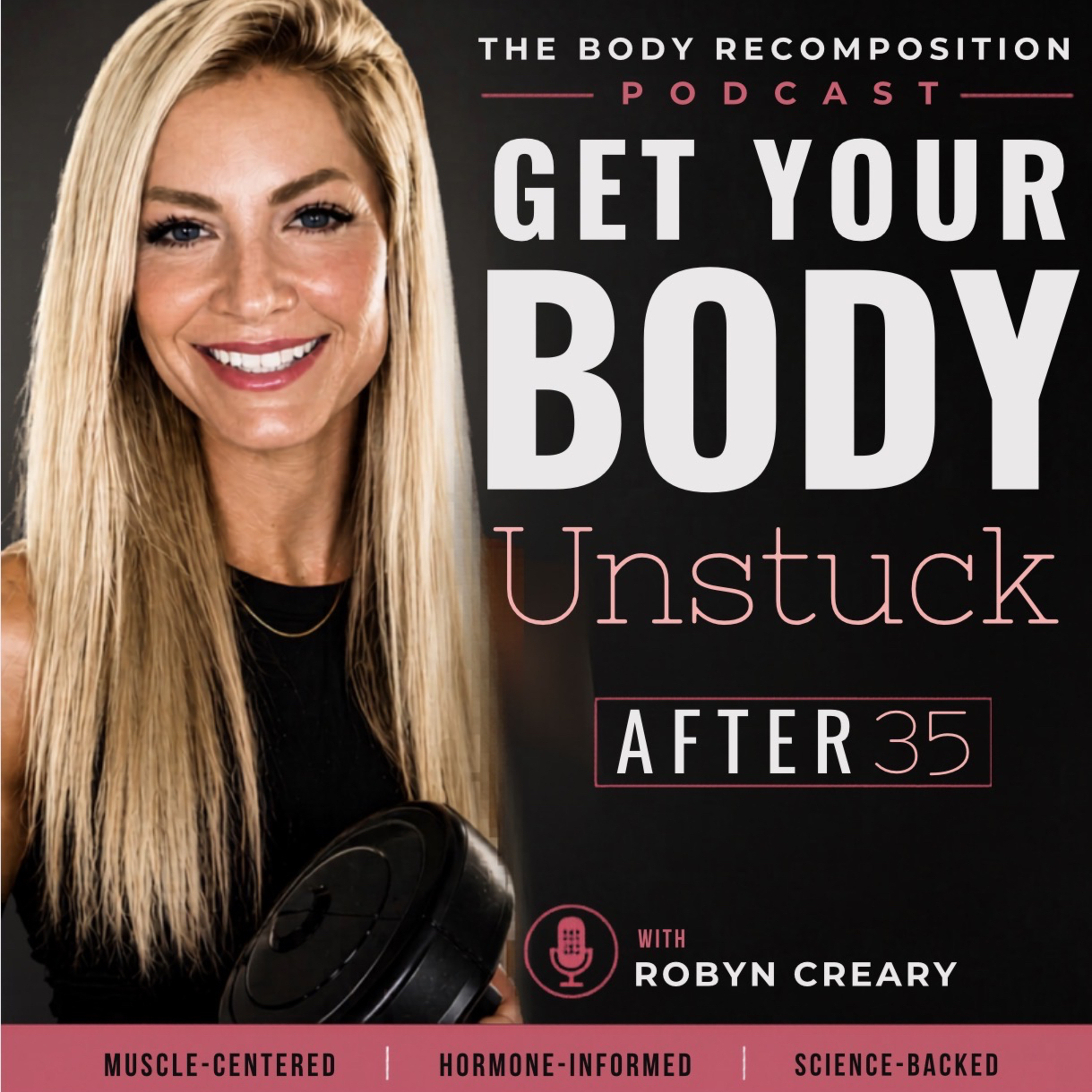
EPISODE · Jan 23, 2026 · 29 MIN
Pilates for Weight Loss After 35: Why You’re Not Getting Toned
from Lose Weight + Build Muscle After 35: The Body Recomposition Podcast · host RAC Fitness - Robyn Creary
Why Pilates, OrangeTheory, and Running Aren’t Giving You a Toned Body (And What Actually Will)insta https://www.instagram.com/racfitness_/If you’ve been doing Pilates, OrangeTheory, fitness classes, or running, and you’re beyond frustrated that your body doesn’t look the way the marketing promised, this episode is for you.In this episode of The Body Recomposition Revolution, I break down one of the biggest misconceptions in women’s fitness: the idea that high-rep, low-weight workouts and endless cardio will “tone” your body. If you’ve ever said “I’m not trying to build muscle, I just want to tone,” this conversation will completely change how you see training.You’ll learn:What “toned” actually means from a physiological standpointWhy Pilates and fitness classes burn but don’t build muscleThe difference between movement, conditioning, and muscle hypertrophyWhy fat loss is driven by nutrition, not high-rep workoutsHow to use Pilates, running, and classes strategically without sabotaging resultsRobyn also introduces the RAC REPS, a simple muscle-building checklist used inside RAC Recomposition to verify whether training is actually capable of producing muscle growth.A quick framework to audit whether your workouts are doing what you think they are:R — Reps (and effort)Hypertrophy isn’t about chasing a magic rep number, it’s about effort. Muscle growth can occur across a wide range of loads when sets are taken close enough to failure.Green light: Most working sets fall roughly in the 5–30 rep range with ~0–3 reps in reserve (RIR). If you finish a set and could’ve done 5+ more reps, it was too easy to grow muscle. **Quick self-test: The last 2–3 reps slow down, burn, and require focus without your form breaking.E — Exercise selectionEven hard sets won’t build muscle if the movement doesn’t load the targeted muscle well for your body.Green light: You can FEEL the targeted muscle, control tempo and range of motion, progress reps or load over time, and keep technique consistent, especially important for women 35+ P — ProteinTraining is the signal. Protein is the building material.Green light: Daily protein intake is high enough to support muscle gain or retention, especially during fat loss. Evidence-based targets often land around .75g-1.5g/day per lb of ideal bodyweight. Spreading protein across the day tends to support muscle protein synthesis better than saving it all for dinner.S — StructureMuscle builds from repeat exposure and progression, not random “good workouts.” Green light: Repeat key lifts enough to improve them, accumulate enough hard sets per muscle per week (10+ is a common starting point for many), progression plan: add reps → add load → add sets.📩 For custom macro formulation PDF *3 quiz* ($49) or coaching inquiries: [email protected]📲 Follow Robyn on Instagram: @racfitness_00:00 — Welcome to The Body Recomposition 00:45 — The Promise vs. Reality of the “Pilates Body”Why marketing doesn’t match results02:30 — “I’m Not Trying to Build, I Just Want to Tone”The phrase stalling progress04:10 — What ‘Toned’ Actually MeansMuscle + fat loss06:30 — Why High-Rep, Low-Weight Training Falls ShortBurn ≠ hypertrophy09:15 — Movement vs. Muscle GrowthWhy feeling worked isn’t enough12:00 — Why Pilates Isn’t Designed for HypertrophyControl vs. muscle growth15:10 — Where Fat Loss Really Comes FromNutrition drives fat loss17:45 — Why Cardio Alone Doesn’t Create DefinitionRunning and classes in context20:40 — Introducing the RAC REPS CHECKHow to verify muscle-building training22:00 — R: Reps & Effort (RIR)Why proximity to failure matters24:30 — E: Exercise SelectionLoading the right muscles safely27:00 — P: Protein for Women 35+You can’t build without it29:30 — S: Structure & ProgressionWhat progress looks like over time32:30 — Should You Quit Pilates or Running?Using them strategically35:00 — Final Takeaway: Train With IntentionStop guessing. Start verifying.
What this episode covers
Why Pilates, OrangeTheory, and Running Aren’t Giving You a Toned Body (And What Actually Will)insta https://www.instagram.com/racfitness_/If you’ve been doing Pilates, OrangeTheory, fitness classes, or running, and you’re beyond frustrated that your body doesn’t look the way the marketing promised, this episode is for you.In this episode of The Body Recomposition Revolution, I break down one of the biggest misconceptions in women’s fitness: the idea that high-rep, low-weight workouts and endless cardio will “tone” your body. If you’ve ever said “I’m not trying to build muscle, I just want to tone,” this conversation will completely change how you see training.You’ll learn:What “toned” actually means from a physiological standpointWhy Pilates and fitness classes burn but don’t build muscleThe difference between movement, conditioning, and muscle hypertrophyWhy fat loss is driven by nutrition, not high-rep workoutsHow to use Pilates, running, and classes strategically without sabotaging resultsRobyn also introduces the RAC REPS, a simple muscle-building checklist used inside RAC Recomposition to verify whether training is actually capable of producing muscle growth.A quick framework to audit whether your workouts are doing what you think they are:R — Reps (and effort)Hypertrophy isn’t about chasing a magic rep number, it’s about effort. Muscle growth can occur across a wide range of loads when sets are taken close enough to failure.Green light: Most working sets fall roughly in the 5–30 rep range with ~0–3 reps in reserve (RIR). If you finish a set and could’ve done 5+ more reps, it was too easy to grow muscle. **Quick self-test: The last 2–3 reps slow down, burn, and require focus without your form breaking.E — Exercise selectionEven hard sets won’t build muscle if the movement doesn’t load the targeted muscle well for your body.Green light: You can FEEL the targeted muscle, control tempo and range of motion, progress reps or load over time, and keep technique consistent, especially important for women 35+ P — ProteinTraining is the signal. Protein is the building material.Green light: Daily protein intake is high enough to support muscle gain or retention, especially during fat loss. Evidence-based targets often land around .75g-1.5g/day per lb of ideal bodyweight. Spreading protein across the day tends to support muscle protein synthesis better than saving it all for dinner.S — StructureMuscle builds from repeat exposure and progression, not random “good workouts.” Green light: Repeat key lifts enough to improve them, accumulate enough hard sets per muscle per week (10+ is a common starting point for many), progression plan: add reps → add load → add sets.📩 For custom macro formulation PDF *3 quiz* ($49) or coaching inquiries: [email protected]📲 Follow Robyn on Instagram: @racfitness_00:00 — Welcome to The Body Recomposition 00:45 — The Promise vs. Reality of the “Pilates Body”Why marketing doesn’t match results02:30 — “I’m Not Trying to Build, I Just Want to Tone”The phrase stalling progress04:10 — What ‘Toned’ Actually MeansMuscle + fat loss06:30 — Why High-Rep, Low-Weight Training Falls ShortBurn ≠ hypertrophy09:15 — Movement vs. Muscle GrowthWhy feeling worked isn’t enough12:00 — Why Pilates Isn’t Designed for HypertrophyControl vs. muscle growth15:10 — Where Fat Loss Really Comes FromNutrition drives fat loss17:45 — Why Cardio Alone Doesn’t Create DefinitionRunning and classes in context20:40 — Introducing the RAC REPS CHECKHow to verify muscle-building training22:00 — R: Reps & Effort (RIR)Why proximity to failure matters24:30 — E: Exercise SelectionLoading the right muscles safely27:00 — P: Protein for Women 35+You can’t build without it29:30 — S: Structure & ProgressionWhat progress looks like over time32:30 — Should You Quit Pilates or Running?Using them strategically35:00 — Final Takeaway: Train With IntentionStop guessing. Start verifying.
NOW PLAYING
Pilates for Weight Loss After 35: Why You’re Not Getting Toned
No transcript for this episode yet
Similar Episodes
Mar 26, 2026 ·1m
Mar 19, 2026 ·34m
Feb 18, 2026 ·11m
Feb 11, 2026 ·45m