
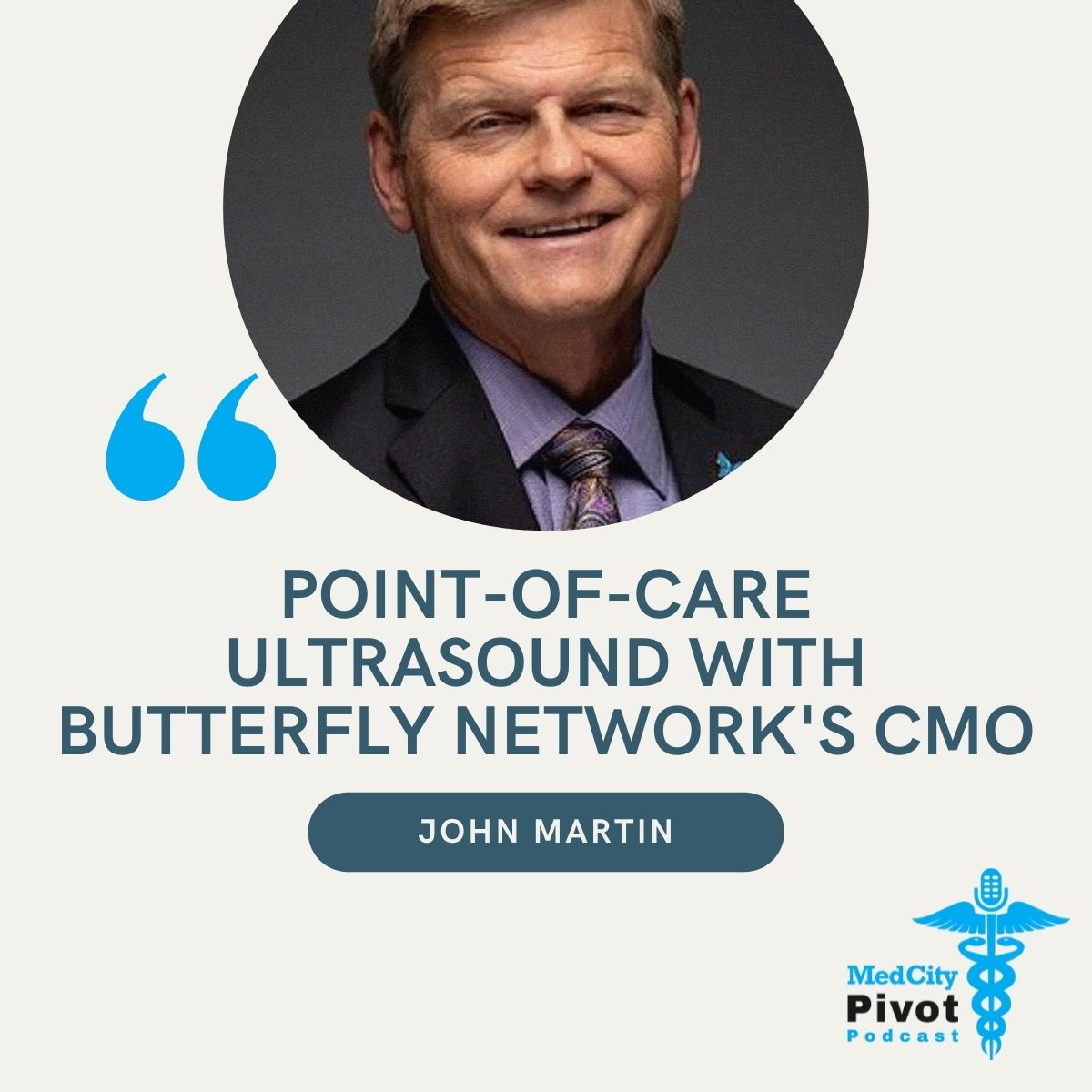
Hello and welcome to the Metzity's pivot podcast. I am Orland Udi Parmar, your host and the editor-in-chief of Metzity News. Butterfly Network is a medical device company based in Guilford, Connecticut, that allows people to take full-body ultrasound with a single probe with results viewable on a smartphone. The company began with a bold goal to replace the ultrasound cart.
It has since then evolved to go public and has muted its ambitions somewhat. Still, making point-of-care ultrasound universally accessible is a noble mission. In this episode, I chatted up the company's Chief Medical Officer John Martin about where Butterfly Network is as a company today, how it has evolved and where it needs to go. Hello and welcome to Metzity's pivot podcast, John.
Thank you. It's a pleasure to be here today. So back in 2019, when I spoke with the then-president of Butterfly Network, he was very confident that technology, such as Butterfly IQ, would ultimately replace the old ultrasound technology powered by Pezo Zoyt crystals. So where are you in terms of achieving this goal?
I think this is what's really exciting about Butterfly is we're actually redefining the way in which people practice medicine. And so maybe an evolution of our thinking is not so much about, okay, we have a new way of doing ultrasound. As opposed to we have a new way of practicing medicine. And I think maybe that's the best way to look at the way we've evolved.
The classic way we've looked at ultrasound is always it's a test you've ordered. So you do a history, you do a physical examination, and then we think, okay, we need more information. We order a test. What Butterfly is doing today is very different.
It's where incorporating that ultrasound, the process of capturing imaging data into the initial decision making. So it's really about incorporating the process of getting ultrasound information to make the initial clinical decision and then change the way in which we manage our patients in a much more effective and efficient way. So not so much about replacing ultrasound, but changing the way in which imaging is used in the way we practice medicine. And I think that's really been the evolution of Butterfly and why it's so different in the way we think today.
Then maybe thinking about there's a card over there, we want to replace that card with less expensive device. No, we want you to think differently about how you practice medicine because practicing medicine this way gives you a much more accurate, clinical decision made at the beginning, much more efficient care if you get better faster. Okay, that makes sense. So let's talk about that evolution because previously it was very much about the probe and the convenience of the probe and the fact that you can do it bedside, which is easier for the patient, less stressful.
So talk about the evolution of the company from that very much focused company to maybe there are more tech services, add-on services that you've now created. Yeah, I think it's an appreciation that the probe is a critical piece of butterfly technology. It's a brilliant piece of technology that's changed the game and if you will, shattered it, if you will, that ceiling of how ultrasound cannot be personal. So it's now a personal device.
What it also does is open up the door to say, what else does it take to practice medicine effectively? It's the workflow of actually doing that and how that image information gets into the workflow that allows us to be much more efficient in the way we care. So it's the device itself, it's the user interface that we built, it's so simple to use and learn. It's the education tools that accelerates people's journey to competence.
And then it's the enterprise or what we call compass now as part of the workflow that moves the information through the system. So you capture the data, you store the data, you store a report and it's incorporated into the electronic health record. And with that, we also track information so people can credential their folks, they can track their quality of their scans, they can use it as a really effective tool for training as well. So butterfly is not just a probe anymore, it's a ecosystem that actually it's incorporated the way people deliver care.
Okay, talk to me a little bit about your international reach and expansion there because it seems like a tool like this and then all the other add-on services will be really valuable in places where access to such technology isn't real danger. Yeah, so we are very lucky that we're expanding around the globe and I won't get the term that the number exactly right because the global health team will be better, but somewhere at a 40 to 50 of the lowest resource countries in the world. Butterfly is now operating, I think there's more than 100 NGOs that partner with butterfly to deliver this technology because what's really dramatic about this is it's pretty simple information that actually changes the way people get their care. And one of the two biggest areas are OB, we're actually just knowing what position the baby's in, what the gestational age is a critical thing and determining outcomes for them.
And we know still every 90 seconds there's a woman dies as complications of childbirth, we can change that with butterfly. The other pediatric pneumonia is another really big one where you can make that decision whether antibiotics are actually necessary or needed and that can be done pretty simply with butterflies. So there's been a really big emphasis within our company on the global health. We feel it's a core part of our mission as a company and when Dr.
Rothberg started the company's very first thing he was, he wanted to democratize medical imaging around the world. And I think we've seen in the time that that realization is actually part of this journey and something that we've been able to benefit from. It's part of what motivates everybody inside this company where I'm a very mission driven company and it's the exciting stories that constantly come back out of the environment like they really make a difference in our lives and in their lives. Artificial intelligence of course is playing a great and great role in healthcare.
Obviously in radiology was had one of the most successful applications and now we're seeing it being used elsewhere. Can you talk about how you're using AI within butterfly network? So we think about artificial intelligence in really two very specific ways. And that is we know that if imaging information is going to be used and valuable, we got to allow people to very quickly learn how to do these scans and they got to very quickly learn how to interpret those scans so they can make better decisions.
And so historically people have been pretty intimidated by learning ultrasound. We think we have to learn the whole broad expanse of everything. What butterflies doing is using those artificial intelligence tools and driving that expertise into the probe in the application itself. And so one of the great tools the first one is the bladder scanner.
So literally you plop the probe down right on the synthesis, blow down in your abdomen, it seeks out the bladder, does a vector scan and then spits out what the volume of the bladder is. That's an artificial intelligence tool. So you don't get intimidated to have to search for the bladder. Can I do all these things?
It drives the simplicity of the device down so quickly that that journey to competence is incredibly short. The valuable information is to try to begin. Now we've got other tools that we're actually introducing that will come in the future in front of the FDA and others that will come. We have a unique partnership with Capture and Health that we've announced that you may have seen.
They are the first company to have kind of a steering, if you will, on the device itself. Non-healthcare professional can pick up a butterfly now, plop it on the chest and it will drive you to get a good image. Show you move lap, move up, move down. It will capture that image and then with a series of them automatically calculated an injection fraction.
That's an incredibly valuable tool for the management of patients in a number of different settings. And so the use of AI is capturing the image easier, interpreting the image easier so you can span the number of users that can take butterfly and rapidly accelerate that journey to competency. So the tool reaches its full potential of providing the kind of information people need to make clinical decisions. And we'll continue to roll out more and more applications as we move forward.
I'm wondering if you can talk a little bit about the name of the company. What does that refer to if you're aware of it? Yeah, so Butterfly Network actually came, our founder Jonathan Robert went to a lecture with Max Tegmar at the MIT. And that lecture was talking about linking together radio telescopes to look out into space to study the origin of the universe.
And Jonathan was thinking about the concept of linking things together and he said, I can't make a business out of looking out into space. But if we can use that same concept and look inside the bot, create a window into the body, that's something that could serve mankind now and I'd be willing to do that. And it's a methodology of linking computers together to actually leverage the power. And this Jonathan was very famous for next generation DNA sequencing, putting it on a silicon chip.
So you could lower the cost and expand the power and leverage the silicon industry and that's the same thing we've done with Butterfly. The other part of that story was he said to Max, he said, I'll do this if you give me the smartest kid at MIT. And at the time that was Nevada Sanchez that worked at his lab, Jonathan stole him out of MIT and he's been a butterfly ever since. And a key part of the inventors of our chip technology is we move forward.
Thank you for that explanation. I'm curious about the software platform that you've built. I understand that now it not only supports the probe that Butterfly has come up with but also other ultrasound machines. So I'm wondering what led to the decision to make that platform agnostic.
Is it almost an admission that it's not going to be easy to replace that ultrasound card? No, I think it's an understanding what is the role of Butterfly and what is the role of actually getting a key information right at the bedside of where our technology is today. There's so much value in what we can do. If you look today, when we look at trying to make clinical decisions, and that means if I do a history of physical examination and I don't know what's wrong with you, up to 80% of the time, it's simple imaging that answers that question.
That's where Butterfly steps in. And that's where we're at bedside 80% of the time we can answer those simple questions and that's what we do today. We also appreciate there's going to be a role for very high-end systems that have to answer very complex questions that we don't do. Those $200,000 systems that are out there or even hospitals that have a whole bunch of other cards that are out there.
We want to serve the role we have but then provide that platform because our software is so good, you want to bring them all in under one environment so you can track what's being used for what? Take advantage of the great quality and credential programs that are built inside Butterfly and understand that backbone ecosystem to manage all of these devices is critical to the way people actually work inside the hospital. If you go to most hospitals today, they don't know how often any of these devices are being used or who's using them and the power of that knowledge is really good. If you want to build a good quality program inside the system and then take maximum advantage, when can you use a butterfly at the bedside to make good decisions and save those complex decisions for a limited resource that is incredibly expensive without very expensive tech in those different situations?
It's a very effective way to actually leverage this technology. Okay, so if you want to say that it's complimenting the more expensive machinery for situations, I also want you to address sort of the growth of the company. As you mentioned, it's an exciting company. You've gone public, you have unicorn status, but Butterfly, similar to other digital health companies that have gone public, have seen the stop prices really decline and not really attain the highs of the IPO days.
So does the market overestimate the value of bring or your undervalue? Are you satisfied with how the market is looking at you? What can you do to change that perception? So I'll leave the financial questions to the financial people in our company.
That's really their actually responsibility. They provide you probably a better answer. I can tell you from a clinical perspective, we're incredibly excited about the opportunity that Butterfly is presented and we've watched healthcare change in front of us. We do know healthcare takes time to change.
We know the adoption of new technology this very well. You covered the field. People don't do it instantly, but we've seen our device spread. We're at every single care venue now that you can think of.
We're at the sidelines at major sporting events. We're up on the space station now and we've been in a number of space flights. We've expanded rapidly within the veterinary market. We're growing around and we're changing healthcare in all these different venues.
Is it the right pace that I leave that to the financial people to do that? I can tell you clinically, I'm watching doctors change the way they practice medicine and we're really excited about them learning how to break this into a different way of which they practice. Okay, fair enough. Tell me how your company was affected during the pandemic.
What were some of the challenges? What were some of the opportunities that you saw in this unprecedented time that we've got? I can think of it in a couple ways. First of which is we're a mission-driven company that bans together to change healthcare.
We obviously all felt like we did much better when we were with one another. I think we missed that. Obviously, you could be productive in working in different environments and we were exactly that. The camaraderie that's built around a mission-driven company.
We've lost some of that. I think the other thing is we've lost the ability to be front and center with all of our customers for an extended period of time. Major national meeting stopped to be able to go inside the hospital and demonstrate our product was put on hold for an extended period of time. I think we felt that, like every other industry, we missed that connectivity.
We're happy to see it come on. We're also thrilled with what COVID did for us. If you look at the research around, for instance, long ultrasound, for COVID, it's dominated by butterfly. While it gave us a problem with actually being able to see physicians that brought out, if you will, some of the true advantages of our technology and being a real partner with health systems and managing patients in this pandemic.
It was a really exciting way to maybe very quickly give butterfly credibility that this is a real device. Sometimes you have people look at $2,000. It can't be that good. It's only $2,000.
Yes, it was. Yes, it was. And COVID gave us that opportunity to really clinically and definitively prove it was. So now we're in the next phase of butterfly, and that is, okay, this is a really credible device, those wonderful things, their studies comparing it to cards and stuff.
Now, how do we take the world into butterfly 2.0 and change the way people practice medicine and think about the information that's gathered and ultrasound and how you can impact care differently? Now, it's very much about not only affecting clinical outcomes or the better. It is also about economic utility because everyone's thinking about value-based care. How do you fit into that narrative?
This is part of the most exciting things about butterfly because everybody knows it can be wonderful, but if you can't afford it and it doesn't have a great impact on ROI, are people really going to use it. And the beauty of butterflies, you can use it in any capacity that you want. And I'll give you a couple of clear examples. If you're in outpatient environment, you can actually use butterfly today, perform clinical studies, build for those studies using CPT codes, and candidly reduce an expensive, more expensive testing down the road to potentially reduce the need for secondary referrals or more advanced consultation.
So we can provide revenue for that physician, but overall lower the cost of care. If you're an inpatient, there are good studies done. There's a nice study done in England that use that hospitals use this device. It reduced the number of handheld ultrasound at the bedside, reducing the number of chest x-rays needed by 87%.
And just understand that any test you do on an inpatient, that's an expense to the hospital. They're paid a fixed amount of money to take care of people. So we can use butterfly to make better decisions at the bedside, reduce the need for these expensive tests inside the hospital, expedite care. And so I think there's a revenue opportunity, there's a cost savings opportunity in butterfly plays, which depends on the environment in which it's in.
So we're very confident about the economic story behind this device. And I think it's one of those unique things in healthcare. You think about almost every other technology, it's almost always more expensive, but we're justifying the expense because we think it does. It's actually really less expensive and to do money, which is really a unique situation, which I think another reason why butterfly is going to be so successful.
But I think there are people that have used this device and used maybe competitive devices and say in some cases, the resolution is a little bit better. So are you continually providing updates to the product because now technology is all about the next upgrade to the next best products? I'm wondering how often you provide updates to your product, how often you change the entire hardware completely? Yeah, so we do actually provide updates on a regular basis of software updates every six to eight weeks.
And some of those things, for instance, the bladder tool came in as a software update to all our people that had it. We do continue to perfect image quality and continue to improve. We started with IQ. Now we have IQ Plus, which was the next generation that also improved.
That we have different tools like coherence imaging that improve image quality. And so there will be constant iterations. So every couple of three years, there'll be new technology from a hardware perspective. Every six to eight weeks, you're going to look at it.
And that's typically what we've talked about in software updates. But here's the challenge I say back to every physician assistant. He says, you know what, I get a little bit better picture with this versus that. And my very next question is please tell me a question you couldn't answer with the device.
Yes, maybe it was a little bit prettier picture for you with that because a lot of image qualities in the eyes that could you answer the clinical question? And what you find is in the vast majority of time, people can answer the question. We've got a number of studies going on that actually show that. So it reframed your thinking, I often get people the analogy, probably not a good one, but I use it.
When we watch football games today on high definition, you see the little bits of rubber coming up. And it's an incredibly beautiful thing to watch. But you know what, you still know of both things. What's the score of the game is who won?
You saw the past being thrown in somebody catching it. And at the end of the day in medicine, it's really about making good clinical decisions at the bedside. And if you have a tool that's now available in your pocket, immediate to make better decisions, I don't necessarily need the prettiest image. I need the right image that answers the question.
I'll have to defer to you on that. When I can tell you that in my home, I could not get my kids to watch where he goes there with Clint Eastwood because the quality was not, I'd definitely should. You're asking them the wrong question. Do they know what happened in the movie?
Yes? No? Oh, you did? Okay.
No, I didn't know. And I personally also couldn't watch it after a while, although that was one of my favorite movies growing up. But I knew what you're saying. Sometimes pretty things tend to distract from the real issue.
So I hear you. How are you looking at the next six months? What are your goals as a company and individually as a leader in the company? Where would you like the company to be in six?
No, I think the biggest thing for us is to continue to advance this message of getting people to think differently. To think about this, it's the power of imaging at the bedside to make better clinical decisions, not whether or not I should do ultrasound. If I compare the effectiveness of a stethoscope and evaluating a heart and the effectiveness of butterflies, it's a great difference. You look for instance at the accuracy of a chest x-ray or a stethoscope to look for congested heart failure.
It's about 50%. You can flip a coin. If you look at it with long ultrasounds, about 90%. So part of the way is to reframe the way people think.
We're going to keep tounding that message. The other thing is you probably saw, we have big deployments at Rockchester as an example where probes are going to go throughout the entire organization. And that is as much about understanding logistics of everybody actually having a probe within the system and all those different care venues on how you actually do that. The second thing is what is the scaled economic and clinical return of those devices at big scale.
And then we have a number of really good research projects. We're continuing our work toward the whole with patient self-scanning as a big objective. So working on studies that will be doing those kinds of things and the continued evolution of our product. We have lots of really interesting research going on that we think will bear fruit in the next six months and those are things that we will eventually be able to talk about publicly and be really excited about it.
But I love the journey that we're on. Most of us, I came to Butterfly five years ago because I saw that possible. That we could change the lives of people in far away places in ways that we've never imagined. If you think about the world of medicine today, I often say this, there's only two things so far that really span the globe and that is that have had real impact in robotics and vaccines.
Outside of that, there's not been much there. There's no CT scans rolling around these places or even X-ray machines, but they have cell phones. And if they have cell phones, they could get butterfly. And in the way in which the versatility of this device and its affordability, we can go in those places.
And I think those certain moments when you see the same device using in the most outwards regions of Kenya, putting gestation wage on the most advanced healthcare systems in the world guiding somebody be put on ECMO. You understand the power of what butterfly can do because in both situations, it's the power of that information to change clinical decisions to get better outcomes, and that's how healthcare is going to change. John, thank you so much for spending the time with me and Metcivi. I really appreciate the discussion and reaching the best of luck.
Well, we look forward to talking to you again a little farther down the road and you can see what kind of progress that we made.