
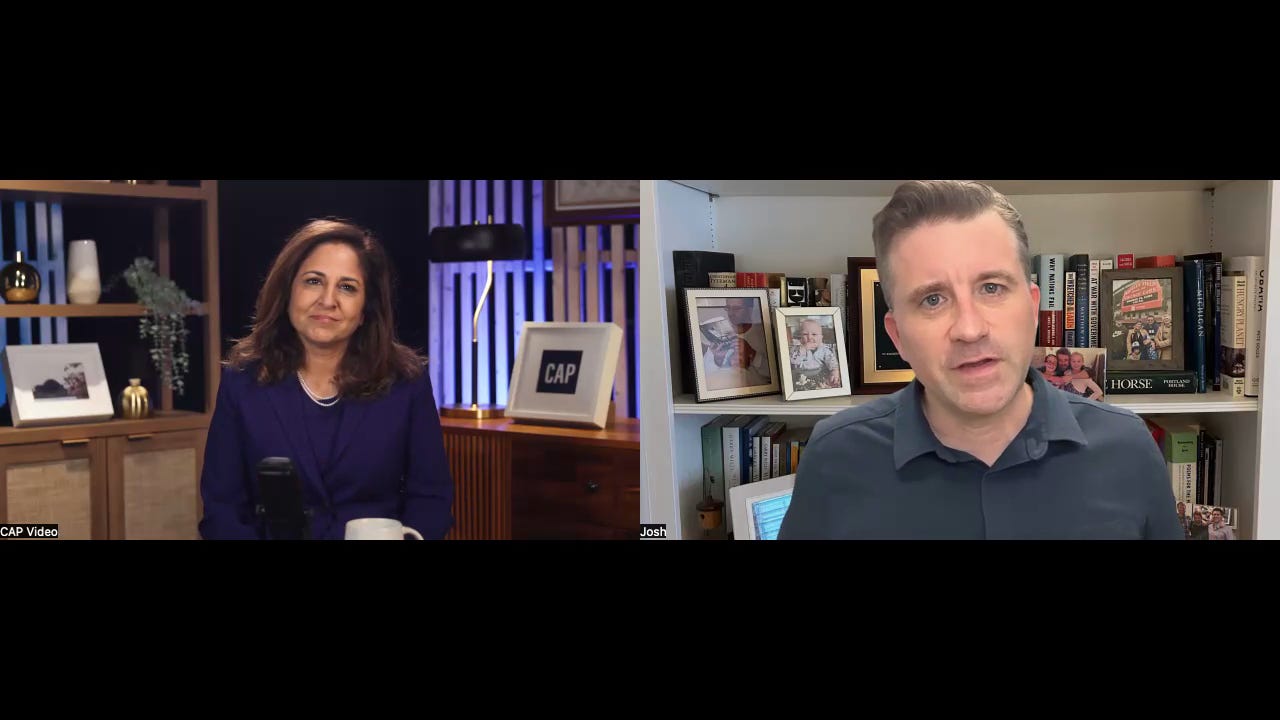
EPISODE · Jun 17, 2026 · 21 MIN
Politics by Addition, Not Subtraction.
from The Forum with Josh Cowen Podcast · host Josh Cowen
I’ve been wanting to sit down with Neera Tanden for quite awhile now. She’s currently the president and CEO of the Center for American Progress—the premier policy institute in D.C. focused on standing up policy and political strategy from the center-left.Neera Tanden has a long history in Democratic politics. She served in Joe Biden’s White House in several different roles, was most recently as head of the Domestic Policy Council. She served in the Obama Administration and worked on both Barack Obama’s and Hillary Clinton’s presidential campaigns. She remains a close friend and advisor to the Clintons.She’s also an attorney, with degrees from UCLA and Yale.We connected recently to talk about the state of play for the Democratic Party heading into November—and both the politics and the policy of putting forward an alternative vision to leadership in the Trump era.A Conversation with Neera TandenWelcome and thanks for being here. Just to set ourselves up here: I think most of the folks in the policy and politics communities generally have a sense of the work the Center for American Progress does, but tell me a bit about what CAP is up to right now in terms of mission and strategic priorities.Sure. The Center for American Progress is an action-oriented think tank. We’re really kind of located on the broad center-left. We work a lot on issues that can appeal to what we hope is a broad majority in the country. We have policy teams on almost every major issue, national security, economic policy, domestic policy, climate, you know, healthcare.Just every significant issue in the country, we have people who are experts in those areas. Right now, we’ve developed ideas to address affordability, so specific ideas to address the cost of living crisis in the country.Specific ideas to lower health care costs, to address premiums. Premiums have risen 25% in the last five years. I think people are hungry for lower costs in health care. We’ve developed ideas to lower housing costs, food costs, utility costs. Utility costs have risen the sharpest of any major cost over the last decade, other than gas, over the last year. So I think from our perspective, working class people, middle class people are finding it really hard to make ends meet in this economy. The economy does really feel kind of K-shaped to most people. The top 30, 40% are doing pretty well. The top 1%, obviously, doing really, really well.The bottom, you know, 60, 70%, are anxious. Anxious about being able to afford things that they used to be able to afford easily. We’ve developed a whole series of ideas for leaders to take up. And I think one thing that we’re very focused on is how you can specifically assure this public through actual policies that you will deliver lower cost for them.My overarching lesson here is for people who particularly believe in government, you need to ensure that government is working and will solve problems. And it’s not up to us what the problems are. It’s up to the public. And sometimes I think people forget that.—Neera Tanden We’re about six months out from the midterm. Give me a status check or a landscape analysis from your vantage point on the Democratic Party: where are we, where should we be optimistic, where are some of the dangers?You know, elections are always a choice, and I think a kind of crucial issue here is that voters are frustrated. Many of them are angry at the direction of the Trump administration. And we’ve seen a lot of polling—we have a research arm—there have been really three shocks, downward shocks to Trump’s approval. One was the tariffs. Two was the murder of Alex Pretti and Renee Goode, and the third has been the Iran War. And I guess I would say I think the political discourse basically discounts the power of losing a war. You know, Americans don’t lose that many wars, and the fact that the president is in this very weakened position with the Iranians is an element. I think a crucial part of this is people have been wondering why they’re paying for this war with higher gas prices. So, I think a really big part of this election is how how voters are seeing the incumbents, and they have a pretty negative view of incumbents. We’re seeing now that Trump has lost the people who voted for him once. The real question is now he’s seeing some losses amongst people who voted for him three times, which is a big change for him. So, that is, like, a central element to what’s gonna happen in these elections. On the other side of it we have party primaries happening on the Democratic side, and there are a lot of competitive races. When I look at elections I ask is the map expanding or contracting?The map for Democrats is expanding. Every couple of weeks, you’ll see more people put races on the board. But I have been in election cycles that were supposed to be big sweeps and puttered out, at least in particular races, because they need, you know, people didn’t think they had a credible alternative. So from my perspective, it’s really important—I say this all the time, I’ve said it on TV, I say it online—the job of the voters in the primary is to select someone who can actually win the general. Now, if you’re in New York City, whoever Democrats pick will win, but if you’re in Wisconsin, or Michigan, or Texas, or Iowa, or Alaska, or maybe Montana, or Mississippi or Missouri, you have to think about putting together a coalition because Democrats aren’t enough. So I think if we have if there are credible Democrats in all these races, Democrats can take the House and Senate. And crucially, win governor’s races that are going to be very important to 2028 in just being a block to election interference. But that’s a big question going forward. Now, I feel overly very optimistic if the election were held today, Democrats would take the Senate, which I think is, you know, no one thought that was gonna happen a year ago, so I’m fairly bullish. But, we have to think about the end result here.Donald Trump doesn’t speak in policy or four-page policy briefings, but he has policies. He had tariffs. He had building the wall. He had, you know, mass deportation. These are things that communicated policies to people or ideas to people. And the real problem for Donald Trump is his policies have failed.—Neera Tanden There’s an old joke in some of the political staff communities about what happens in campaigns or for electeds when “comms forgets to check with policy” before rolling out something new. How do you think about the interplay between politics and policy right now for Democrats, when it comes to a path to victory not just in November but further into the future? Do we have an ideas problem? A message problem? All of the above?I think a lot of people, and a lot of Democrats, look at Donald Trump and say, well, policy doesn’t really matter, because, obviously, this guy’s…Donald Trump.But I think that is a pretty significant error.Donald Trump doesn’t speak in policy or four-page policy briefings, but he has policies. He had tariffs. He had building the wall. He had, you know, mass deportation. These are things that communicated policies to people or ideas to people. And I think a real problem with Trump today: everyone’s always like, “everything’s messaging,” etc, but the real problem for Donald Trump is his policies have failed. You know, he came in to office, he’s had a pretty radical policy agenda, and it is actually raising costs for people instead of lowering costs. And that is why he’s seeing significant erosion of working-class white voters for the first time in any election that he’s ever faced. So, I look at reality, I look at America today, and I say, you know, it’s actually good that people are looking at the facts of their lives and deciding they are turned off from this guy. My own view about policy is…you know, people will go for a bad answer over no answer. And our job is to give people better answers, better solutions. I mean, I’m very scarred by the Biden administration’s work on immigration. I was not in charge of the border, but I was dealing with domestic immigration, so I sat on our, on our immigration council, and I think that’s an issue where we saw a big problem at the border, and we should have tackled it earlier, and we really tackled it only after Trump was a nominee, I think a lot of people thought, well, if we only did it because of Trump, and if I really care about immigration, I will vote for Trump. So my overarching lesson here is for people who particularly believe in government, you need to ensure that government is working and will solve problems.And it’s not up to us what the problems are. It’s up to the public. And sometimes I think people forget that. They think if we talk about an issue a lot, that’s what makes it matter. And actually, voters have their own views on what’s important to I think the fundamental issue the public is interested in: Parents. Community leaders. People who don’t have kids in school. It’s: how are schools improving? How are schools ensuring that students academic performance is increasing. And what is the system in which schools are improving themselves? them.At the end of the day, I think one of the reasons why our schools in some way feel like they’re standing still is because we don’t have national leaders really pushing the ball forward with ideas of how the whole country benefits from a good education system.—Neera Tanden I focus a lot here in this series on issues affecting kids and families. I came up in education policy. There’s new polling out there showing Democrats have completely lost an edge on education—including among folks who voted for Kamala in 2024. And since 2020, Democratic candidates have simply stopped talking about schools as often as Republicans. You see guys like Rahm Emanuel making this a big thing but that’s about it right now. How if at all do you think education—K12 specifically but also across the board—should fit into a larger vision for where progressives ought to be and where we’re going?This is a fantastic question, and I really appreciate it, because I think a lot about education. I hate aging myself like this, but I came up in the 90s, One of my first jobs, I was privileged to work in the Clinton White House. Bill Clinton talked a lot about education. You know, he had a whole theory of what you earn will depend on what you learn. That’s why we have to make college more affordable to people. We have to give more people access to college. Maybe we overdid it on college, but he had a conversation with the country about education on a regular basis, As did Barack Obama. Now, I think a real challenge over the last several years is, No Child Left Behind did not deliver the level of school improvement it basically promised.And then as a result of NCLB not really delivering enough school improvement, we then kind of moved away from it, but didn’t replace it with much. Like, to be totally candid, in the Biden administration, we were focused on mental health, and we did focus on absenteeism in the last few years, because that was a big problem. But I think the fundamental issue the public is interested in, from parents, to community leaders, to people who don’t have kids in school is: how are schools improving? How are schools ensuring that students academic performance is increasing. And how, what is the system in which schools are improving themselves? And at CAP, you know, we are evidence-based. We’ve looked at around the country and you do see innovations in places like Mississippi, Alabama. When I was the domestic policy advisor to the president, we had the superintendent of Alabama at the White House. Bipartisan learning from what they did. And fundamentally, what states are doing that are succeeding, these southern states, is they have a pretty state-based, top-down push on accountability. And the accountability isn’t here’s this cookie-cutter way that you should improve your schools. I mean, they are investing in tutors and other things, but they’re basically trying to drive school systems, and then school systems are driving superintendents, superintendents are driving principals to improve year to year. And yes we should have a broad based discussion of each policy that works and we should invest in tutoring and we should get make school interesting to people with lots of different kind of experiences and not just, you know, career-connected learning. But at the end of the day, I think one of the reasons why our schools in some way feel like they’re standing still is because we don’t have national leaders as much really pushing the ball forward with ideas of how the whole country benefits from a good education system. It should be a national priority, not just a state priority. But I also think when it’s a national priority, that also ends up driving school improvement in a way that is hard to measure but does seem to have a real impact.What we should really be aiming for is a broad, resilient majority in the country that is so large that Republicans doubt whether MAGAism is a electoral success strategy for them. There’s lots of issues in which I might have a different view from someone, but I think we have to give space to welcome independents and even some Republicans. It’s really crucial. —Neera TandenI had Run for Something’s Amanda Litman on a few weeks ago and she’s really pushed this line I’ve been quoting constantly and that’s something like “be flexible with policy, consistent on values.” How do you think about a guidepost like that? Are there some policies on the Democratic side where compromise actually would be a betrayal of values? I think probably reproductive freedom is one. Marriage equality. Where are some places for you where the values are the policy, and where should we be more flexible?So let me say how I see the next 3 years. I’ll answer this question, but I think it’s really important for people to think about the possibilities and what’s at stake. So, I think it’s important to win elections, absolutely. But I would like this nightmare of the last 10 years to be over. I would like to wake up days and not think of Trump, or MAGAism. There is a MAGA movement in the country, it’s not just Trump. So, that’s what we have to defeat.To me, the real problem in our politics is that we are in 50-50 election cycles. Joe Biden’s election, he won seven more million more votes for sure. And he won a bunch of swing states over Trump. But those seven swing states were decided by like 250,000 votes. What got him to over the hump was relatively close. But it shouldn’t be close. The way I orient my life and our work here is, it’s the job is to win elections, for sure. But what we should really be aiming for is a broad, resilient majority in the country that is so large that Republicans doubt whether MAGAism is a electoral success strategy for them.And that only happens where you defeat or expand movements with broad election sweeps. So, from our perspective, there’s lots of issues in which I have a different view, but I think we have to give space to welcome independents and even some Republicans. It’s really crucial. And these issues are debated back and forth in all these primaries. There are Democratic candidates today who are winning, you know, 7, 8, 9% of their vote from Republicans who voted for Trump. Like, last year, Abigail Spanberger, Mikie Sherrill. This candidate who won in Texas 9 in January: they were able to put together a broad coalition that include liberal Democrats, moderate Democrats, moderates, independent voters, and a sliver of Republicans, non-MAGA Republicans.Do I know that will defeat MAGAism? I do not. But I do know we will never defeat MAGAism if we are in, like, 50-50 elections. Because if the elections are so close, they will always have a story that they were cheated, not defeated. And that’s my orientation. I think we should think about issues like: if we want Republicans or moderate Republicans to come into a coalition where they have to be flexible, we have to be flexible, too. Now, there are some issues, again, like civil rights for people. I think for the Democratic Party, a core value, is basic civil rights for all people. I’m against racism, sexism, homophobia, Islamophobia and I’m against anti-Semitism. I don’t find that to be a complicated thought for me, But I think a big challenge in the Democratic Party that is weaponized by the right, for sure, and unfairly weaponized, is the sense of judgment: you are being judged by this elite who looks down on you. That is, like, a constant message of Republicans. So, more than just issues, I think we have to have the orientation towards people, which is you’re not stupid for disagreeing with me. We have a disagreement. Let’s talk it out. And I think that’s something we can all measure, we can all work on and none of us are perfect on this.Politics is about addition, it’s not about subtraction. And, you know, and I will say, I will give credit to Mamdani, who was a pretty, you know, pretty left guy, but had an ethos in his campaign of trying to welcome people who disagree with him: Trump voters, everybody. And I think that, beyond particular issues, is a really important ethos.Neera Tanden is President and CEO of the Center for American Progress. This is a public episode. If you'd like to discuss this with other subscribers or get access to bonus episodes, visit joshcowen.substack.com/subscribe
Embed this episode
Ready to play
Politics by Addition, Not Subtraction.
No transcript for this episode yet
Similar Episodes
No similar episodes found.
Similar Podcasts
No similar podcasts found.