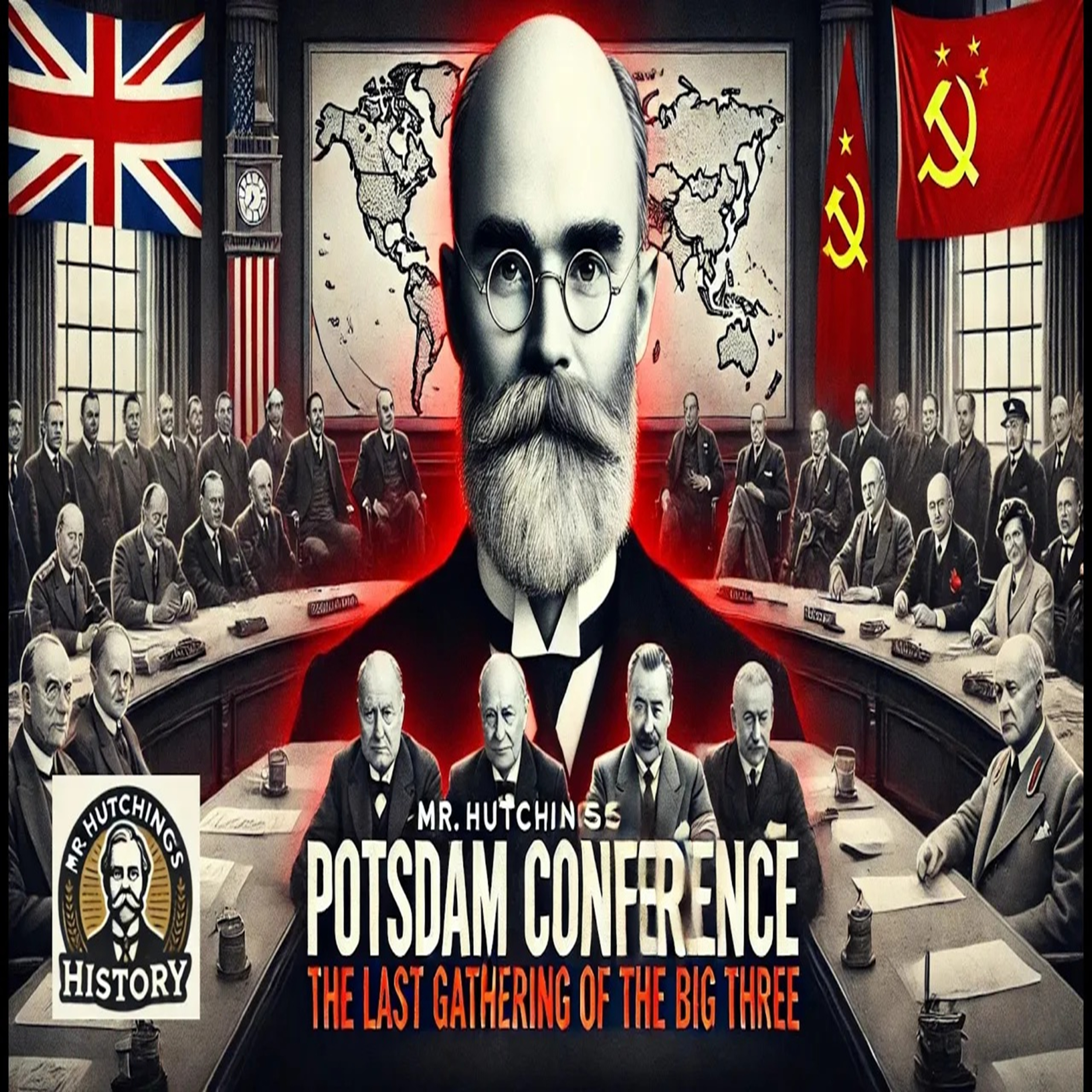
Potsdam Conference – The Last Gathering of the Big Three episode artwork

EPISODE · Nov 21, 2024 · 12 MIN

Potsdam Conference – The Last Gathering of the Big Three

from Mr. Hutchings History · host Produced, created, and written by Harold M. Hutchings

Welcome toMr. Hutchings History! In this episode, we dive into the Potsdam Conference of July 1945, the final meeting of the Big Three—Roosevelt, Stalin, and Churchill. As World War II ended, the discussions held at Potsdam would not only shape post-war Europe but also expose the growing tensions between the United States and the Soviet Union, setting the stage for the Cold War.We'll cover key decisions made on the future of Germany, Poland, and Eastern Europe, and how the successful test of the atomic bomb altered power dynamics. With new leadership, particularly Truman's tougher stance, and Stalin’s determination to maintain Soviet dominance, the conference highlighted the emerging ideological divide. Topics include the division of Germany, reparations, the atomic bomb’s impact, and the creation of the United Nations.Historians offer various perspectives: Traditionalists see Soviet expansionism as the key cause of Cold War tensions, while Revisionists highlight U.S. policies, especially the atomic bomb. The Post-Revisionist and Realist schools stress mutual security concerns and shifting power dynamics.Join us as we analyze how Potsdam marked the beginning of Cold War rivalries.#Paper2WorldHistory #ColdWar #PotsdamConference #SuperpowerRivalry #Truman #Stalin #Churchill #AtomicBomb #PostWarEurope #SovietExpansion #UN #ColdWarHistoryWorks CitedGaddis, John Lewis. The Cold War: A New History. Penguin, 2005.Leffler, Melvyn P. For the Soul of Mankind: The United States, the Soviet Union, and the Cold War. Hill and Wang, 2007.Mearsheimer, John J. The Tragedy of Great Power Politics. W.W. Norton, 2001.Schlesinger, Arthur M. The Cycles of American History. Houghton Mifflin, 1986.Chapters(0:00) Introduction – The World on the BrinkJuly 1945: The war is ending, but tensions are rising at Potsdam.(0:51) The Big Three – A New DynamicTruman replaces Roosevelt, Churchill gets voted out mid-conference—power shifts dramatically.(2:12) The Fate of Germany – Punishment vs. StabilityHow to handle a defeated Germany—division, demilitarization, and economic tensions.(3:50) Reparations Debate – The Soviet vs. Western ApproachStalin demands German reparations, while the US and UK fear another Versailles mistake.(5:31) Poland – A Political Tug of WarPoland’s borders shift westward—was this a compromise or Soviet domination?(6:34) The Atomic Bomb – The Silent Game ChangerTruman casually mentions the bomb to Stalin, altering global power dynamics forever.(8:03) Historians Debate – Who Started the Cold War?Traditionalist, revisionist, and post-revisionist views on Potsdam’s role in Cold War tensions.(9:47) The United Nations – A Glimmer of Hope?Despite growing mistrust, the Big Three finalize plans for the UN and collective security.(11:02) Conclusion – The Dawn of a New ConflictPotsdam ends, but the seeds of the Cold War are firmly planted.

Welcome toMr. Hutchings History! In this episode, we dive into the Potsdam Conference of July 1945, the final meeting of the Big Three—Roosevelt, Stalin, and Churchill. As World War II ended, the discussions held at Potsdam would not only shape post-war Europe but also expose the growing tensions between the United States and the Soviet Union, setting the stage for the Cold War.We'll cover key decisions made on the future of Germany, Poland, and Eastern Europe, and how the successful test of the atomic bomb altered power dynamics. With new leadership, particularly Truman's tougher stance, and Stalin’s determination to maintain Soviet dominance, the conference highlighted the emerging ideological divide. Topics include the division of Germany, reparations, the atomic bomb’s impact, and the creation of the United Nations.Historians offer various perspectives: Traditionalists see Soviet expansionism as the key cause of Cold War tensions, while Revisionists highlight U.S. policies, especially the atomic bomb. The Post-Revisionist and Realist schools stress mutual security concerns and shifting power dynamics.Join us as we analyze how Potsdam marked the beginning of Cold War rivalries.#Paper2WorldHistory #ColdWar #PotsdamConference #SuperpowerRivalry #Truman #Stalin #Churchill #AtomicBomb #PostWarEurope #SovietExpansion #UN #ColdWarHistoryWorks CitedGaddis, John Lewis. The Cold War: A New History. Penguin, 2005.Leffler, Melvyn P. For the Soul of Mankind: The United States, the Soviet Union, and the Cold War. Hill and Wang, 2007.Mearsheimer, John J. The Tragedy of Great Power Politics. W.W. Norton, 2001.Schlesinger, Arthur M. The Cycles of American History. Houghton Mifflin, 1986.Chapters(0:00) Introduction – The World on the BrinkJuly 1945: The war is ending, but tensions are rising at Potsdam.(0:51) The Big Three – A New DynamicTruman replaces Roosevelt, Churchill gets voted out mid-conference—power shifts dramatically.(2:12) The Fate of Germany – Punishment vs. StabilityHow to handle a defeated Germany—division, demilitarization, and economic tensions.(3:50) Reparations Debate – The Soviet vs. Western ApproachStalin demands German reparations, while the US and UK fear another Versailles mistake.(5:31) Poland – A Political Tug of WarPoland’s borders shift westward—was this a compromise or Soviet domination?(6:34) The Atomic Bomb – The Silent Game ChangerTruman casually mentions the bomb to Stalin, altering global power dynamics forever.(8:03) Historians Debate – Who Started the Cold War?Traditionalist, revisionist, and post-revisionist views on Potsdam’s role in Cold War tensions.(9:47) The United Nations – A Glimmer of Hope?Despite growing mistrust, the Big Three finalize plans for the UN and collective security.(11:02) Conclusion – The Dawn of a New ConflictPotsdam ends, but the seeds of the Cold War are firmly planted.

NOW PLAYING

Potsdam Conference – The Last Gathering of the Big Three

0:00 12:28

No transcript for this episode yet

We transcribe on demand. Request one and we'll notify you when it's ready — usually under 10 minutes.

The 48 Laws of Power by Robert Greene (Full Audiobook) Robert Greene Amoral, cunning, ruthless, and instructive, this multi-million-copy New York Times bestseller is the definitive manual for anyone interested in gaining, observing, or defending against ultimate control – from the author of The Laws of Human Nature.In the book that People magazine proclaimed “beguiling” and “fascinating,” Robert Greene and Joost Elffers have distilled three thousand years of the history of power into 48 essential laws by drawing from the philosophies of Machiavelli, Sun Tzu, and Carl Von Clausewitz and also from the lives of figures ranging from Henry Kissinger to P.T. Barnum.Some laws teach the need for prudence (“Law 1: Never Outshine the Master”), others teach the value of confidence (“Law 28: Enter Action with Boldness”), and many recommend absolute self-preservation (“Law 15: Crush Your Enemy Totally”). Every law, though, has one thing in common: an interest in t The Laura Ingraham Show Laura Ingraham The most-watched woman in the history of cable news brings her no-holds-barred political and cultural commentary to podcasting with The Laura Ingraham Show. A bestselling author, breast cancer survivor, and mother of three internationally adopted children, Laura was the most listened-to woman in talk radio before launching her own podcast. A trailblazer across media platforms, she brings a unique perspective to this twice-weekly show, drawing on her experience as a white-collar criminal defense litigator and a Supreme Court law clerk.New episodes drop twice a week—delivering the clarity, courage, and common sense America needs. Vampires of the Paper Flower Consortium Elizabeth Guizzetti Come for the evening, stay for eternity! Paper Flower Consortium is a podcast from the largest vampire coven in Seattle. Their stories are told by Loretta Fabron Onfoy, coven historian and librarian, in the hope that the modern vampire's way of life is not lost during the next great language transformation. Some tales in this anthology are horrific, some are droll, some are filled with misadventure--just like any eternal existence. Episodes sponsored by the Paper Flower Consortium's Business Community. The history is followed by questions from curious initiates. Want to ask Lady Loretta a question about vampirism? Have a topic you want to see discussed? Email [email protected] WW2 - the Key Questions, answered by Laurence Rees. Laurence Rees A former Head of BBC TV History programmes, Laurence has specialized in writing books and making television documentaries about World War Two, the Nazis and Stalinism for thirty years. He won a BAFTA and a Peabody for his TV series 'The Nazis: A Warning from History' and a British Book Award for his book on Auschwitz, which is also the world's best selling book on this notorious camp. His book 'the Holocaust: A New History' was described by the Times as 'exemplary' and by the Daily Telegraph as 'the best single volume account of the atrocity ever written'. Educated at Oxford University, for several years he was a visiting senior fellow at the London School of Economics, London University. He holds honorary doctorates from the University of Sheffield and the Open University. Professor Robert Service, of Oxford University, described Rees as 'one of the world's experts on the Second World War'. Sir Max Hastings wrote in the Sunday Times, in a review of Laurence Rees' 'World War Two: Behi

Frequently Asked Questions

How long is this episode of Mr. Hutchings History?

This episode is 12 minutes long.

When was this Mr. Hutchings History episode published?

This episode was published on November 21, 2024.

What is this episode about?

Welcome toMr. Hutchings History! In this episode, we dive into the Potsdam Conference of July 1945, the final meeting of the Big Three—Roosevelt, Stalin, and Churchill. As World War II ended, the discussions held at Potsdam would not only shape...

Can I download this Mr. Hutchings History episode?

Yes, you can download this episode by clicking the download button on the episode player, or subscribe to the podcast in your preferred podcast app for automatic downloads.
URL copied to clipboard!