
EPISODE · Aug 12, 2025 · 1H 7M
Pregnancy and Childbirth in Ancient Egypt
from Afterlives of Ancient Egypt with Kara Cooney · host Kara Cooney and Jordan Galczynski
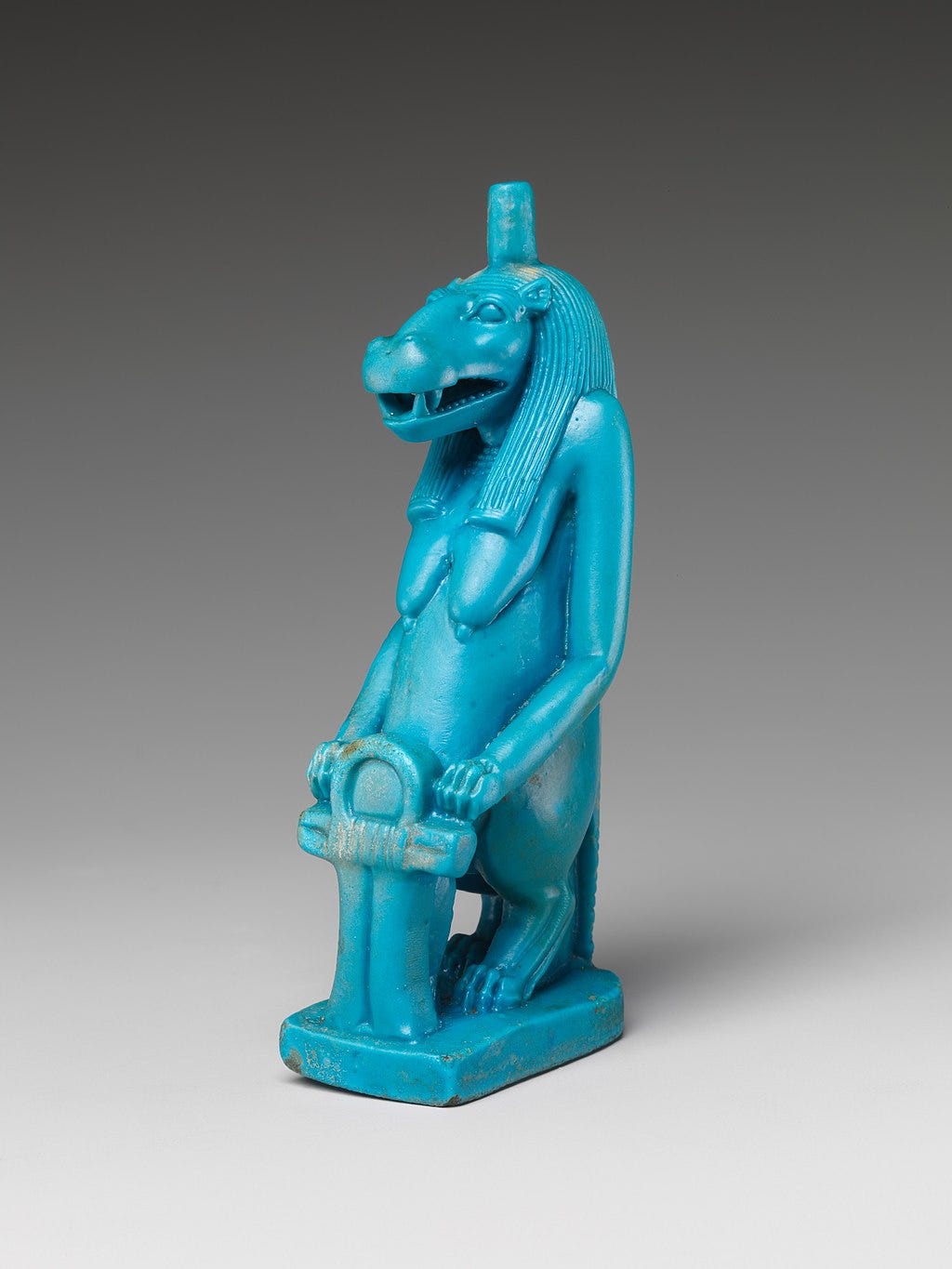
Content Warning: Adult themes of sex and sexuality; death and traumaIn this podcast episode, we take a deep dive into pregnancy and giving birth in ancient Egypt. How were fertility issues dealt with? How was conception conceptualized? What was the childbirth process like? What role did magical rituals and belief in the gods play? What role did midwives, doctors, wet nurses, and others play in the process? And what can we gain from the experiences of these ancient people today? We ultimately come to understand that ancient Egyptian birth was a private matter that took place in the home, that the baby and mother received the support of intimate and extended family, that the new mother was welcomed back into society with celebrations of her beauty and fecundity, a rite of passage in which community was integral. Indeed, all of this is exactly what pregnant individuals and new parents are missing and seeking out in 2025. We might assume that it is better to be pregnant now than in the ancient world. And in some ways it is— antibiotics, anesthesia, and sonograms save lives everyday. But we also know healthcare access is not equal across race and socio-economic status, governments are defunding care facilities, and a woman’s right to choose are all under threat. To make matters worse, as of a 2023 JAMA study, U.S. pregnancy-related deaths are on a steep uptake since 1999, especially amongst Indigenous and Black communities. The defunding of pregnancy and childbirth-related services, like Planned Parenthood, is one contributing factor. Given that cuts to abortion access are meant to push women back into traditional, shut-in, patriarchal roles, please don’t expect a glorification of the ancient world here. But we can’t laud the modern situation either. Let’s just say that we can learn useful lessons from both sides of our human selves. It’s complicated.All of our current medical possibilities have created their own unintended overmedicalized consequences that no one in the ancient world had to suffer. Today’s drug-induced births, often chosen for the convenience of medical staff, create contractions that are ten times more painful than normal contractions. The high number of chemically induced births demands that modern American mothers labor for hours under epidural spinal pain blocking, accompanied by heavy opioids. The inability to feel anything during the birth process takes agency away from the mother entirely. She cannot move; she pushes from her back. No squatting and birth bricks for her. No gravity to assist the descent of the baby in the birth canal. Instead, very long labor can result in traumatized mothers with ripped tissue, babies squeezed and pulled out of the birth canal. Many modern births result in overmedicalized interventions, thus the high rate of cesarean sections, which are 5x more likely to cause complications than vaginal births. The COVID-19 pandemic hit pregnant and post-childbirth individuals particularly hard. Even celebrities— people we would assume would have the best medical treatment available— have had near-death experiences (Read about Serena Williams’ ordeal). In many ways, the modern (American) birth process is a system perfected to create trauma and loneliness. I think if we had the choice presented to us with clarity, most of us would want to give birth the ancient way—with community and agency—but with modern aids like surgical ways of dealing with a cord wrapped around the baby’s neck, or a stuck shoulder, or a placenta blocking the birth canal, or means of stopping hemorrhaging, or antibiotics to stop infection. Somehow our discussions about childbirth have become very black and white, such that anyone demanding a midwife is putting their baby in mortal danger to the level of Oh-You-Would-Have-Wanted-The-Nazis-to-Win-World-War-II kind of rhetoric. But the ancient world can provide some much-needed nuance in our perspective of maternal agency, healthy outcomes, and community involvement.One of the most shocking findings of a recent study was the prevalence of mental health-related death in the 4th trimester (the time between birth and 12-week post-partum). Modern childbirth usually places the mother in charge of her baby alone. New parents are not getting the support and care they need. Instead of the embrace of the community in the ancient world, women today experience loneliness, anxiety, and isolation. But we are still those same people, in many ways, with the same desires, emotions, and bodies. And we don’t like being cut off from care. We want human connection during this essential rite of passage. It is no surprise that we are seeing a rise in midwifery and doulas as a way for pregnant individuals to take back the process. A doula is like a claim of emotional support, direct from the ancient world. Midwives are not just women taking care of women in the old ways, but a rejection of the formal doctor-knows-all over patient relationship. TikTok and other social media apps are also comparing how divergent countries deal with pregnancy and childbirth—making many Americans curious about more non-hyper-medicalized options.The modern world is so disassociated from community care that we have outsourced it, paying a postpartum nanny if you can afford it, to help support the parent during the precarious 4th trimester, for example. The ancient (patriarchal) world would have placed the new mother and baby in the arms of other mothers, aunts, and grandmothers. The ancient pre-patriarchal world would have allowed more caregiving from the father, uncles, and grandfathers, too.We don’t mean to romanticize the old ways. Indeed, in the ancient world, pregnancy and childbirth carried extraordinary risks and complications. One study on ancient Greece argued for a childbirth mortality rate as high as 30%. Though some recent studies of pre-modern Europe have pushed back against the idea that pregnancy and childbirth were always über dangerous— pregnancy complications, birth obstructions, hemorrhage, and infection were all too common.Prof. Anne Austin’s bioarchaeological work (2024) at Deir el-Medina found a high rate of female deceased in young adulthood, which could be linked to childbirth complications. Experts have even identified mummified individuals who died during childbirth with the fetus still in the birth canal (though one is debated…). Babies who died as a result of miscarriage, stillbirth, or early childhood deaths received special burial treatment, often within the confines of the home or in pots. The ancient Egyptians didn’t place their youngest and most vulnerable into the necropolis; they were kept in the home, usually under the floor.Yes, childbearing was and is hard, but it wasn’t all doom and gloom…. There was magic and a hippo goddess!!Ancient/Now is a reader-supported publication. All our content is free and open to the public. To receive new posts and support my work, consider becoming a free or paid subscriber.Show NotesFertility Treatments & Issues* Votive figurines* Waraksa, E. Female Figurines from the Mut Precinct: Context and Ritual Function. Orbis Biblicus et Orientalis 240. Fribourg; Göttingen: Academic Press; Vandenhoeck & Ruprecht, 2009.* Teeter, E. Baked Clay Figurines and Votive Beds from Medinet Habu. OIP 133. Chicago: Oriental Institute, 2010* Plant aphrodisiacs – Blue lotus & mandrake* Ibrahim, Venice and Shehatta Attia. 2022. Some sedative plants in ancient Egypt: Egyptian blue lotus, hemp, mandrake & opium poppy. In Győry, Hedvig (ed.), Aegyptus et Pannonia VIII: Acta symposii anno 2021, volume 2, 259-297. Budapest: MEBT-ÓEB* Counsell, D. J. 2010. Blue lotus: ancient Egyptian narcotic and aphrodisiac? In Cockitt, Jenefer and Rosalie David (eds), Pharmacy and medicine in ancient Egypt: proceedings of the conferences held in Cairo (2007) and Manchester (2008), 51-55. Oxford: Archaeopress.* Comestic Spoons* Peter Lacovara – The Meaning and Symbolism of Swimming-Girl Spoons from EgyptConceptualizing Conception* Roth, Ann Macy. 2000. Father earth, mother sky: ancient Egyptian beliefs about conception and fertility. In Rautman, Alison E. (ed.), Reading the body: representations and remains in the archaeological record, 187-201. Philadelphia: University of Pennsylvania Press. * Ancient Egyptian creation mythsGender Preferences and Infanticide* Mahi, Ali Tigani El. 2000. Prehistoric population controls in the Sudanese Nile Valley: a consideration of infanticide. Beiträge zur Sudanforschung 7, 103-118.* Schneider, Thomas. 2015. God's infanticide in the night of Passover: Exodus 12 in the light of ancient Egyptian rituals. In Arbel, Vita Daphna, Paul C. Burns, J. R. C. Cousland, Richard Menkis, and Dietmar Neufeld (eds), Not sparing the child: human sacrifice in the ancient world and beyond: studies in honor of Professor Paul G. Mosca, 52-76. London; New York: Bloomsbury T&T Clark. DOI: 10.5040/9780567659170.ch-003.Depictions of Pregnancy in Egyptian ArtChildbirth Practices and Rituals* Samir, Nermeen. 2023. Childbirth postures within the Egyptian mammisis. In Abdelhalim Ali, Ali and Dagmar Budde (eds), Mammisis of Egypt: proceedings of the first international colloquium, held in Cairo, 27-28 March 2019, 279-290. Le Caire: Institut français d'archéologie orientale. * Andreeva, Anna, Erica Couto-Ferreira, and Susanne Töpfer. 2014. Childbirth and women’s healthcare in pre-modern societies: an assessment. Dynamis 34 (2), 279-287. DOI: 10.4321/S0211-95362014000200001.* Ladinig-Morawetz, Franz-Stephan. 2023. Defining "magic" using the example of Egyptian gynaecology. In Aguizy, Ola el- and Burt Kasparian (eds), ICE XII: proceedings of the Twelfth International Congress of Egyptologists, 3rd-8th November 2019, Cairo, Egypt 2, 1109-1115. [Cairo]: Institut français d'archéologie orientale.* The Role of Birth Wands and Bricks* Roth, Ann Macy and Catharine H. Roehrig. 2002. Magical bricks and the bricks of birth. Journal of Egyptian Archaeology 88, 121-139.* Miller, Jordan. 2021. Emblematic representation on ancient Egyptian apotropaic wands. Archaeological Review from Cambridge 36 (2), 119-141. DOI: 10.17863/CAM.86209* Involvement of the gods – Bes, Tawaret, Hathor, and Isis Midwives, Doulas, and Village Support* Austin, Anne. 2024. Healthmaking in ancient Egypt: the social determinants of health at Deir el-Medina. Culture and History of the Ancient Near East 138. Leiden; Boston: Brill. DOI: 10.1163/9789004700871.* O. Cairo J 72452, where the workmen’s crew got off for a childbirth* Amulets for childbirth that most likely originated from Deir el-Medina suggest that childbirth could have been within the purview of a zA.w or xrp-Srq.t (Austin 2024).* Geraldine Pinch, “Childbirth and Female Figurines at Deir El-Medina and El-‛Amarna,” Orientalia 52, no. 3 (1983): 405–14.* Arnette, “Purification Du Post-Partum et Rites Des Relevailles Dans l’Égypte Ancienne.”Thanks for reading Ancient/Now! This post is public and free, so feel free to share it. Get full access to Ancient/Now at ancientnow.substack.com/subscribe
Embed this episode
NOW PLAYING
Pregnancy and Childbirth in Ancient Egypt
No transcript for this episode yet
Similar Episodes
No similar episodes found.
Similar Podcasts
No similar podcasts found.